Category Archives: Theatre

Namatjira, Perkins, Du Bois, Stojanovski

There’s been an extraordinary confluence in my cultural intake over the last week: Hettie Perkins’s Art + Soul on the ABC, Big hART’s Namatjira at Belvoir Street, Andrew Stojanowski’s Dog Ear Cafe, and W E B Du Bois’ The Souls of Black Folk, which I’m just starting. If I was a public institution and the Coalition was in power I’d have my funding cut.

A major element of Namatjira is the story of the friendship between the man known to non-Arrernte people as Albert Namatjira and the white World War One veteran Rex Battarbee. If Dog Ear Cafe had a single take-home message, it would be about the importance of solid relationships. In an exchange between Stojanovski and Robin Japanangka Granites, a Warlpiri elder. Stojanovski (named Yakajirri in Warlpiri) says that he feels that blackfellas (Yapa) and whitefellas (Kadiya) are standing on opposite sides of the Grand Canyon ‘looking at each other and waving at each other, but our cultural worlds are so different that we are not connecting at all’. Robin answers:

No, Yakajirri, I think you are wrong. I see tightropes across that canyon, and I see people like you and me walking those tightropes, connecting both sides.

Probably the most attractive thing about Art + Soul is the way Hettie Perkins puts herself in the frame, letting us see the warmth, but also the awkwardness of her relationships, as an urban Aboriginal woman and curator, with artists from remote communities.

The first of the 14 essays in Du Bois’s 1903 book begins with a brief impression of white folk clumsily attempting relationship:

Between me and the other world there is ever an unasked question: unasked by some through feelings of delicacy; by others through the difficulty of rightly framing it. All, nevertheless, flutter round it. They approach me in a half-hesitant sort of way, eye me curiously or compassionately, and then, instead of saying directly, How does it feel to be a problem? they say, I know an excellent colored man in my town; or, I fought at Mechanicsville [site of a Civil War battle]; or, Do not these Southern outrages make your blood boil? At these I smile, or am interested, or reduce the boiling to a simmer, as the occasion may require. To the real question, How does it feel to be a problem? I answer seldom a word.

I know the legacy of US slavery is very different from that of Australian genocide and dispossession, but they do share some features, and I couldn’t resist blogging about this  little volley of reminders of the importance of personal relationships in dealing with those histories.

Imara Savage directs Sam Shepard

Full disclosure: I was thrilled to attend this preview night of Imara Savage’s production of Fool for Love Downstairs at Belvoir Street, not because I’m passionate about the play – I was underwhelmed by the London production in 2006, and before that by Robert Altman’s 1985 film – but because I’ve known Imara all her life and nearly half mine, and have always appreciated her fine sense of the theatrical.

The production uses the tiny space downstairs at the Belvoir to great effect: a man and a woman in a seedy motel room, with another not-quite-real older man sitting up at the edge of the audience with a guitar. It’s claustrophobic and intimate. All four actors are brilliantly cast and perform brilliantly. Instead of the rockstar glamour of Juliette Lewis or the Hollywood iconicism of Sam Shepard and Kim Basinger, the main actors, Emma Jackson and Justin Stewart Cotta, give us a May and Eddie who are worn down by life, can’t live with each other, can’t do without each other, struggle with their compulsive need for each other: there’s no celebrity charisma to confuse the issue. Terry Serio as the older man with the guitar is spot on, and Alan Flower, innocent bystander, is a perfect foil for the destructive passions of the rest.

I’ve seen Sam Shepard done badly, without a feel for the music of his language, and it just grinds on incomprehensibly. This Fool for Love isn’t one of those occasions: there’s a point where Eddie delivers a very long monologue that could bring the play to a crumbling halt, like the verbal equivalent of an explanatory flashback. As performed by Justin Stewart Cotta, with Alan Flower a captive audience, it’s mesmerising. I wasn’t surprised to read in the program notes that Stewart Cotta is an accomplished musician.

You know how when an Australian cast does a US play, there’s often a dreadful unease about the accents, as if you can feel the gears grinding to keep them in place? There wasn’t a hint of that here.

It was a preview, and there was a technical hitch that involve the theatre filling with smoke and the smell of cordite. We had an unscheduled interval. It’s a sign of the strength of the performances that the spell wasn’t broken. This is a magnificent hour and a half of theatre.

Quack at the Griffin

I love the theatre in Nimrod Street, Darlinghurst, now known as the SBW Stables – it gave us Flash Jim Vaux and Hamlet on Ice, Gloria Dawn in  A Hard God and Reg Livermore in The Tooth of Crime, John Bell’s productions of Measure for Measure and The Removalists. It’s the kind of intimate theatre where Jane Harders as a loose woman from early colonial Sydney could proposition a nerdy young man in the front row and have that young man fall in love with her forever. When the Nimrod moved out, I followed them to Belvoir Street, though I have seen any number of good things at the Stables in the intervening years. I didn’t see Holding the Man there, but I wish I had because it was obviously intended for a more intimate space than the Drama Theatre in the Opera House

We expected to be the oldest people in the audience for Griffin Theatre’s Quack last night. The publicity mentioned zombies, and surely zombies are for the young. But no, the 22-person audience was as silver-haired as Belvoir Street on a Sunday afternoon.

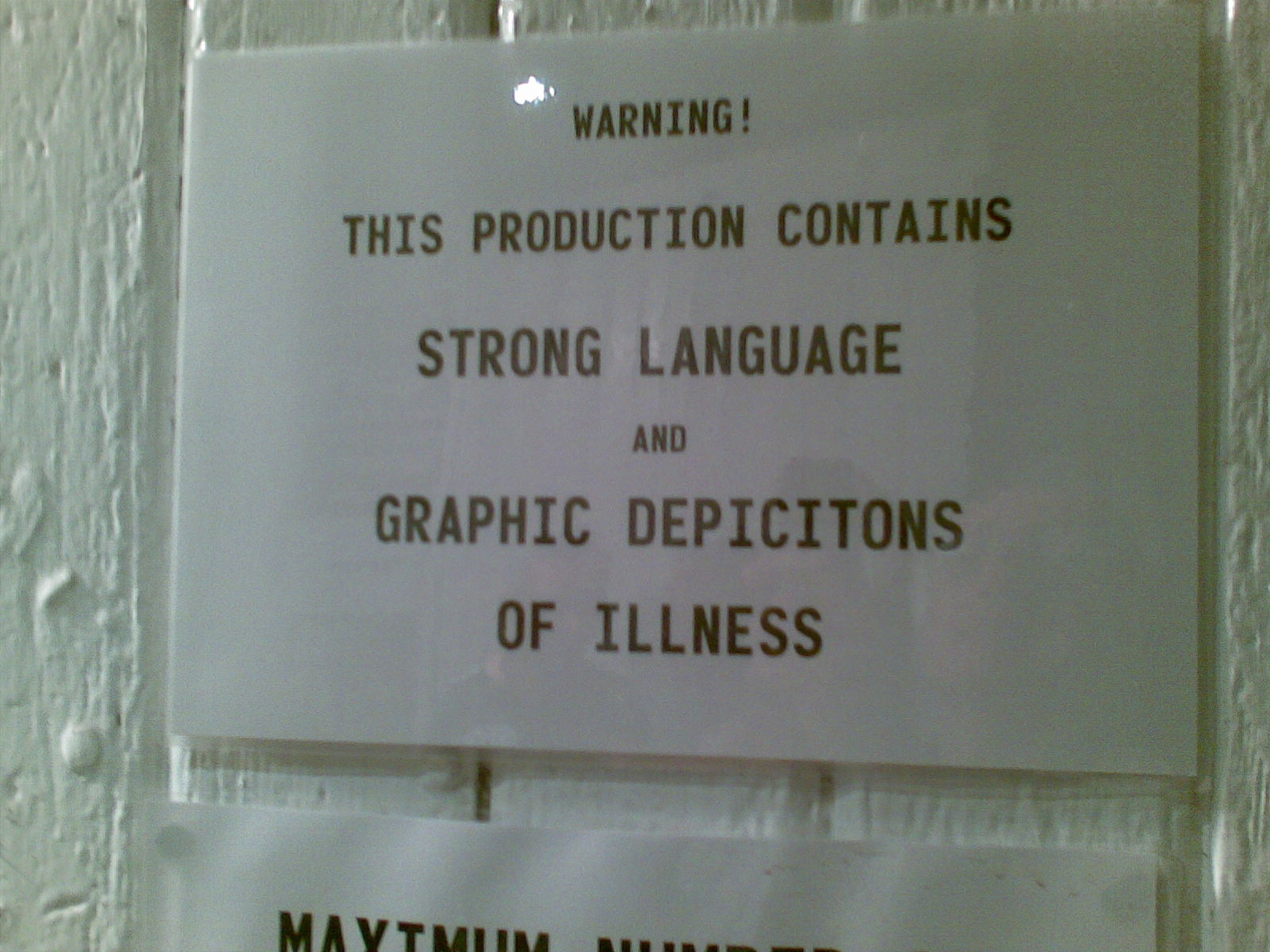
There were signs in the recently refurbished foyer, warning of strong language and ‘DEPICITONS OF ILLNESS’. Just before the curtain at the foot of the stairs was pulled aside for us to ascend, a young man invited us to sit as close to the front as we wanted, but to be aware that during the graphic depictions (not depicitons after all) of illness, bodily fluids would be sailing around the space … all water soluble so nothing really to worry about. We sat two rows from the front; some less brave souls sat in the very back row.

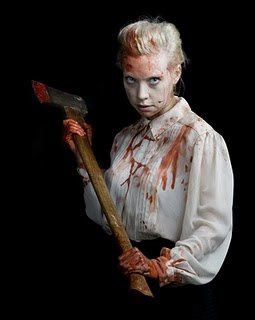
Aimee Horne as Fanny, complete with creepy contact lens

The show itself? I don’t think I can do better than the description on the Griffin web site: ‘a romantic historical western drama noir exploitation comedy. With zombies.’ I would add, though, that there are musical interludes, beautifully sung by Aimee Horne, and a strong satiric thread. As everybody knows, zombies must never be read as symbolic. A zombie is a zombie is a zombie. But when you have the old doctor in a town saying he just wants everyone to be relaxed and comfortable, and the young doctor who seeks to replace him singing the praises of hard work and then delivering enraged diatribes involving copulating rats, you begin to realise that the non-undead characters have intentional similarities to actual politicians.

Most of the actual zombie action happens offstage (hard to do the Zombie Apocalypse with just four actors), and though there was much that was gruesome, most of it was described rather than enacted, and what was enacted was mostly comical. I confess there were a couple of non-zombie scenes when I had to close my eyes and control my gag reflex. But the couple of splashes of fluid that landed in my hair didn’t worry me at all.

This show could have been a disaster. Instead, as far as my companion and I are concerned it was a great success. And neither of us is particularly drawn to zombie movies (though we did both love Peter Jackson’s Brain Dead on DVD). It felt like a chaotic romp, but playwright Ian Wilding, twice winner of the Patrick White Prize, clearly knew what he was doing. Director Chris Mead and the cast – Jeanette Cronin, Charlie Garber, Chris Haywood, Aimee Horne –  get the silly-OTT mode just right. The set – red velvet curtains and a dangerously sloping wooden floor – and the howling sound design are brilliant.

It’s only on for another week. It deserves more than 22 bums on the seats each night. More than 22 people a night deserve to have this much fun . If you’re in town, go!

SWF: Inside the Westside Writers Group

One of my highlights from last year’s Sydney Writers Festival was a staged reading in Bankstown Town Hall by members of the Westside Writers Group. Naturally, we trekked west in the rain to see what they were putting on this year.

A big room in Bankstown Youth Development Headquarters had been set up with a couple of sofas, cushions, a standard lamp and a coffee table for the group and seats for the audience in the rest of the room. They proceeded to have a meeting like the ones they’ve been having every fortnight for years: each member of the group read a piece she or he had been working on – some brand new, some reworkings or extensions of things the group had heard before.

It was a risky idea, and could have failed in any number of ways. But it was great. All the writers have been trained in reading to an audience, and as their mode of working is to read to each other rather than circulating printed copies of their work, they have all become skilled listeners. So we were treated to a lovely range of readings, and then some tender but forthright exploration of what made each one tick and where it could be improved. Luke Carman and Michael Mohammad Ahmad were the stand-outs for me, the former with another of his strangely surreal monologues/stories, the latter with a vignette (a word evidently much discussed by the group) of life in a small ethnic community in the western suburbs. Nothing was dull: sestinas by Lachlan Brown, other poems by Fiona Wright, Lina Jabbir and Rebecca Landon, stories by Susie Ahmad, Sam Hogg, Felicity Castagna and Peter Polites (the dark-haired man on the couch in the pic, shaven headed and unrecognisable on the night), and video in the making from Bilal Reda. All this with the delicate, respectful probing and prompting of Ivor Indyk, resident literary guru.

And you know, from where I was sitting none of these young writers seemed at all fazed by having an audience of roughly fifty people watching and listening from the shadows as they exposed the fruits of their imagination to one another’s critical gaze.

Later addition: I can’t believe I forgot to mention that Alexis Wright was there as a special guest, putting her two cents worth into the discussion and reading what may end up as the start of her next book. When she’d finished her reading – an unsettling piece involving a personification of drought, a young woman carrying a not-quite dead swan in her arms – Ivor Indyk challenged the group: ‘Anyone want to take on a Miles Franklin winner?’