Andrew Charlton’s Dragon’s Tail

Andrew Charlton, Dragon’s Tail: The lucky country after the China boom (Quarterly Essay 54, Black Inc July 2014)
9781863956567As with every Quarterly Essay, I turned first to the back of this issue for correspondence on the previous one, Paul Toohey’s essay on asylum seekers, That Sinking Feeling (which I blogged about here). The correspondence is excellent, with contributions from asylum seeker advocates (a lawyer, the caseworker and adviser who was responsible for the TV show Go Back to Where You Came From, a Jesuit detention centre chaplain), a journalist and – the one I was particularly struck by – Neil James, executive director of the Australian Defence Association. I just looked up the Australian Defence Association, and see from their recent tweets that their military-focused point of view may be impervious to evidence on at least some issues, but here James puts his case in a way that invites reasoned debate rather than the flinging of books across rooms. As Toohey remarks in his ‘Response to Correspondence’, the discussion manages ‘a rare achievement in this particular debate: that those who took issue did so without hostility’. Partly this is because for once party politics is laid aside. That Rudd and Gillard stuffed up seems to be generally agreed, but no voice is raised in defence of Tony Abbott and Scott Morrison’s opportunistic and hypocritical cruelty.

As for Andrew Charlton’s essay, which accounts for the previous 71 pages, I had to overcome a knee-jerk aversion to reading about economic matters to tackle it at all. But though it is indeed one more lecture on how important China is to the Australian economy, and although it does use words like leveragedistortion and correction in ways that have nothing to do with engineering, funhouse mirrors or blue pencils,  the essay is mostly very readable, with engaging anecdotes, carefully structured argument, and at least one arresting chart. Here’s the chart:
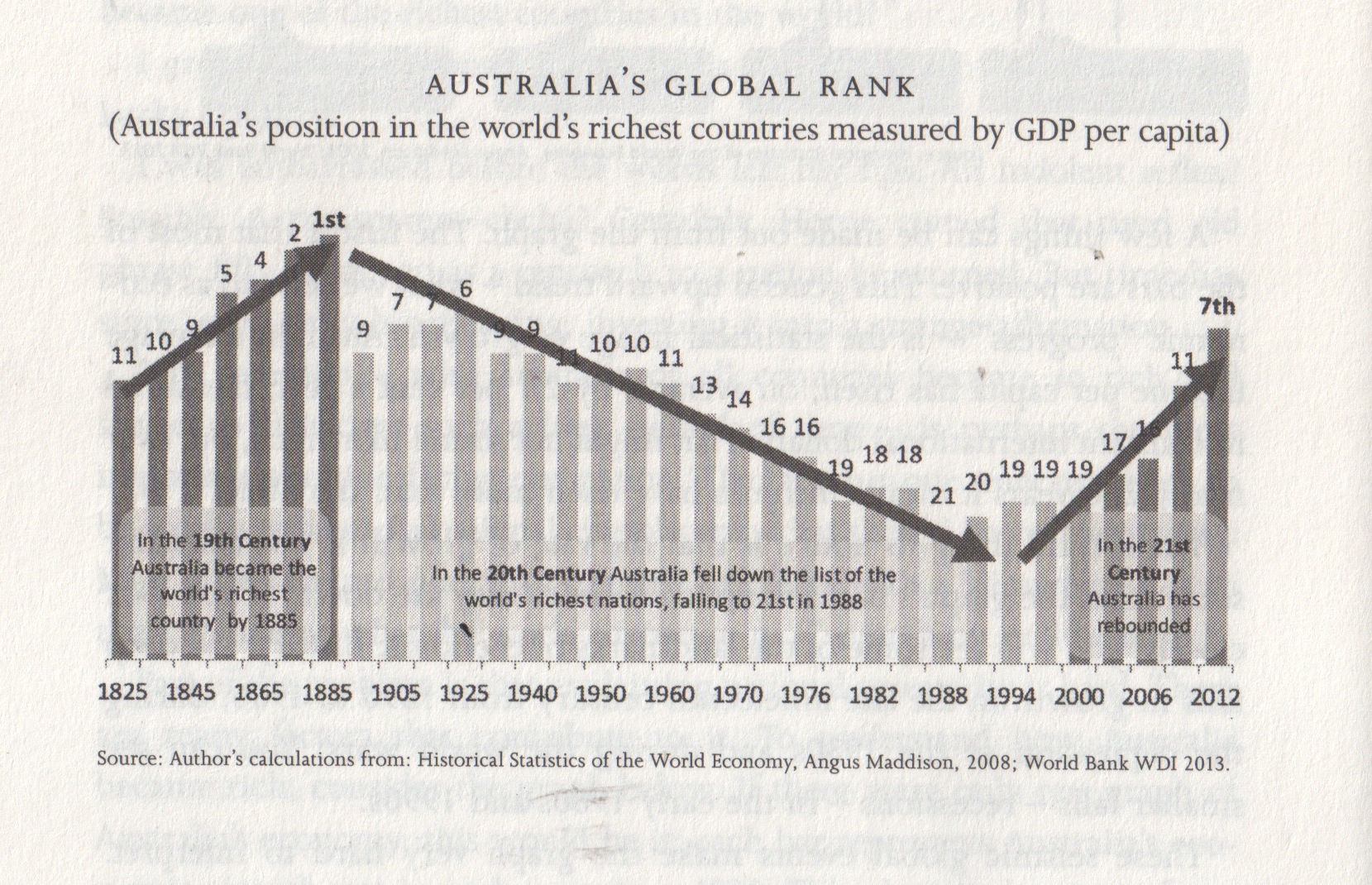
Charlton graph

In case that print is too hard to read:
‘In the 19th Century Australia was the world’s richest country by 1885.’
‘In the 20th Century Australia fell down the list of the world’s richest countries, falling to 21st in 1988.’
‘In the 21st Century Australia has rebounded.’

Australia’s prosperity in the 1880s came from its great success as a supplier of resources – wool and gold – to a leading economic power – England. It was followed by a devastating Depression in the 1890s. Our current prosperity, Charlton argues, has a similar genesis – vast amounts of Australian iron ore has fuelled China’s phenomenal growth over the last 20 years. China’s industrialisation, he writes,

is perhaps the most significant economic event since the Industrial Revolution that transformed Britain in the eighteenth century and laid the framework for the modern world. And China’s industrialisation has occurred 100 times more quickly and on a scale 1000 times larger than Britain’s Industrial Revolution.

The essay builds to a cogently argued warning: China’s growth, which has brought 100 million people out of poverty, is built on an unsustainable model, and the Chinese economy is heading for a crash unless the government’s current attempts to change course succeed. Either way, Australia risks being a goose laying golden eggs that no one wants – that is to say, just a goose. (Blame me for the goose metaphor: Charlton wouldn’t stop so low.)

The essay ranges back in time, travels to many parts of the globe, draws the connections between a café owner in Cairns and global economic abstractions. I look forward to the correspondence on this one, hoping we won’t be treated to someone dismissing it as Labor Party propaganda because a) Charlton used to work for Kevin Rudd, and b) it doesn’t praise the brilliance of John Howard (the Australian Spectator has indeed published such a piece).

What I particularly appreciate is the broader perspective the essay brings to Australian affairs, striking a blow against the resolute insularity of much discussion (about the economy, but also – shockingly – about asylum seekers and climate change). Here’s a paragraph from early in the essay:

Our national debates are frequently partisan and parochial. For example, if you are on the right, you know that the budget is now in deficit because Labor wasted money; if you are on the left, you know that a deficit was necessary to save hundreds of thousands of jobs. On the right, you know that Australian manufacturing jobs are disappearing because we are uncompetitive with our Asian neighbours; on the left, it’s because Australian industry doesn’t receive the same subsidies that those of other countries enjoy. On the left, you would argue that  the global financial crisis was caused by greed and lax regulation of financial markets; on the right, you might point the finger at excessive government debt. If you are on the right, you know that Australia pulled through the financial crisis because John Howard left Australia with a strong surplus; on the left, it was because of Kevin Rudd’s economic stimulus. On the right, you know that productivity growth is low because powerful unions disrupt workplace efficiency; on the left, it is because Australia hasn’t invested sufficiently in skills and infrastructure.
These positions are easily digestible and often self-serving, but they are all either wholly wrong or drastically incomplete because they overlook the events beyond our borders that have shaped us.

Charlton’s account of the global financial crisis refreshingly avoids the other pitfall of writing about these matters: he doesn’t go into the technicalities of dodgy financial instruments and manoeuvres, but sticks to the big picture, and as a result remains comprehensible.

P Craig Russell’s take on Neil Gaiman’s Graveyard Book

Neil Gaiman, The Graveyard Book, Volume 1, graphic adaptation by P Craig Russell (Bloomsbury 2014)

the-graveyard-book-graphic-novel

This is a wonderful translation of The Graveyard Book into comic form. Paradoxically, it’s for an older readership than the novel, though I suppose that’s only a paradox if you think comics are just for children, and no one except newspaper headline writers think that any more, surely.

The reason I say this is for an older readership is that the story begins with a multiple murder, which the novel describes, brilliantly, in almost completely abstract terms, conveying the horror but not creating any images to haunt the young potential reader, but which the comic, while not going all out for the horror, makes completely explicit.

It’s a glowing jewel of a book. The story is full of surprises, the fantasy world is charming and scary, and the artwork – by Russell along with Kevin Nowlan, Tony Harris, Scott Hampton, Galen Showman, Jill Thompson, and Stephen B. Scott – is gorgeous.

If I remember the novel correctly, the episodic nature of the first half gives way to a more plot-driven second half. It certainly feels at the close of this volume as if the overarching story is about to assert itself, as the killer from the opening pages comes back into the picture. I’m looking forward to Volume 2, due out later this year

Steven Herrick’s Caboolture

Steven Herrick, Caboolture (Five Islands Press 1990)

1cabooltureSteven Herrick has written a number of terrific verse novels for young readers, most recently Bleakboy and Hunter Stand Out in the Rain (UQP 2014). He’s kept busy performing from them in schools, he has won prizes for them, and more significantly he has attracted a keen readership. In a recent radio interview, asked about his beginnings as a writer, he acknowledged almost sheepishly that he used to perform ‘to lots of drunks in pubs’, that he started out writing about ‘inner-city life’.
It’s a neat bit of counterpoint: as the poet matured he progressed from grown-up venues to children’s and young people’s writing. I’ve enjoyed a number of his more mature works (that is, the verse novels for young readers), so it was only natural that, when a secondhand bookshop shelf offered me Caboolture, a book from his former incarnation, I snapped it up.

I enjoyed these poems, which mostly relate one way or another to masculinity: youthful escapades (not all of them legal) and relationships with women (not all of them Hallmark-worthy), father–son scenarios in which the speaker occupies both roles (in different poems), traveller’s tales, car lyricism. They range from swaggering fun to starkly elegiac, with an occasional foray into poet-identity (in one of several poems set in the US, the speaker has enough money for a book of Frank O’Hara poems or a pie – he can’t have both). They read well on the page, but cry out to be read aloud – or performed, the purpose for which they were originally written.

The only clue to the direction that Herrick’s work was going to take is in five poems featuring his infant son Joe. ‘Country Joe’, for example, takes us through the small hours:

Joe’s awake
it’s 2 am
I threaten Joe
with a song
he acts like he’s asleep
Joe’s awake
it’s 3 am

an so on. On that recent radio interview, when asked for something from his pub-reading days, he performed ‘To My Son, Joe’, a poem he said went down reasonably well in pubs, which begins:

for the first five years
you’ll be like your Dad
you’ll fall over a lot
always be on the bottle
& stay awake all night.

Here’s a YouTube of him performing it, in which he says it’s from his book Water Bombs, a book published five years after Caboolture, described on its cover as ‘a book of poems for teenagers’. I’d say the poem goes down pretty well in schools: a genuine crossover poem. Have a listen.

If you don’t know Steven Herrick’s work, I’d start with one of the verse novels rather than Caboolture. But if, like me, you love his later work, here’s something different.

Words of warning: If you’re younger than about 30 you may need help with some of the cultural references (as in ‘Brian Henderson Saw Us Make Love’, though the poem would still work if you didn’t know Brian Henderson was an iconic newsreader). If you’re from Goondiwindi you may object to having your town’s name consistently misspelled. If you’re from Caboolture, on the other hand, I imagine it will be good to see that someone knows how to say your town’s name right.

Andy Kissane’s Radiance

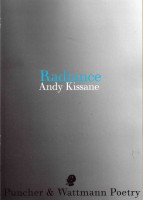
Andy Kissane, Radiance (Puncher & Wattmann 2014)

1radiance

Andy Kissane’s poetry is rooted in white, middle-class, heterosexual, inner-west Sydney. Among other things, it features memories of a Catholic childhood and celebrates non-dysfunctional domestic family life. And it’s terrific.

Maybe I think it’s terrific because all those descriptors apply to me as well. But the thing is, it’s a poetry that’s modest, witty, at times quietly ecstatic, and capable of looking well beyond the inner-city horizon.

As in Kissane’s earlier books, there are a number of dramatic monologues and other poems dealing with people suffering at the pointy end of capitalism – in Victorian London, on a Mexican street, at an airforce hangar, on a Cambodian garbage dump. Also as in earlier books, there are witty and poignant engagements with other writers – Keats, Shelley, Virginia Woolf (who criticises Kissane’s ‘infernal overwriting’), Dylan Thomas, Miklós Lorsi, Buddy Holly, Nick Hornby.

For me, it’s the more personal poems – poems of domesticity, if you like – that are the richest. I’ll try to articulate why by using the book’s title.

Forms of the word radiance occur in three poems. The first is ‘Trip to the Ice Rink’. The poem’s speaker performs ‘a role / crucial for adolescent wellbeing: efficient driving.’ In the opening lines his daughter gets into the car in a black mood, but:

By the time I pull up outside the Canterbury ice rink,
the thunder has blown away and the sky
is now a radiant, cloudless blue. ‘Thanks, Dad,’
she says, as she goes off to practise her Lutz.

The speaker’s focus shifts from wry acceptance of his utilitarian role:

I can see her as she concentrates on the long backward
glide, digs her toe pick down hard into the ice, lifts
and spins into the air, striving with her whole body
to land this difficult jump for the first time.

It’s a commonplace moment. But there’s a suggestion of the numinous in that father’s mental image of his daughter doing what is after all something fairly ordinary. The daughter’s smile is not the only radiance.

The second ‘radiance’ is in ‘Schooling the Heart’, whose three pages invoke scenes from Anna Karenina, kindergarten experiences with plasticine and cuisenaire rods, the self-immolation of Buddhist monk Thích Quảng Đức in Saigon in 1963, and Catholic iconography remembered from childhood: ‘the immaculate heart / of Mary radiating light, exploding like a penny bunger / wedged into a pine cone’. Despite the comical simile, that radiance is not to be discounted: the poem is suffused with a yearning – and the potential – to let one’s heart shine forth in spite of the rebuffs that have schooled it into caution.

Then there’s ‘Sea of Tranquillity’, the suite of nine poems that make up the fourth and final section of the book. The first, ‘Total Eclipse’, begins:

The Moon drinks tea from her favourite china cup,
decorated with the flowering tassels and green leaves
of a yellow gum.

The Moon turns out to do many things that a middle class woman in the inner west suburbs would do: she grows vegetables, argues violently about movies, serves up pizza, works with teenage drug abusers, goes to a poetry reading where she

________longs to read the book hidden
in her overcoat pocket, only she doesn’t want to appear
rude.

She’s clearly an ordinary woman, the speaker’s long term partner. ‘The Moon’ is not quite a metaphor, but it’s more than a nickname. Her pain – physical and emotional – is described as craters, and the poems are shot through with light imagery: at their first meeting (in ‘Total Eclipse’) she opens a door and he sees her lit from behind with ‘a fluttering corona pulsing around her outline’; elsewhere she sashays across the sky

with that long stride of hers, poised and frisky,
her radiant beauty set to shine all night long.

In another poem she is explicitly not ‘the celestial moon’. It’s playful, whimsical, and – though an epigraph from A Midsummer Night’s Dream warns against solemnity – lyrical. I read the sequence as a brilliant rebuttal of the truism that long term relationships by their nature become matters of habit, companionable maybe but pallid in comparison to the first flush of passion. This is completely convincing love poetry, and if I had to tie down the meaning of ‘radiance’ here I’d say it was the way the loved one (or the loved universe) appears to the lover.

One other thing: at a poetry reading in ‘Moon Rocks’, the speaker has an experience that would be familiar to many people who have attended such an event. The first reader’s words

______ collapse in on themselves
and I’m being sucked into the core of a black hole.

Not that there’s anything wrong with black-hole poetry, but Kissane doesn’t write it.

As I’ve mentioned before on this blog, I have co-written a short film script based on one of Andy Kissane’s poems. I received a complimentary copy of this book from the publisher.

John Williams’s Stoner and the Book Group

John Williams, Stoner (1965, NYRB 2006)

1590171993Published in 1965 and rediscovered by the New York Review of Books in 2006, this novel is currently having a big day in the sun, and our Book Group has its metaphor-mixing finger right on the pulse.
Before the group met: I loved this book, though I find it hard to say why with any confidence. William Stoner, born late in the 19th century into a grim farming community is sent to university at age 19 because his father grasps that education in agriculture will help the farm to survive. He has an epiphany part way through his second year of study when a lecturer recites a Shakespearean sonnet, and he changes course. He goes on to complete a PhD in literature and then to a life of teaching at that same university. He marries unhappily, has a daughter who doesn’t turn out well, makes powerful enemies in academia who stymie his career, endures a major heartbreak, lives on and finally dies. Grim, grim, grim, you might say.

What’s more, William Stoner is no man of action: he chooses not to enlist in the First World War, not to leave his intolerable marriage, not to challenge lies being circulated about him. There’s a moment near the end when he has a chance to speak in public, to communicate something of what matters to him: he says six words – words that are moving to the reader, but must sound almost completely inconsequential to his listeners. He is exactly not the ideal protagonist of a Hollywood movie.

Which may be his appeal. He isn’t noteworthy because of any great achievements, but he is a man who falls in love with a vocation – the vocation to teach – and is true to it for the rest of his life. Even though for long stretches he is a mediocre teacher, he finds a deep spiritual nourishment and meaning there, and at key moments chooses to sacrifice his chances for advancement or happiness in order pursue it.

The book is beautifully written. Every now and then, I’d forget that I’ve only got so many years left and so many books still to read, and just linger over a turn of phrase, a sentence, a paragraph. Like this:

In his extreme youth, Stoner had thought of love as an absolute state of being to which, if one were lucky, one might find access; in his maturity he had decided it was the heaven of a false religion, toward which one ought to gaze with an amused disbelief, a gently familiar contempt, and an embarrassed nostalgia. Now in his middle age he began to know that it was neither a state of grace nor an illusion; he saw it as a human act of becoming, a condition that was invented and modified moment by moment and day by day, by the will and the intelligence and the heart.

 After the meeting: It’s winter: one man was down with a heavy cold starting a second round of antibiotics, two were off in the European summer, a third had an early flight to Manila this morning, one who works for an environmental organisation had urgent work sprung on him (whether because of the good news from the State government or the continuing torrent of bad from Canberra he didn’t say), and yet another had been intending to come but mysteriously failed in the  attempt.

So four of us drank from crystal glasses and sat down to far too much food and a sustained and animated conversation about the book, which we had all read (a rare event) and were all enthusiastic about. I think everyone read something, each picking out a different bit to hold up for the collective enjoyment.

Someone said that he wept in public as he read it; that when Stoner found love in middle age it was as if the novel changed from black-and-white to colour, and then, wretchedly, back again.

One of the passages that was read out was the account of Stoner and his wife’s sex life in the early years of their marriage. Be warned this might trigger sexual abuse memories:

Out of an unspoken stubbornness they both had, they shared the same bed; sometimes at night, in her sleep, she unknowingly moved against him. And sometimes, then, his resolve and knowledge crumbled before his love, and he moved upon her. If she was sufficiently roused from her sleep, she tensed and stiffened, turning her head sideways in a familiar gesture and burying it in her pillow, enduring violation; at such times Stoner performed his love as quickly as he could, hating himself for his haste and regretting his passion. Less frequently she remained half numbed by sleep; then she was passive, and she murmured drowsily, whether in protest or surprise he did not know. He came to look forward to those rare and unpredictable moments, for in that sleep-drugged acquiescence he could pretend to himself that he found a kind of response.

Williams doesn’t shy away from the word ‘violation’, but ‘love’ isn’t just a euphemism either. As someone in the group said, your heart breaks for both of them.

Swapna Dutta’s Juneli’s First Term

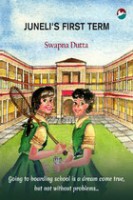
Swapna Dutta, Juneli’s First Term (1992, CinnamonTeal Publishing 2014)

1jftBefore I was sent off to boarding school when I was 13, I enjoyed the tales of English boarding schools in the Boys Own and (yes, I read them too!) Girls Own annuals that occasionally found their way into our house. They were tales from another era, another planet almost – and I wasn’t surprised when my own boarding school experience had very little of their camaraderie, independence and adventure (though it did have some of the bullying – poor Billy Bunter!).
Similar stories captured the hearts of Swapna Dutta as a Bengali child a decade or so earlier, and of young Juneli, protagonist of this book a decade or so later. If Juneli’s First Term and its popularity with Indian children when first published are any evidence, the romance of those British stories (the Chalet School series is the name here that rings a bell) were closer to the experience Indian girls sent to missionary schools than they were for a North Queensland boy sent to a Brisbane Christian Brothers school.

Juneli lives in a remote place with only her widowed father and the servants for company. She is happy enough, but when she discovers her mother’s trove of boarding-school story books she yearns for the life she reads about there, for companionship and adventures with children her own age, and to learn from teachers other than her father. At the urging of his long-absent sister, Juneli’s loving father sends her to a boarding school, and it turns out to be just as wonderful as she had hoped, with samosas instead of cream buns and illicit play with colours on the festival of Holi instead of midnight feasts.

There is unpleasantness of course: a snobbish girl and her hangers-on make trouble, a cooking class goes seriously wrong, an innocent joke about a flamboyant male teacher brings shame on Juneli. These episodes ring true, but so does the overarching benignness of school life.

The book is illustrated by the author’s daughter Sawan Dutta. She did the illustrations for the original publication when she was barely out of school. For that edition, her cover image wasn’t used, but it graces this e-book, and it’s hard to see why it wasn’t used the first time.

I guess any boarding school book without magic and a cosmic villain who must not be named will seem pallid in this post-Potter days, but what this book lacks in spells and sorcery it makes up for in warmth and quiet celebration of ordinary things – with two added bonuses: for Indian readers as I imagine, the chance to see their own reality mirrored in the genre, and for westerners, a gentle example of the colonised speaking back.

You can buy the book from Dogears etc. for 99 rupees, which is about $1.75 Australian. I don’t know if there are any plans to bring out ebooks of the rest of the Juneli series.

I should mention that Swapna is a friend of mine, and that my copy of the book is a gift from her.

Art Spiegelman’s Co-Mix

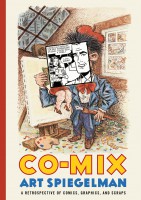
Art Spiegelman, Co-Mix: A Retrospective of Comics, Graphics, and Scraps (Drawn & Quarterly 2013)

co-mix

I remember the relief when I discovered in my 30s that my father really liked Gentleman’s Relish, which David Jones sold in fancy jars that were big enough to last from his August birthday to Christmas and then Christmas to the next birthday. The presents problem was solved. Forever.

I suspect my late-found interest in comics has brought similar relief to my sons. I’m not complaining.

This big, hard-cover book isn’t a comic as such. Sandwiched between Spiegelman’s scathing one page review in comic form of the Museum of Modern Art’s 1990 exhibition, High and Low: Modern Art and Popular Culture and an essay by Robert Storr about Making Maus, MoMA’s exhibition of Spiegelman drawings the following year, it’s a book-shaped equivalent of a retrospective exhibition.

It begins with early works that turned up in underground magazines and established publications, including Playboy. There are Mad-magazine influenced cards for a chewing gum company, and RAW, a graphic magazine Spiegelman ran with his wife, Françoise Mouly (who later became art director at The New Yorker). The early stuff tends to be satirical, surrealist, scatological, confrontingly sexual, but never stupid or bland.

Spiegelman is best known for Maus, the ground-breaking comic about his family’s Holocaust experience, originally published as two books, in 1986 and 1991. Co-Mix assumes its readers know that work (and if you haven’t read it, I recommend that you do), so reproduces only one page from it. But there are seven pages illustrating Spiegelman’s painstaking process of drawing study after study on the way to the final images. ‘In the time that other artists can draw forty pages,’ he’s quoted as saying, ‘ I can draw one page forty times.’

There’s a generous sampling of covers he did for The New Yorker in the 1990s, which segues into a section on In the Shadow of No Towers, the extraordinarily beautiful large-format book about his response to the terrorist attack on New York in 2011. In that book, Spiegelman represents himself sometimes in human form, sometimes with his mouse avatar from Maus, its pages are full of cartoon figures from an earlier era, and up the back there’s an essay and a number of beautifully reproduced comics from the early 20th century. The combination of 21st century New York angst, race and PTSD with Katzenjammer and earlier cartoonery feels completely right, but mysteriously so. There’s an illuminating comment here:

The classic comic strip characters, Spiegelman said, gave him aesthetic solace because they represented ‘vital, unpretentious ephemera from the optimistic dawn of the twentieth century … That they were never intended to last past the day they appeared in the newspaper gave them poignancy: they were just right.’

There’s a lot more, including children’s books, book covers, pages from his notebooks, lithographs, accounts of collaborations with a dance company and in musical theatre, and painted glass windows for New York’s High School of Art and Design.

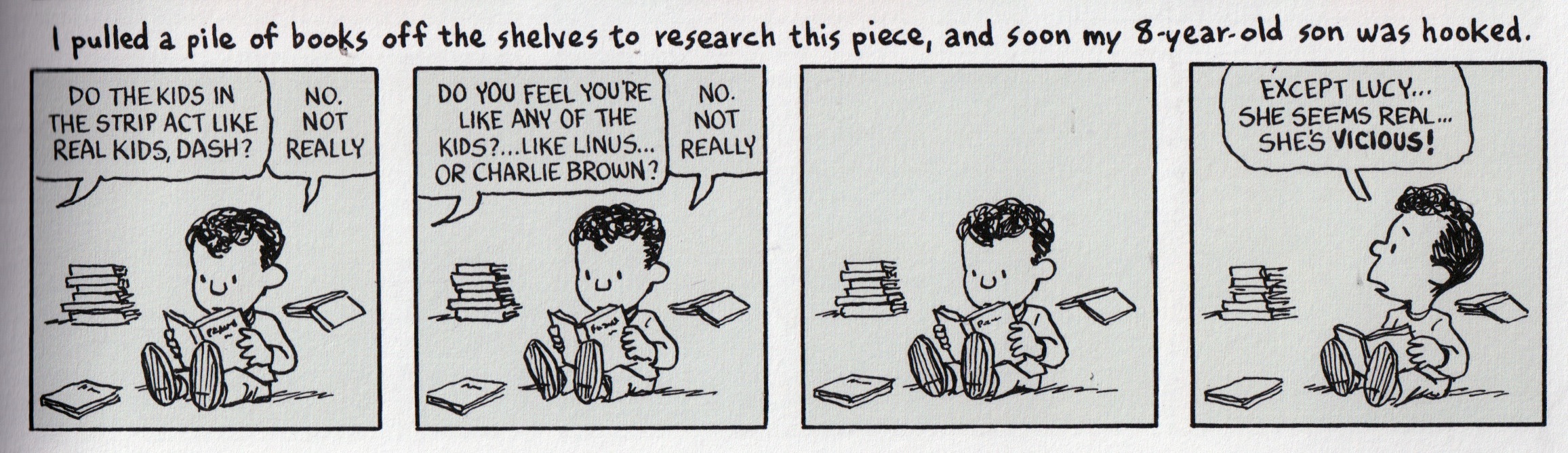
It’s all interesting, but the section titled ‘Comics Supplement’ is on a whole other level: 17 pages of complete comics from The New Yorker, one from the Washington Post and one from McSweeney’s. Here’s where you’re reminded why a Spiegelman retrospective makes sense. In particular, if you have a chance to browse though this book, flip to pages 72–81 for the generous, witty, deeply respectful tributes to Maurice Sendak (on the occasion of his death), Charles Schultz (on the occasion of his retirement, published five days before his death), and – again on the occasion of his death – Harvey Kurtzman, early editor of Mad magazine who made a cameo appearance, without being named, in another book I blogged about recently, Lawrence Lipton’s Holy Barbarians.

The copyright notice says I can reproduce ‘small portions for review purposes’ without needing written permission. Here’s a strip from Spiegelman’s three pages on Schultz:

spiegelman

Jenny Blackford’s Duties of a Cat

Jenny Blackford, The Duties of a Cat (Pitt Street Poetry 2014)

1dcThis tiny book of 12 poems about cats, with seven charming ink drawings, would make an excellent gift for a cat-lover. But, dear reader, before you start thinking about cute internet kittehs, think of Christopher Smart considering his cat Jeoffry:

For he camels his back to bear the first notion of business.
For he is good to think on, if a man would express himself neatly.
For he made a great figure in Egypt for his signal services.

or, much more recently, David Malouf’s ‘Eternal Moment at Poggio Madonna’:

Miss Mischa in her cool
reclusion curls on the mat.
Has a feel for
creaturely comforts and has sniffed out
this spot, though nothing
in nature or that the eye
can see marks it as special.

Cats and fine poetry are by no means incompatible.

Pitt Street Poetry – publishers of, among others, Lesley Lebkowicz, Geoff Page, Eileen Chong, Luke Davies and Mark Tredinnick – have not lost their judgment. Jenny Blackford turns a loving, amused, admiring and sometimes unsettled eye on the creature from another species that shares her home.

It’s not irrelevant that some of these poems have been previously published in The School Magazine (though not yet in my long-ago time as editor) and in science fiction/fantasy magazines as well as literary journals for adults. The cats of these poems have eerie science-fictional qualities, as in this from ‘Their quantum toy’ (the whole poem is online here):

I’ve seen him levitate, I’ve seen him
lift, weightless,
impossible, from lawn to fence,
or rug to bed,
up from the ground without a hair
or muscle moved.

They can have great child appeal, as in ‘Soft silk sack’, which begins:

Cat puddles
against the floor
his body flat as milk

But there are poems that start cutely like that and end, for example, with the cat’s  eyes as ‘ chips of blue-grey glacial ice’. Like cats themselves, the poems can be charming and dangerous in the same breath.

So yes, this would make a great present for someone who loves cats and isn’t allergic to poetry, but also for someone who loves poetry and isn’t allergic to cats.

awwbadge_2014The Duties of a Cat is the seventh book I’ve read as part of the 2014 Australian Women Writers Challenge. Added later: I should have mentioned that we did publish two of Jenny’s ghost stories when I was editor of The School Magazine, that she and I are Facebook friends, and that she gave me a copy of The Duties of a Cat  as a gift.

Lawrence Lipton’s Holy Barbarians

Lawrence Lipton, The Holy Barbarians (@ 1959, WH Allen 1960)

1llhb

A young friend pressed this on us, saying it had changed their life. It’s an account of the community of ‘beats’ in West Venice in Southern California in the 1950s. Lawrence Lipton introduces himself as a veteran of earlier bohemian communities who aims to give us a portrait of this one as it develops. Wikipedia says he was a journalist, whose name is linked to the beatnik movement because of this book and not much else, but all the same this is an insider’s account, or at least an account by someone with full access.

I can see why it made such an impression on a teenager in a country town with artistic yearnings. It’s about young people and young adults from an earlier era who challenged the society of their parents to follow in the footsteps of Jack Kerouac, Allen Ginsberg, Henry Miller and so on, in what Lawrence Lipton calls Disaffiliation. It was interesting to me to see how much of what was novel, even heroic to the beats in the 50s (or at least to Lawrence Lipton reporting on them) was pretty commonplace for people in their 20s in Sydney in the 70s: relaxed sexual mores, jazz, marijuana …

The differences, though, are huge. The unquestioning acceptance of sexism is very in-your-face: women’s stories are told almost entirely in terms of their sexual behaviour and their relationships with men; at one point, being grandly inclusive, Lipton refers to citizenesses. African Americans are there, as Negro jazz musicians, the heroes of the beats but never really characters with their own stories. There is discussion of Marxism, but class is the elephant in the room, leaving the impression that this was a community of middle class white youth getting stoned and full of a sense of their own importance, choosing poverty but always with the possibility of asking their parents to bail them out, disengaged from politics and telling themselves that this was a mark of moral superiority.

Then there’s the language: even while professing a Zen rejection of dichotomies, the book assumes an apparently impermeable division between on one side the squares and on the other the hip, the cool, the beat. The squares might know about Taoism, for example, by reading and study, but the hip dig it. It’s awfully redolent of rigid high-school divisions between skaters, surfers, nerds, jocks, cool girls, etc.

Still, with some serious skipping, it’s an interesting journalistic account of an interesting moment in Western culture. It sent me off to YouTube to listen to Ginsberg perform ‘Howl‘, partly to check that the poem does refer to ‘angelheaded hipsters’ rather than the much more enigmatic ‘angleheaded hipsters’ mentioned by Lipton a number of times, but mainly because this book made me realise what a gap in my education it has been never to have heard him read it.

The book’s absolute highlight is not to do with the West Venice hipsters at all, but a marvellous account of a poetry reading by Allen Ginsberg and Gregory Corso, where a confrontation between a drunken Ginsberg and a drunken heckler escalates to the point where, provoking outrage among the square audience, Ginsberg strips naked, while Anais Nin – meeting Ginsberg for the first time – sits through it all unperturbed and regal. If you come across a copy I recommend you read pages 194–198. (It turns out I’m not alone in seeing this as the most interesting part of the book. At least two people have uploaded the passage, so you can read it here and here.)

The Aboriginal Story of Burke and Wills from CSIRO

Ian D. Clark & Fred Cahir (editors), The Aboriginal Story of Burke and Wills: Forgotten Narratives (CSIRO Publishing 2013)

0643108084History, as Winston Churchill famously said, is written by the victors. As someone else has surely said, it’s also passed on by word of mouth among the conquered, and – if we’re lucky – revised by the descendants of both. Although only one of the essays in this collection is written by an Aboriginal author, the book is a happy example of that kind of revisionism.

Every schoolchild of my generation and earlier knew the Burke and Wills story: the successful crossing of Australia from south to north, the terrible coincidence of arriving at the Cooper’s Creek depot hours after their supply party had given up waiting for them, the Beckettishly symbolic ‘Dig Tree’, the wretched death of most of the party in the ‘wilderness’, the survival of King among an Aboriginal community, the retrieval of the bodies. As one of the essays in this book comments, the story is a key example of ‘the mythology of victimhood that, ironically, secures a settler claim to cultural legitimacy by marginalising the actual victims of colonisation – namely, Aboriginal people’ (Leigh Boucher, ‘Alfred Howitt and the Erasure of Aboriginal History’, p 255).

The myth-making impulse was so strong that no official account of the Victorian Exploring Expedition of 1860–61, to give it its full title, was attempted at the time, and it wasn’t until 2011, when CSIRO published Burke and Wills: The Scientific Legacy of the Victorian Exploring Expedition, that the expedition’s scientific achievements were explored in any systematic way.

The Aboriginal Story, edited by two Bathurst University academics, explores the other major area that has been largely neglected by the scores of journalists, novelists, filmmakers, painters, poets, sculptors and yarners who have dealt with the expedition, namely ‘the interaction between Indigenous people and the expeditioners and their potential and actual contribution to the expedition’ (p. v).

Not everything here is news. As a postgraduate student 40 years ago, I read the selections from Wills’s diary and letters published by his father, and was left in no doubt that Burke’s arrogant dismissal of Aboriginal hospitality and ABoriginal knowledge played a major part in his disastrous end. My abiding memory from that reading is the image of the bearded Irish policeman, close to death from starvation, knocking to the ground an armful of freshly caught fish being offered to him by a group of Aboriginal men.

That perception and that image occur in a number of the essays here, but there is much more. The book opens with an introduction by Aaron Paterson, a Yandruwandha man, descendant of the community in whose land Burke and Wills died, the people who cared for John King, the expedition’s only survivor. His lyrical description of his country demolishes in a couple of pages the whole edifice underpinning the tragic explorer myth: Burke and Wills weren’t crossing an implacable wilderness, but stumbling ineptly through other people’s home.

And it goes on from there. This is a collection of scholarly essays, each meant to stand alone if need be, with the result that there is a lot of repetition: the reader is introduced to characters such as the expedition artist Ludwig Becker many times over, and there is no single account of the expedition. I skipped a little, but only a little: most of it is fascinating reading – we learn about the languages of the people encountered by the expedition; there are Becker’s wonderful drawings of landscape and people, including the images on the cover; encounters with Aboriginal people quoted from the journals of members of the expedition and the follow-up expeditions; portraits of a number of the minor figures in the expeditions, including the Aboriginal men who worked as guides at various times; some scuttlebuck about Burke’s death and the daughter King may have fathered with an Aboriginal woman; an essay on Aboriginal people as messengers on the Australian frontier (a role which, unlike their role as trackers and as ‘native police’, has generally faded from the collective memory).

For me the most surprising essay was Peta Jeffries’ ‘The influence of Aboriginal country on artist and naturalist Ludwig Becker of the Victorian Exploring Expedition: Mootwingee, 1860–61’ (and yes, the essay titles generally aren’t too snappy), in which she explores one of Becker’s paintings, arguing that it prefigured an understanding of Aboriginal connection to country, that in it ‘the narrative of colonial occupation has subsided’. The most telling essay was the one by Leigh Boucher that I quoted from above, which demonstrates that Howitt’s early writing acknowledged the important role Aboriginal people played in the success of his expedition, but as time passed they disappeared from the story, their knowledge and help being replaced by Howitt’s own bushcraft. Genocide comes in many forms, and one of them is forgetting.

The ‘narrative of colonial occupation’ has dominated accounts of the Burke and Wills expedition and much else from Australian history until now. This book is a mostly very readable corrective. It’s worth noting that it doesn’t present a single ‘Aboriginal story’, as its title suggests, but many stories: there was a wide range of Aboriginal responses to the original expedition and to the follow-up expeditions, from active participation in a number of capacities, through benign oversight to outright hostility. As I read it, I could feel unexamined assumptions being dragged out from under rocks in my head, and the over-arching narrative of my early education being delivered another blow of the wrecker’s hammer.