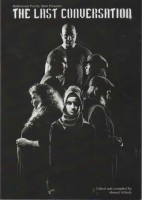
Bankstown Poetry Slam presents The Last Conversation

Ahmad Al Rady (editor), The Last Conversation (BYDS 2013)

1lcThe Bankstown Poetry Slam, which happens on the last Tuesday of every month, is one of the most exciting events on Sydney’s cultural calendar.

Last month nearly 400 people gathered in the Bankstown Arts Centre to hear more than 20 poets with varying degrees of virtuosity perform their own work – to hear, applaud and at least pretend to judge them as they at least pretended to compete with each other. There was also cake, strawberries and watermelon, all for a gold coin donation at the door.

My own experience of spoken word and poetry slams is extremely limited, but Wikipedia and YouTube inform me that many features of the BPS are standard to slam culture. There are procedural elements such as a loosely enforced time limit (two minutes this time because there were so many poets), judges chosen at random from the audience, a ‘sacrificial poet’ to kick things off without being part of the competition. And the range of subject matter is described well in Wikipedia’s entry on spoken word:

The spoken word and its most popular offshoot, slam poetry, evolved into the present-day soap-box for people, especially younger ones, to express their views, emotions, life experiences or information to audiences. The views of spoken-word artists encompass frank commentary on religion, politics, sex and gender, often taboo subjects in society.

Likewise the preponderance of non-white performers and the notion that spoken word and slam performance styles are generally influenced by hip hop. (I have listened to Muriel Rukeyser on a podcast since the slam, and it seemed to me that her powerful words would benefit immensely from a slam-style rather than in the measured manner available to her.)

Yes, poet after poet declaimed passionately, like prophets calling us to reject consumerism, psalmists crying out from the midst of suffering or yearning, orators decrying oppression in many forms. One man’s poem was short enough to allow him time for a brief introduction; he said he was honoured to follow those who came before and to precede those who came after, because ‘we are giving you our hearts’. He was right: there was plenty of witty wordplay, social observation, and even some elegant story telling, but again and again a shy young person would approach the microphone and be transformed into an eloquent, spellbinding exposed heart.

[Added later: Click here for a YouTube of Yasmine Lewis, who won the slam]

The air was thick with generosity. When anyone dried up and had to search for their next line – in memory or on a scrap of paper – the crowd applauded. When a judge gave anyone less than 9 out of a possible 10, she was booed. There was no party line: one person urged us to turn to God, another described religion as a stain on humanity, a woman in a hijab was followed by a man advocating for marriage equality, and all were equally met with finger-clicks (the convention for expressing approval of a good line) and cheers. The emcees, co-founders of the event Ahmad Al Rady and Sara Mansour, were unfailingly appreciative and kept the mood buoyant.

The slam happens under the auspices of Bankstown Youth Development Service, whose Director, Tim Carroll, was dragooned into speaking. Since this slam started nearly two years ago, he reminded us, there has been some terrible stuff in the media about Islam and Muslims. What a different picture was created by this event, he said, in which the Muslim presence was so pronounced. And what a shame some of those columnists weren’t there to see it.

The Last Conversation was published last December as a way of capturing something of the slam’s first exhilarating year. I blogged about its launch. As I’ve just read it cover to cover for the first time, I find myself thinking of it as a record of poetry – a book that hasn’t really been read until it’s been read aloud, with full attention to rhyme and assonance, and a hip-hop-like exaggeration of rhythmic effects. And maybe that’s true of any book of poetry.

Noel Pearson’s Rightful Place (and Andrew Charlton’s correspondence)

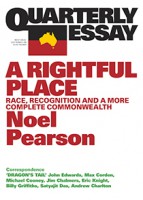
Noel Pearson, A Rightful Place: Race, recognition and a more complete commonwealth (Quarterly Essay 55)

qe55 ‘In this essay,’ Noel Pearson writes, ‘I seek to make a case for constitutional reform recognising indigenous [sic] Australians.’

In case some of my readers need it (as I did), let me start with a couple of paragraphs of background.

Beginning of background. A referendum will happen in the next couple of years on recognising Aboriginal and Torres Strait Islander Peoples in the Australian Constitution. In June last year, the responsible parliamentary committee published a Progress Report, which is well worth reading. There have been animated public meetings around the country. There’s a T-shirt, a well resourced people’s movement and a decorated Qantas plane. There have been bizarre arguments against change from the likes of Andrew Bolt and – less bizarrely and with much less media prominence – from some Indigenous people. Celeste Liddle’s recent article in the Guardian, ‘Indigenous Recognition’ is a good place to go for some of the latter.

In brief, it looks as if we will be voting on whether to repeal two references to race, and on some form of explicit recognition of Aboriginal and Torres Strait Islander peoples. The race references are in sections 25 and 51 (xxvi):

25. … if by the law of any State all persons of any race are disqualified from voting at elections for the more numerous House of the Parliament of the State, then, in reckoning the number of the people of the State or of the Commonwealth, persons of the race resident in that State shall not be counted.

And

51.The Parliament shall … have power to make laws … with respect to: – … (xxvi.) The people of any race, for whom it is deemed necessary to make special laws

It’s hard to imagine a reasonable argument against repealing those clauses, given how direly anachronistic they are. The real debate comes with the committee’s other recommendations, which include adding sections recognising the special status of Aboriginal and Torres Strait Islander peoples, empowering Parliament to make laws for the ‘peace, order and good government of the Commonwealth with respect to Aboriginal and Torres Strait Islander peoples’, prohibiting discrimination ‘on the grounds of race, colour or ethnic or national origin’, and recognising that the ‘Aboriginal and Torres Strait Islander languages are the original Australian languages, a part of our national heritage’.

End of background

The reason I needed the background, even if you didn’t, is that Noel Pearson isn’t concerned here with those details, but his essay needs at least some of it to be understood. His concern, as I understand it, is to lay out general principles that will appeal to a broad audience of thoughtful Australians, including crucially those who identify as conservative. He brings his lawyerly training and extraordinarily wide reading to the task.

The goal of appealing to conservatives has some unfortunate by-products. Readers of delicate constitution might skip a rhapsodic paean to Rupert Murdoch and Chris Mitchell’s Australian on pages 53–54 without missing much, and likewise page 57 where he sprays someone he calls ‘the left’ with intemperate sarcasm (elsewhere the sarcasm is more muted, but ‘the left’ remains mostly unspecified and beneath argument). It would be a shame if these moments were taken to represent the essay as a whole.

I won’t try to summarise his arguments, except to say that he makes a case for calling what has happened in Australia genocide; he points out that contrary to Captain Cook’s orders, this continent was not taken possession of ‘with the Consent of the Natives’ – there was no consent – which leaves the question of sovereignty politically if not legally unresolved; he explores the implications of parliamentary democracy for a group that is an ‘extreme minority’; he lays out a nuanced concept of multiple, layered identities; he makes some broad brush stroke structural proposals for how Indigenous voices can be heard in political decisions made about Indigenous people; he lays out ‘an agenda for the classical culture of ancient Australia’. The essay is passionate, questing and challenging, and transcends any political stoushes that may surround it.

Pearson begins with an invocation of Yolngu Petition submitted to Kevin Rudd in 2008, and goes on to quote Galarrwuy Yunupingu’s Monthly article from the end of that year, which he describes as ‘an existential prayer’. He then lists a number of Aboriginal people who have, like Yunupingu, agitated for inclusion in the Australian Commonwealth over many decades. It’s a profoundly respectful acknowledgement of those who have gone before him.

Curiously, from that point on the essay barely refers to other Indigenous Australian contributions to the current discussion. Exceptions are a one line quote from Michael Mansell – ‘the British had more impact on Aborigines than the Holocaust had on the Jews’ – and the description of a cultural preservation project being taken on by Rachel Perkins. He mentions his colleagues on the Expert Panel on Constitutional cognition of Aboriginal and Torres Strait Islanders Peoples, but doesn’t name them.

Instead, the essay engages primarily with European and settler viewpoints, at times drawing on their insights at others differing sharply. Pearson quotes H G Wells (whose War of the Worlds was inspired by the invasion of Tasmania), Trollope, Darwin and Dickens consigning Australian Aboriginal peoples to inevitable extinction. He quotes WEH Stanner’s famous passage about Australia’s ‘cult of forgetfulness’. He differs from Inga Clendinnen, Henry Reynolds, Bain Attwood on whether there has been genocide in Australia, basing his argument on English historian Tom Lawson’s The Last Man. German philosopher Johann Herder (1744–1803), Indian economist Amartya Sen, British contrarian conservative Roger Scruton (recently a guest of the  Institute of Public Affairs), and anthropologist Peter Ucko get guernseys. Keith Windschuttle and Andrew Bolt are accorded something approaching respect, and a ‘felicitous phrase’ is quoted from George W Bush.

I don’t know how convincing the hard-line conservative echelons will find Pearson’s arguments. Very, I hope. I also hope that his slanting the argument towards that readership won’t deter readers not committed to the culture wars, or at least not to the ‘conservative’ side, from reading and engaging with this essay.
—–
And then there’s the correspondence on the previous Quarterly Essay, Andrew Charlton’s The Dragon’s Tail, which was given extra bite by recent consumer activity in my house. Just before the September issue arrived, the Art Student and I had finally been persuaded to ditch our seven year old 27 inch LCD television set and buy a bigger, smarter, more environment-friendly LED TV. As it happened, we gave the old set and its four year old set top box away on Freecycle, so they will still be consuming energy, just not in our house. As I was throwing out the receipts for the old gear, I saw that its combined cost was nearly three times that of the new. Which brought to mind Andrew Charlton:

ten years ago, a shipload of iron ore exported to China was worth about the same as 2200 flat-screen televisions imported from China. Today the same shipment of ore is worth 22 000 flat-screen televisions!

A striking enough illustration of his point in June had become personal by September. None of the 30 odd pages of correspondence this quarter is personal in quite that way, though it seems that many of these people know each other from working together as advisers to Labor politicians, or as ALP parliamentarians themselves. The main take-home I got from the correspondence is that John Edwards’s Beyond the Boom, published at about the same time as Charlton’s essay, challenges of the received wisdom about the boom that preceded the global financial crisis of 2008, arguing that while – as is generally acknowledged – the Howard government frittered away the benefits on tax cuts, people in general were smarter than the government so that domestic savings increased with healthy results for the economy. There’s quite a bit of argie-bargie among economists, who find fault with each other’s charts and sampling methods so that in the end one is confirmed in one’s suspicion that economics is largely about obfuscation.

Among the correspondence there’s a curious moment in a piece from former banker Satyajit Das. The ‘reply’, which barely mentions Charlton’s essay and is in effect its own lecture on the state of the Australian economy, cites the comparison of iron ore and TV sets, but attributes it differently:

On 29 November 2010 … the governor of the Reserve Bank, Glenn Stevens [said]: ‘[In 2005], a shipload of iron ore was worth about the same as about 2,200 flat-screen television sets. [In 2010] it is worth around 22,000 flat-screen TV sets.’ In a Freudian slip, the governor had identified the fundamental issue with Australia’s economic model. Australia may have substantially wasted the proceeds of its mineral boom, with the proceeds channelled into consumption.

Is Das tacitly accusing Charlton of plagiarism, or quietly reproaching him for not naming his sources? Has Charlton repeated Stevens’s ‘Freudian slip’? (The invocation of Freud makes no sense to me, and after a quick look at the Glenn Stevens speech, it makes it even less sense.) Perhaps Charlton’s failure to mention Das in his ‘Response to Correspondence’ was a bit of tit for tat.

Naomi Shihab Nye’s 19 Varieties of Gazelle

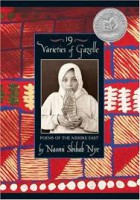
Naomi Shihab Nye, 19 Varieties of Gazelle (Greenwillow Books 2002)

119vg

Naomi Shihab Nye put this book together soon after the destruction of the World Trade Centre in September 2001.  Most of the poems had been published previously, but the rise in anti-Islamic and anti-Arab sentiment in her native USA called out for a book celebrating her Palestinian heritage and offering a perspective on conflict in south-west Asia (I’m learning to stop calling it the Middle East) rooted in that heritage.  She says in the introduction that her Palestinian grandmother who had died eight years earlier

swarmed into my consciousness, poking my sleep, saying, ‘It’s your job. Speak for me too. Say how much I hate it. Say this is not who we are.’

‘If grandmothers and children were in charge of the world,’ she writes, ‘there would never be any wars.’

The current news from Gaza, Iraq,  Syria, Nigeria and the sometimes vicious responses it elicits make this quiet Palestinian–American poet’s voice even more timely. From ‘Jerusalem’:

I'm not interested in
who suffered the most.
I'm interested in
people getting over it.

As with a lot of poems celebrating heritage, there is a lot of food and drink in these pages: olives, falafels, oranges and endless cups of coffee and tea, embodying the great Arab tradition of hospitality. From ‘The Tray’:

Even on a sorrowing day
the little white cups without handle
would appear
filled with steaming hot tea
in a circle on the tray,
and whatever we were able
to say or not say,
the tray would be passed

There are poems about violence and war, grieving for the killed and bereaved and yearning for peace rather than dwelling on the horrors. ‘All Things Not Considered’, for example, lists some appalling casualties of conflict – what would be called collateral damage in more abstract discourse – but it ends:

The curl of a baby's graceful ear.

The calm of a bucket
waiting for water.

Orchards of old Arab men
who knew each tree.

Jewish and Arab women
standing silently together.

Generations of black.
Are people the only holy land?

For me, the poems work as a reminder of the humanity of people involved in the conflicts reported in the headlines. And while they may have an intention of that kind in the background, they are much more particular than that. Many of the poems are filled with affection for the poet’s father and for her uncles, grandmother and people she meets on visits to Arab country.

You can read more about Naomi Shihab Nye on the Poetry Foundation web site.

Marrickville’s phantom mattress poet(s), Part 2

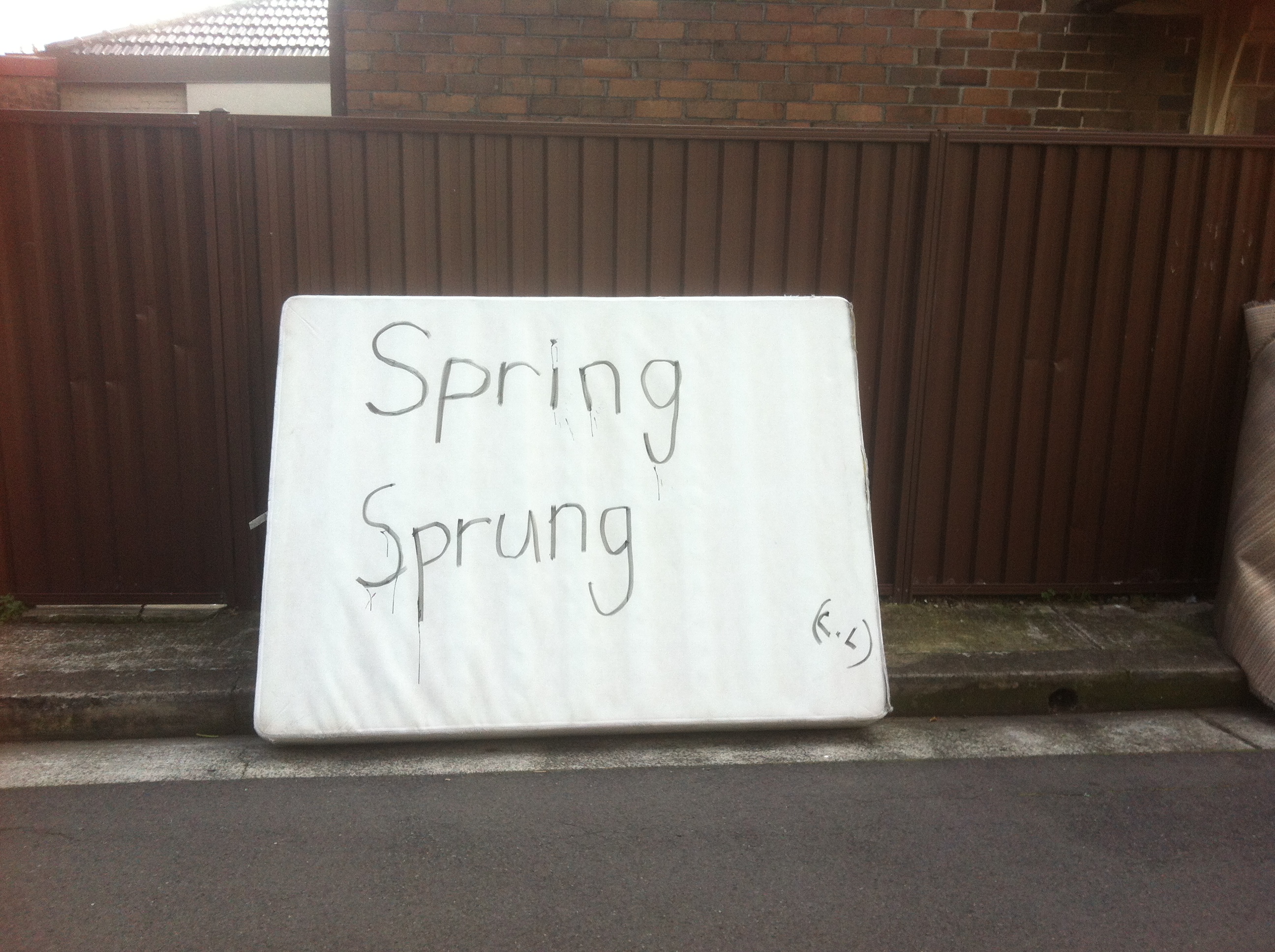
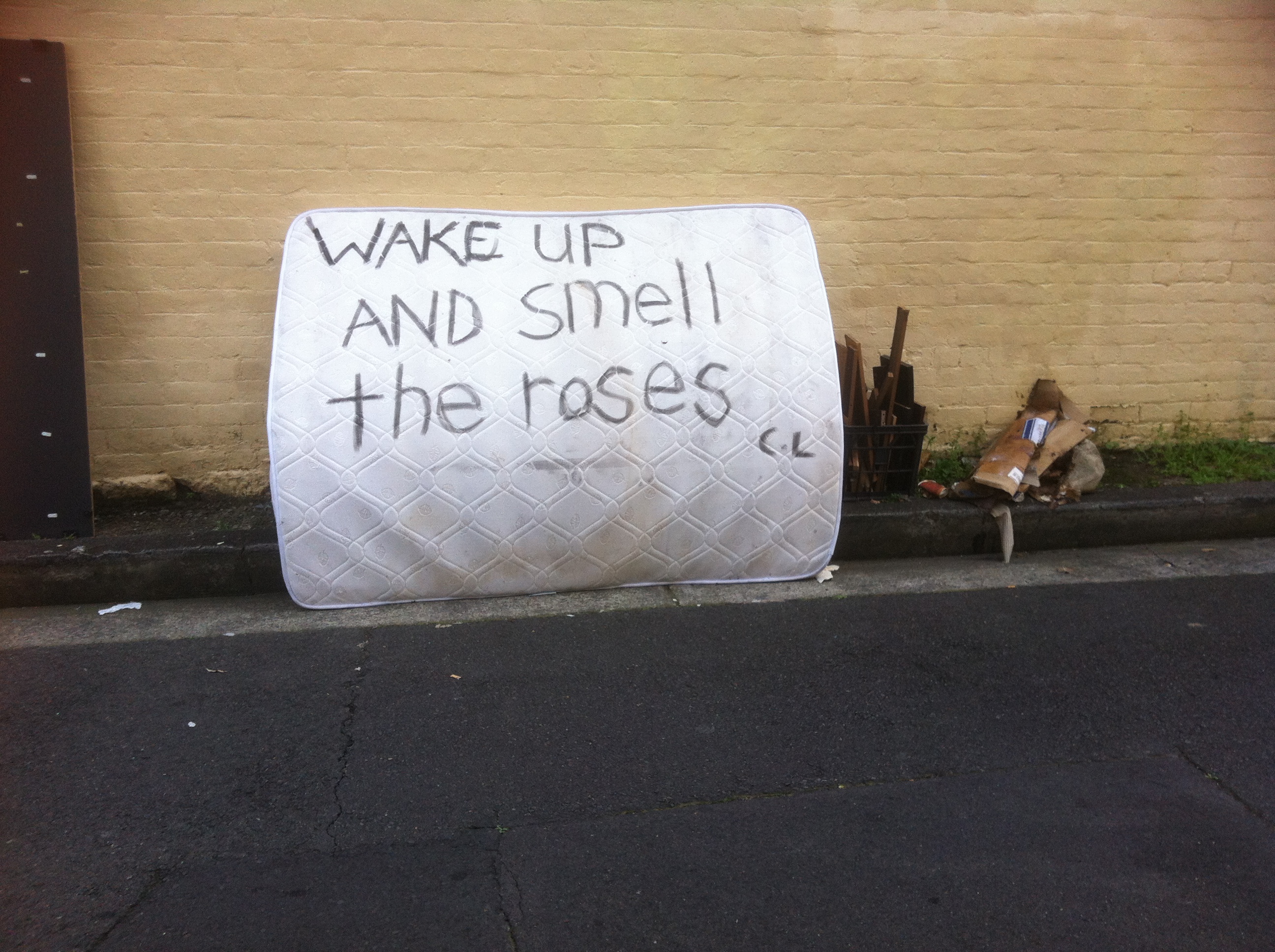
It’s 20 months since I posted about Marrickville’s mattress poetry. This morning wandering through the back lanes on my way home from the library, I saw not one but two more examples, these ones initialled by the poet, and I read them as a sequence:

Mattress sprung

Mattress roses

The sequence was made doubly poignant by the meaty smell that filled the lane as I took this photo – a man was hefting carcases from a refrigerated truck with ‘Lamb from the Wiradjuri Country’ emblazoned on its side.

Overland 215 & 216

Jeff Sparrow (editor), Overland 215 Winter 2014
Jeff Sparrow (editor), Overland 216 Spring 2014

overland215I know it’s wrong to judge a book by its cover, but the creepy, Not Suitable for Public Transport sexual-predation image on the cover of Overland 215 was enough to put me off reading it until Nº 216 arrived in the mail. I did have a quick look before consigning it to the shelf.

I skipped discussion of the Sydney Biennale boycott (this year’s Biennale was a fizzer anyhow), the politics of Wolf Creek 2 (gore fests aren’t my cup of tea), the importance of writers being paid (a no-brainer, surely), and Joe Hockey’s disingenuous anti-entitlement rhetoric (it’s enough to endure it without  going on about it). I skimmed a debate about privilege discourse, an article on queer Indigenous identities, a piece about girls in detention in Victoria in the 1970s for ‘offences’ that included being raped.

I read the instalment of ‘Fancy Cuts’, fiction editor Jennifer Mills’s project in which contemporary writers respond to a short story from Overland‘s archives: here Tara Cartland responds to ‘Josephina Anna Maria‘, Katharine Susannah Prichard’s gruelling tale, published in Overland in 1958, of a migrant woman who dies in childbirth. In Cartland’s story, ‘Nativity‘, a single mother moves to a new town and deals with an invasion of small lizards. The comparison makes our modern protagonist seem awfully individualistic and pampered, which may have been the intention.

There’s some excellent art, particularly a graphic about our complicity in the government’s border protection policies by Sam Wallman, Javed de Costa and Angela Mitropoulos (with a suggestion that we visit xborderoperationalmatters.wordpress.com) and a powerful Mary Leunig image of oppressive domesticity.

In the poetry section, I particularly enjoyed Luke Best’s ‘Desire‘ which riffs on some bits from  Song of Solomon, John Hawke’s ‘The Point‘ which starts out as a backhanded homage to (I think) D H Lawrence and goes somewhere completely unexpected, and Michelle Cahill’s ‘Castrato‘ whose final extended simile I restrain myself with difficulty from quoting.

Overland 216 You can’t tell from the image on the left, but Overland 216 has a very flash cover – a stylised map of a port city with dots on the water, some of them spot varnished: reading this on public transport creates no worries at all. On close inspection it turns out that we’re looking at a partly submerged Melbourne –  artist Megan Cope‘s futuristic vision.

As part of Overland‘s 60th anniversary (pretty good going for a literary magazine, more than half The School Magazine‘s age), there’s quite a lot in this issue that approximates navel-gazing – essays on aspects of the writer’s life, a number of literary magazine editors commenting on their magazines, another Fancy Cut, and an article about Overland‘s founding editor, Stephen Murray-Smith.

In the Fancy Cut, Christos Tsiolkas’ ‘Petals‘ riffs beautifully on Brian Gorman’s ‘Afternoon among flowers‘ from 1965. They are both prison stories, both grim, but unlike the two previous Fancy Cuts, this new story is tougher, nastier, more convincing than the original, and Tsiolkas has found a brilliant equivalent of the Gorman’s broken style by casting his story as written in Greek and translated by its author. ‘Stephen’s Vector’ by Jim Davidson gives us a fascinating glimpse of post-WW2 left politics, and the machinations needed to produce a literary magazine that’s affiliated to an often doctrinaire and authoritarian left.

Imagined worlds by John Marnell is another piece on the importance of writing, this time about African sexualities and the importance of queer theory in the struggle against oppression in a number of African countries: ‘Queer Africans are the new thinkers, the new criticism and in many ways they are at the cutting edge of political and social transformation on the continent and its diasporas.’ It’s almost as if, in his view, sexuality has replaced class as the key to understanding and combating oppression. I used to feel that people who insisted on relating everything back to class were a bit tedious – I seem to have changed sides in that equation.

Not all the writing here is about writing and publishing.

Disappeared in Laos‘ by Andrew Nette and ‘Hope Dies Last’ by Shannon Woodcock are two pieces of hard news that would surely have met with the approval of the 1950s Communist Party: the former, on the disappearance of Sombath Somphone in Laos and the international campaign to locate him and return him to his family (more information here), reminds us that this popular tourist destination has a very dark side; the latter is a straightforward account of the deportation and murder of Romanian Romani under the Nazis.

I doubt if the CPA central committee would have approved of Alison Croggon’s column, ‘On intimate otherness’, but I do. Always good value, Croggon manages – even in the age of the Internet – to be fresh and intelligent on the subject of cats. In the city, she writes, pets are an important reminder ‘that human beings are not the only species on this planet’.

Alternative Spaces‘ by Barnaby Lewer would probably have been too academic for the 1950s Realist Writers project of bringing literature to the workers, but they would have been poorer if they’d ignored this discussion of Andrea James & Giordano Nanni’s play Coranderrk as ‘one example of the way that art, culture and history can reveal how the seemingly “natural order” of our contemporary situation is produced and imposed’.

As always, sequestered up the back, is the poetry.  Whereas issue 215 had a number of activist poems – on our government’s asylum seeker policies, the desecration of sacred sites – this batch tend to be inward looking. Not one, but two despondent poems from Pam Brown, ‘Fading’ and ‘Collected Melancholy’ – so many quotable lines, but I like this bit of poetic injoke:

no phenomenon but in things
like slim cyber tablets
scissors sharpeners vinyl bucket seats
glass paperweights brass padlocks
a sundial

Really I just quoted that because of the nice resonance it has with Kate Fagan’s wonderful ‘Thinking with Things‘, which takes as its starting point a line from Pam Brown’s 2008 poem ‘Things‘, which in turn is taken from Heidegger, ‘why are there things rather than nothing’. Fagan’s poem ends up happily not much caring about the answer.

Overland puts most or all of its content online, but it does it bit by bit. I’ve given links to some of the articles. Others will be available online some time soon at https://overland.org.au/previous-issues/issue-216/. If you subscribe to the paper journal you get them when they’re fresh.

Russell McGregor’s Indifferent Inclusion

Russell McGregor, Indifferent Inclusion: Aboriginal people and the Australian nation (Aboriginal Studies Press 2011)
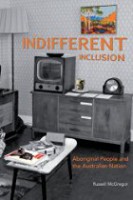
0855757795

On a recent edition of the ABC’s Q&A, Senator Nova Peris was discussing the proposed acknowledgement of Aboriginal and Torres Strait Islander peoples in the Australian Constitution. ‘As Aboriginal Australians,’ she said, ‘we are excluded. For such a long time we were regarded as flora and fauna. It’s about making a wrong right.’

Paradoxically, the 1967 removal of the Constitution’s two mentions of Aboriginal people (and, by implication, Torres Strait Islanders) was a significant step towards inclusion.

According to Russell McGregor, those two references resulted from indifference. He argues that the first, which prevented the federal government from making laws with respect to ‘the aboriginal race’, dates from the 1891 draft where it was inserted in order to protect the rights of Maori if, as then expected, New Zealand joined the new nation; when New Zealand withdrew, nobody cared enough to take the clause out. The other mention – ‘In reckoning the numbers of the people of the Commonwealth, or of a State or other part of the Commonwealth, aboriginal [sic] natives shall not be counted’ – rested on the assumption, he argues, that Aboriginal people counted for little. ‘Neither section,’ he continues, ‘formally excluded [Aboriginal and Torres Strait Islander peoples] from the legal rights and entitlements of Australian citizenship, but both implied that Aboriginal people were outside the community of the Australian nation.’

Indifferent Inclusion charts the decades of debate and changing attitudes among settler Australians, and activism and argument on the part of Indigenous Australians, that led up to the 1967 Referendum, in which an unprecedented 90 per cent of the electorate voted for change. It hardly needs saying that the Referendum was not the end of exclusion. Four years later, in what might have provided an epigraph for this book, a FCAATSI report described racism in Australia as mainly ‘cold, callous indifference to Aborigines, rather than intemperate hatred’. Punctuated by momentary expressions of good will such as the Walk Across the Bridge, the Sea of Hands and the Apology for the Stolen Generations, that indifference has persisted and non-Indigenous Australians have been largely silent in response to Aboriginal Deaths in Custody, the Northern Territory Intervention, and straws in the wind such as our Prime Minister’s recent description of the continent as ‘unsettled or, um, scarcely settled’ before 1788.

All the same, the story told here is one of progress. On one hand the voices of Aboriginal and Torres Strait Islander activists gain progressively more effective platforms, and the narrative introduces any number of passionate and eloquent individuals who ought to be household names: William Cooper, Jack Patten, Bill Ferguson, Stan Davey (author of a pamphlet on assimilation titled Genesis or Genocide?), Faith Bandler and more. On the other, settler Australia’s self image grows and develops, and with it the image it projects onto Indigenous Australians.

McGregor begins with the policy of ‘absorption’ which, though never official government policy, dominated the thinking of government departments charged with Aboriginal affairs in the 1930s, underpinned by what now looks like a bizarrely irrational emphasis on the importance of white skin to the Australian identity. This policy was a cold-blooded plan to control the relationships of people of part-Aboriginal heritage so that they had children only with white partners. This was called ‘breeding out the colour’: within a few generations, Australians would all have white complexions, and the treasured myth of ethnic homogeneity would prevail. ‘Full-blooded’ Aboriginal people would either die out or be kept cordoned off in the Western Desert, on tracts of lands to which the only non-Aboriginal people with access would be scientists. Most alarmingly, the dominant public opposition came from people who objected that the plan would corrupt the purity of the white race.

However, the self image of settler Australians did change, ‘blood’ (aka skin colour) giving way to ‘way of life’ as the main defining factor (as the White Australia Policy came to feel more anachronistic). In a number of ways, non-Indigenous people began to appreciate something of Indigenous culture: the Jindyworobaks had their doomed idea of finding a true Australian national identity by appropriating Aboriginal culture, but even kitsch tea-towels and wallpaper with ‘Aboriginal’ motifs reflected this growing appreciation. The voices of Aboriginal and Torres Strait Islander activists began to be more widely heard – the 1938 Day of Mourning was a landmark event; men served in World War 2 (though their enlisting had been resisted by conservatives who feared rightly that if they fought for Australia their claim to inclusion in the national community would be strengthened); Albert Namatjira and others demonstrated that artistic creativity wasn’t the sole preserve of non-Indigenous people; perhaps more influentially, Lionel Rose, Evonne Goolagong and others demonstrated that Aboriginal people could excel in sport.

‘Assimilation’ became the key policy word, which, although it has a bad odour these days, was supported in the 1940s and 50s by leading Aboriginal activists. According to McGregor, the assimilationist policies didn’t always, or even most of the time, entail the loss of Aboriginal identity and community: the distinction which came later, between assimilation and integration, was really an attempt to differentiate between two tendencies within the assimilationist movement. On the one side, for example, Paul Hasluck, who was Commonwealth Minister for Territories from 1951, proposed a version of assimilation in which

the Aboriginal cultural heritage would not disappear, but rather would dissipate into folkloric remnants, and Aboriginal identity would not be erased but privatised, contracting to little more than an individual’s sense of personal ancestry.

On the other side, anthropologist A P Elkin wrote:

The Aborigines are racially different from us, and recognizably so. In spite of the economic, religious, social and political assimilation at which we aim, they will be a distinct group, or series of groups, for generations to come. Indeed, they will develop pride in their own cultural background and distinctness while at the same time being loyal and useful citizens.

Elkin’s language was to change, but when he wrote this, he was using the language of assimilation. By 1961, most supporters of assimilation policies were towards Elkin’s end of the spectrum. It was generally understood that assimilation (or integration) did not mean the end to distinctive Aboriginal identity, culture and language. It was a question whether something was being done to Indigenous people, or with and by them.

I had vaguely supposed before this eminently readable book put me right that the 1967 Referendum gave Indigenous Australians the vote. But it turns out that the reading of the Constitution that led to their disenfranchisement had been successfully challenged before then. In spite of the rhetoric of the Yes campaign – ‘Right Wrongs, Vote YES for Aborigines on May 27’ – the Referendum didn’t change very much at all, and the federal government of the day under Harold Holt chose not to use their new powers, not to rock the boat. In the domain, its as if every change, seen to be huge as it approaches, turns out to be tiny.

These pages are full of odd and admirable characters, and any number of curious incidents. One truly odd moment was a piece of legislation ushered in by Paul Hasluck, the Northern Territory Welfare Ordinance 1953, subtitled An ordinance to provide for the care and assistance of certain persons. The striking thing about this legislation was that, while its concern was entirely with Aboriginal people, it never once used any version of the term ‘Aboriginal’, because Hasluck believed that no distinction should be made on the basis of race in legislation: it was easy enough to work out what distinct group was being declared wards of the state, of course, but somehow not using the name was meant to make it less discriminatory.

Many of the debates and attitudes covered here feel weirdly alien now but, as Nova Peris’s choice of language illustrates, the issue hasn’t gone away, and it’s sobering to reflect that what was once believed and spoken out loud is still lurking somewhere in our minds, unacknowledged even to ourselves. One one hand, The past is another country. They do things differently there. On the other: The past is never dead. It’s not even past.

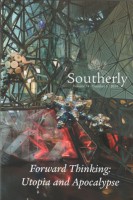
Southerly 74/1

Elizabeth McMahon and David Brooks (editors), Southerly Vol 74 No 1 2014: Forward Thinking: Utopia and Apocalypse

southerly741If I read  the editorials in journals at all, I generally leave them until last, so I read without regard for any theme. I did read enough of this Southerly‘s editorial to gather that it was anticipating the 500th anniversary of Thomas More’s Utopia, but in the rest of the journal I mostly registered mentions of Utopia or utopianism as peripheral to what I found interesting. Some of my highlights:

  • Rozanna Lilley’s memoir, ‘The Little Prince, and other vehicles’, would be wonderful reading whatever her parentage: it’s very funny on the subject of inter-generational bad driving and builds to bitter-sweet reflections on her relationship with her father. But as Lilley’s parents were Dorothy Hewett and Merv Lilley (a fact coyly avoided in the Editorial and Notes on Contributors, but explicit in the memoir itself), it makes a substantial addition to the lore about that magnificent couple. For example, the passing mention that Rozanna had hidden her father’s rifle away from him in his erratic old age is particularly chilling in the light of Merv’s book, Gatton Man, which argues plausibly that Merv’s father was a serial killer, and convincingly that he was capable of murder.
  •  ‘Exile on Uranium Street: The Australian Nuclear Blues’, by Robin Gerster, author of the brilliant Travels in Atomic Sunshine about the Australian occupying force in Hiroshima after the bomb, is a sprinting survey of Australian responses to the nuclear age. Wilfred Burchett’s famous report from Hiroshima, Neville Shute’s novel On the Beach and Stanley Kramer’s film of it have overshadowed other responses, from Helen Caldicott’s activism to protests about Maralinga’s murderous tests. This essay fills out the picture in a way that makes one hope there’s a book on the way. It has a disconcertingly jaunty self-deprecating tone, but occasionally moves in for the kill, as when it challenges our current complacency about nuclear weapons: ‘There is no cause for panic, then – unless one ponders the possibilities.’
  • ‘And in our room too’ by Liesl Nunns starts from the experience of being woken by an earthquake in the middle of a storm in Wellington, New Zealand, and ruminates interestingly about the unexpected, weaving together stories of Maori gods and taniwha, personal experience, and scientific data in true essayist style. I am uneasy about her telling Maori stories in a way that makes them sound like Greek myths, but they powerfully evoke the instability of that part of the world, as does her recurring phrase, It never occurred to me that this could happen.
  • A number of pieces deal with individual mortality. Nicolette Stasko’s poem ‘Circus Act’ deals with the stark unreality of death in a hospice. Susan Midalia’s short story ‘The hook’, in which a woman goes travelling alone two years after her partner’s death, captures the way grief persists but life eventually begins to reassert itself.
  • As always, there’s a satisfying range of poetry. Apart from ‘Circus Act’, I most enjoyed Andy Jackson’s pantoum ‘Double-helix’, Margaret Bradstock’s ‘The Marriage (1823–1850)’ (another of her fragments of colonial history) and Ben Walter’s ‘Joseph Hooker’s Hands’. Geoff Page’s review of books by Tim Thorne and Chris Wallace-Crabbe made me want to read them both.
  • I skipped much of the scholarly content (Southerly is, after all, a scholarly journal), but Jessica White’s ‘Fluid Worlds: Reflecting Climate Change in The Swan Book and The Sunlit Zone‘ was worth persevering with for its interesting insights about Alexis Wright’s work. Danny Anwar’s ‘The Island called Utopia in Patrick White’s The Tree of Man‘ may do the same for Patrick White, but the near-impenetrable technical language proved too daunting for me. My prize for impenetrability goes, though, to A J Carruthers’ review of Melinda Bufton’s Girlery, which isn’t so much densely technical as splendidly uncommunicative, not to mention disdainful of the need for consistent punctuation or the workings of the French language, as in this snippet (because I can’t make WordPress show non-itals in quotes, words that should be in italics appear here as red):

Think of Girlery as a sociostylistic and amorous liaison with girlish grammar. Around each coquine clause the female reader eyes the book, “Hitherto unwritten”, knowingly participating in a kind of ‘quixotica,’ an erotics of reading where “a little grin does that thing only read in books / Plays on our lips / Tout les deux” (27).

Someone in these pages talks about the role of the creative writer in helping us to bring our minds to bear on frightening or otherwise potentially numbing realities. It’s important work, and this Southerly is part of it.

Goodbye Mollie

In my early days of blogging I wrote quite a lot about my family, particularly about life with my mother-in-law Mollie, who had Alzheimer’s. For a number of reasons, including a growing awareness of privacy issues, the blog has become less personal, pretty much restricted to literary matters. But here is one more post about Mollie.

After some years of not leaving her bed, of not speaking, of not eating solid food or more recently being able to manipulate spoon or cup,  Mollie died last Wednesday, aged 92. The visiting palliative care nurse phoned Penny two weeks ago today to confirm – what Penny already thought – that death was imminent. For what turned out to be 10 days, someone from the family was by her bedside for several hours each day, and as the days went by, Penny was there most of the daylight hours. Although Mollie was shockingly wasted in body and mind, she responded to touch and to voices, and seemed to be conscious until the end. She died with Penny’s hand on her forehead and Penny’s voice in her ears.

All her grandchildren were able to say goodbye in those last days. Penny’s brother interrupted his work in London to fly home, and arrived just three hours after she died, so was able to say goodbye in the nursing home.

With just family present, we buried her on Saturday in the Katoomba Cemetery, in a bushland setting not far from where she spent formative childhood years and the last years before she decided she couldn’t live alone any more. We had readings – some of Mollie’s writing about her childhood and her activism, a blistering letter she wrote to the general manager of her husband’s firm criticising an unjust policy, a letter she wrote to her husband on their 25th anniversary. Each of us spoke. We read Marge Piercy’s poem ‘The Low Road‘ in honour of Mollie’s life as an activist.

Yesterday we had a small memorial gathering at our house, with scones and jam and cream, one of Mollie’s favourite treats. It was very good to come together with a small gathering of people, some of whom had come long distances, and remind each other of who Mollie was. My own mother said she didn’t want people to talk about her at her funeral, because if someone needed to be told about her then they had no business being there. We honoured her wishes, but she was wrong: any one life has so many aspects, and I think we all came away from yesterday’s gathering with a deepened and enriched sense of the person we have lost: a woman who had handed out how-to-vote cards when young for the Liberal Party (note to non-Australians: that means Conservatives), who educated herself about the world and became a tireless activist against wars, for Aboriginal issues, for the environment; who embraced new ideas and stayed curious and experimental well past the age when most people settle for the familiar; who stayed gracious to the end.

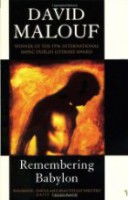
David Malouf’s Remembering Babylon and the Book Group

David Malouf, Remembering Babylon (©1993, Vintage 1994)

009930242X Remembering Babylon is an A-Stranger-Comes-to-Town story. The Stranger is Gemmy, who was thrown overboard as a boy from a ship somewhere off the Queensland coast in the first half of the 19th century. Already not quite the full quid after an impoverished early childhood in London, and traumatised further by his near death by drowning, he was taken in by a group of Aboriginal people. The Town is a tiny community of white settlers who arrive in the area some years later. As Gemmy observes them, his half-remembered previous life stirs in memory, and on encountering a group of children he stammers words David Malouf has appropriated from the historical Gemmy Morrell (or Morril), ‘Do not shoot. I am a B-b-british object!’

Although we have some access to Gemmy’s inner life, the book is mainly about the small settler community, about their range of responses to this part white, part Aboriginal man, and more broadly about the process of British settlers accommodating to the new Australian reality. Malouf would never put it this crudely, but it’s as if Gemmy, for all his addledness, has adapted to the new world more fully than any of them, so his presence becomes a catalyst for their differences and tensions to be exposed.

In Gemmy’s early days in the settlement, for example, a number of the men try to extract information from him about ‘the blacks’, but he resists:

And in fact a good deal of what they were after he could not have told, even if he had wanted to, for the simple reason that there were no words for it in their tongue; yet when, as sometimes happened, he fell back on the native word, the only one that could express it, their eyes went hard, as if the mere existence of a language they did not know was a provocation, a way of making them helpless. He did not intend it that way, but he too saw that it might be true. There was no way of existing in this land, or of making your way through it, unless you took into yourself, discovered on your breath, the sounds that linked up all the various parts of it and made it one.

Yet while this theme is being explored, the narrative adopts one character’s point of view after another – two of the three children who first meet Gemmy, their parents, the young school teacher, the minister – and each time on feels one is meeting a real person, someone Malouf knows well, perhaps even someone he in some way is or has been.

I read Remembering Babylon as part of a body of work by non-Indigenous writers, including Inga Clendinnen’s Dancing with Strangers (2005), Ross Gibson’s 26 Views of the Starburst World (2012) and David Brooks’ essay ‘Origins of Modernism in the Great Western Desert‘ (2008), which explore ways the encounter between these vastly different cultures plays out in non-Indigenous minds. It’s not really a historical novel: I doubt if any part of the Queensland coast was settled as peacefully as this fictional one apparently was, or if there would have been so little contact (ie, none apart from Gemmy) with the local Aboriginal people if it had. It’s surely symbolic rather than historical that an aristocratic woman lives in a beautiful Queenslander just a little way off in the bush from the rudimentary dwellings of the other settlers.

I’m sorry it’s taken me so long to read this book, but it’s interesting to see that some of the themes of Malouf’s recent poetry – particularly the idea of humans as creating a planet-wide garden – were being developed 20 years ago.

The group is meeting tonight. I can’t go because there are things happening in my family that have priority. It’s a pity, because there’s a lot to discuss.

Brendan Ryan’s Paddock in His Head

Brendan Ryan, A Paddock in His Head (Five Islands Press 2007)

1pihhThe first poem in this collection, ‘I Know, I Know’ consists mainly of a list of moments from a dairy-farm childhood, benignly mundane moments with no obvious connecting logic and no obvious emotional significance: lights from the neighbour’s dairy seen at night, dogs dragging on their chains, ‘mum’ hurling tea leaves down a drain. Then the final line:

some days are rosaries that never end

For readers who might need a gloss on that, the next poem, ‘Catholic Daydreams’, has a large Catholic family saying the rosary, the kitchen ‘humming with Hail Marys’ and

My father’s dairy farming fingers
slip down the beads

as if each bead was a grip
on the Joyful Mystery
of ten children charging through

the Hail Holy Queen,
the tempo picking up
according to what was on T.V.

Most of the poems here are shot through with that kind of Catholic sensibility: a sense of the holy unceremoniously embedded in the mundane, messy, painful, occasionally joyful, often strenuous, mostly inarticulate everyday life on a small dairy farm in rural Victoria – and in the farm escaped from, remembered, missed, revisited. It’s sacramental but not at all solemn, in fact not at all pious. There are hints of the Benedictine motto laborare est orare, but without religion.

And many of the poems are like rosaries: lists of things observed like beads, evoking fragments of story associated with each one. Like this, from ‘Tower Hill’:

Driving into the crater
past shelves of basalt, clinker and limestone

I wait for my aunt’s stories.
She remembers a king tide claiming the paddocks

a house being lifted, then taken away by a river.

In the few poems of city or town life, the sense of place and the sense of community are just as strong. From ‘Summer Conversation’:

Three days of heat
and the lounge expels us to the backyard.
From over fences
an accordion being played
footsteps in the back lane,
neighbours on their front verandah
with Greek radio and a well-hosed footpath –
they watch everyone who passes.

In this and his previous book, Why I Am Not a Farmer (my blog post here), Brendan Ryan has maintained a remarkably tight focus on this one subject: the life of a small Catholic farming community and what it means  to leave  it for a town life.

In case I’m giving the impression that this poetry is naive or monotonously single-minded, I’ll mention ‘Naringal Landscape’, a conversation with a Clarice Beckett painting that seems to be called 7 Naringal, Landscape.

The bush we don’t see closes in like memory.
A clump of eucalypts floats above the horizon.
The silence of the paddocks creeps outside the canvas.
Late afternoon, smells of heat and rye grass thickening in your head.

I’ve just read that he has published two books since this one: A Tight Circle and Travelling through the Family. I’m glad to report that the latter book was shortlisted for the 2014 Victorian Premier’s Literary Awards, which seems to mean I’m in good company in wanting more of his work.