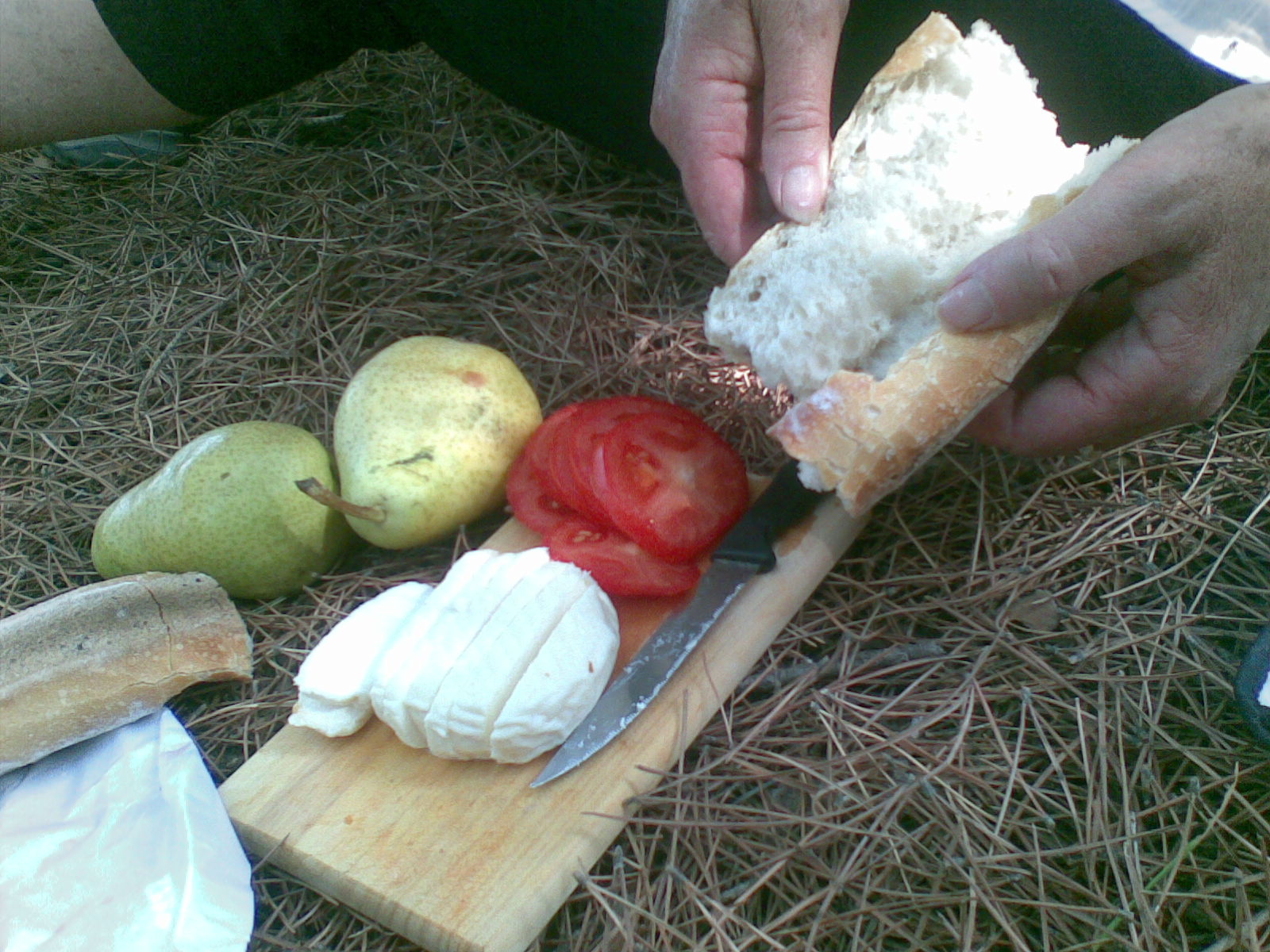
Pain de campagne, tomate, St Marcellin, tomate, des poires et – hors d’image – un pacquet de tranches de dinde plastique.

Pain de campagne, tomate, St Marcellin, tomate, des poires et – hors d’image – un pacquet de tranches de dinde plastique.
Hilary Mantel, Wolf Hall (4th Estate 2009)
 This is a truly engrossing historical novel – I hope it wins the Booker Prize.
Written in beautiful, slightly quirky and so captivating prose, it’s full of vividly realised scenes and characters to care about, of engrossing argument in which the stakes couldn’t be higher. For me the main pleasure was of historical revisionism. In taking Thomas Cromwell as its hero, it effectively challenges the version of the English Reformation – indeed of the Protestant Reformation as a whole – that I absorbed from the nuns and brothers and, I’m embarrassed to acknowledge, remained pretty much intact under the assault of an undergraduate course in Reformation History. I’m consoled somewhat by having the great Erasmus as an offstage character who pretty much shares my understanding, and by a sense, especially toward the end, that it’s Robert Bolt’s A Man for All Seasons rather than my young self that Hilary Mantel has in her sights. Thomas More – that’s Saint Thomas More to me – is portrayed here, among other things, a pitiless torturer and a misogynist a***hole. I suppose my younger self might have read this as Protestant propaganda. I hope I would have checked the evidence, and come to the conclusion that if it is propaganda, what it’s propagating is the view that rigid and intolerantly held religious views are an abomination, and that there is great virtue in devoting one’s self to making things go well.
I can’t read historical fiction these days without sensing Inga Clendinnen reading over my shoulder. I think she would approve of this.
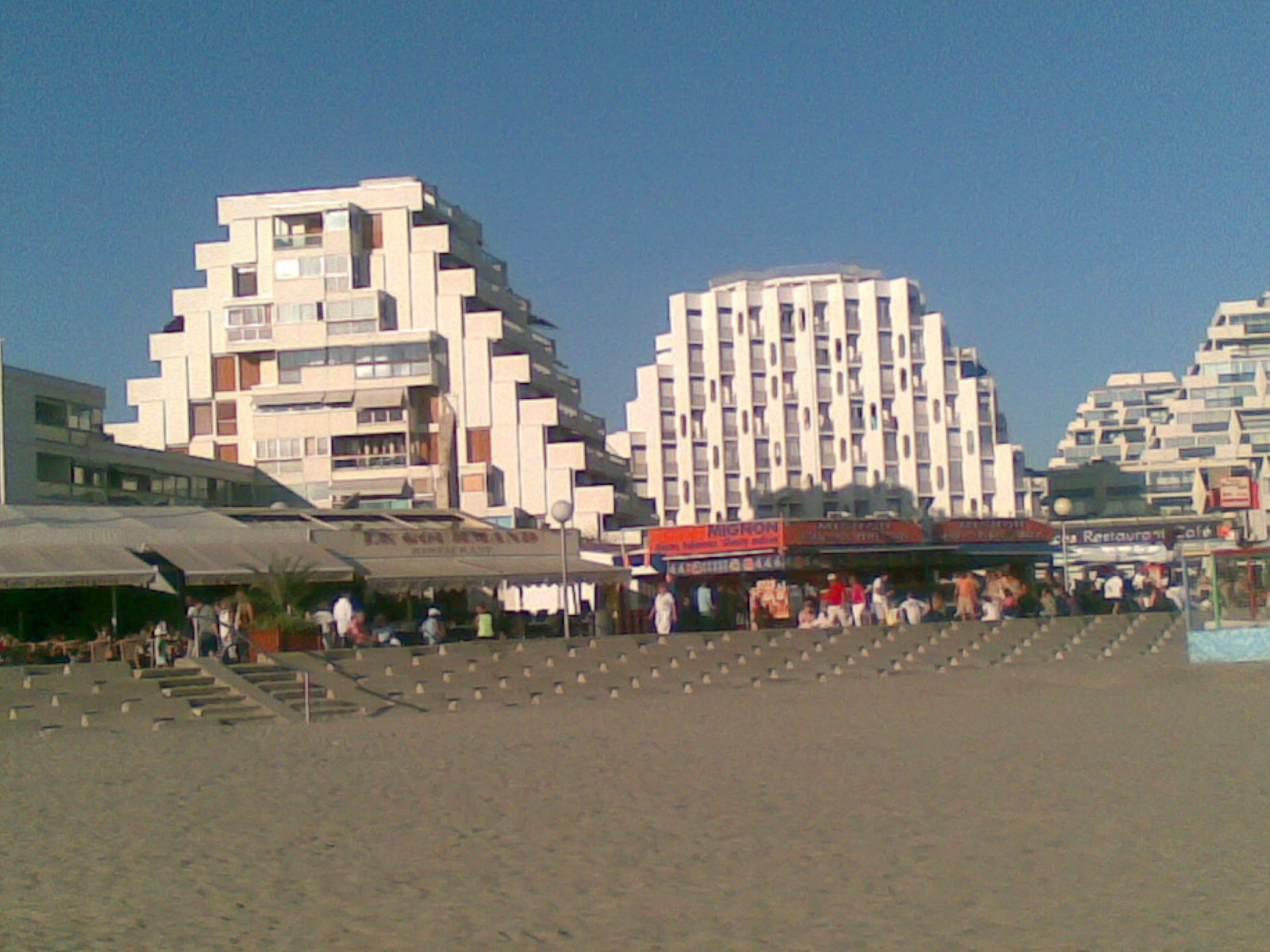
In Egypt people were buried in them. The Aztecs killed people on them. At La Grande Motte, people go to them to wait for death.
I haven’t exactly managed a daily post as we walked through the Loire Valley: points d’internet aren’t exactly common and those I have found, when they functioned at all, have had keyboards that drive me crazy. But here I am in beautiful Orléans, having now walked for 20+ kilometres four days in a row, with just one day to go. I’m sore of foot but it’s been fabulous. There have been mysteries, such as the siren that blared out at midday in one village, or the row of adult-sized high chairs made from tree branches, ten metres apart, along the side of a ploughed field (the latter probably something to do with hunting). There have been sublime moments, such as hearing the monks of Fleury sing Vespers at the magnificent church in St-Benoit. And horrible moments, as in the same St-Benoit where neither of the two restaurants was open the night we were there. We’ve got lost, but then been given directions by a kind boulangère. We’ve had wonderful meals, ranging from the one we scraped together that night to any number of lovely restaurant meals. We’ve had a salade avec grésiers, which tasted great, but looked like gobs of flesh that might crawl off their bed of lettuce any second. The company who organised it for us, Sentiers de France, have done a lovely job, and the French system of walking paths is meticulously mapped.
I’m off to bed for an early rise to croissants, hot chocolate and a long walk.
Stieg Larsson, The Girl Who Played with Fire (2006, English translation 2009)

I apologise for not listing the translator’s name – I left the book in the Paris Bercy train station so can’t check on such things. It was gripping enough, and I plan to read the third book in the trilogy; I did see the three books, in French, with much more appropriate covers than the English editions’, in a shop window in Lyon (yes, I read the book while travelling). The French title of this one translates as something like The girl who dreamed of a jar of petrol and a match.
I wish Stieg Larsson had lived to see his book through the editing process. I think they would have benefited — less repetition, perhaps, a less plodding pace. But even though I’m not as entranced by Lisbeth Salander as Stieg evidently was, this was a very good train and hotel read. A comedown after Anna Karenina, but then what wouldn’t have been?
My next blog post will be about walking in the Loire Valley.
Leo Tolstoy, Anna Karenin (1873-1877, translated by Rosemary Edmonds 1957, 1978)
 What with cleaning the house, travel, conference, broken computer and jet lag, this has taken me longer to read than it normally would have. It’s wonderful wonderful – funny, confronting, deeply instructive. At times I felt as if Tolstoy wrote the book to explain the society of his time to readers who wouldn’t be born for at least 70 years (the situation of women, the conditions of the peasants …). I knew in advance that this was a book about a woman who throws herself under a train, and expected it to have a bit of A Doll’s House about it. I didn’t expect it to have elements of P G Wodehouse twittiness at one extreme and almost Joycean internal monologue at another. And is there a bit of proto-Wittgenstein (‘Whereof one cannot speak, thereof one must remain silent’ ) in Levin’s decision to renounce argument in the last chapter? And how about those similes! (Just in case you’re reading this and haven’t read the book: maybe half a dozen times, at intense moments in the narrative, a character’s mental state is explained through a simile, and each time it’s just brilliant.)
Why didn’t anyone tell me? I may have to set aside time for War and Peace sooner than I’d planned. (I’ve been told I should have read it first, because it’s not as grim. Oh well …)
We’re now in the tiny village of St-Gervais just outside Bagnol-sur-Cèze to the north west of Avignon. Driving hereabouts is no longer a white knuckle experience, though there’s still quite a bit of adrenaline pumping around every time we make a left turn. (My adrenaline is entirely that of a passenger – Penny does all the driving.) We’re having fun being tourists, enjoying the tolerance and even kindness of the French as we mangle their beautiful language. I’ve reached the heights of being able to tell when I’m being corrected, as in when I asked for ‘un glace vanille’, the man behind the counter replied, ‘Vous en voulez une.’
I’ve just uploaded our photos so far to Facebook — pretty much unculled and no captions yet: the Eiffel Tower, the Musée du Quai Branly, views from the Aqueduc des Arts, Provençal markets, Nimes, the Théàtre Antique in Orange. I would have put them somewhere more accessible, but I don’t remember passwords for those places and mon ordinateur à moi, where they are stored, is navré.
One fabulously unnerving scene didn’t make it to a photograph. To avoid misunderstanding I should preface my description of it by telling you that in my childhood whenever my family came home after dark, my mother and sisters would go inside and line up at the lav, while my father, my brothers and I would relieve ourselves on the grass beside the garage, making frothy patches in the moonlight. So it’s not surprising I’m charmed by some of the spectacles of public urination that we’ve encountered here – a man and his small son peeing through a car park fence into a field, for instance, strikes me as a sociable, environmentally responsible act, and the two women standing near the car didn’t seem to mind the wait. I do discriminate. Like most people, I find the stench in some Parisian parks appalling. Today in Orange we saw something else entirely.
We were strolling along, enjoying the feel of the narrow street when a car pulled up just in front of us. A stout middle-aged man stepped out of it, crossed the street, and walked briskly into a garage that happened to have an open door. As he pulled the door shut behind him, he was unzipping his fly and before we were out of earshot we heard the splash of piss. I looked back before going around the next corner, and sure enough he came back out into the street, hopped in his car and drove off.
If ever you move to France and live in a village, don’t forget to close your garage door.
I know I should be telling about my travels — how there are almost as many psychics awnings out on the streets of Manhattan as there are Starbucks, and that’s a hell of a lot, how I’ve met three women (an Australian, a Scot and an Englishwoman) who go to Las Vegas once a year or so, how Paris is fabulous, not least for its peches plates — but my time on my host’s computer is limited, and as soon as I sit at her keyboard my mind goes to my computer troubles.
There was a splendid moment of hope when the CEO of MacMD (or similarly named enterprise, tucked away on the 12th floor of a building on West 35th Street Manhattan) told me he could replace my screen for only $450 US, and do it in time for me to catch my plane. That hope was dashed when I turned up four hours later: he hadn’t realised it had to be an LED screen. He could still do it, for £600, but not before I had to leave. So I reclaimed my poor damaged ordinateur, and pretty much as soon as I arrived in Paris (where free WiFi seems to be ubiquitous) took it to a promising place in the Marais.
‘Parlez-vous anglais?’ I asked. ‘Pas du tout,’ said the jeune homme behind the counter, then added when I showed him my screen, now even more alarming than the image I posted the other day, ‘But I don’t need to speak English to understand what your problem is.’ He said that in French, but I caught his drift with complete confidence. He told me it would cost €1050.
I protested, in what seems to have been comprehensible French, that the guy in New York had said he could do it for 600 dollars, less than a third of the price. In civil and unmistakable French he gave the universal response to such protests: ‘Well, take it there then.’ And you know, even though it means relying on the kindness of friends and the availability of cybercafes for the whole month we’re in France, that’s what I intend to do.
Speaking of the availability of cybercafes, would you believe there are no internet kiosks in the International Terminal at JFK? Not even paid ones! I asked and was told I could join something called the Galileo Club at $50 a day, which would enable me to log on. Yet the poor oppressed people of the United States continue to believe that they have the highest standard of living in the world.
Paris is beautiful. My attempts to speak French have been laughed at, but not in a nasty way. Many people are away for the summer, so the streets are comfortably uncrowded. It’s our second day and we’ve already been to two museums, eaten excellent Israeli kebabs, and figured out what to say in order to get coffee that’s up to Sydney standards (that’s not for me, but for my addicted companion). Soon I’ll have grieved sufficiently over my laptop to be able to give you proper traveller’s tales. Au revoir for now
Since I couldn’t get to sleep, Here’s a phone snap of my tragically damaged MacBook screen: 
Appropriately enough, the current desktop picture seems to be a snap taken from the rim of the volcano on Vulcano. one of the Aeolian Islands.
 Currently reading & watching


 Me fail? I fly!