Conversations while reading while walking

I’ve posted about these brief conversations before, and they continue to amuse and even fascinate me. How much can be communicated in the time it takes to pass a friend, neighbour or stranger in the street! The conversation en passant is an under-appreciated artform.

So here are a couple that have accumulated over the last couple of weeks.

Neighbour: (beaming) Jonathan, every time I see you you’re reading. I wish it would rub off. It’s years since I’ve read anything.
Me: It’s not always serious stuff, you know. (Though I was reading Sarah Maddison’s Black Politics, which is surely serious enough for anyone.)
—–
A non-conversation that fits here anyhow: I actually saw someone else in the Taylor Street Park reading while walking, accompanied by a dog. We didn’t acknowledge each other, and I didn’t get close enough to see what she was reading. It had an orange cover.
—–
This one could have happened whether I was reading or not (I was wearing my red Viva-the-Kevolution shirt – a red version of this one, not this one):

Silver-haired man outside Glebe library: I’m not talking to you! (When I took no notice, being about 20 metres away) Hey, man in the red shirt … I’m not talking to you! (As I look up from my book and acknowledge him) I’ve got ADHD and I’m disciplining myself not to talk to everyone who walks past, so I’m not talking to you.
Me: (somewhat absent-mindedly) Oh, OK, thanks. (Now more like 30 metres from him, I return to my book.)
Silver-haired man: (calling cheerfully) I’m a little disappointed in your response. It would have been better if you’d said. ‘Now I’ll never know what I’m missing out on,’ or something like that.
Me: (closing my book, turning to face him, but not retracing my steps) Of course, I’m sorry. I wasn’t paying attention.
Silver-haired man: You see how needy I am!
Me: You’ll do.

My guess is that this charming man has been convinced  by a well meaning psychiatrist / psychologist that his ‘inappropriate’ gregarious impulses constitute a disorder.
—–

More of these conversations as they occur. I do get a lot of indulgent smiles, and I’m not including dog-psychology haiku chats

Peter Madden on creating sustainable cities

Peter Madden, Chief Executive of the UK not-for-profit organisation Forum for the Future, has just visited Australia for a series of public lectures. The main event has been his part in the Deakins – the Alfred Deakin Eco-Innovation Lectures, an initiative of the Victorian government – and I gather his Melbourne lectures were well publicised and will soon be up on the web. On his way home, he spent a couple of days in Sydney , and I went to his lecture, ‘Creating Sustainable Cities’, at UTS on Thursday night. Although it was technically public, this lecture seems to have been a well kept secret, advertised pretty much by word of mouth,  with notes on the UTS staff bulletin board and the Sydney Cyclist web site. As far as I’ve seen it went unnoticed by the press. And you thought sustainability was a hot subject!

Forum for the Future was founded roughly 13 years ago by to members of the Green Movement in Britain who realised that Greens seemed to spend most of their time protesting – their activities had a predominantly negative feel to them. They decided to organise on a positive footing, and the Forum was the result. It has been working with business and government to persuade them to take environmentally responsible initiatives, and show them how.  The opening slide of the lecture showed the logos of maybe a hundred organisations that have worked with Forum for the Future. The idea is to help them think through ways to change their practices in response to climate change – to reduce their own carbon footprints and then to make their activities benign rather than destructive in relation to the environment.

I won’t try to summarise the lecture, but I have two thoughts to inflict on you.

The level of public conversation about climate change is very different in Britain from the one here. Prominent Australian politicians proudly declare themselves to be climate sceptics, failing to realise that the science of climate change is based on systematic scepticism and that they are actually identifying as denialists, and debate often gets bogged down there, pretty much at kindergarten level. Meanwhile the question of whether to pass the tokenistic CPRS legislation gets to be seen as the be-all and end-all, with Kevin and Penny saying, either disingenuously or idiotically,  that since they’re being criticised from both left and right they must have it about right. That is to say, climate change is hardly treated seriously at all, for all the lip service it’s given. In Britain the conservative opposition has more far-reaching policies about climate change than the Labour government, and there are significant commitments from Government – for example, by 2015 to have every new house built be carbon neutral.

Peter Madden guesses that the issue is taken seriously in the UK because so many of the leading climate change scientists are British , and speak with authority. It strikes me that the reason the science is treated with such disregard here is a legacy of the Howard years: just as the Howard government dismantled ATSIC and deprived Aboriginal and Torres Strait Islanders of a national voice, it also set about discrediting CSIRO, once looked to as a reliable source of information on scientific matters, now able to be dismissed by the likes of Nick Minchin, along with the vast majority of climate scientists, as left wing propagandists.

The other thought, more or less unconnected, is that greenies fail to communicate their message because they/we fail to listen. According to Peter Madden a recent study shows that green activists tend to have a weird and atypical psychological make-up, in which abstract, altruistic concerns rate high. Their/our attempts to communicate often come off sounding like preaching or even haranguing. What he and the Forum for the Future try to do is reframe the conversation in the positive: here’s a major problem we’re all facing, and here are some ideas for how we can address them. Business can do this thing and still be profitable. Governments and do that thing and still be re-elected. Individuals can do the other thing and still live well. So Tesco, the huge, many would say rapacious, supermaket chain, has a green strategy with teeth; the NHS is exploring ways to reduce its carbon footprint and at the same time deliver health services more intelligently.

About individual action to reduce carbon footprint, he said you could cut through a lot of the agonising over details by addressing these key questions:

1. What forms of transport do you use?
2. Where do you go for holidays?
3. How much red meat and dairy do you eat?
4. How do you heat or cool your home?

I’m sorry the audience for this lecture was so small, mainly because it gave a glimpse of possibilities. During question time, one man evidently a green activist, asked Peter to talk about bullshit moments – that is to say, moments when he realised that he was listening to someone talk about their green credentials in a completely disingenuous way. Peter did mention a bottled water company who claimed to be carbon neutral – the Forum had refused to work with them because bottled water is an environmental disaster, end of story. But he was adamant that while almost none of the companies he worked with could claim to be completely clean, they were all going on a journey. Even in the most profit-motivated corporations, there are people who, given half a chance, will have a go at sustainability.

What does fortuitous mean?

Me and the dictionaries I have to hand all agree on the answer to that question, though the Macquarie Dictionary, Third Edition, does take a moment to editorialise. Having defined the word as an adjective meaning ‘happening or produced by chance; accidental’, it goes on:

Usage: Strictly speaking, fortuitous means `happening by chance’, whether to one’s advantage or not. But the similarity with fortunate leads many writers to use the word only when referring to good luck.

That is to say the word has a clear meaning but it’s often used – carelessly or in an uninformed way – to mean something else.

I suppose that’s the way the language changes, and this is a word, like disinterested, that’s keeping its particular meaning only among people who care, but generally being treated as if it’s a slightly pompous variation of a more common word.

But what are we to make of this, which prompted this post? It’s from a respectable academic publisher, in a literary-award winning book that generally uses recognisable English.

EPSON001

In case you can’t read it, the first paragraph begins, ‘Whoever had created Australia, white men were certain that “this land of promise” belonged to them. It seemed fortuitous that the original inhabitants appeared destined to fade away before the superior forces of civilisation and progress.’

I can’t make any sense out of that second sentence, even if fortuitous is being used in its careless sense. Can something both seem to be caused by chance and seem to be destined? If the original inhabitants are – or are to ‘appear’ – to be wiped out by superior forces, surely chance doesn’t come into it.

Honestly, I’m not just being snarky here. I really did stumble over this, worrying that the writer (and the co-author, and the book’s editors and the proofreader*, and the award judges) knew something about the word that I didn’t. Having looked up a number of dictionaries and style guides, I’m now pretty much persuaded that the word has simply been misused, as a rough equivalent of good.

[Maybe I should have read on to the start of the next paragraph – ‘In fact, the Aboriginal population had already been decimated by the rapidity of dispossession in Victoria’ – before going to so much trouble. But the battle to keep the original meaning of decimate is by now long lost.]
—–
* Or, as I saw in the credits of a magazine in an osteopath’s waiting room today, proffreader.

A cool invitation?

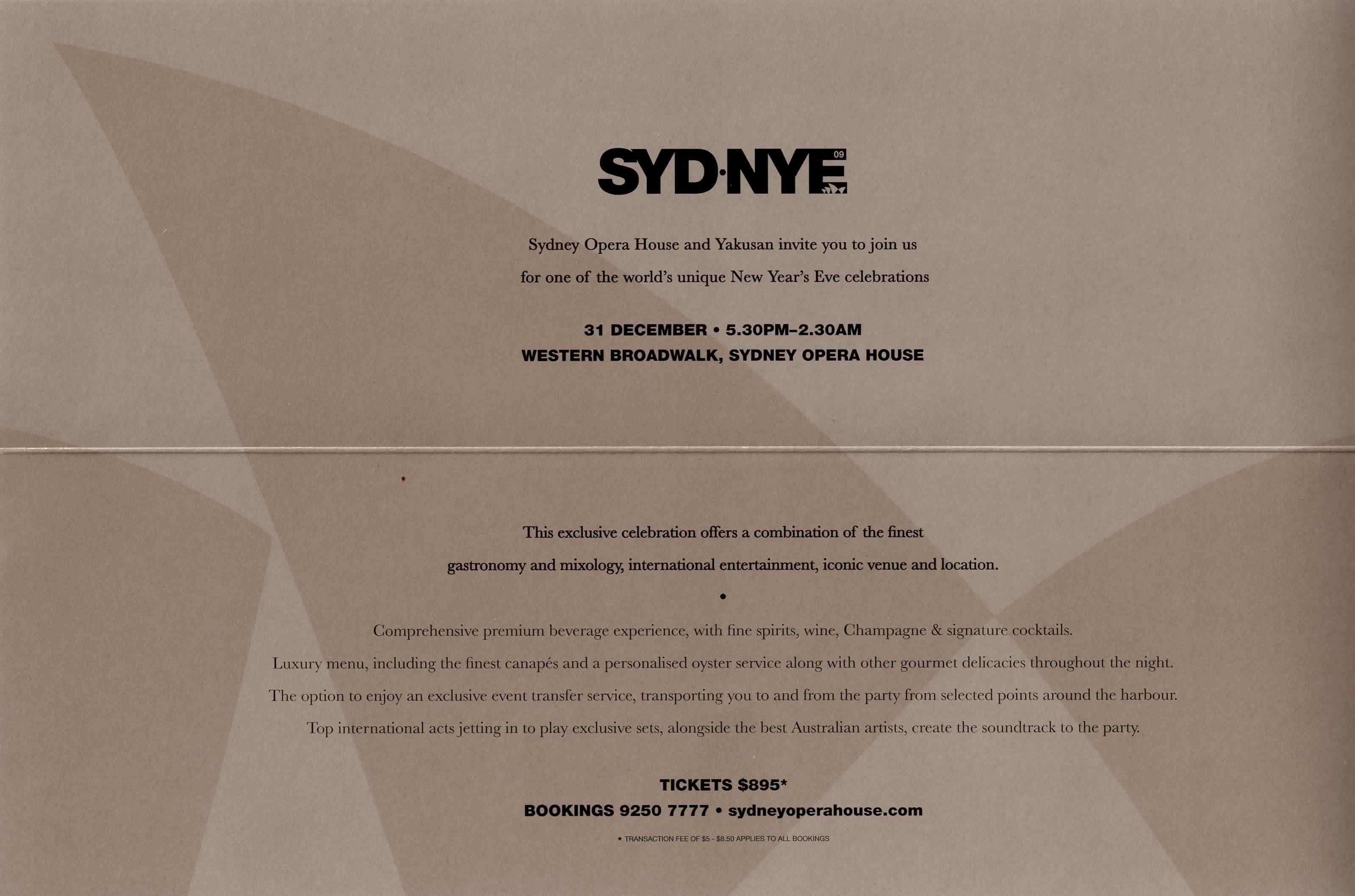
A tantalisingly misshapen envelope arrived in our mailbox today, and it turned out to contain an invitation to a party.

SYD NYEClick to see bigger.

In case you can’t read it, it’s to  a New Year’s Eve party on the Western Boardwalk of the Sydney Opera House, offering ‘a combination of the finest gastronomy and mixology, international entertainment, iconic venue and location’.

How fabulous, I thought. One of our really influential friends must have got us onto the guest list. As a non-drinker I’d even put up with all those expensively tipsy people for the sake of the sheer exclusivity of it.

But then I reached the bottom of the page.

EPSON002_2

Oh, it’s not an invitation at all. It’s trying to sell something. Let’s see, is this the way I want to spend $895? Before the obvious answer could settle in my mind, I saw the very tiny type at the bottom

EPSON002_2

Yes, not only would I have to give the Opera House $895 to accept this ‘invitation’, but I’d have to pay between $5 and $8.50 for the privilege

In that case, I thought, they can keep their mixologies.

You know you’re getting old when …

… someone who was in your son’s class at school is appointed artistic director of a major cultural institution.

Congratulations, Ralph!

Productivity Commission’s recommendations rejected

As they said over at Alien Onions:

see more Lolcats and funny pictures

The Brain that Changes Itself

Norman Doidge, The Brain that Changes Itself (2007, Scribe 2009)

1DoidgeThis has been beside my bed since the Sydney Writers Festival in May, and had been vaguely circling my TBR list well before that. It was James Tiptree Jr’s stories that finally got me to the point of opening it up. Alice Sheldon was a research psychologist and her stories reflect a deeply pessimistic sense, presumably based on her professional knowledge, that brains are hardwired. In ‘Houston, Houston, Do You Read’, for instance, the all-female Utopia, faced with three men delivered to them by a freak of time travel, have to choose between allowing the innately violent, hierarchical creatures to ruin their society and killing them humanely. In an alternative reading, of course, it’s a mostly Australian-heritage Utopia faced with three US military types. Either way, plasticity – that is to say, the capacity for change – doesn’t enter into it. My own experience contradicts this pessimism: with enough thoughtful work, and enough taking of two steps forward for each step back, I believe we can achieve all sorts of things that look impossible. The Norman Doidge book promised good news from the hard sciences and I turned to it for evidence-based optimism.

As well as some unexpected echoes of my recent Tiptree reading (for example, Doidge’s account of the PETA’s 1981 intervention to ‘save’ monkeys from alleged experimental cruelty reads like a real-world equivalent of the fantasy exodus from the labs in Tiptree’s 1974 story ‘The Psychologist Who Wouldn’t Do Awful Things to Rats’), I got what I was looking for.

The book is immensely satisfying science for lay readers, that is to say for people who know Sweet Fanny Adams about neuroscience but are interested in the workings of human brains. The subtitle – Stories of Personal Triumph from the Frontiers of Brain Science – is a fair summary of the book’s approach to its subject: each of eleven chapters matches the work of a scientist or clinician with the story of a person who has benefited directly from that work. At the start of the twentieth century, mainstream brain scientists were localisationists, working with a model of the brain in which every function was performed by a particular section of the brain, and if that part was damaged, the function was permanently lost. With increasingly reliable and accurate techniques for mapping brain activities, brain scientists have been discovering that the brain is much more complex than that model allows, and much more adaptable. What’s done cannot be undone, sure enough, because the brain isn’t elastic, but nor is it made of stone. Neurons that fire together wire together – if you can figure out a way to make them fire separately, it takes a surprisingly short time to make them unwire from each other. A Spanish scientist named Alvaro Pascual-Leon demonstrated in the 1990s that ‘our thoughts can change the material structure of our brains,’ and that’s only a part of it.

Seen from one point of view, the book is full of wonders. A woman born with only half a brain nevertheless reads, relates intelligently to other people, performs astonishing feats of memory, and dreams of a heaven tailor-made for her needs. People paralysed by stroke years earlier recover speech or movement through an intensive exercise regime. Persistent pain in phantom limbs is relieved using a mirror in a box. People move objects using only their imaginations (helped by electrodes attached to their brains and linked to computers).

From another point of view, it charts the progress of hard science catching up with common wisdom. Contrary to the dogmas of the ‘mental health’ industry, observable changes in the brain don’t incontrovertibly indicate physical conditions that can only be remedied by drugs, surgery or electric shock. The aggressive assertions of evolutionary psychologists look even more ideologically based than they did without this evidence. Addictions, including to internet pornography, look a lot less like life sentences. Doidge is a Freudian, and the progress of one man’s analysis as an exercise in neuroplastic therapy. In an appendix, ‘The Culturally Modified Brain’ he writes:

Neuroplastic research has shown us that every sustained activity ever mapped – including physical activities, sensory activities, learning, thinking and imagining – changes the brain as well as the mind.

I’m glad my primary schooldays included endless amounts of memorising. It looks as if the years that lie ahead will need to include even more.

If Tiptree/Sheldon were writing now, perhaps her time-lost astronauts would be welcomed to the new Earth, and the story would have to become a novel to chart their progress. Perhaps, too, she would have found an intense, repetitive practice to overcome the depression that debilitated her.

Street-fightin’ gentry

A little of the paper war about Revolver spilled over into the physical world on the weekend. I was taking Nessie out for her evening constitutional, just as the café was closing round about 4 o’clock. As I neared the corner I became aware of raised voices. Rod, the café owner, was standing at the fence of nearby neighbours, and both the man and the woman of the house were making a lot of noise with their mouths. I’m a dreadful reporter – I couldn’t distinguish a word they were saying. But as I passed them, their little dogs came charging at the fence yapping furiously at Nessie. Nessie, of course, responded in kind and I was preoccupied with getting her to the corner. I did hear Rod say, with admirable calm, ‘Well, all I can say is, go ahead and take more photos …’ Someone told me that he had offered them free breakfasts, but it seems they are implacable.

Apparently just before I arrived on the scene, the outraged neighbour had shouted into the cafe, urging Rod to pack up and leave because no one wanted him there, and then seized the brass ashtray, threatening to smash it on the footpath. Oh dear!

Our new painting

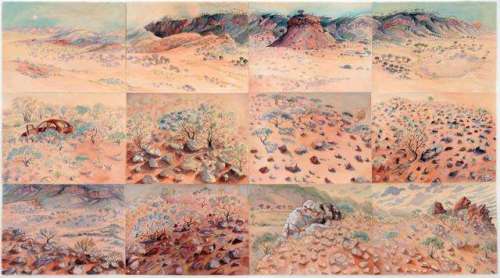
We really really couldn’t afford this. It’s Valley, by Carol Ruff, perhaps it should be rechristened Folie (à deux)

valley

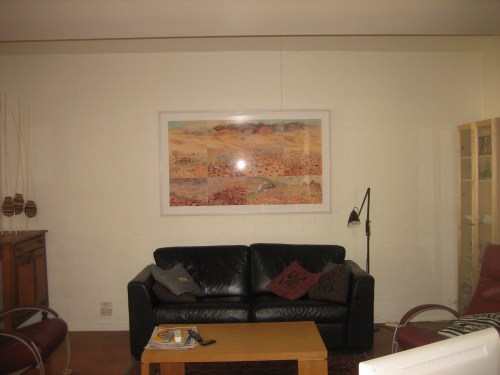
But here it is on our wall, making the endorphins flow:

IN room

Star Songs of an Old Primate

James Tiptree Jr, Star Songs of an Old Primate (Del Rey Books 1978)

0345254171Somewhere in the course of reading this book I realised it was a first edition, indeed an only edition, and that it’s been out of print for close to 30 years. You can’t even buy a copy on e-Bay. There is one collection of Tiptree’s stories still in print, Her Smoke Rose Up Forever, from Tachyon Publications in 2004, which contains eighteen stories compared to this volume’s eight, so perhaps there’s no big deal. Still it’s a shame that the fabulously self-promoting title of this collection has gone from the bookshop shelves. James Tiptree Jr/Alice Sheldon is the old primate in question, and a depressive old primate s/he is – I wouldn’t recommend these stories to anyone prone to letting grim prognoses for the planet take them on a nose dive. For all her feminism, her stories here feature an unhappy biological determinism, and even way back in 1978 she was terribly aware tht if nuclear war didn’t get us, then global warming or some terrible pandemic would.

I was glad to have Meet Me at Infinity still to hand, because Tiptree’s own comments on these stories, especially ‘Her Smoke Rose Up Forever’ and ‘Houston, Houston, Do You Read?’, greatly enriched the reading experience for me. Those comments make it clear that part of her project was to introduce what she calls software into hardware science fiction – she was au fait with cutting edge and out-on-the-edge psychological research of her time, and found in it the stuff of poetry.

Speaking of Meet Me at Infinity, I don’t care if F R Leavis said the artist’s biography was irrelevant to the work of art, ‘The Man Who Wouldn’t Do Awful Things to Rats’ gains tremendous resonance from its relationship to Alice Sheldon’s own history. Like her, Tilly Lipsitz is a researcher in psychology whose interests are at odds with the dominant mode of his place of employment. Like her, he is exhilarated by biological research; and their fields of enquiry are similar. Here’s a paragraph from the story (first published 1976):

He will never outgrow the thrill of it. The excitement of actually asking, after all the careful work of framing terms that can be answered. The act of putting a real question to Life. And watching, reverently, excited out of his skin as Life condescends to tell him yes or no. My animals, my living works of art (of which you are one) do thus and so. Yes, in this small aspect, you have understood Me

and one from an interview published in Contemporary Authors in 1983:

It takes time and work to learn how to ask a meaningful, unambiguous question of nature. For instance, you have to learn everything that has already been asked in your field, and what the answers were and the statistical techniques. And after you are qualified, there is still a period where you stand, as it were, in the great Presence, dejectedly hearing it grumble, ‘No … no … garble in …’ But you try and try, until one great day the needed cunning comes. And Everything-That-Is responds majestically, ‘Yes. You have truly grasped one of the hidden dimensions on which My creatures live and move.’ Time will never blur the wonder of that moment for me.

In the story, but hopefully not in the life, this thrill is overshadowed by the grim academic environment, strapped for cash even then and engaged in hideously cruel practices. That overshadowing grimness is characteristic of the stories, so even though there’s much that is rich in this book, I don’t see it becoming a favourite.

—–

And a niggle from a Down Under editor: It’s nice that Tiptree made Australian women the main surviving humans in ‘Houston Houston Do You Read?’, and gave the humanity of the future an Australian accent (‘date’ is pronounced ‘dyte’), but I wish she or her editors had checked the spelling of ‘Woomera’. I just checked in Google Books, and see that it wasn’t corrected for the 2004 edition either. Hooston, do you read?