Niece news

I don’t suppose many people would see an item about youth suicide in Queensland as a good news story, but this story in today’s Sydney Morning Herald marks my niece Kym’s first byline in a major newspaper. They’re a talented lot, my nieces.

Coetzee’s Youth

J M Coetzee, Youth ( 2002)

This is the second of three (so far) novels in Coetzee’s Scenes from Provincial Life series, which are fiction, but also by strong implication unsparing autobiography. It takes up our hero as an 18 year old student and aspiring poet living in a one-room flat in Capetown and drops him again as a 24 year old computer programmer living in an upstairs room in a house in the depths of the Berkshire countryside, convinced that he is a total failure.

It’s the 1960s. The young Coetzee is committed to escape being defined by his family, trapped in the dullness of colonial life, and torn apart in what he sees as the impending revolution in South Africa. He aspires to the status of poet, and theorises endlessly to himself about how he should live (as opposed to write) to achieve that aim. He agonises over his incompetence in relationships with women, over which writers and artists he should emulate (Ezra Pound presides over his pantheon, and Beckett the novelist is a late apparition), over how to shake off his colonial identity. He rationalises his moments of appalling behaviour and then berates himself for his rationalising, and for his general coldness. He aspires to Angst, but realises his sole talent is for ‘misery, dull, honest misery’.

I loved this book. There are two possibilities: either Coetzee’s interior life as an adolescent/young adult was uncannily like mine, or he has turned a searing light onto his experience of that time of his life and laid bare something essential about the collision of adolescent romanticism with the demands of reality. Given that the externals of his life weren’t noticeably similar to mine, and I never had his overarching sense of destiny, I’m guessing it’s the latter. Young Coetzee’s misery, confusion about sex, self castigation, romantic theorising and bitter disillusion are all presented without commentary, but with a gentle irony – which may derive partly from the reader’s knowledge that this pathetic youth went on to win the Nobel Prize (and possibly that an idea that comes and goes on page 138 was the seed of his first novel), but which also simmers in the prose, bubbling to the surface as humour often enough to suggest, without invalidating the character’s intensely felt experience, that an older, wiser head is constantly there, shaping the story. My favourite bubble pops up when young Coetzee, who lives alone and feeds himself with classic adolescent male incompetence, is ruminating on Ford Madox Ford:

Ford says that the civilization of Provence owes its lightness and grace to a diet of fish and olive oil and garlic. In his new lodgings in Highgate, out of deference to Ford, he buys fish fingers instead of sausages, fries them in olive oil instead of butter, sprinkles garlic salt over them.

We do wonder if he misses the point about so much else by quite so wide a mark.

Young Coetzee was writing an academic thesis on Ford. The paragraph after the one I just quoted describes the thesis as involving ‘the task of reducing his hundreds of pages of notes in tiny handwriting to a web of connected prose’. My sense is that this book has achieved something very like that: whether Coetzee has drawn on actual diaries from the period or on the virtual pages of his recollection, he has created from the material a shiny, elegant narrative web.

Early in his stay in London, young Coetzee hears a BBC talk about the Russian poet Joseph Brodsky and is enraptured by his poetry. He reflects on what Brodsky and a handful of other poets mean to him:

they release their words into the air, and along the airwaves the words speed to his room, the words of the poets of his time, telling him again of what poetry can be and therefore what he can be, filling him with joy that he inhabits the same earth as they. ‘Signal heard in London – please continue to transmit’: that is the message he would send them if he could.

If in my early 20s I could have received this book as a signal, I would have responded, I’m sure, with a very similar joy. As it is, confident though I am that J M Coetzee won’t be reading my blog, I’m sending him a belated message on behalf of my younger self:  ‘Signal heard in Sydney 40 years later – please continue to transmit.’
—-
I read Youth in a library copy. A previous reader had ‘corrected’ the text:

  • on page 53 s/he fixed a simple typo, inserting be in ‘It would nice to write’ (‘Thank you,’ I thought)
  • on page 72 s/he altered pay to pays in ‘But none of the girls on the trains pay him any attention’ (‘Hmm, you are an old-fashioned pedant, but at least you left that But alone’)
  • on page 85 s/he changed oneself to one’s self in the sentence ‘Only love and art are, in his opinion, worthy of giving oneself to without reserve” (‘Someone please take the pen away from that person’)
  • on page 95 s/he changed the phrase to eat packet soup, possibly because one doesn’t eat soup, then – sensibly – scratched  out the alteration
  • thereafter, s/he presumably resigned themselves to the probability that Coetzee and his editors were competent after all.
  • A Raffish Experiment launch

    In my mid 20s I worked for The Currency Press. It was my first real job, and it spoiled me forever. Our offices were frequently visited by luminaries from Australia and beyond. David Williamson ducked to get under the lintel; Jim McNeil and Peter Kenna duelled with anecdotes over afternoon tea; Alex Buzo described one of his leading ladies as having a face like the back of a bus; Richard Eyre (whose Stage Beauty I watched on TV last night) dropped by on a visit from the UK; Aileen Corpus chatted about developments in Aboriginal theatre; Dorothy Hewett and Merv Lilley moved in just up the road. I don’t remember if I actually met Rex Cramphorn, but his Performance Syndicate was one of the most exciting things happening in Sydney theatre at that time. I remember editing a short piece he wrote for a little newsletter that Currency used to produce, in which he imagined a production of Don’s Party in which the actors wore masks and high platform soles. More to the point, his productions made a deep impression on me – I still find myself humming snatches of song from Muriel, a play he directed about a young woman with developmental delay.

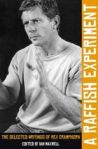
    Tonight at Gleebooks Louis Nowra, another occasional visitor to our office back then, launched A Raffish Experiment, a collection of Cramphorn’s writings, edited by Ian Maxwell and published by Currency Press. I got there early, bought a copy and sat in a corner browsing it, sipping on a glass of water (the only non-alcoholic drink on offer) while the crowd gathered. I didn’t see anyone I knew to talk to, though there were a number  faces familiar from stage, screen and the photographs in the book. I spent a lovely 20 minutes reading reviews of plays I saw more than 30 years ago. In 1970 Cramphorne (as he then spelled his name) described Hair as ‘the only doggedly good value in theatre here’, and ‘enjoyed the texts of Rosencrantz and Guildenstern Are Dead and Little Murders – though not the productions’. He describes the overture of a production of Reedy River as ‘a blackout in which the sonic hum of the air-conditioner contested for precedence with a medley of tunes hummed offstage’. Oh how one yearns for such a fearlessly opinionated reviewer these days.

    As the speeches were about to begin, a tall silver-haired man sat next to me. we exchanged pleasantries, and then I recognised him and said, ‘Oh hello Arthur!’ It was the great Arthur Dignam who of course doesn’t know me from Adam. By the time we’d established that, the lights had dimmed and the launch was on.

    Louis Nowra told charming tales of his collaborations with Cramphorn. Unlike almost everyone else in the theatre he didn’t pay much attention to opening nights – the show would come good eventually, and it didn’t really matter if that eventuality was three weeks into the season. (I must have been one lucky punter, as I have nothing but good memories of his shows, and looking at the list up the back of the book I can see that I did see quite a few.) Ian Maxwell read some excerpts from the second part of the book, which deals with Cramphorn’s own practice in the theatre and said he hopes it’s a book that will prove useful to anyone starting out on a career in the theatre – he wished he had been given a book like this when he was starting out to be a director: we can learn from Brecht and Artaud, and also from Rex Cramphorn.

    Speaking as one whose role in the theatre is to put a bum on a seat, I do hope a lot of them on the supply side read the book, and are infected with its disdain for the dull. The launch was a muted celebration of exactly that infection.

    Verbatim

    Today at the dementia ward, not a word of exaggeration:

    Penny: A choir is coming soon.
    Dot: (alarmed) There’s a fire?
    Penny: No, there’s going to be a choir.
    Dot: There’s going to be a fire?
    Penny: No. A choir! They’re going to come here and sing some lovely songs.
    Dot: I couldn’t care less about the songs.
    Penny: That’s not true, Dot. You love songs. You were just singing along with the CD a minute ago.
    Dot: Yes, but not if we’re all going to be burned to death.

    Mollie’s conversation, meanwhile, consists almost entirely of nods and headshakes. We tried to entice her into exercising her arms by playing with a balloon. After responding with apparent indifference for a while, she eventually batted the balloon in my direction with an emphatic backhander. I thought she had a mean look in her eye when she did it, but thought I must be mistaken, because she has such a sweet disposition. Later Penny confirmed that she shared my impression: every time Mollie hit the ball in my direction it was as if to say, ‘Take that, and f*** off!’

    Bankstown Cooks with Grace Under Pressure

    Bankstown Pressure Cooks final cook-off was today. You may have seen some publicity during the week, even heard Shaista Khan talking to Deb Cameron on 702 Mornings.

    I was drawn into the vortex, ferrying chairs and other equipment yesterday as well as providing amateur tech help, then today acting as marshal (because the Centro shopping centre insisted that there be marshals lest the fifty or so people who turned up disrupt the Saturday morning shoppers), getting the Powerpoint program to run, and generally being helpful.

    It was a terrific event. The competing teams had to cook a salmon dish in a cuisine that was outside their own heritage. In earlier rounds, Lebanese entrants had cooked Thai, Chinese had cooked European pastries. Today, the stretch wasn’t so great: ‘Hot and Spicy’, a Chinese couple cooked Thai, and the Maltese ‘Crazy Daisies’ cooked Italian. But it was far enough to satisfy the judges, and a fabulous nailbiting time was had by all. The local member and the mayor were there. The specially and expensively installed electricity didn’t work, so someone rushed out to buy electric frying pans. The four cooks didn’t seem to miss a beat. ‘Hot and Spicy’ won by a whisker.

    The mood was great. Lots of hijabs were in evidence, though it’s the second day of Eid l-‘Aḍḥā and presumably the hijab wearers had plenty of cooking of their own to do at home. Apart from the inadequate electricity, the only thing approaching a sour note was the two tables of elderly Greek men who evidently meet in that particular spot every Saturday morning to drink coffee, read the newspapers, gossip, argue, finger their beads. They paid casual attention to our goings-on, but clearly weren’t going to budge from their routine: if it could survive transplanting from the Aegean to western Sydney, then no fuss about cooking was going to cause it to falter.

    My recent reading prompted me to reflect that this is the utter catastrophe that White Australia was desperately trying to protect us from.

    Girl 3

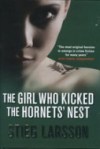
    Stieg Larsson, The Girl Who Kicked the Hornets’ Nest (2007; tr Reg Keeland, Maclehose Press 2009)

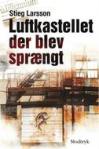
    Also known as: The queen in the palace of currents of air – A Rainha no Palácio das Correntes de Ar (Portuguese), La reina en el palacio de las corrientes de aire (Spanish), La Reina al palau dels corrents d’aire (Catalan), La reine dans le palais des courants d’air (French); The queen of the houses of cards – La regina dei castelli di carta (Italian); Justice – Gerechtigheid (Dutch); Forgiveness – Vergebung (German); Exploding  castles in the air The Castle in the Air That Was Blown Up (thanks to Reg Keeland in the comments for the correction) – Luftslottet som sprängdes (Swedish, original), Luftkastellet der blev sprængt (Danish), Pilvilinna joka romahti (Finnish), Luftslottet som sprengtes (Norwegian). Dear commenters, please correct my translations of these titles if you think they need it.

    Plenty of material there for a prediction exercise in a literacy class, and then there are the covers:

    In fact, as you would expect, neither the titles nor the covers actually tell you much about the book at all. It’s very long, hard to put down, and could have done with more stringent editing. All of its twists and turns are signalled well in advance, and there’s a prolonged anticlimax. but I liked it more than the other two. The Pippi-Longstocking-esque Lisbeth Salander is confined to a hospital bed and then a prison cell for almost the whole book, so the author’s irritating fascination with her didn’t have a lot of room to play. Perhaps perversely, I enjoy the regular pauses in the action in which characters explain to each other the specifics of the Swedish legal–political system and constitution. I even came to savour the meticulous plotting of police procedures and tracking of journalistic protocols that regularly slow the action to a crawl.

    Drawing the Global Colour Line

    Marilyn Lake & Henry Reynolds, Drawing the Global Colour Line: White Men’s Countries and the International Challenge of Racial Equality (Cambridge University Press 2008)

    1colour

    This book shared the 2009 Prime Minister’s Literary Award (non-fiction category). Otherwise, it hasn’t made much of a splash. I didn’t have to wait in line to get my copy from the local library.

    The book starts brilliantly, quoting W E B DuBois’s 1910 essay, ‘The Souls of White Folk’:

    the discovery of personal whiteness among the world’s peoples is a very modern thing – a nineteenth and twentieth century matter indeed. … What is whiteness that one should so desire it? … Whiteness is the ownership of the earth forever and ever, Amen.

    (The whole article was reprinted in the Monthly Review in 2003. He’s a formidable writer, one I’m ashamed to say I haven’t read until now.)

    The historical narrative starts with the arrival of an entrepreneurial Chinese man in Melbourne in 1855, two years after the discovery of gold, and then ranges around Australia, New Zealand, South Africa, California, British Columbia, tracing the progress of the ideal of ‘white men’s countries’, and along with it the betrayal of promises made by the British Empire and US to their non-Anglo-Saxon subjects and citizens.

    It’s a hard read, especially in the first two sections – ‘Discursive frameworks’ and ‘Transnational solidarities’ – where public intellectuals of more than a hundred years ago solemnly put forward blatantly racist propositions that are still awfully familiar, but with very little of the dog-whistling, denial and misdirection we’re used to these days, and then democracy-loving politicians proceed to build on each other’s successes in excluding and disenfranchising anyone who is classified as not white. We have our noses rubbed in the arrogant and repulsive racist atmosphere in which the Australian Commonwealth and the Union of South Africa were founded and first California and then the rest of the US chose ‘racial solidarity’ even with recent bitter enemies and legislated to keep Asian, particularly Japanese, immigrants away from their shores.

    In some ways it’s like a horror story, a sort of I know what you did last century. The scientific consensus reached in the 1940s, that ‘race’ was ‘not so much a biological phenomenon as a social myth, which had “created an enormous amount of damage, taking a heavy toll in human lives causing intolerable suffering”,’* followed by the UN’s Universal Declaration of Human Rights in 1948, amounts to the moment where we wake up and discover it was all a terrible dream … or was it? That moment is followed by a long tail, in which the ‘white men’s countries’ one by one open their doors and legislate against racial discrimination, until ‘Nelson Mandela and the African National Congress sweep into power and dismantle the last bastion of white supremacy.’

    Sadly, the book lacks the visceral appeal of (I imagine) even very bad horror writing. It marshalls a vast amount of material, and it has hugely enriched my understanding of the White Australia Policy, among other things, but the prose is heavy going, and the authors are often absent except as competent and passionate compilers of evidence. This may well be necessary when there is such a complex field to cover, but it makes me wonder how the arguments went in the judging panel for the Prime Minister’s Literary Awards. I know literature is a slippery term, but oughtn’t the quality of the prose (or verse), the way the author’s (or authors’) mind makes itself felt in the work play at least as large a part as the importance of its contents?

    The chapter on the Paris Peace Conference of 1919 is a rich exception to the prevailing drabness. The Australian Prime Minister, W M Hughes, emerges there as a lively fall-guy cum villain: he vociferous opposes  the Japanese delegation’s diplomatic, courteous and eminently rational push to include a paragraph on racial equality in the covenant of the League of Nations. The other white leaders, who generally despise the uncouth Australian, say that if it was up to them they’d include the paragraph, but you know, the Australians (who didn’t actually have a seat at the table) won’t stand for it … Hughes went to the grave thinking of this as a great victory. Someone ought to make a movie of that chapter.

    Let me finish with two shiny factoids. First, when the Australian and New Zealand armies steamed to the Middle East in the First World War, their troopships were protected by the Japanese fleet. (Suck on that, Billy Hughes!) Second, tangential to the book’s main narrative (and incidentally an excellent example of the book’s prose style):

    Australia remained constitutionally dependent on Britain and sovereignty remained formally with the monarch, but with effective sovereignty in matters of race, the quest for political independence lost its urgency. Not until 1926, with the Balfour Declaration, did Australia gain full power over foreign relations and the implementation of treaties. In 1931, the Statute of Westminster acknowledged the full statutory independence of the Dominions, but Australia didn’t sign until 1942.

    Yet another thing we weren’t told at school!

    Dejan/Ludwig

    Disclaimer: I don’t know anything at all about music. I don’t even know what I like.

    Last night we went to an Australian Chamber Orchestra Beethoven 4 concert at Angel Place. I went mostly for the company, I confess, but I ended up enjoying myself hugely. The first piece was Testament by Brett Dean, a Brisbane born composer: I’d had transport troubles so slipped into my seat without a chance to read the program, so the first whisper on the snare drum (I think) caught me off guard, and I stayed of guard for the whole exhilarating tinnitus-dominated piece. I didn’t have the tinnitus thought until I read the program notes, where we’re told this was the intention, but I certainly got the effect, so that when sweet melodies emerged from the ‘glassy noise that seems to be losing its grip on sound’ is fabulously moving. After interval, we had Beethoven’s  fourth symphony, which was wonderful.

    But it was the second part of the pre-interval program that thrilled me – Beethoven’s fourth piano concerto, with Croatian Dejan Lazic on the piano. He was a complete revelation: flamboyant as you’ve never seen unless in a Warner Brothers caricature of a concert pianist, he had vampirish pallor and sleeked back hair, at times hunched Igor-like over the keyboard, or mouthing the notes like a genius baboon. He looked as if he was making it up as he went along, playing back-and-forth with the orchestra, leaping from intricate exhibitionism to sweet contemplation in a moment, raising his left hand in limp-wristed command to the orchestra, turning to the leader (Richard Tognetti – not exactly a bland presence himself) as if to ask permission to stop for a moment. He inhabited the music. Or maybe he inhabited the ghost of Beethoven. At one stage in the first movement, I laughed out loud, which I only realised because the woman in front of me turned around and – thank God! – smiled with broad fellow feeling. At the end, when he thanked us for the applause, I was almost surprised that he was capable of human speech.

    I found this on YouTube, where he’s playing some Beethoven with cellist Pieter Wispelwey. You get at least some idea of his style.

    Alan Ramsey at Gleebooks

    When Alan Ramsey retired in December last year he left a gap in the Saturday morning ritual at our house. Reading his Sydney Morning Herald ‘column’ (usually a whole page) aloud, with all its grumpy vehemence, its aggrieved sense of history (he’d been writing from Canberra for more than 20 years), its long screeds quoted from other people, its telling glimpses behind the scenes at Parliament House, had become as habitual as poached eggs on Vegemite toast. To judge from the mood of the crowd last night at Gleebooks we weren’t unusual.

    The occasion was the recent publication  by Allen & Unwin of A Matter of Opinion, a collection of 150 of his columns. If journalism is the first rough draft of history, I imagine this book will be an invaluable resource to historians of Australian politics, because Ramsey wrote without fear or favour, and did it with formidable intelligence and intelligence-gathering savvy. Last night he was ‘in conversation with’ Monica Attard. I suppose I had been hoping for some behind-the-scenes stuff, the goss as one woman put it – not who-did-what-with-whom-and-in-what-bedroom goss, but how-it-all-works-in-Parliament goss. Instead we got an hour or so of largely misanthropic and eminently crowd pleasing opinion (I count myself one of the pleased). Monica Attard started off setting up a game: ‘I’ll give you a name, and you give me one word in response.’ But Ramsey is probably physically incapable of a one-word response, and the ‘conversation’ consisted for the most part of Monica Attard and then audience members throwing him a name or a phrase and him ripping into it until he was thrown the next one: Bob Hawke (‘I couldn’t stand him, he was a narcissist, but he was the best Prime Minister of post-war Australia’), Kevin Rudd (‘a prim, prissy prick’), John Howard (‘Let’s move on’), Peter Garrett (‘Whatever you think of his performance, you have to realise that no one in his position would do any better, and he fights for what small victories he manages’), Peter Reith (‘one of Howard’s thugs’), the best politician he observed in his time in the press gallery (John Button, an excellent politician and an attractive human being), and so on.

    It was all good fun, with frequent flashes of insight, but if you didn’t already know the broad story, there wasn’t a lot of information to help you orient yourself. And much of the game could easily have been renamed, ‘Say something definite to confirm my dislike of/contempt for X.’ I It was a relief when towards the end someone asked why he referred to asylum seekers as ‘queue jumpers’. ‘Because that’s what they are,’ he snarled, and just like that we’d moved beyond show-pony opinion to what could have become a heated debate if there’d been time. My impression was that Alan Ramsey welcomed that prospect.

    Bankstown Pressure Cooks

    Sha’s Place is a very welcome, brand new blog by a Sydney Muslim woman who comes originally from Pakistan. Her second entry is about a project that my Penny is the moving power behind, Bankstown Pressure Cooks. The Pressure Cooks site decribes it as a competition that

    is part of a celebration of the cultural diversity of the Bankstown area, encouraging Sydneysiders to recognise the culinary delights of the area. That means the competition will test [participants’] ability to cook from different cultural traditions (as well as [their] own).

    Sha’s Place says:

    This has by far been my most positive experience in Aussie Land. I arrived here just over a year ago and am simply amazed at the genuine warmth of the people here. My association with all members who have worked on this project has given a boost to my dwindling morale in an economy hit by recession.

    There have been two rounds so far, which I haven’t blogged about because I haven’t been able to attend. The Grand Final Cook-Off happens on Saturday 28 November at Centro, Bankstown CBD from 11 o’clock in the morning.