
Magdalena Ball, The Density of Compact Bone (Ginninderra Press 2021)
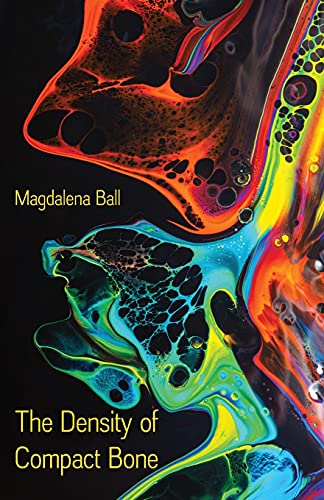
Magdalena Ball was raised in New York city and now lives on Awabakal land in New South Wales. She runs the formidable review website Compulsive Reader and, if the poems in this book can be relied on, she rolls in the dirt when no one’s looking. She brings tremendous erudition to bear on intensely personal, bodily experience. She finds resilience in Jewish family history, and looks unflinchingly at the climate emergency. Her poems cast their net wide in the cosmos and bring tiny, meaningful things to light. There are riddles that, as far as I can tell, have no answers; there are love songs, laments, cries of pain, excursions into quantum physics and meditations on the nature of time. That is to say, this book is quite a ride.
It’s in four sections, each with a dominant mode or theme. The first, ‘The Age of Waste’, addresses the climate emergency, with poems about endlings (animals that are the last of their species) and ‘the Sixth Mass Extinction’. It’s waste as in ‘laying waste’, devastation. The prose poem, ‘Earth Scars’, for example, includes this:
Is it easier if it's random? If there was nothing we could have
done? I could be there, first in the queue, taking the hit for our
planet
The second section, ‘The Stronger the Entanglement the More Warped Space Is’, lives up to the complexity of that heading, with poems that don’t disappoint expectations roused by titles like ‘Time Is Not’, ‘Tomorrow’s Box Is Quantum’ and ‘Fermat in Wonderland’. That last one begins ‘I have no time / for rabbit holes’, which is delightfully ironic given the number of potential rabbit holes to be found in this section: I went googling (actually duck-duck-going) Cooper pairs and phase transition, for example, and struggled to remember what I’ve gleaned about Schrödinger’s box, wormholes and the properties of quarks.
The third section’s title, ‘Chronon’, seems to promise more of the same: according to Wikipedia, a chronon is ‘a proposed quantum of time, that is, a discrete and indivisible “unit” of time as part of a hypothesis that proposes that time is not continuous’. Happily (or not, depending on how much you enjoy being tantalised by advanced physics and philosophy), though this section deals with time and memory, it does so in a much more accessible, personal and emotionally engaging manner. The intimidatingly titled ‘Noumena Phenomena’ for example, addresses someone, possibly a close relative, who is living with dementia:
You smile
at everyone every day
the Buddha you never were
dispensing joy in coconut confetti
as we move in closer
circling round the gravity
of the hearth you continue
to keep
in your head.
The fourth section – ‘The River will Wash Us All Down’ – continues the personal note, with some wonderful poems dealing with love and complex relationships, and also returns to the global concerns of the first section. The context thickens and darkens with the cataclysmic bushfires of the 2019–2020 summer and the Covid pandemic.
Many of these poems grapple with the notion of time. ‘Time Is Not’, for example, has the lines, ‘Change is real / but time is not.’ ‘How to Make Lokshen Kugel says: ‘Understand that authenticity is a myth / like time, like love, like trauma. / Understand that these myths are real / and must form the basis of your recipe’. ‘Eastern Whipbird’, the first poem in the ‘Chronon’ section, is probably richer when read in the context of those other poems, but read in isolation it’s still very rich:
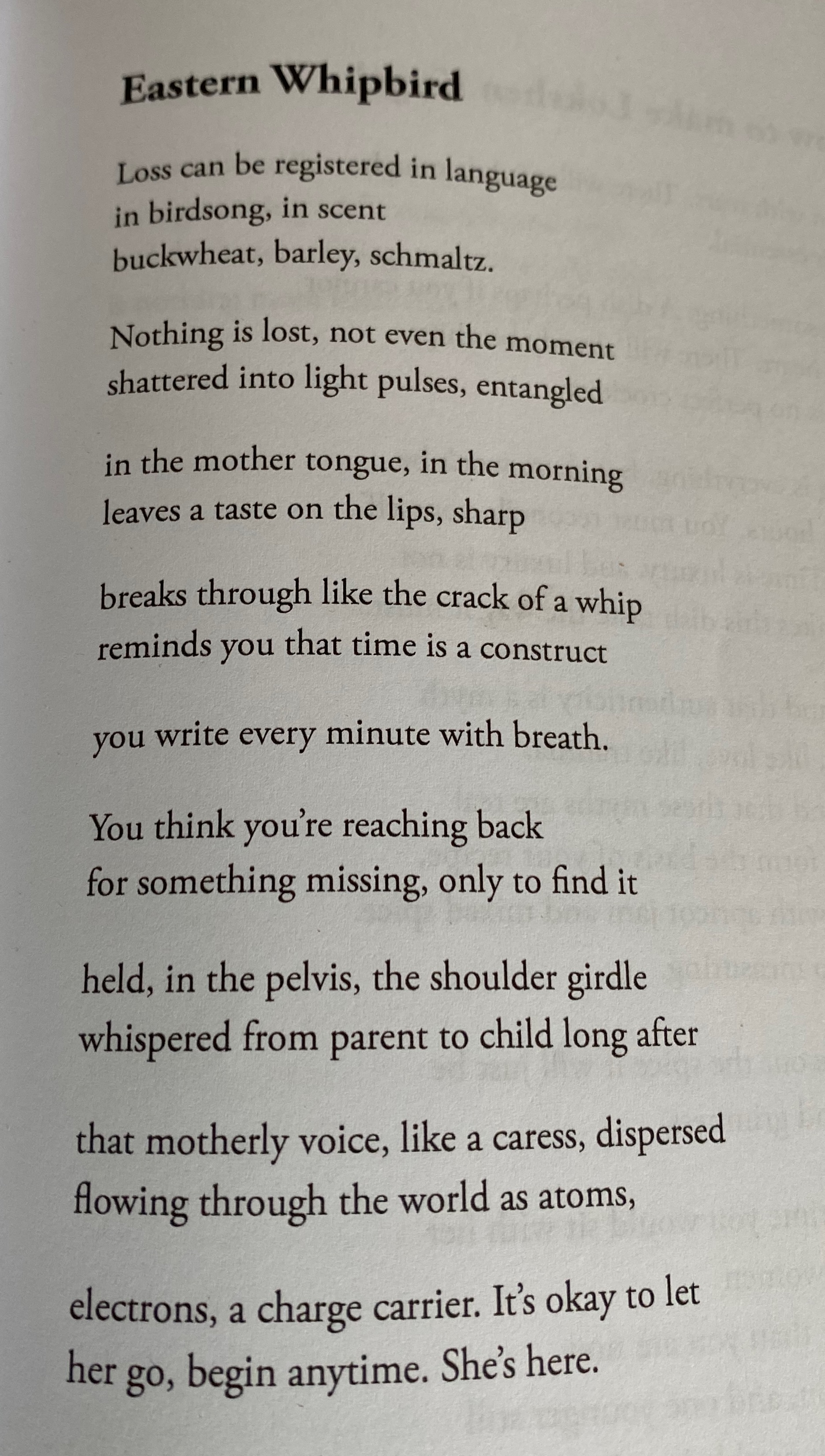
The title might lead you to expect a description of a bird. If so, prepare to be disappointed. The whipbird is there, but never mentioned explicitly. The first three lines announce the subject:
Loss can be registered in language
in birdsong, in scent
buckwheat, barley, schmaltz.
It’s as if the first line responds to the question, ‘How do we register loss?’ It’s fairly abstract. ‘Birdsong’ in the second line suggests that the actual prompt for the poem may not have been the abstract question but a surge of emotion triggered by a birdcall (the whipbird of the title, perhaps). It could just as easily have been a ‘scent’ that did the triggering. Then the third line (line breaks are important here) narrows the focus. Birdsong and scent could remind anyone of anything, but these three things are connected with cooking, in particular, in the case of ‘schmaltz’, with Ashkenazi Jewish cuisine.
Nothing is lost, not even the moment
shattered into light pulses, entangled

in the mother tongue, in the morning
leaves a taste on the lips, sharp

breaks through like the crack of a whip
reminds you that time is a construct
These three couplets seem at first to contradict the first trio, denying that loss is real. But they don’t so much contradict the opening statement as reframe it. Rather than register the loss, we become aware of the persistence of that which is lost. People who have migrated and been obliged to take on a new language often report that hearing their mother tongue spoken brings back the emotions of their childhood: the lost moments are entangled in the language, become as present as a taste on the lips. Notice the subtle way that first cooking is evoked and then the word ‘mother’ turns up. we are being prepared for something. Coming back to the immediate prompt, something, we’re not told what, is made present by the call of a whipbird. This leads to the assertion that ‘time is a construct’. The poem has the task of clarifying that assertion.
you write every minute with breath.
This carries a particular kind of weight as the poem’s only stand-alone line. It justifies that weight as a six-word explanation of the idea that time is a construct. We don’t just experience time passively, but our breath, metaphor for human spirit, creates it like a poem.
You think you're reaching back
for something missing, only to find it

held, in the pelvis, the shoulder girdle
These lines return to the opening paradox: we register loss in a number of ways, but nothing is lost. A personal pronoun appears for the first time: not ‘I’ or ‘We’ but ‘You’. The reader is being challenged to test the poem against his (in my case) own experience. It’s true that when it comes to memory of something lost, I think I’m reaching back. It’s also true that when I remember, say, how my mother put her face up to be kissed by one of us kids, something registers (that word again) in my body. I wouldn’t say it’s in the pelvis or the shoulder girdle, but it could have been. I get the point.
whispered from parent to child long after

that motherly voice, like a caress, dispersed
flowing through the world as atoms,
electrons, a charge carrier.
Now the kind of loss we’re talking about is in clear focus. The thing that ‘you’ (definitely the poet now) find somewhere in your body is a mother’s whisper. Here Magdalena Ball’s scientific bent comes beautifully into play. It’s not that the actual mother or her actual voice still exist on some spiritual, other-worldly plane. She and the air that carried her voice have been dispersed into their constituent atoms – and again a paradox: the notion that we are immersed in a flow of atoms and electrons that may once have been part of our loved ones’ body and breath carries a charge, a charge that we invent. (I think of the Sweet Honey in the Rock song, ‘Breaths‘: ‘Those who have died … are in the rustling trees … in the groaning woods … in the crying grass … in the moaning rocks.’)
_________________________It's okay to let
her go, begin anytime. She's here.
I was completely unprepared for the emotional punch of this. There’s so much intellectual complexity and then this simple, profound statement. It may be eccentric of me, but I think of the moment in the movie Truly Madly Deeply when the Juliet Stephenson character finally lets the ghost of her husband go. Begin anytime – we don’t have to be passive around time, wait for time the great healer to help us overcome our grief. In some important sense time is our creation. And there’s another paradox, or a restatement of the same one: in the act of letting go, we understand that memory exists in our bodies. ‘She’s here.’
I am grateful to the author and Ginninderra Press for my complimentary copy..




















 Me fail? I fly!