
tl;dr: This is a review of a book that argues that a future that isn’t devastated by climate change is possible. If you can’t bear to read one more thing about global heating, you might like to listen to Saul Griffith talk to ABC’s Richard Fidler at this link.
Saul Griffith, The Wires that Bind: Electrification and Community Renewal (Quarterly Essay 89, 2023)
– plus correspondence in Quarterly Essay 90

In the late 1960s at Sydney University, when someone from Engineering took the microphone at an anti-war rally, you could be sure he (they were always men) would speak for the forces of reaction. So there’s a frisson of pleasure for me in reading Saul Griffith’s visionary account of an electrified Australia where fossil fuels are kept in the ground, communities thrive, a new kind of politics has replaced the current toxicity, women’s leadership is acknowledged, and global warming is slowing dramatically. It’s visionary, but suffused with an engineer’s practicality, not to mention a baker’s dozen of complex charts.
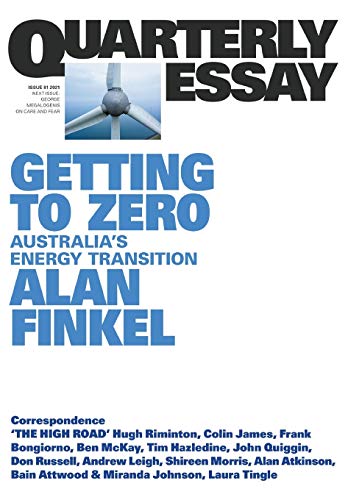
If you’re tempted to despair about global heating – and who isn’t? – you’d do well to read this Quarterly Essay. It doesn’t offer blind optimism or hope based only in philosophy, but charts a feasible path to a desired outcome. It covers much of the same ground as the 2021 Quarterly Essay on the same subject, Getting to Zero by Alan Finkel, also an engineer. But where Alan Finkel had been scientific adviser to the Morrison government and seemed, to me at least, to be concerned not to antagonise that do-nothing bunch of deniers, delayers and obfuscators, Saul Griffith comes from playing a role in creating Joe Biden’s Inflation Reduction Act, and is co-founder of community organisations Rewiring America and Rewiring Australia.
In my blog post on Finkel’s essay, I said:
I was heartened to read Finkel’s lucid, careful, methodical argument that the challenge of the climate emergency can be met – with difficulty, but successfully, and without significant sacrifice (‘No trade off, no dichotomy. Prosperity and low emissions.’). I was also uneasy. Surely something has to change as well as our technology. There was a herd of elephants in the room.
Saul Griffith also seems to offer a way forward that doesn’t involve significant sacrifice, but he does address other elephants. Ordinary householders are at the centre of his argument. We don’t have to see ourselves simply as consumers of whatever is on offer from government and profit-driven businesses; if we act together we can become hugely effective agents for change. One simple thing we can do is to decide that, whenever a household item that depends on fossil fuel needs replacing, we opt for something electrical – an induction stovetop, an electric vehicle, heat pump, and so on. And we can see that our electricity comes from renewable sources. His local postcode, 2515, is making great strides as a community to becoming electrified in this way. If we all did this, without significantly pushing the speed of replacement of devices, we would all be electrified by 2040.
He argues that this electrification would result in cheaper energy and cheaper travel – the expense is all in the initial purchase. Government intervention will be needed to make it possible for less wealthy households to make the shift.
There’s a lot more to his argument. I can’t say I followed it all; some of the more technical bits mystified me; and the economic arguments are out of my league. But having had as an article of faith that technical solutions to global heating exist and all that’s needed is the political will, I’m heartened to read solid argument to back up my sometimes tenuous faith.
My current practice of looking at page 76 can give you a glimpse of how the essay works at a granular level.
The page is in the section ‘Planes, Trains and Automobiles’, which deals with transport (or transportation as he says, reminding us of his years in the USA). The section includes some envelope pushing – every parking space to have a solar roof, small electric aeroplanes with a 500-km range using today’s battery technology, etc. It also lays out some basic facts. The use of cars and trucks ‘for moving us and ourselves around’ is currently the second largest source of CO2 emissions. The switch to electric vehicles (EVs) is under way, but it’s not a panacea. Cars need not only to go electric (and run on renewably sourced electricity); they also need to be smaller, lighter and slower in order to reduce the environmental damage they cause, including the damage to roads. Griffin produces some interesting figures comparing the emissions per passenger of our most efficient public transport system – Melbourne trams – and a light EV with two passengers: the EV comes out ahead. But that’s not so with heavy vehicles.
Page 76 is mostly the subsection with the title ‘Tax the tyres’. It begins with hard facts:
Australians use about 50 million litres of petroleum products per day, We spend $35–50 billon per year importing foreign oil. The government collects 49 cents per lire, after the various exemptions that are granted (thereby subsiding fossil fuels and emissions), which amounts to around $14 bilion per year. About half of that goes to road building and transportation projects. Even so, it is not enough to pay for all our roads, and councils have to pay for much of this from their rate base.
Reforming how we pay for roads is a gnarly political problem that I think we must have some honesty about. Low-income people commute further, often in less efficient cars, and often for work. The crux of the political problem is that those who can least afford to pay for transport pay the most, and fuel excise exacerbates that problem.
Then he takes us on a brief excursion into utopian imaginings:
I would like more kids to walk to school on dirt paths through forests breathing clean air and learning about ecosystems as they do so. I’d like to fly electric aircraft more and have fewer ecosystem-damaging roads.
He may have utopian leanings, and it sometimes feels as if Damon Gameau’s delightfully optimistic movie 2040 is playing in the background (he does mention it once), but he comes beck to the practical problem:
But with all that, I am not going to deny that roads are useful and we need good road infrastructure. …
If you study road wear, it turns out that the damage to a road is proportional to the square of the weight of a vehicle. A ute will do about seven times as much damage as a passenger car, mostly because of the extra weight. If you were designing systems to pay for our road infrastructure, it would be most scientifically done by charging by the weight of the vehicle and the number of kilometres it travels.
Which calls attention to what may not be an elephant in the room, but is maybe a thorny devil. How do these necessary changes get paid for? ‘If you were designing … it would be most scientifically done by’ indeed. The next paragraph is in some ways characteristic of the essay as a whole. In his acknowledgements, Griffith says it ‘would not have been written without community’ and lists a number of people on whom he relied ‘to contribute long passages’. In this passage, he present an idea that came from the audience on his book tour:
An audience member came up after a talk and suggested what we should do is tax the tyres, which would have the same effect. Heavier cars doing more kilometres go through more tyres faster. It would be a way of taxing the system that pays for roads, which would push the system to evolve to smaller, lighter vehicles. That would be a good thing.
I hope it’s evident from that little bit that the essay is multifaceted, trying ideas on like an essay in the classical sense of the term, having a bit of fun, and offering insights and proposals that could have a profound impact.
As usual with the Quarterly Essay series, the correspondence in Nº 90 fleshes out the subject beautifully. It was excellent to note the absence of people wanting to deny the science, or others pushing for nuclear power as Peter Dutton is doing in the headlines as I write this.
For just one example, Christine Milne posed a question that had been niggling me:
Can the Earth afford the transition to renewables if it is embedded in the linear business-as-usual, take-make-dispose model of unlimited consumerism and economic growth? There cannot be infinite growth on a finite planet.
Griffith’s response is worth reading. To paraphrase and crudify his argument: to transform the economic system would take too long – you can’t make an omelette without breaking eggs and this omelette is too urgently needed to worry too much about eggshells.
The passage that stands out for me in Griffith’s response to correspondents is this exemplary piece of self-criticism:
Guilty of boostering, addicted to carrots, I have avoided the hard discussion of regulations with teeth. Perhaps my time in the Land of the Free softened me or made me frightened of things that might be conceived as infringing on personal liberty. … To be very clear, it is in the interest of the energy transition to have a phase-out date for all fossil-fuelled machines, and the sooner the better. Governments are scared of the headlines around mandates and bans, but that is what is actually needed, not eventually, but soon.
At the Sydney Writers’ Festival recently, Saul Griffith said that someone described his earlier book Electrify as a brilliant piece of guerrilla policy-writing. The book went on to play a role in developing major climate-change legislation in the USA. I don’t know if it’s all completely practical or if it addresses the social issues adequately or accurately, but the thought that this isn’t just someone having good ideas on the sidelines but solid policy proposals backed up by substantial experience at the community level is surely grounds for hope


 Me fail? I fly!