Tag Archives: Alison Croggon

Overland 211

Jeff Sparrow (editor), Overland 211 Autumn 2013

OL211

As a happy subscriber (and not only because I won some free chocolate in last year’s subscriberthon), I’m glad to read in Jeff Sparrow’s editorial in this issue that although Overland is now a project, of which the print journal is only one part, the printed object will continue to appear regularly for the foreseeable future. I am one of the many people who, he says, ‘still like to read (in particular) long essays, literary fiction and poetry on paper, away from the distractions of their iPad’. I also enjoy the synergies that can arise within the bounds of physical covers, quite different from the boundless variety of the online world.

An example of what I mean by synergy occurs in the play of ideas and perspectives among: ‘The one day of pure form’, in which Guy Rundle argues that Anzac Day is a weird commemoration whose meaning can and does change to suit the needs of whoever happens to be in power; ‘Peregrinus Requiescat’, a short story by Warwick Newnham that, beneath a sophisticated play with form and some not always correct or correctly translated Latin, is moved by a straightforward impulse to honour a man who died in combat by marching in his place on Anzac Day; and Barry O’Donohue’s poem, ‘Vietnam ritual’, whose speaker is a Vietnam War veteran free of any commemorative or romanticising impulse. ‘The innocence of Australians’ by Ramon Glazov, a review of a collection of short stories that imagine terrorist attacks in Australia, takes on a different hue in the context of those three pieces. Glazov sees in most of the stories an inability to imagine a plausible motive for attacking Australia – because after all, so the ‘thinking’ goes, we’re innocent global citizens in the sense that what we do hardly matters, whether it’s sending a token force to kill and die in the US’s wars, or opening another coal mine. This presumed innocence isn’t the same as the ‘pure form’ that Guy Rundle sees in Anzac Day, but the two concepts talk to each other interestingly.

Synergy is there again in the way one’s mind bounces between ‘The possibility of patronage’ by Anwen Crawford, a curmudgeonly piece about the limitations of crowd-funding, pop-up galleries and other innovative ways of getting artists and money together, and ‘Paying the writers’, in which Jennifer Mills and Benjamin Laird are set up to debate responses to the trend to expect writers to accept ‘exposure’ as recompense for their work, but can’t help agreeing that some form of collective action is desirable. That bouncing affects the way one reads Alison Croggon’s characteristically elegant column ‘On Homelessness’. She doesn’t connect her two experiences of homelessness with being an artist except to imply that writing was her way of keeping her sense of self intact, but in this context one wonders if poor compensation for writing may have had something to do with the problem in the first place. And then there’s Judy Horacek’s cartoon parodying a current credit card ad: ‘A career in the arts: priceless. And for everything else, there’s dumpster diving.’

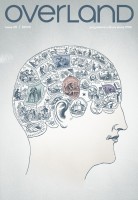
There are also stand-out stand-alones. In ‘Pump’, Stephanie Convery tells of her participation in a women’s body-building course, which manages to challenge some aspects of sexism and male domination while bowing to others: the article includes fascinating history, high comedy, memoir and challenging analysis. Apart from some Melburnian sneers at country Queensland, ‘All those women’ by Jacinda Woodhead is richly empathetic: in the context of Queensland’s dire abortion situation – abortion is a crime except under closely defined conditions; it’s hard to access, expensive and stigmatised – Woodhead presents a portrait of tiny anti-abortion, anti-war group Protect Life. While recoiling from their politics on abortion, she and pro-choice activists she interviews communicate a respect for their commitment to principles and sheer stamina. Jill Dimond’s ‘Ned Kelly’s Skull’, which justifies the phrenological cover image, includes a fascinating look at some eccentric colonials. Giovanni Tiso makes some alarming sense out of recent events in Italian politics in ‘The Net will save us’.

In the poetry section, I was relieved to see a couple of bird poems, since current Going Down Swinging submission guidelines specifically rule out ‘poems involving birds, wings, feathers or flight’ and it would be a shame if birds were to disappear from Australian poetry altogether. I’m grateful for The shearwaters by Jules Leigh Koch, ‘a long tideline / like a driftnet / to fish for stars’, and I probably would have loved ‘The swallows in Saint Peter’s Square’ by Luke Whitington for its name alone.

Not all those links will take you to a full article, at least not at the time of writing, but be patient. Overland does tend to put just about everything online in the weeks after an issue comes out. Or you could buy a hard copy and find your own synergies.

Overland 210

Jeff Sparrow (editor), Overland 210, Autumn 2013

210-overland Your mileage will vary, but the article in this Overland that stands out for me is Beyond denial by Philip Mirowski, Jeremy Walker and Antoinette Abboud, which argues that ‘the phenomena of science denialism, emissions trading and geoengineering are not in fact unrelated or rival panaceas but rather constitute together the full neoliberal response to global warning’. The article makes a distinction between neoclassical economics and neoliberalism, describing the latter, in what I wish was a harsh caricature, as worshippers at the shrine of an all-wise market, who hold, for example, that ‘Science is not an independent mode of truth discovery: it is a boutique knowledge format only validated by “the marketplace of ideas”‘.

The neoliberal response to the climate change challenge is, if I understand the article correctly:

  1. Deny the science so as to distract attention from the crisis and buy time for commercial interests to find a way to profit
  2. Back emissions-trading schemes in order to divert political actors from using state power to curb emissions into setting up carbon markets, which won’t ever work, because the big polluters are already finding ways to go on polluting
  3. Develop grand geoengineering schemes that will make huge profits for corporations but will not address the root problem of increasing carbon dioxide concentrations or stop ocean acidification.

The article doesn’t come up with an opposing plan, but it gives a salutary map of the terrain. I recommend the whole thing.

Elsewhere, this issue strikes a nice balance between giving pleasure and holding the reader’s feet to the fire.

First, the pleasures include:

  • interesting chat from regular columnists Alison Croggon and Rjurik Davidson  about, respectively, Tolkien and Hollywood’s version of Second World War resistance movements
  • Francesca Rendle-Short writing about writing about her late father (as she has elsewhere), including poignant moments that will strike a chord with anyone who has a close relative with advancing dementia:

    [H]is hands dance largo, float and rise and fall in a slow movement set to its own tune, an adagio. First, he clasps them in front of his chest as though in a praying gesture, a supplicant hold where the palms lie flat against one another. Then he pauses a moment to pray, to ask for God’s blessing before the fingers start to stir larghetto. They loop first this way so the fingers interlace each other; then right then left, before rising up elongated in a slow, seesaw action. A ritual dance.

  • The cartography of foxes,  a deeply satisfying and unsettling short story by Theresa Layton that augurs well for Jennifer Mills’s tenure as Fiction Editor
  • Peter Minter’s report as judge of the 2012 Overland Judith Wright Poetry Prize for New and Emerging Poets, which is almost as enjoyable as the winning poems, particularly his description of how he read and re-read the submissions in the midst of domestic life
  • The winning poems, especially the winner, Augury? by Luke Fischer
  • An essay by Californian Aaron Bady that, after going on a bit about the Great American Novel, confirmed my decision not to give any cash to the makers of Zero Dark Thirty, with an argument that chimes with my experience of The Hurt Locker. The movie succeeds as propaganda, he writes,

    because it never tries to glorify the protagonist’s obsession, never tries to rationalise it, defend it or even make it seem attractive … But it’s still the one we’re stuck with for two and a half hours … You have no choice but to identify with torturers whose motivations you understand, and with the victims of Muslim terrorists whose motives you are not allowed to be privy to.

  • Judy Horacek’s dark cartoons (I couldn’t find a link), especially one that should probably be in the ‘feet to the fire’ category, in which two people holding a ‘Save the Planet’ sign face a gang holding signs that read  ‘Save our Profits’ – she manages to be funny about discouragement.

And then there’s what Overland does so well, argument and analysis of the harsh realities of our times from a progressive point of view. Some highlights:

  • Alyena Mohummadally on being same-sex attracted, Muslim, and organised in Australia
  • Panagiotis Sotiris offering an alternative view of the Greek economic situation. His repeated calls for ‘struggle and solidarity’ as the necessary response to the fascist Golden Dawn, is little more than sloganeering shorthand, but where else can you find a clear challenge to the mainstream narrative about Greek laxity finally being brought to heel by the benign forces of the EU, the IMF etc?
  • Martin Kovan on the alarming number of ethnic Tibetans who have set themselves on fire in recent years, mostly with fatal results. The article discusses how these burnings remain largely unnoticed in the West, ‘inside the narcissism of self-interested, racially conditioned and materially anaesthetised ethical immunity’, then focuses on the English Buddhist novice who self-immolated in southern France late last year. Kovan knew the monk, and his reflections are personally charged
  • Guy Rundle, self-described default Luddite, reporting on 29c3 – the twenty-ninth Chaos Communication Congress, at which hackers confronted the rise of the total-surveillance state. He reflects on the relationship between hacktivism and the Left, in particular on what their different histories mean they can learn from each other. In doing so, he manages to end the journal on a note of restrained optimism.

I’ve included links to everything except the cartoons. Overland make its entire content available on line. It also publishes background interviews on some articles in its Editors’ Blog, which is one place on the Internet where the comments don’t make you want to run screaming from the room.

Overland 209

Jeff Sparrow (editor), Overland 209, Summer 2012

overland209There’s an interesting self-referential moment in this issue of Overland when Rjurik Davidson takes issue with the mainstream notion that writers engage ‘in an ongoing discourse among equals that takes place in the public sphere’, a notion that ‘presumes a single culture, a realm of enlightened discussion and the free play of ideas’. He argues for

a conception of the radical writer belonging to a counter-public (or more accurately, counter-hegemonic) sphere, a sphere that includes its own publications and institutions, its own periodicals and clubs and networks of power. It’s a quite different notion of the writer, one that recognises that polite liberal discourse excludes certain things from being said and that, within the public sphere, comments that strike at the heart of things and books that ask fundamental questions tend to sound shrill or unhinged.

Overland, as a periodical belonging to such a counter-hegemonic sphere, does have its unhinged-sounding moments: in this issue, ‘The pessimism of time: The paradoxes facing the Left‘ by Nina Power, calls on ‘the Left’ to abolish time, or at least to create ‘a life in which nobody seeks to make time measurable at all, for all time’. (Given that ‘Frank O’Hara’s Animals‘ by Tara Cartland, a short story further on in this issue, is a fantasy about a girl who really can make time stop, I haven’t entirely given up hope that Power’s argument is a poker-faced satire, or that its inclusion is an editorial prank, designed to make readers appreciate the sensibleness of the rest of the issue.)

Elsewhere there’s plenty of anti-hegemonic goodness that doesn’t come close to shrillness and stays on its hinges. In a characteristically elegant column, Alison Croggon skewers the commodification of writers and writing implied in the idea that a writer must be a ‘brand’. David Carlin gives a warts and all account of life in a successful anti-hegemonic theatre institution, Adelaide’s Red Shed Company. Everett True’s essay on Pussy Riot contextualises and actively embraces their music and their politics, both of which tend to be seen as shrill and unhinged in the mainstream media. Isabelle Skaburskis and Elizabeth O’Shea rely on their experience as activists to go beyond the familiar media narratives on human trafficking (sorry, no link) and the indefinite detention of asylum seekers respectively. Sophie Cunningham challenges the received version of what happened in Darwin after Cyclone Tracy, having found evidence of, among other things, including looting by NSW police (again, no link: they can’t give us everything for free). Don’t expect to see any of those articles reprinted in the mainstream media.

Among such riches, the stand-out piece for me is Lisa Farrance’s article, ‘Living the life within: The benefits of sport‘. It’s fairly common when people are bewailing the lack of funding to the arts that an arts–sport dichotomy is invoked. You know the line: more Australians visit an art gallery or take part in another cultural event on any given weekend than attend a sporting match, yet sports receive disproportionately more help from the public purse. So it’s refreshing to read an article in a literary journal that celebrates sport as a means to ‘find ourselves whole again’, to challenge sexism and the alienation we experience under capitalism, to enact progressive politics: not just exercise to keep fit, but sport to become whole. And not only that, but Ms Farrance’s exemplars of sports with radical potential are two that are easily dismissed with a shudder in ‘polite liberal discourse’: boxing and roller derby.

There’s a fiction section comprising the three winners of the inaugural Overland Victoria University Short Story Prize for New and Emerging Writers: ‘Killing Floor‘ by John Turner, ‘The day the world stayed the same‘ by Melissa Fagan and ‘Frank O’Hara’s Animals‘ by Tara Cartland. All three stories make me look forward to their authors’ continuing emergence.

And tucked away up the back on tinted paper, as if in a kind of quarantine, ten pages of poems. The little I’ve read of Michael Farrell’s work until now I’ve found shiny but inaccessible – something for hardcore poetry readers. His poem here, ‘Making Love (to a man)‘, makes me reconsider: it’s funny and sexy and warm and friendly. The same is true – with less of the ‘sexy’ – of Fiona Wright’s ‘Obit‘, whose 24 lines, like a conversation at a wake, evoke a sense of loss through cool, anecdotal reminiscence.

I know the Overland subscriberthon is over, so if you subscribe now you won’t win any prizes (like the block of chocolate and free sub I won in November), but you would get your money’s worth.

Overland 208

Jeff Sparrow (editor), Overland 208, Spring 2012

There’s a lovely interplay among articles in this issue of Overland: one voice picks up a theme introduced by another and amplifies it or does something unexpected with it, disagreements emerge and remain unresolved, odd harmonies and counterpoints pop up. It’s like ideas music.

Longtime working journalist Jonathan Green predicts the imminent death of the quality newspaper. Responding to the commonplace that newspapers have to develop a new business model in the age of the internet, he writes:

In truth there never has been a business model for quality journalism, only a happy coincidence in papers like the Sydney Morning Herald, the Age and the New York Times in which a successful platform for the publishing of classified advertising coincided with newspaper owners who saw advantage, influence, power – and perhaps even a public duty – in fostering serious, thoughtful journalism.

‘The sad truth for journalists in a commercial construct,’ he argues, ‘is that their department is exclusively a cost. It produces no revenue … In the commercial mind, journalistic content is either the plaster between the ads or something tailored specifically at attracting them. … No one ever valued serious journalism enough to pay for it.’ He doesn’t put it this way, but he’s describing the way contradictions work in capitalism – in order to make a profit, the enterprise has to provide people with something they need, and ever since the mid 18th century some for-profit newspapers have on the one hand served the ideological and commercial needs of capital but on the other provided their readers with a significant record of events and a forum for discussion,with a huge potential for fostering resistance to capitalism.

Alex Mitchell’s ‘Fatal Obsessions‘, about aspects of Rupert Murdoch’s early years, amplifies one element of that story. Murdoch as a newspaper owner has certainly fostered serious, thoughtful journalism, but Mitchell describes how, even his early years, he rubbed shoulders with ‘bent coppers, crooked politicians and illegal gamblers’, and put some of them on staff. It’s clearly a case where the ‘quality’ bit of quality journalism is there at the whim of the owner.

The veteran Green has no sooner lamented the passing of what quality newspapers have provided – ‘a mature, moderated conversation that was broadly shared and thus to be reckoned with’ – and shaken his head at ‘our more fragmented, shriller public life’, than young New Yorker Malcolm Harris pipes up with ‘Twitterland‘, describing Twitter as a terrain rather than a tool, and then, getting down to cases, telling us approvingly how Twitter can be used to lie on an industrial scale, to shout down ideological enemies, to hide from the consequences of your actions and to unleash mob actions against individuals. That these things are done, in his examples, for in order to draw a crowd to an Occupy event, counter corrupt but sophisticated arguments, evade malicious prosecution and ward off a harasser appears to render them unproblematic in his view. In the context of Green’s article, it’s hard to share his complacency.

The proximity of Harris’s article to Green’s raises another interesting question: if it is indeed, as Green says, a ‘happy little accident’, a ‘weird conjunction of advertising and reporting that has managed to maintain a healthy fourth estate’, isn’t it another happy little accident that makes commercial enterprises like Twitter available as places where progressive forces can organise?

Another set of resonances is kicked off by Anwen Crawford’s ‘Fat, Privilege and Resistance‘, a response to an article by Jennifer Lee in the previous issue. It’s brilliant, arguing that while Lee tellingly draws attention to fat oppression, she doesn’t take readers much beyond the act of recognition. In particular, Crawford introduces much-needed class analysis into the conversation. But it’s a different bit that fits my theme of serendipitous connections. Here’s Crawford taking issue with Lee’s argument that fat women should make themselves visible as a liberatory act:

Women – fat and thin – live with a particular kind of watchfulness, a sense of always being on display …

Perhaps we lack a word subtle enough for the condition that I described in [my essay ‘Permanent Daylight’, Overland 200] as ‘a deep and systemic psychic distress … of perpetual visibility’. If visibility is a condition of women’s oppression, then why should we keep demanding to be seen? If all the billboards across the world were replaced overnight, and fat women took the place of bone-thin models advertising underwear and perfume, would this constitute victory? I wouldn’t think so: I’m still being sold stuff, and someone else – another woman – is still being objectified for the purpose of selling it to me. To demand visibility is to submit to capitalism’s strictures: to accept that being an image is more important than being a subject; to accept representation in place of participation.

I’m sure there’s argument to be had there, but the phrase ‘representation in place of participation’ is cogent. And it casts a long shadow over the article ‘Outsider Porn‘, in which Matt Cornell argues, among other things, that ‘porn can be a powerful venue for self-expression, for asserting agency in a culture with narrow, constricting ideas of beauty, sexuality and gender expression’. If you are cut off from participation, then go for representation. I remain unconvinced of the liberatory value of porn. The connection to the debate about fat liberation becomes explicit:

One of the central critiques of pornography is that it objectifies women by reducing them to specific body parts. Yet this is what happens routinely to fat people who are photographed from the neck down for moralistic news stories on the obesity epidemic.

I’m sorry, this is just about as logical as the argument that feminists shouldn’t object to sexist abuse of women in public life if they don’t object with the same passion to male politicians being insulted: ‘You say this is oppressive. Well, that over there is oppressive too.’ I love it that Overland gives space for genuine, unresolved disagreement, publishing this porn-as-liberation article after issue 207’s ‘Porn and the misogyny emergency‘ debate, which was unanimous in seeing porn as degrading. I don’t know how the editorial team would feel about my quoting John Stuart Mill in support of their practice, but I dimly remembered a quote and found it by googling. It’s from On Freedom:

though the silenced opinion be an error, it may, and very commonly does, contain a portion of the truth; and since the general or prevailing opinion on any subject is rarely or never the whole truth, it is only by the collision of adverse opinions that the remainder of the truth has any chance of being supplied.

Then Juliana Qian’s personal essay ‘The Name and the Face‘ tackles the issue of visibility, objectification and agency from a whole other angle. She came to Australia from China as a child, one of a generation that ‘was promised equality after assimilation’. That promise was broken, and the essay ruminates on the kind of invisibility that comes from being stereotyped as an Asian/non-Indigenous person of colour, and the complexity that the stereotypes ignore:

I have a lot of stories. Most of them are not about tradition, nor about assimilation. Most of my life is not about tradition or assimilation. I grew up not between cultures, but within overlapping cultures that are themselves amorphous, contradictory and changeful.

The threads of connection reach into the fiction section, to Jannali Jones’s mock Kafkaesque ‘Blancamorphosis, in which cultures don’t so much overlap as weirdly implode: ‘Jon Dootson woke up in the morning to find he’d been transformed into a long, skinny white man.’

There’s more – it’s a bit of a bumper issue really, with a report on the Goulburn Valley Food Cooperative by Michael Green, a fable-ish (I’d say fabulous, but that means something different now) short story by Jennifer Mills, which has its own Kafkaesque quality, an elegant column on Jane Austen by Alison Croggon, and a swag of poems that, though they’re kept up the back on different coloured paper, do speak to the rest of the journal in many ways. This post has turned out to be far too long, so I’ll content myself with a couple of lines from Tim Thorne’s ‘Honesty‘ that touch on the theme of the quality newspaper:

When I was a teacher
the really smart kids saw through
‘Hard work brings rewards.’ But then,
I’ve always told lies for a living:
dole forms, poetry, I once wrote
a column for a Murdoch newspaper.

On theatre blogs etc

Belvoir Street hosted a forum this afternoon about blogging and theatre criticism. There were two bloggers, two newspaper reviewers and the theatre writer from Time Out, who seemed to occupy a kind of in-between space – he has a word limit and a consumer guide brief, but there is a comments section.

Toward the end of the question time I felt a tremendous urge to grab one of the mikes and say some very interesting things. Luckily I’ve seen what happens when other people act on such urges (in case you’ve been spared the experience, I’m talking about those tedious types who talk about themselves to a hall full of people who are there to talk about something else). But this is my blog, so I’ll say my interesting things here.

One of my fondest memories of my eldest brother is walking home – it took nearly two hours – after seeing a preview of Steve J Spears’ The Elocution of Benjamin Franklin, talking our heads off. We thought the play had tremendous potential, Gordon Chater was wonderful, and the production was very interesting. We both agreed, though, that it missed the mark: the structure didn’t work, the morality was muddled, it tipped over into squishy self pity. Such a pity, we told each other. The pleasure with which I recall that walk, that conversation, that connection with my brother, is in no way dimmed by the fact that everyone else in the world saw it differently: the play went on to be a huge success, including a long season in New York.

By contrast I went to the Sydney opening night of The Rocky Horror Show with a newspaper theatre critic. We both enjoyed the show, but after we’d exchanged brief post-show comments, I realised that further discussion was being forcefully discouraged. She needed to focus, husband her responses, keep her next day’s review free of contamination.

In my mind these two evenings are emblematic of the difference between blogs and newspaper reviews: the former are about communication, connection, passion, excitement; the latter carry the burden of privileged speech – a readership with little or no right of reply, a position of influence that may of course be completely illusory.

Mostly these days I get my theatre criticism from blogs – Alison Croggon who sadly lives in Melbourne but made the trip up for today’s forum, and Kevin Jackson in Sydney, who sadly wasn’t there. Though I have profound respect for their ability to articulate and contextualise their experiences of theatre, I invariably argue with them, and occasionally even press send.

[I started writing this on my phone in the Belvoir foyer between the forum and the afternoon session of Babyteeth, and accidentally uploaded a fragment. Apologies to M-H and anyone else who got the fragment.]

Heat 23, Overland 200 and Asia LR 17

The ‘dead white male’ critique of Western Civ […] did not lead, as many of us had hoped, to a new internationalism, but rather to a new form of nationalism that emphasised hyphenated Americans. Chinese-Americans and Chicanos were now part of  the intellectual universe, which was fine as far as it went, but Chinese and Mexicans were still excluded. Multiculturalism was, and is, not very multicultural at all.
(Eliot Weinberger, ‘The Post-National Writer’ in Oranges and Peanuts for Sale)

I’ve just read three literary journals whose roots lie respectively in a rejection of Australian xenophobia, in Communism with its commitment to internationalism and in a mission to publish Asian writing in English. Although we don’t do hyphens in quite the same way as the US, it seems reasonable to see how these journals stack up against Weinberger’s complaint.
***

Ivor Indyk (editor), Heat 23: Two to Go (September 2010)
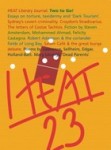
This issue of Heat is atypical in not including any work in translation. Multicultural themes are addressed, but very little attention is paid to the world beyond our shores. There’s not even any travel writing, unless you count Vanessa Berry’s ‘Dark Tourism: Three Graveyard Tales’, in which the author visits two graves and strolls in a London cemetery (in a piece that might have been more accurately titled ‘Mildly Crepuscular Travels with my Mum’).

Turkish born, ethnically Greek Melburnian Dmetri Kakmi’s ‘Salam Cafe and the Great Burqa Debate’ might seem to fit Weinberger’s description of Clayton’s multiculturalism pretty well – a non-Muslim man joins the argument about what Muslim women should or shouldn’t be allowed or made to wear. But he puts the lie to that pigeonholing by acting as a conduit for Muslim points of view, drawing on his childhood memories of Turkey and his time as a student in Istanbul, and discussing burqa-related artworks by Muslims Shadi Ghadirian (a woman) and Kader Attia (a man, whose ‘Kasbah’ was shown in this year’s Sydney Biennale).

Weinberger’s aspersions might also seem to apply to Michael Mohammed Ahmad’s story, ‘The Hat Dance’, the piece that comes closest to the kind of hyphenation he dislikes. But this account of a dust-up in an extended family living in Western Sydney is so gloriously exuberant only some kind of Diversity Bean-counter could fail to relish it.

Of course, Heat doesn’t claim to fill a hypothetical Diversity Quota in every issue, and there’s no reason it should. Its characteristic approach to fostering diversity is by presenting crosscultural encounters, an approach I’m fairly sure Weinberger would approve of. Kakmi’s piece is an example of that approach. So is Michael Atherton’s portrait of Harry (christened Charalambos) Vatiliotis, who lives in the Sydney suburb of Croydon and makes classical violins in the manner of Stradivere, each one a unique work of art. Cassi Plate quotes from letters of Costas Tachtis, Greek novelist who lived for some years in Australia, and his friend Carl Plate, an Australian artist: ‘The letters,’ she writes, ‘take us into a cosmopolitan world within the heart of what is often assumed to be parochial 1950s Sydney.’ Maybe cosmopolitanism is a better word than diversity for the thing that Heat does so well.

Cosmopolitanism can incorporate voices from elsewhere, and also bring a sharp eye to bear on the local, as Peter Doyle’s fascinating ‘Bashful City: Sydney’s Covert Criminality‘ does to photographs from the archives of Sydney’s Justice and Police Museum.  It can also include intensely place-specific writing like  Mark Tredinnick’s review of  Judith Beveridge’s most recent book of poetry, in which, incidentally, he compares her to a shark and a Philip Marlowe thug, and convincingly means both as compliments.

I do worry about Heat‘s copy editing and proof reading. There’s curiousity, practicing (though correct Australian usage practises elsewhere), an umbilical chord. Someone is heard cluttering in his garage. In Robert Adamson’s delicately poised ‘The Coriander Fields of Long Bay Penitentiary’, a with is repeated over a line break – I know it’s poetry, but that’s just a mistake. One article has this near the beginning: ‘It is one of the great dividers between the civilised among us: those of impeccable taste.’ I wasn’t interested enough in the article’s subject – taxidermy – to endure whatever came after that.
****

Jeff* Sparrow (editor), Overland 200 (Spring 2010)

The first issues of Overland, published in 1954,carried the slogan ‘Temper democratic; Bias, Australian’, hardly a promise of cultural diversity or cosmopolitanism. But as a project of the mainly Communist Realist Writers’ Group, the journal had a commitment to internationalism. Surprisingly, there’s not a lot of that in this anniversary issue, unless you count a deference to Europe and the US. Not that there’s necessarily anything wrong with that: for instance, Alison Croggon’s ‘How Australian Is It?‘ talks with her characteristic clarity and generosity about the way much of our theatre has opened out to the world, freed from constricting preoccupations with national identity but distinctively Australian all the same. On the other hand, when Clive Hamilton characterises the Australian as an agent of ‘the Republicans’ war on climate science’, he implies – perhaps intentionally – that in this matter Australia is humiliatingly no more than an arena in which US battles are being fought. There’s a fair whack of ‘theory’**, enough to create a gnawing sense of Australia as a site for the application of theory developed elsewhere – no sign of Raewyn Connell’s Southern Theory here. (The most theory-rich piece, Alwyn Crawford’s ‘Permanent Daylight‘, which deals with the intimate connection between capitalism and anorexia, is nevertheless compelling reading because of a ballast of passionate personal testimony.) Christos Tsiolkas is the Literary Big Gun of this issue, with a short story about the market in European art, but I found it unreadable (that is to say, I couldn’t tell what the story was trying to do, whether it was a spoof or something else very dull). There’s no non-European voice, and little interest in non-European culture: one piece, by a non-Muslim, quoting no Muslim voices, uses the Western burqa debate as a springboard for theoretical reflections on the visibility or otherwise of women in the West; Jacinda Woodhead gives us an attractive profile of Melbourne rapper-comedians Fear of a Brown Planet (there’s a wonderful YouTube clip of one of them here); Kabul is mentioned in one article, but it’s in a quote from an organisation aimed at creating a market for US cosmetics there.

So Weinberger’s kind of internationalism isn’t overwhelmingly evident in Overland. The three outstanding pieces, in fact, aren’t even particularly multicultural. Chris Graham does a demolition job on Noel Pearson in ‘Telling whites what they want to hear‘. Graphic novelist Bruce Mutard re-tells a story from Overland 1: the story is ‘Nine O’clock Finish’ by John Morrison, a marvellous socialist realist writer, and the resulting 8-page comic is to weep. Janette Turner Hospital’s short story ‘Weird People’ is a tour de force centred on the captain of a tourist boat that takes mainly US tourists out to look at humpback whales off the coast of New South Wales – I suppose it could be read as a protest against our cultural client-state identity.

In Overland, though less so than in Heat, proofreading is a worry: ‘haute bourgeois’, the Communications Minster, and at least one article written in an academic style that apparently defeated all attempts to wrangle it into English.

* In a classic example of Mruphy’s law, when I first put this up, I misspelled Mr Sparrow’s first name – immediately after whingeing about someone else’s poor copy editing. I’ve fixed it now
**  Writers referred to include Ariel Levy (North American liberal feminist), Nina Power (British philosopher and feminist), Mark Fisher (British cultural theorist), Guy Debord (French theorist), Sheila Rowbotham (British feminist historian), Edward Said (the exception that tests the rule and finds that it holds up), Naomi Baron (US linguistics professor).

****

Stephen McCarty(editor), Asia Literary Review 17 ([Northern] Autumn 2010)
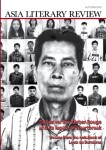
It’s a telling confirmation of Weinberger’s generalisation that the ALR’s web page header reads ‘Asia Literary Review – Asian American writing’, apparently promising US-ers that they can read it without danger of encountering anything genuinely foreign. Happily, it’s a false promise.

From the beginning, there’s no doubt that we’ve left the leisurely contemplation of anti-grand abstractions far behind. US-expat journalist Robbie Corey Boulet kicks off with a report on the first case tried – in 2009! –  by the tribunal set up to deal with ‘those most responsible’ for the crimes of the Pol Pot regime. Itself a fine combination of court-reporting, historical background and interviews with people still looking for answers about their murdered relatives, it is followed a few items later by a suite of poems by Peauladd Huy whose parents were murdered by that regime and who now lives in the USA. And it finds a grim echo at the end of the journal, in an excerpt from Frank Dikötter’s Mao’s Great Famine, which draws on archival sources to explore the terror and violence of the Great Leap Forward (‘at least 45 million people worked, starved or beaten to death’). There are other pairings, including a story and a photo essay about floods in the Philippines. A good bit of the ALR probably amounts to armchair dark tourism – much stronger medicine than the piece wearing that label in Heat.  The one actual piece of travel writing – about Mount Merapi, a Javan volcano –  has enough disastrous loss of life for the darkest tourist sensibilities.

There aren’t many laughs, but there’s plenty of wit and imagination: ‘Youth-in-Asia‘,  a story set in Korea by Canadian Ron Schafrick, delivers on its punning title; Priya Basil’s ‘Losing Their Religion‘ is a quietly entertaining memoir of religious conversion and un-conversion that spans three continents; GB Prabhat’s ‘The Silencer‘ gives us a clever inversion of  celebrity stalking.

There is no Australian presence, apart from two full-page ads, for the Melbourne Writers Festival (featuring a Hokusai wave) and Heat (‘Australia’s only international literary journal’) respectively.  Insert your own ironic comment.

One sentence leaps out to meet my eye.  Jonathan Watts, an English journalist, moved from Korea to Beijing in 2003. His interviewer James Kidd tells us:

The signs of conspicuous pollution made an immediate impression: a keen runner, Watts found himself wheezing after a short jog; a father, he was alarmed when his two daughters were not allowed outside during breaks at their Beijing school. It was China that taught him to fear for the future of the planet.

I’m not sure I can afford to keep up my subscriptions to all three of these journals. I was thinking of letting my subscription to Asia Literary Review lapse – but it’s teaching me to think in terms of the whole planet