Tag Archives: Amor Towles

The Essays of Montaigne, progress report 6

Michel de Montaigne, The Complete Essays (Penguin Classics 1991, translated by M. A. Screech)
– end of Book 2 Essay 12, “An apology for Raymond Sebond’ to part way through Book 2, essay 17, ‘On presumption’
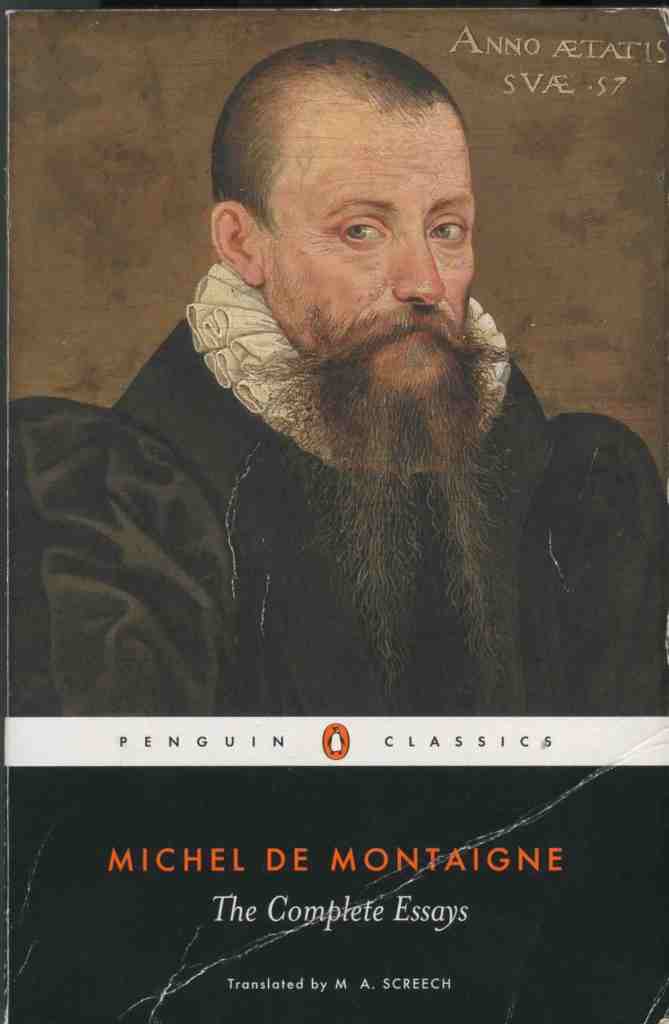
The month has flown by, and it’s time for another progress report on my project of reading Montaigne’s essays, four pages every morning. Two friends have sent me examples of Montaigne cropping up in their own reading: the first has just started reading Amor Towles’s A Gentleman in Moscow, and was reminded of my project when the confined Count finally gets to read Montaigne; the second forwarded me Nicholas Gruen’s weekly newsletter for the 18th of August, which includes Montaigne’s essay ‘On a Monstrous Child’. I’m not alone in reading him.

It’s taken much more than a month, but I’ve now finished ‘An Apology for Raymond Sebond’. Whether from shrinking attention span, lack of interest, or the nature of the essay itself, I happily confess that I had trouble following its argument. It went on and on, endlessly quoting ancient philosophers, repeating itself, and proclaiming radical scepticism. I thought it was about to discover the scientific method, but no, it seemed to end up saying you can’t trust reason or the senses, but – implied rather than stated outright – you can always trust the revealed Word of God. I’m glad that one is behind me.

Today I’m part way through ‘On Presumption’. Having discussed in the preceding essay the relative worthlessness of reputation (‘glory’) compared with actual virtue, in this one Montaigne begins by saying that one’s opinion of oneself is similar to glory – prone to wishful thinking and no real indicator of one’s real worth. He’s now in the middle of a generally unflattering – and I think intentionally funny – self-portrait. He loves poetry, but is a terrible poet. He loves fine writing but:

There is nothing fluent or polished about my language; it is rough and disdainful, with rhetorical arrangements which are free and undisciplined. And I like it that way, by inclination if not by judgement. But I fully realise that I sometimes let myself go too far in that direction, striving to avoid artificiality and affectation only to fall into them at the other extreme. … Even if I were to try to follow that other smooth-flowing well-ordered style I could never get there. (Page 725–726)

False modesty? Maybe not. It does read as a genuine attempt to describe his own writing.

Beauty, he says, is the ‘first sign of distinction among men’, and height is the only quality that determines manly beauty, but his own ‘build is a little below average’. In one of the passages that makes reading him such a pleasure, he lists the qualities that don’t count:

When a man is merely short, neither the breadth and smoothness of a forehead nor the soft white of an eye nor a medium nose nor the smallness of an ear or mouth nor the regularity or whiteness of teeth nor the smooth thickness of a beard, brown as the husk of a chestnut, nor curly hair nor the correct contour of a head nor freshness of hue nor a pleasing face nor a body without smell nor limbs justly proportioned can make him beautiful. (Page 729)

Having just told us that only height matters, he implies the counter argument: he’s at least a bit sorry that men who look good and don’t smell bad aren’t regarded as beautiful. Not that he attributes those qualities to himself. He says his build is ‘tough and thickset’ and describes (in Latin, possibly quoting someone) his bristly legs and tufty chest, etc.

So this isn’t so much a progress report as a snapshot of where I’m up to when the blog post falls due. I just flicked forward 120 pages to see that next time I may be talking about an essay entitled ‘On three good wives’!


This blog post was written on Gadigal-Wangal land, where understandings of the universe beyond Montaigne’s imaginings were developed millennia before the Ancients he discusses. The weather is warming up alarmingly early. I acknowledge the Elders past, present and emerging of the Gadigal and Wangal Nations,.
The Book Group with A Gentleman in Moscow

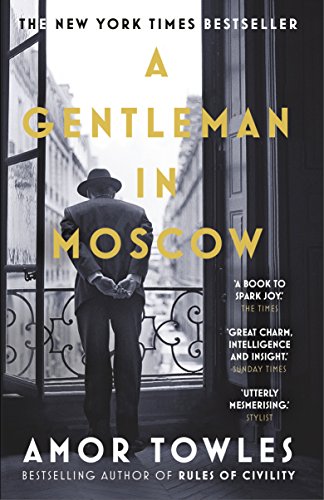
Amor Towles, A Gentleman in Moscow (2016, Windmill 2017)

Before the meeting: This is a fabulous book to read after The Disappearing Earth. Both are by USians looking to Russia, but where Julia Phillips’s novel is a contemporary thriller (kind of) set in remote Siberia, and features Indigenous people, Amor Towles’s novel is a comedy of manners (kind of) whose action takes place almost entirely within the walls of the luxurious Hotel Metropol in post-revolution Moscow. It’s probably not stretching things too far to say that, for all their difference, they are both reactions against mainstream US’s Russophobia, while neither goes so far as to assert any sympathy with Communism. They seem to confirm that the Book Group has a recurring interest in Russia and the former Soviet Bloc, coming as they do after Anna Karenina (discussed in August 2009), Chekhov’s short stories (September 2012), China Miéville’s October (September 2017), and Svetlana Alexievich’s Chernobyl Prayer (November 2017).

Count Rostov is a Former Person, that is to say a member of the pre-revolutionary aristocracy, whose life is spared because of a poem filled with pre-revolutionary zeal, and who is sentenced to live the rest of his life under house arrest in the Hotel Metropol. Rostov, whose aristocratic virtues include extraordinary social adeptness, courtesy, wit and generosity, has been a favourite guest at the hotel. When he is moved by decree from his luxurious quarters to a tiny room on the top floor, his relationships with members of the staff remain affectionate. He is befriended by a young girl (who initiates the friendship by asking him what has happened to his spectacular moustaches – which have been peremptorily scissored by a brutish apparatchik) and some decades later takes on the guardianship of her daughter, who becomes the emotional centre of his life. He is employed as head waiter in the hotel’s prestigious dining room, where his aristocratic training in tact and diplomacy serves him well. Over the decades of his house arrest, his gift for friendship wins him unexpected allies, even while his undaunted aristocratic bearing makes an enemy or two.

All this plays out against the history of Stalinism, the Second World War, the coming of Kruschev, forced collectivisation, purges, straitjacketing and worse of artists, writers and performers, the gulags, millions dying of famine, increasing wealth and eventual opening up to the West, samizdat. The Count leaves the hotel only once before the final pages; history comes to visit him, and friends fall foul of the iron hand of Stalinism. He is described as the luckiest man in Russia.

Beneath this charming fantasy, there’s a joyful assertion of the value of decency, a celebration of resilient humane virtues. I enjoyed it a lot, and laughed out loud more than once. But …

… although at no stage did I feel the urge to stand up and sing ‘The Internationale’ (to quote Mark Kermode reviewing Downton Abbey), I was uneasy about the possibility that the book plays into a quietistic approach to life, as in, ‘I can be decent, even generous, with people within my small sphere, but what can I possibly do about big issues like climate change when my sphere is so limited?’ I don’t know. Maybe this is a question for the Group – that is, if we can resist the pull to rip into Scott Morrison dealings with Trump.

At the meeting: I was surprised that this book was substantial enough to hold our attention for long, yet it provoked very interesting, wide-ranging, inclusive and at times robust conversation.

One man had read it twice, the second time when he had a visitor staying with his family to whom he read a page or so on a number of nights, which he and his audience enjoyed immensely. This man actually stayed at the Hotel Metropol some decades ago, a disclosure he managed to withhold until well into the evening, winning a round of applause for his restraint. He also challenged the idea that may have been floating in the room and/or the book that civility and grace were somehow aristocratic virtues – two of the most gracious people he had ever met were working class unionists Jack Mundey and Jack Ferguson.

I got to put my question, or call it my unease, and wasn’t dismissed out of hand. One man immediately wondered aloud if that unease wasn’t the actual intentional subject of the book. One chap described the book as a Western liberal response to the Russian Communist experiment, in which liberalism comes out as superior. Another (a recovering Trot, I think) saw it as asserting that attempts at major social change were doomed to fail because the old order just reproduces itself in new forms. Someone else heard me as using the rhetorical device of ‘What about …?’ – that is, asking how we could be giving attention to this froth and bubble when Climate Change. (I think I defended myself successfully against that charge.) If Rostov doesn’t engage with the social change activism, perhaps it’s because he’s under house arrest, and perhaps (this was a quick aside from someone) we all tend to feel we’re under house arrest.

We managed to talk about any number of subjects without leaving the book: Boris Johnson and the Etonian old boys currently running the UK (aristocratic virtues, anyone?), The Good Place (addresses the question of what it means to be good!), Poldark (which not many of have watched, but evidently it addresses contemporary issues through a story set in the past), being fathers of girls.

I love my Book Group.