Tag Archives: Australian Women Writers Challenge

Leila Yusaf Chung’s Chasing Shadows 

Leila Yusaf Chung, Chasing Shadows (Vintage Books Australia, 2014)

1csIn August 2001, John w Howard kept the press away from the asylum seekers who had been rescued by captain Arne Rinnan of the Norwegian ship Tampa. It was crucial to Howard’s strategy of depicting the would-be refugees as ‘illegals’ and ‘queue-jumpers’ that Australians not see them as individual men, women and children. His famous utterance, ‘We will decide who comes to this country and the circumstances in which they come,’ could not have sounded like a defiant assertion of sovereignty if its hearers knew the wretched terror and misery – not to mention courage and determination – of those who were being ‘decided’ against.

Short of meeting asylum seekers in person, and so far I haven’t bestirred myself to do that, fiction has to be a good way of engaging imaginatively with this class of people who are still being relentlessly disparaged and dehumanised in our media. I bought a copy of Leila Yusaf Chung’s novel with those considerations in mind after hearing her speak, beautifully, at the Sydney Writers Festival about the importance of women in refugee communities.

I’m happy to report that the book filled the brief I had given it. Set mainly in Israel and Lebanon from the 1940s to the 1980s, it has real people who suffer real losses, confront real mysteries, and make their ways through the violence and indifference they meet at every turn. The form of the book mirrors the complexity of Middle Eastern politics, to the extent that plot summaries either misrepresent the book or are close to impossible to unravel. A character who seems to be the main driver of the plot becomes marginal to the point that when he dies we hardly notice; sympathetic characters do terrible things, and a shift in perspective reveals what looked like – and was – abuse to be an act of love; an early scene narrated from an uncomprehending child’s point of view turns out to contain a mystery that is central to the story; there are many false starts, many shifts of location and allegiance.

The book has a Zelig quality – characters find themselves on the spot just in time to be on the wrong side of a disastrous event: a Polish Jew living in Israel converts to Islam just before the naqba, so that he and his new family are among the hundreds of thousands of Palestinians driven from their homes by the Israeli army into apparently permanent exile; a young Palestinian woman is persuaded to marry an Iranian official, only to arrive in Tehran the day of the 1979 revolution and be gaoled along with hundreds of women who don’t meet the requirements of Ayatollah Khomeini’s new regime; characters are caught up in the Lebanese civil war and the Israeli invasion of Lebanon in 1982.

Identity is fluid, and sometimes a  pragmatic choice: the Jew Lavi becomes the Muslim Abu Fadi in order to marry a young Muslim woman; his Arab daughter poses as a Christian Armenian to give her infant daughter a safe environment to grow up in; another daughter finds a source of strength in strict Islam. Nothing is simple.

I recommend the book. If you read it I’d love to hear your response in the comments.
aww-badge-2015

Chasing Shadows is the twelfth book I’ve read for the 2015 Australian Women Writers Challenge.

Ali Cobby Eckermann’s Inside My Mother

Ali Cobby Eckermann, Inside My Mother (Giramondo 2015)

1imm

If you haven’t read anything by Ali Cobby Eckermann, you’re not keeping up. In the last five years or so, in three books of poetry, two verse novels and a memoir, she has made a huge contribution to our general understanding of what Australia is. She was taken from her Aboriginal family when she was a small child, and brought up by a white, German heritage family. Her writing is largely animated by the charge from her reunion as an adult with her mother and with  her Yankunytjatjara and Kokatha relatives and heritage.

The memoir, Too Afraid to Cry, tells her story and is on my reading list. The poetry in Inside My Mother touches on it in many ways – on her relationship with her mother, and the pain of her death soon after renewing contact; and also on her rediscovery of Aboriginal culture, as in the first poem in the book:

Bird Song
 our birds fly
 –––––on elongated wings
 ––––––––––they fly forever
 –––––––––––––––they are our Spirit

–––––––––––––––our bird song
 ––––––––––is so ancient
 –––––we gifted it
 to the church

This kind of assertion of the power of Aboriginal culture is hard to pull off without coming across as defensive or preachy, but Cobby Eckermann manages it here, and throughout the book, with grace and a faint satirical edge.

The poetry here is wonderfully varied: love lyrics, fables, autobiographical narrative, polemic, surrealism and some silly humour.

As I’ve been ruminating about this book over the last couple of weeks, my mind keeps returning to ‘Hindmarsh Island’, not because it stands out as excellent, but because it cries out to be read alongside Les Murray’s ‘Inspecting the Rivermouth’ in his most recent book, Waiting for the Past.

Les Murray’s fine poem can be read online here. It celebrates the renewal of the mouth of the Murray River, in particular the prosperity and vitality that has come to Hindmarsh Island thanks to the bridge that has recently joined it to the mainland. It has Murray’s characteristic joy in linguistic display, the wonderful image of the bridge throwing houses onto the island, and the joyful underlying pun on ‘Murray mouth’.

Then along comes Ali Cobby Eckermann’s ‘Hindmarsh Island’:

hindmarsh Island 

Cars drive over the babies!

And we realise that for all his emphasis on the importance of the past, Les Murray as a non-Indigenous poet can glide over some elements of our history. The Signal Point café is part of the thriving scene celebrated in ‘Inspecting the Rivermouth’, but from an Aboriginal perspective, we don’t have the luxury of forgetting that the bridge was built over the prolonged protests of a group of women who asserted that it meant the destruction of a significant cultural site. It’s possible that Cobby Eckermann had read the Murray poem (which was first published in Quadrant in September 2010), but I doubt if it’s a deliberate response: this is just a different take on the same phenomenon, one that demonstrates how important Aboriginal voices are if our national conversation is to have integrity.

Ali Cobby Eckermann’s previous books of poetry are Kami (a Vagabond Press Rare Objects chapbook, 2010) and little bit long time (Australian Poetry Centre’s New Poets Series, also 2010) and love dreaming and other poems (Vagabond 2012). Her two verse novels are His Father’s Eyes (OUP 2011) and Ruby Moonlight (Magabala Books 2012). Her memoir, Too Afraid to Cry, was published by Ilura Press in 2013.

aww-badge-2015

Inside My Mother is the eleventh book I’ve read for the 2015 Australian Women Writers Challenge.

Lisa Gorton’s Life of Houses

Lisa Gorton, The Life of Houses (Giramondo 2015)

9781922146809

Lisa Gorton is a an award-winning poet. I’m using that journalist’s phrase because I haven’t read enough of her poetry to have any real sense of it. I have read some of her criticism and been intensely grateful for the insights she shares. Her first novel, Cloudland, was for young readers. The Life of Houses is her first novel for a general readership.

The action of the novel unfolds over about a week. Anna manages a Melbourne art gallery. While her husband is visiting his family in England, she sends their teenaged daughter Kit to stay with her estranged parents in a tiny seaside town a couple of hours’ train journey away. Anna has to prepare for an exhibition opening during school holidays, but her real reason for packing Kit off is so she can spend time with a lover, who is pressing her to leave her husband.

While Anna wrestles with her ambivalence about her love life, Kit encounters the miasma of unresolved emotion in her mother’s childhood home – her grandparents’ not-really-unspoken resentment of their daughter who left them with barely a backward glance, and the small-mindedness of small-town life beyond the family.

Not a lot happens. A teenage boy has died, probably by suicide, probably because he was gay, and Scott, an artist who was Anna’s childhood friend, falls under suspicion because he had spent time with the boy. There’s something needy and a bit creepy about Scott, but I don’t think it’s a spoiler to say we never learn anything about his sexuality, and that the suspicion is purely a symptom of small town thinking. He befriends Kit, and is the only person who has an inkling of what she is experiencing.

There’s another death, but external events are much less important in this novel than internal processes. Kit begins to think of her mother differently, and her sense of herself has grown. Anna’s attitude to her family softens, and her ambivalence about the lover deepens. Scott almost decides to leave the town. Everyone has a take on the building that is the family home: its history, its ghosts, who will inherit it, its emotional meanings and (in passing, but ominously) its market value. Absolutely nothing is neatly resolved.

Lisa Gorton and the editorial team at Giramondo aren’t afraid of hard-working adjectives or busy punctuation. For example:

The whole scene lay open before her: heat shimmering off scrub out where the road was, mile after mile of flat, low, secretive country. She found a sort of elation in it: a loneliness answering her mood. Sharp, scattering sounds drew her eyes to where the bird was lifting wing-beat by wing-beat up from the surface of the lake, its legs trailing in the water. She watched holding her breath; it seemed so unlikely the bird would rise.

That’s two colons and a semicolon in four sentences. More than once, a single sentence matches that. Here’s one from when Kit is listening in on a conversation between her aunt and Scott soon after she arrives in the town:

Their way of ignoring so much made Kit notice more: the creaking sound of some loose join in the decking; and that lasting roar: it was the wind, not the sea, she could hear.

The frequent use of sentence structures that call for this kind of punctuation has the effect of blocking the flow of the narrative. What is happening is almost always less important than the process of observing it. And often it feels as if things are there because they have been observed, even though they add nothing to the narrative or our understanding of character. Anyone reading to find out what happens next may be disappointed. The pleasures of this book lie elsewhere.

I received my review copy of the book from Giramondo.

aww-badge-2015

The Life of Houses is the tenth book I’ve read for the 2015 Australian Women Writers Challenge. I’ve now finished the challenge – but I don’t expect I’ll stop reading relevant books.

Lisa Gorton recently gave a fascinating interview about The Life of Houses to Fiona Gruber on the ABC’s Books and Arts.

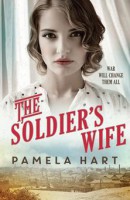
Pamela Hart’s Soldier’s Wife

Pamela Hart, The Soldier’s Wife (Hachette Australia 2015)

9780733633737

Romance novels really aren’t my thing, but Pamela Hart, as Pamela Freeman, has written a number of magnificent books in other genres, so I stepped out of my comfort zone to read her first venture into the world of historical romance. Also, it’s the centenary of the landing at Gallipoli, and in our house the schmaltzy, revisionist jingoism in the media has made it close to impossible to attend to the occasion. James Kent’s movie of Vera Brittain’s Testament of Youth was a big crack in that frozen wall. The Soldier’s Wife promised another.

The book  delivers on both fronts: as a story of the WWI home front, and as a all stops out romance.

Ruby has had a blissful honeymoon week with her tall handsome husband Jimmy, and then one last day in town before he is shipped off to Gallipoli, where they know he is going into harm’s way. (If I was being true to the period and to the book, I’d call her Mrs Hawkins, but after all I’ve been though with her, she’s Ruby to me.) Hailing from Burke, Ruby lodges with the friend of a friend in Annandale, a Sydney suburb, and gets a job as bookkeeper in a timber yard – the boss of the yard has a son who is an officer in the same battalion as Jimmy, which accounts for his willingness to take on a woman.

And it goes from there: Ruby lives in constant terror that the next telegram to be delivered will bring news of Jimmy’s death; she negotiates the perils of the all male workplace, where she fends off sexual predation and high-toned disapproval; having so briefly enjoyed married life and then left, she is strongly drawn to the handsome, muscular foreman of the yard; bit by bit she takes on more responsibility in the workplace and her relationship with her landlady becomes more solid.

I was surprised by some of the plot twists, and though in retrospect they were completely logical I don’t want to spoil them for you. I’ll just say that we are not spared the harrowing experience of learning of a loved one’s injury and death in battle; and the changing balance in power relationships between men and women that was brought about by the war is made painfully real, along with the ghastly difficulty in communication between those who went off to the unreal nightmare world of war and those who stayed behind in the all too real struggles at home.

The main characters are all Catholic – attending St Brendan’s in Annandale, where I have been myself more than once – and the moral world of the book is that of early 20th century Australian Irish Catholicism. I love this, because so much historical fiction shies away from such religious dimension, yet it is so important to an understanding of the times. It also adds a particular kind of intensity to Ruby’s temptations with the foreman – and I don’t think it’s a spoiler to say that I desperately wanted her to yield to temptation, and that the matter stayed unresolved until almost the last page.

The Soldier’s Wife is being promoted as an ideal Mother’s Day gift. I think my mother would have liked it, though she might have been unsettled by some of the discreetly worded but nevertheless explicit sexual references. I doubt if my father would have read it, but he would have enjoyed it too. It’s a good yarn. You care about the characters. And there’s the blessed relief of being able to think about Gallipoli through the experience of life-sized, complex people without the background noise of rascally patriotism.

aww-badge-2015

The Soldier’s Wife is the ninth book I’ve read for the 2015 Australian Women Writers Challenge.
Lucy Dougan’s Guardians

Lucy Dougan, The Guardians (Giramondo Poets 2015)

1DouganWhen I started blogging about my reading more than 10 years ago, I had a vague idea at the back of my mind that I would do it as an amateur. I could be subjective, ill-informed, cantankerous, idiosyncratic, sometimes enthusiastic, occasionally splenetic, but never claiming any kind of authority.

In that spirit, let me say I found The Guardians  almost completely uninteresting. I approached poem after poem with hope, and time after time was disappointed. I thought I’d find one poem I really liked and just blog about that, but no such poem arrived. I re-read the book, thinking perhaps it had been a matter of poor timing. Same thing.

In the current Sydney Review of Books Ivor Indyk editorialises about ‘difficult’ poetry. He attributes the perception of difficulty to a failure to recognise that poetry needs a ‘different method of reading’ from prose:

You should feel easy with the prospect of reading a poem many times, in the process of weighing its implications, in contrast to the largely single and forward-directed reading you give to a novel.

Paradoxically, I find The Guardians difficult because a ‘single and forward-directed reading’ of many of the poems seems to be more than enough, while others read to me as disparate jottings on a theme.

Maybe the problem is that the poems are so pared down, so restrained, that I lack the imagination to feel their substance or emotional impulse. Understatement taken to the point of inaudibility. A series of poems narrates an experience of breast cancer (‘The Guardians’, ‘Right Through Me’, ‘The Deer’, ‘Driving to the First’, ‘Eve’, ‘Here’, and ‘The Hammock’), a big subject if ever there was one, but they hardly touch the sides.

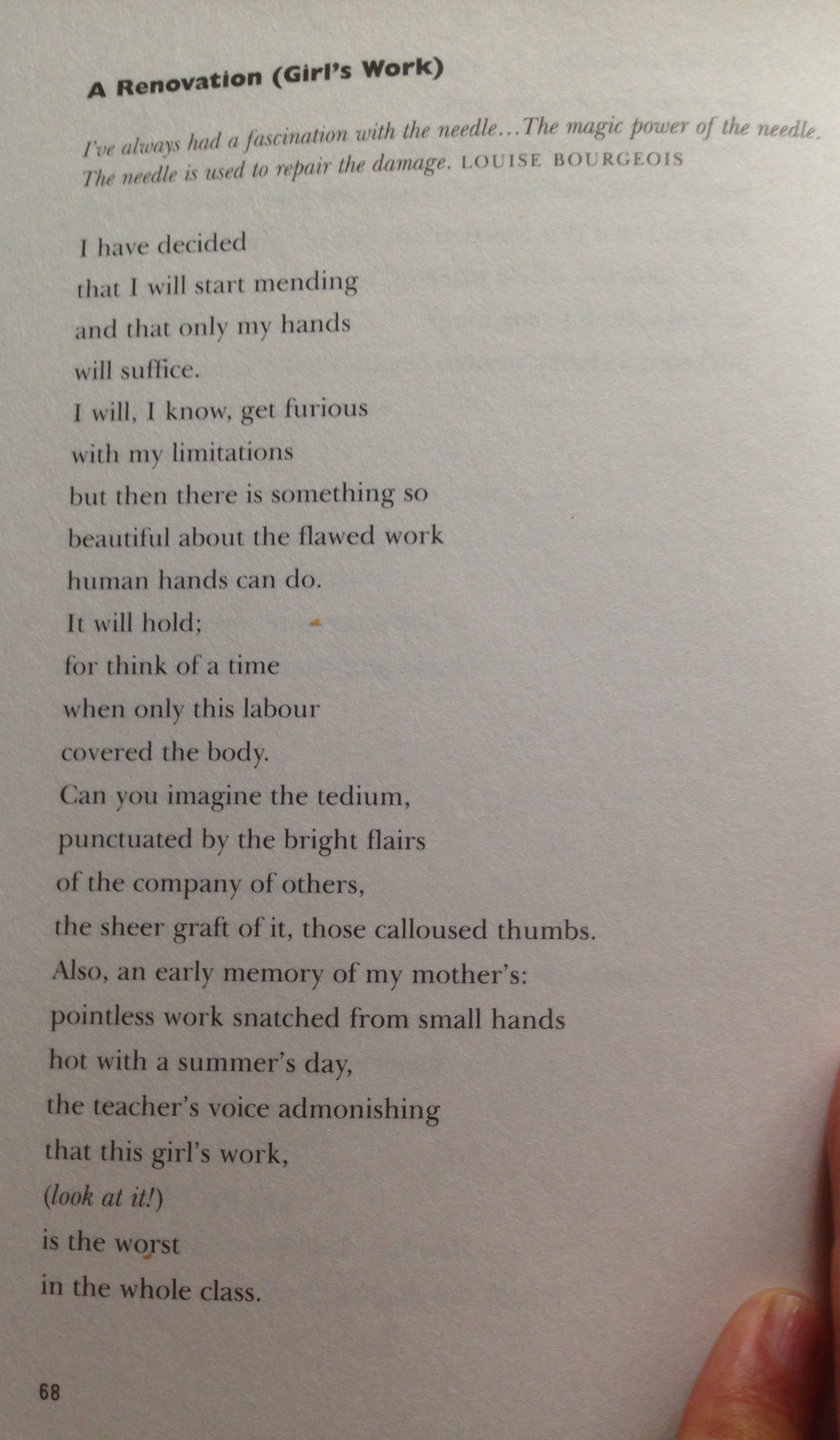
I did read one poem to the Art Student, who professes to hate poetry, and she loved it. The poem was ‘A Renovation (Girl’s Work)’:

renovation

It would be tedious for me to say what I dislike about it. Enough to say that the Art Student, perhaps of an age with Lucy Dougan’s mother, resonated with the final section, was touched by the praise of imperfection, and loved the lines:

for think of a time
when only this labour
covered the body.

I can’t quarrel with her about any of it.

If I have one comment on the book that’s verifiably about the poetry rather than me as its reader, it’s to do with the sense of place. A recurring theme is place as containing personal and ancestral history. Yet, place is so abstract in these poems that – apart from those poems where places, all but one of them European, are named –it’s not clear even what continent we are on. The first poem, ‘A Mask’, with its mention of ‘dimpled louvres’ and ‘a room beneath the house’, suggests Australian architecture, but then gives us a child’s imagining of rooms beneath rooms beneath rooms, each with an ancestral identity – that is to say, a child’s imagining that her family has been in this land from time immemorial. Fair enough that a child might imagine that, but neither this poem nor any of the others about revisiting childhood locations and memories acknowledges the key element of non-Indigenous Australian experience: that our forebears come from elsewhere. (I’m assuming here that these childhood memory poems do refer to Australian places – mostly on the basis of what little I know of the poet’s biography, but also from the mention of wallabies in one poem.)

Maybe that’s what was nagging at me as I tried and failed to relate. On a third reading, I was no longer just unengaged, but positively dismayed, by the lines in ‘A Bourne’ in which the speaker, visiting Chudalup (the one non-European place to be named), feels a patch of rock, ‘warm to its core’:

A whole unschooled knowledge of place streamed in
and the liquid vision of boatmen,
was mine in constellations.
Just in this moment the way the planet turned
moved through the axis of my bones

I’m writing this the day after going to a demo in Sydney about the closure of remote Aboriginal communities in Western Australia. With the speakers’ eloquent assertion of Aboriginal connection to the land fresh in my mind, this poem’s claim to ‘knowledge of place’, even if ‘unschooled’, and even though based in an experience once can sympathise with, reads as a Eurocentric denial of Indigenous knowledge and history.

I received a complimentary copy of The Guardians from Giramondo Publishing.

aww-badge-2015This is the eighth book I’ve read for the 2015 Australian Women Writers Challenge.
Emily Bitto’s Strays

Emily Bitto, The Strays (Affirm Press 2014)

1straysThis is a novel about a fictional artist’s colony in Victoria in the 1930s. Though the colony bears some resemblance to the Heide group, and a couple of historical figures, notably Bert Evatt, are mentioned or make brief appearances, it would be a mistake to read it as a roman à clef. At least, I hope so – if not, Heide was quite a bit nastier than I’ve heard.

The narrator, Lily, looks back in middle age to her girlhood friendship with Eva, whose father, Evan Trentham, is a modernist painter and a towering figure in the Australian art scene, and to the years in which she became a virtual member of Eva’s family – one of a number of ‘strays’, of whom the others were young modernist artists. From a deeply conventional family herself, young Lily is fascinated by the bohemian life of the Trentham household: adults who are so engaged in their own pursuits that they leave children to fend for themselves, earnest talk, ‘reefer’ and opium seeds, erotic art, casual nudity, and the smells and sights of a group of working artists and their models.

Of course, all is not well in Bohemia. Eva and Lily, friends since they were eight, drift apart in their early teenage years in ways neither of them can acknowledge, and when calamity strikes the household, it brings the death of their intense intimacy as well.

The book is beautifully written. The characters are vividly realised: Evan the alpha male; Helena his wife and presiding goddess of the household; their three daughters – Bea the responsible eldest, bold Eva and deeply resentful Heloise; and the young adult members of the colony – including Jerome, the young artist who will eclipse his mentor and whose transgressions undo the community.

For all its manifest virtues, though, I couldn’t get excited about the book. It’s not that I was bored, and there are some wonderful things: there are moments when the intensely physical intertwining of young Lily and Eva comes brilliantly alive, so that the distance between them when they meet again as adults is devastating. But over all I couldn’t tell why any of it should matter to me, or actually why it mattered to the author. Interestingly, it’s as if the novel knows that concern needs to be addressed. In the over-long, loose-thread-tying section in which the main events of the novel are in the distant past, Lily tells Helena and Eva that she is thinking of writing a memoir about her days with the family. Helena asks the question that had been playing in my mind for 200 pages: why write it? The question leads in the short term to a tense exchange of blame and counter-blame. But later, Lily reflects (omitting spoilers):

The events of the Trenthams and their strays have long since been recorded in the pages of art history.  … Always, … the artist himself was at the centre, with Helena, Eva, Heloise at the distant peripheries. They were cast as ‘events’ that accounted for the prevalence of particular themes, detailed in the same manner as the influence of the war on Jerome. Heloise’s life a footnote explaining Jerome’s brilliant work.

So the narrator’s motive for writing is clear – it’s a feminist redress of the dominant patriarchal narrative. And we can extrapolate that as the novelist’s motive as well. But any passion behind that motivation didn’t make it to the page, or at least didn’t communicate from the page to me. Perhaps the book’s beginnings as part of a PhD left a subliminal sense that it was being written for an examiner’s eye. Perhaps it’s that I read The Strays after the Biff Ward’s grimly real In My Mother’s Hands, and was unconvinced by Emily Bitto’s inventions. Or maybe I’ve finally reached the predicted old-man condition of not liking fiction much any more. Certainly my lukewarmness seems to be a minority response.

aww-badge-2015This is the seventh book I’ve read for the 2015 Australian Women Writers Challenge.

Biff Ward’s In My Mother’s Hands

Biff Ward, In My Mother’s Hands (Allen & Unwin 2014)

1743319118When my Book Group were picking our next book, someone asked about In My Mother’s Hands, which was on my teetering to-be-read pile. ‘It’s a misery memoir,’ I said, and we moved on to other possibilities
I was wrong. There’s misery in it, but there’s a lot else. Biff Ward, born in the early 1940s. gives us a lovingly detailed portrait of family life in suburban, regional and Canberran Australia. Early in the book, she describes how her mother would wash her hair when she was little:

She began by folding a towel around my neck in an efficient, nurse-like manner to stop drips and breakaway runnels creeping down in my neck. The water was a delicious, perfect temperature and it streamed over me. She believed in rubbing the scalp with her strong fingers, making sure not even a tiny spot was missed. I closed my eyes, I gave myself to the warm wetting, the soaping, the rubbing, the rinsing, the divine sense of clean. Next she flopped the towel on my head and scrubbed vigorously before saying, Bend over.
She then wrapped the towel around my head, tight at the neck behind, a turban twist on top like a woman in a magazine, the way I still do today. I walked or sat carefully for five minutes until my hair was dry enough for the towel to come off. Sometimes, she then sat beside me saying, I’ll just give it a bit of a squiggle to get the curls going.

Not a lot of misery in that! I don’t want to give a false impression, though. This benign intimacy is a long way from representative of the mother–daughter relationship at the heart of the book: in fact, it’s a memory that might never have been recalled if it hadn’t been triggered by a companion washing the writer’s hair in her 30s. The passage does illustrate the book’s loving attention to detail, an attention that is shot through not just with the need to tell (a defining feature of misery memoirs?), but also with the need to know, to understand, to deepen the writer’s grasp of things and to take the reader with her.

This could be a beautifully written memoir of any child’s family life from that time and place, except for two major differences. First, this child’s father is Russel Ward, eminent historian, best known for The Australian Legend, a one-time member of the Communist Party, a man of the word. This means that Biff Ward’s recollections and those of the friends and family she interviewed are supplemented by a formidable archive, including numerous public statements made by and about her father, and also his extensive personal correspondence – including agonised letters to his parents about his wife’s condition. Which is the second major difference: her mother, Margaret, was  delusional and self-harming, and Biff and her younger brother ‘breathed it in, the irrational in her, the grief in him and the unpredictability all around’.

The book’s title deftly signals a double concern of the book. First, it tells what it was like to grow up in the care – in the hands – of someone who spent most of her time withdrawn into a private world of suffering and delusion, whose behaviour was often bizarre and sometimes deeply alarming, and who may well have drowned her first baby in the bath. Second, it seeks to fathom the story of someone who continually gouges at her hands with sharp implements and keeps the damage hidden by wearing gloves. It’s a book of deep compassion, not just for the mother, but also for the father who, far from faultless, struggles heroically to provide a stable life for his children, while protecting his wife as long as possible from the depredations of the psychiatric profession.

The children felt that the were living with a huge, terrible secret. Perhaps the biggest surprise of the story is the writer’s discovery much later that there was a whole circle of friends who knew the situation, and tried to help in the inarticulate and largely ineffectual way of the time. A fellow academic even wrote a short story based on the Ward family.

This is a truly marvellous book. I ought to say that I have met Biff Ward a couple of times, and have been close to some people who appear in these pages. But the books makes a substantial contribution to our understanding of  families, of Australian intellectual history, and of the horrifying ordeal known in the medial profession as mental illness.

aww-badge-2015This is the sixth book I’ve read for the 2015 Australian Women Writers Challenge.

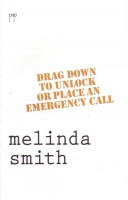
Melinda Smith’s Drag down to unlock or place an emergency call

Melinda Smith, Drag down to unlock or place an emergency call (Pitt Street Poets 2014)

melinda-smithThe most striking feature of this poetry collection is its wild variation in tone.

Take the ten poems in the book’s first section, ‘Uploads’. First comes ‘Passengers are reminded‘ (this and other links are to the poems on the poet’s website, Melinda Smith’s Mull and Fiddle): the speaker, on the way to a funeral, is held up by a delayed train, and her emotional state is evoked obliquely but powerfully. This is followed by a number of direct evocations of grief and loss, though the milieu becomes more literary (one poem is an address to Janet Frame) and the verse more formal (a fine villanelle, ‘Roadside Memorials‘, a pantoum and two syllable-counting haiku). Then the subject switches to divorce, and  the the tone changes abruptly: ‘Decree Nisi’ is pure verbal display, comprising 30 anagrams of its title, and the section’s final poem, ‘bittertweet’, is a cleverly vindictive, multilayered tweet-joke. It feels as if a rug has been pulled out from under the reader. But each poem in the section works in its own right, so all is well.

In the second section, it feels as if war has broken out. There are a number of powerful poems about pregnancy, miscarriage, labour, birth, postnatal depression, motherhood. Take this, from ‘Woman’s Work’:

A new body heaves from her into the light.
Exhaustion melts her. The women pass her the child;
the singers chant again:
Praise her, she has endured the great trial and renewed the life of the world.

Or take ‘Given‘, a response to Francis Webb’s great ‘Five Days Old’. Without detracting from Webb’s wonder as the miracle of a baby is given into his hands, it reminds us of the woman’s experience that has produced and sustains the miracle. ‘Untitled’, addressed to a baby lost at 11 weeks of pregnancy, tears at the heart.

Then – wham! – there are poems that mock or belittle those huge emotions. ‘A birth’, for example, ends, ‘Serenity explodes. I need a beer.’ And  the jaunty ‘Song of the anti-depressant’ in this context reads as an enactment of the great Australian embarrassment that compulsively attacks any show of emotion with a joke.

The mood swings continue in the remaining three sections: ‘News’, ‘Sport’ and ‘Weather’, though the self-deprecatory comic comes more to the fore so that heartfelt love lyrics, serious reflections or, say, ‘Laura to Petrarch’ (in which the beloved writes back – and comes close to calling Petrarch a stalker), are undermined by generally unfunny comic pieces about infidelity, the internet, the weather, and especially an ‘eat drink and be merry’ response to climate change that left a very sour taste in this reader’s mouth.

This book won the Prime Minister’s Literary Award for poetry last year, not one of the controversial winners. I bought my copy on the strength of the award, but while I’m confident it would be a pleasure to attend a poetry reading that included Melinda Smith, I won’t be rushing out to buy the next book given a gong by that set of judges.

aww-badge-2015

This is the fifth book I’ve read for the Australian Women Writers Challenge for 2015.

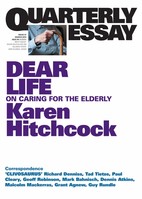
Quarterly Essay 57: Dear Life

Karen Hitchcock, Quarterly Essay 57: Dear Life: On Caring for the Elderly (Black Inc February 2015)

qe57

Like every Quarterly Essay, this one includes lively correspondence on the previous one. Guy Rundle’s Clivosaurus drew thoughtful responses from a number of writers of the left, defensive missives from representatives of The Australian, fascinating psephology from Malcolm Mackerras, and more. Much of it was too technical for my pay grade, but one thing is clear to me: if you get into an argument with Guy Rundle, it would be unwise to let him have the last word – he’s very good at the devastating rebuttal.

A number of people have already tweeted that every Australian should read Karen Hitchcock’s essay on the treatment of elderly people in our health system. She is a general physician who has worked in large hospitals in several Australian states, and so has extensive hands-on experience in working with frail and/or demented elderly people. As she says:

There are two strong narratives in our culture about the ageing population and death. The first is that medicine is keeping elderly patients alive against their will – medicine is denying a death the patient desires. The second is that elderly patients are seeking to stay alive unreasonably – the patient (or their family) is denying an unavoidable death.

The essay takes these narratives on fiercely, and does a brilliant job of unpicking the ageist assumptions and fanciful versions of sickness and hospitals on which they are built. She marshals her own personal and professional experience as well as current research to mount a convincing counter-narrative.

She describes the way modern medicine is fragmented into specialities, a situation that makes it hard to treat elderly people with multiple conditions.

She explores the concept of futility: is treatment futile if it extends a person’s life for just a few days but those few days allow them to say goodbye to family? can a hospital specialist who is as drenched in ageism as the rest of us and has no personal knowledge of a patient be trusted to make a sound judgement about the futility or otherwise of treatment?

She savagely rips into the often heard argument that the increasingly aged population will make the health care system unsustainable.  ‘Sustainable’, she argues, ‘is just a word for “what we are willing to pay”.’ And the real challenge to the health system comes not from the aged but from ‘a population of increasingly poor, obese, diabetic, sedentary young and middle-aged who are the multi-morbid patients of the future and who will require many drugs, doctors, operations (joint replacements, bariatic surgery, amputations, coronary vessel interventions) and hospitalisations’.

Advanced medical directives, documents that spell out ahead of time conditions that are not to be treated if a person is incapable of making their wishes known, are singled out for special opprobrium. Hitchcock is an excellent storyteller, and her story of 84-year-old Fred who came to hospital begging to be allowed to die is enough to win her case without any further discussion: he was wretched, and didn’t want to be a burden (an often heard internalised version of the message with which older people are too often bombarded); she listened to him, encouraged him, treated him, and followed up some time after he was discharged:

I said, ‘Fred , you told me you didn’t ever want to come back to hospital.’
He said, ‘Of course I want to come back if I get sick. I get silly when I’m sick. I hate everything. I say silly things.’

Not all her stories have such cheerful endings. Death does happen. But if we are to have a national electronic system where people’s advanced care directives are recorded, then these directives, she argues, should be reviewed regularly, even monthly, by the people whose lives they concern.

The essay discusses the isolation that is the lot of many elderly people, including those who are placed in nursing homes when their families can no longer care for them. It argues that this is an issue that should be taken up by the society as a whole – ‘if we are to attend to the social needs of our elderly citizens both inside and out of institutions, then we need government interventions and funding, along with the community’s engagement and help.’ What is needed, and what is beginning to happen in some places is

a shift in perspective: the elderly are not a growing cost to be managed or a burden to be shifted or a horror to be hidden away, but people whose needs require us to change our society. They are those for whom we are responsible and to whom we owe real care.

Another sacred cow the essay takes head-on is the idea that it is better to die at home than in hospital. My own father had himself discharged from hospital in Townsville when he knew he was dying, and was flown and driven the 500 miles to Innisfail because he wanted to die at home. I have no doubt that that was a good decision: he spent his last days surrounded by friends and family, being visited by a doctor he’d known most of his life and a nurse he’d known all hers. He died in bed beside my mother, his wife of more than 50 years. But Hitchcock makes it very clear that his situation was exceptional in the western world today. A hospital death can be a good death.

In short, this Quarterly Essay is a call to arms against the oppressive attitudes and practices which we have insinuated their way into our minds and practices around older people. I’m 68, not yet in the frail and/or demented group that Hitchcock is talking about. I hope I never will be. But reading her essay, I wonder if my GP’s slightly disturbing lack of interest in my symptoms on my most recent visit, which I put down to his having had a long day or perhaps the lack of drama in my presentation, might have grown from an assumption that once you’re past a certain age you just have to put up with a certain amount of suffering. And that’s partly Karen Hitchcock’s point: if the problems she writes about are chickens, then we are all roosts waiting to happen.

aww-badge-2015

This is the fourth book I’ve read for the Australian Women Writers Challenge for 2015.

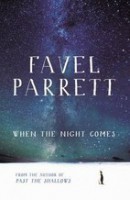
Favel Parrett’s When the Night Comes

Favel Parrett, When the Night Comes (Hachette Australia 2014)

wncFavel Parrett’s first novel, Past the Shallows, published in 2011, was a hard act to follow. In When the Night Comes, her second, she moves to a bigger world, out past Tasmanian waters to Antarctica and Scandinavia, and into a delicate, tender relationship between an adult man and a girl just entering her teens.

I’m tempted to say that it’s actually two novels.

First there’s the one described in the author’s endnote. This is a celebration of the Norwegian ship, Nella Dan, a real ship whose history is sketched in the note, along with affectionate quotes from a number of people who sailed in ‘the little red ship’. If such a celebration had been written by, say, Neal Stephenson, it might have included bravura passages dramatising the ship’s inner workings – the heat and noise of the engine room, the pinging wheelhouse, the compartmentalisation of the hull. But this is not that kind of celebration. Here the engine is background noise that helps the sailors sleep; we spend time in the ship’s kitchen, but no ink is spilled on describing the stoves; if the size of the crew may be mentioned I don’t remember it. In fact, apart from its bright red paint and its size – sometimes surprisingly small, sometimes surprisingly big – we don’t have much sense of the ship as a physical thing at all. What we do have is the way all the characters respond to it, to her, as a dependable almost-maternal, almost-comradely, presence. Almost those things, because Nella Dan never really emerges as a character in her own right.

The other novel is the one I read, and was moved by. In it, the Nella Dan is an interesting setting for part of human story. This story moves between two points of view. The first is that of Isla, 12 or 13 years old, who has recently moved to Hobart with her mother and her younger brother (never known as anything other than ‘my brother’) after their parents’ marriage break-up. A Danish sailor named Bo becomes a regular part of the family. As Isla is completely uninterested in the world of adult relationships, we pretty much have to deduce that Bo and Isla get to spend time together because Bo and Isla’s mother are having a fling, a romance, a domestic relationship of some sort.  Bo’s is the other point of view, and we travel with him on the Nella Dan into Antarctic waters.

Dramatic things do happen: each of the main characters has to deal with the violent accidental death of a close friend, for example, and the Nella Dan runs into the perils of the Southern Ocean. But the strength of the book lies in it depiction of the delicate connection between these two people that allows Isla to imagine herself in a much bigger world, and Bo to find sweet companionship. It feels easy, but when you consider we live in a climate where closeness between an adult male and a child not his own is often looked on with deep suspicion, I can only say I’m deeply impressed – and grateful – for what the book offers.

Sadly, my copy was on loan and has been reclaimed by its owner, so I can’t quote anything. Trust me. Favel Parrett writes lucid, supple prose. The book is full of pleasures.

aww-badge-2015This is the third book I’ve read for the Australian Women Writers Challenge for 2015.