
Esther Anatolitis (editor), Meanjin Vol 83 Nº 4 (Summer 2024)
(links are to the Meanjin website: some but not all of them are available to non-subscribers)
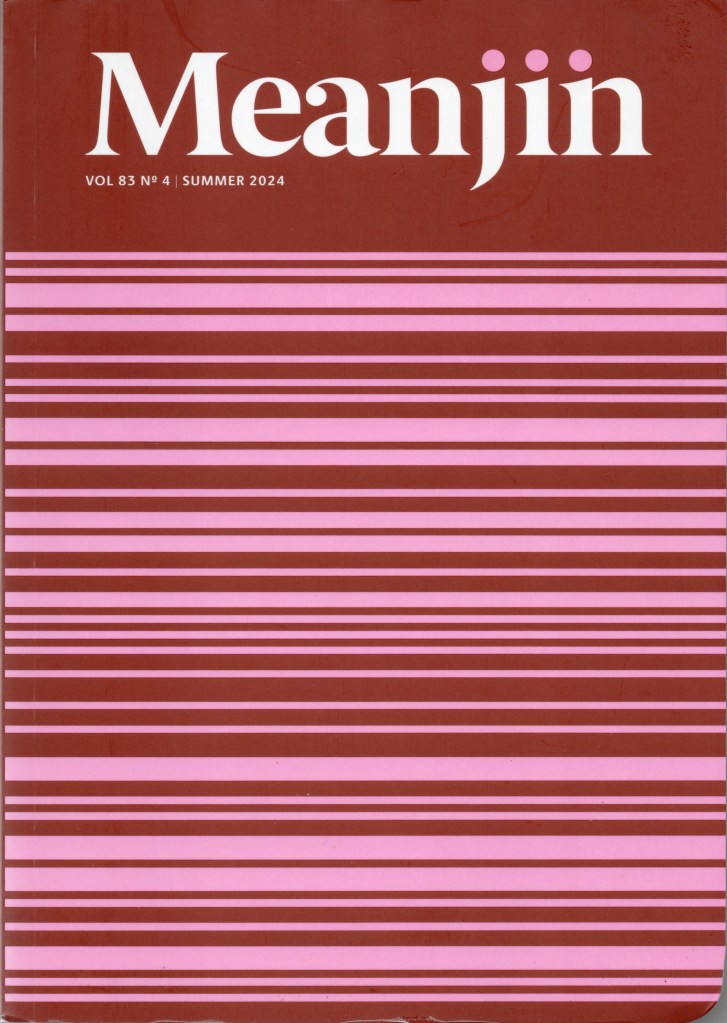
I’m usually at least three months behind in my journal reading, so I don’t expect the journals to comment on the day’s headlines. So it was nice serendipity, on the day I read a piece in the Guardian about bulldozers moving in on a tent city in Moreton Bay Council Area, to read ‘The tent village at Musgrave Park‘ by Lillian O’Neill, which addresses a similar fleeting community in south-east Queensland with curiosity, empathy and (this is Meanjin after all) erudition.
Other essays have a more general but no less pointed timeliness:
- ‘A university, not a corporation‘ by George Williams, Chancellor of Western Sydney University, puts the case summarised so well in its title – a case certainly needed here even if less obviously than in Trump’s USA
- ‘Culture is not “publicly available content”‘ by Nicholas Pickard tackles the rapacity of big tech corporations building their AI capacity
- The title of ‘Who’s afraid of the ABC, apart from the ABC itself?‘ by Matthew Ricketson says it all
- ‘Smooth fade‘ by Zowie Douglas-Kinghorn starts with the recent declaration that a particularly boring fish is extinct and develops into a passionate meditation on the climate emergency.
Meanjin has a number of regular features:
- Even before the contents page, there’s ‘The Meanjin Paper’, an essay by a First Nations writer: it this issue it’s ‘Sing for the Black: From Act to Treaty‘, in which singer-songwriter Joe Geia talks bout his art, particularly his show From Rations to Wages to Treaty
- ‘Australia in three books‘: Shakira Hussein discusses three books about Meanjin/Brisbane – by David Malouf, Melissa Lukashenko and Ellen van Neerven
- Interview: ‘All colour and light’, an interview with Gerald Murnane, eccentric and elusive as ever
- ‘The Year In…’ This issue has ‘… Poetry‘, not a survey, but discussion of a very few favourites by Graham Akhurst & Shastra Deo.
There are short fictions, memoir, book reviews and poetry. To name just one of each:
- ‘Your heart sir‘ by Grace Yee is in the poetry section, but to my taste it’s the best short story in the journal, about the sudden death of an old man and the dementia of his widow
- ‘Seven Snakes‘ by Carrie Tiffany isn’t in the memoir section, but it is a kind of memoir, in which the author, a park ranger, tells of seven encounters with snakes and one, more toxic, with a male manager.
- ‘How Novel is the Novel Prize?‘ by Maks Sipowicz, a review of It Lasts Forever and Then It’s Over by Anne de Marcken and Tell by Jonathan Buckley, joint winners of the 2022 Novel Prize, includes reflections on the function of prizes and awards in the literary ecosystem – and wonders if perhaps the prize should have gone to books of less obvious appeal
- ‘@ClanC #overflow‘, a lovely parody of Banjo Paterson written by Ian Simmons, whose bio says he ‘has been writing bad teenage poetry for almost five decades’, introduces some much-appreciated levity.
There’s much more in the journal’s 191 pages. I’ll give the last word to Maks Sipowicz. He was referring to literary prizes. I think the words apply just as well to literary journals:
As readers, we can only collectively benefit from the spotlight falling onto more challenging texts
I wrote this blog post on the cloud-covered, windy land of Gadigal and Wangal of the Eora nation. I acknowledge their Elders past present and emerging, and gratefully acknowledge their care for this land for millennia. I welcome any First Nations readers of this blog.



 Me fail? I fly!