
[This was originally posted in my now defunct blog Family Life, on 2 August 2006. I’m retrieving it today because it includes some comments on Kate Grenville’s The Secret River, which recently came in at number 20 in Radio National’s Top 100 Books of the 21st Century.]
Books I bought in July:
Robert Charles Wilson, Spin (Tor Books 2005)
Books read:
Poppy Z. Brite, Liquor (Three Rivers Press 2004) and Prime (Three Rivers Press 2005) Marilynne Robinson, Gilead (Virago 2006)
Tim Harford, The Undercover Economist (Little Brown 2006)
Jared Diamond, Collapse (Penguin 2005) (finished)
Kate Grenville, The Secret River (Test 2005)
Philippe Geluck, Le Chat (Casterman 2002)
As this month has been spent travelling, I’ve laid aside a couple of books only partly finished, and mostly started on a whole new swag
I read Poppy C Brite’s Liquor and most of Gilead on the plane to Europe. It’s hard to think of a greater contrast, one about heavy-drinking chefs in pre-Katrina New Orleans, the other an elegiac look at three generations of austere men of religion. Both of them were infinitely preferable to trying to watch a movie in those circumstances (I gave up when an announcement about duty-free shopping interrupted the opening scene of Candy). Poppy C. Brite’s book strikes me as a thinly disguised love song – love for her city (New Orleans, pronounced with the emphasis on the middle syllable), for the world of restaurant work and I presume for her chef husband, and for lovely bits of the English language. The plot is functional, but that’s not where the interest lies.
Gilead is also a love letter, with a lot less disguise: it’s in the form of a letter written from a dying man to his seven-year-old son, in the expectation that the son will be an adult by the time he reads it. The narrator is deeply in love with his little son; Marilynne Robinson clearly loves her narrator, probably the last of a line of passionate preachers in the US midwest. He is a man of profound faith, saturated in bible-awareness, but also acquainted with other intellectual traditions. He is writing the boy’s ‘begats’ – that is to say, he tells the story of his own grandfather, a wild, pistol-wielding preacher called by a vision to fight slavery, of his father, an equally single-minded man of peace, and of himself, struggling with a world where his kind of faith is more and more under attack – by secularism on the one hand and television evangelism on the other. It’s a book full of grace and wisdom.
In Amsterdam I moved on to The Undercover Economist. I’d heard Tim Harford speak at the Sydney Writers’ Festival, and been taken as much by his Tin-Tin quiff as by his talking sense about economics. I feel as a result of reading this that I now have a basic grasp of classic market economics, and it was more or less fun to read.
Prime is a sequel to Liquor, and like that book it abounds in glorious descriptions of the joys of cooking and eating. The book gained extra piquancy for me from being read in Ireland, where we had some difficulty finding palatable food (we gave a special award to the lightly spiced salmon patties served up in a posh-looking hotel dining-room and called Thai fish cakes).
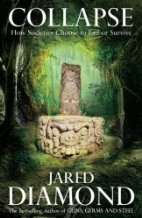
In London, I finished Collapse. Again, this was appropriate, not because it’s a great escapist holiday read (it’s anything but), but because it cast a sharp light on the experience of London’s hottest summer days ever: this wasn’t just a frivolous news story about Poms not knowing how to build cool houses; it was a harbinger of major things to come for all of us. It was good to read his chapter on Australia in London as well, because he argues that our persistent identification with British traditions is one of the things preventing us from choosing environmentally sound directions. I was struck by his articulation of one of the key challenges facing the world:
the challenge of deciding which of a society’s deeply held core beliefs are compatible with the society’s survival, and which ones instead have to be given up.
Before leaving the brick of a book behind on the train to Gatwick (to avoid excess baggage charges), I copied out this from his final section, where he talks about what anyone can do about the current crisis:
an individual should not expect to make a difference through a single action, or even through a series of actions that will be completed within three weeks. If you do want to make a difference, plan to commit yourself to a consistent policy of actions over the duration of your life.
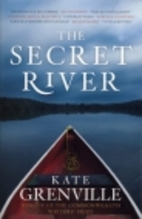
I moved on to The Secret River with high expectations. But whereas recent readings, Neal Stephenson’s Baroque Trilogy and Seamus Heaney’s ‘District and Circle’, had both evoked London localities so vividly that I was constantly being reminded of moments from that novel and that poem during my stay there, I was disappointed that this book’s London remained pretty bodiless. Once the hero, Will Thornhill, arrived on the Hawkesbury with his family, however, my disappointment disappeared: there the book’s true subject emerged, and at the same time the physical world became powerfully present:
When Thornhill jumped over the bow the mud gripped his feet. He tried to take a step and it sucked him in deeper. With a huge effort he dragged one foot out and looked for a place to set it down between the spiky mango roots. Lurched forward into even deeper mud, pulled his other leg up with a squelch, feeling the foot stretch against the ankle, and floundered towards the bank. He put his head down and butted blindly through a screen of bushes, bursting out at last onto dry land. Beyond the river-oaks the ground opened onto a flat place covered with tender green growth and studded with yellow daisies.
His own. His own, by virtue of his foot standing on it.
Will’s first real encounter with one of the people he is dispossessing in this moment occurs within pages, and the book becomes as gripping as the Hawkesbury mud – in which I have no doubt Kate Grenville has had her feet stuck.
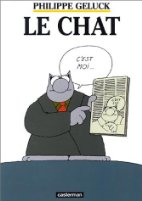
Le chat was my one book in French, a bande dessinée whose measure I found very hard to take. It consists the Steven-Wright-ish monologues of a large, cool, besuited cat. For example:
Le mot ‘long’ est plus court que le mot ‘court’. C’est dingue, non?
And now I return to Romanesque churches and ancient Cathar towers.
Posted: Wed – August 2, 2006 at 03:54 AM


 Me fail? I fly!