Tag Archives: children’s literature

Maurice Sendak’s Pierre

Maurice Sendak, Pierre (HarperCollins 1962)
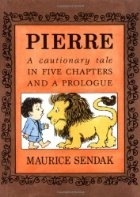
20140309-072501.jpg I don’t generally blog about books I’ve re-read, but my blogging has been light-on recently as I’ve been reading mostly film scripts, which are exempt from my self-imposed task of writing about everything I read, so here’s a quick note on Maurice Sendak’s Pierre, which I re-read recently before wrapping it as a present.

Pierre: A cautionary tale in five chapters and a prologue was first published as a tiny book, cased with three others as The Nutshell Library. Our copies of those tiny books have long since disappeared after a huge amount of use and abuse. Besides Pierre, there are an alphabet book, Alligators All Around, a counting book, One Was Johnny, a book of the months, Chicken Soup with Rice. In case there’s anyone who doesn’t already know, Sendak was one of the 20th century’s greatest writers and illustrators for children, and though these books are in some ways very modest, absolutely obedient to the rules of their genres, each of them is a masterpiece. I have read them all aloud many many times to small co-readers and still love hem.

But Pierre has a special place. I think I first heard of it when my older brother took his eleven year old son on his knee and said,

Good morning, darling boy,
You are my only joy.

And when his son said, shockingly, ‘I don’t care,’ they both laughed.

And that’s the set-up: Pierre’s refrain is ‘I don’t care!’ Because it’s billed as a cautionary tale, the punitive saying ‘Don’t care was made to care’ can’t be far from an adult reader’s mind, as in the cautionary tales of Hilaire Belloc. For those who have so far been spared the delicious horrors of Belloc, let me mention ‘Jim, who ran away from his nurse and was eaten by a lion’. The title tells the whole story really – and then there’s this (punctuated as in the original):

His Mother, as She dried her eyes,
Said, ‘Well – it gives me no surprise,
He would not do as he was told!’
His Father, who was self-controlled,
Bade all the children round attend
To James’s miserable end,
And always keep a-hold of Nurse
For fear of finding something worse.

As a child I enjoyed Belloc’s tales of appalling retribution, confident that my own parents could never be that callous. And I enjoyed Roald Dahl’s even more gruesome variants when I read them to my children. But Sendak pushes the form beyond lip-smacking crime and punishment. Like Jim, Pierre is eaten by a lion as a direct consequence of his naughtiness. But whereas the father imagined by Catholic Belloc goes on to moralise, the Jewish Sendak’s parents, realising that their son is inside the lion, spring into action:

They rushed the lion into town.
The doctor shook him up and down
and when the lion gave a roar
Pierre fell out upon the floor.
He rubbed his eyes and scratched his head
and laughed because he wasn’t dead.

I may be idiotic, but that last couplet never fails to fill me with joy.

There’s a nice discussion of the whole Nutshell Library on the We Read It Like This blog, where there’s also an excellent reading.
Ramayana for children (and westerners) in English

Upendrakishore Ray Chowdhury, Ramayana for Young Readers (translated by Swapna Dutta, The Book Mine, Hachette India 2013)

1rtl;dr: If you’re as ignorant of Indian culture as I am, this book will go a long way to filling gaps. You can buy an ebook from Hachette UK for less than $20 Australian.

The Ramayana, one of the two great epics of Hinduism, dates from well before the common era and its images and characters permeate Indian and related art. Most moderately literate westerners are at least vaguely aware of it, and have surely encountered art derived from it: monkeys battling demons in the Balinese Kecak dance; images or reliefs of Rama and Sita, possibly with a golden deer; paintings and statues of Hanuman the monkey god carrying a mountain; Javanese shadow puppets; chants of ‘Hare Rama’ in western city streets. But few of us have read even a fraction of its 24 thousand verses. This little book, just 165 small pages plus some child-friendly notes, is of course no substitute for reading the original Valmiki Ramayan, but it does tell pretty much the whole story, and enables us to put those fragments in context.

The Chheleder Ramayan, the Bengali book of which this is a translation, has its own distinctive history. Its author, Upendrakishore Ray Chowdhury (1863–1915), was a famous Bengali polymath, friend of the even more famous Rabindranath Tagore and grandfather of filmmaker Satyajit Ray. He had a personal mission to make literary works available for young people, and retold not only the Ramayana but also the other great epic, the Mahabharata. He’s not the only one to have retold these works. Indeed, the translator Swapna Dutta lists several Ramayanas that she has read. But his retelling holds a special place as a project to make the story available to early 20th century Bengali-reading children. This translation makes his Ramayana available in English for the first time.

Like all epics, it contains an awful lot of fighting, so much so that at times it reads like the script for a computer game. In the great climactic battle between the monkey army and the demons, you can almost see the game move up a level, as the lower ranking warriors are all killed or worn out and the next rank come to the fore with increasingly powerful weapons, until at the end it is the two mighty figures of Rama and Ravana facing off with nuclear-level arsenals. I have no idea how this plays out in the original, or how gripping it would be for a young western reader with no prior knowledge of the characters or the different supernatural beings, but even though I was never in doubt who would prevail, I stayed engaged.

This Rama is not a god, but an extraordinary man. His great prowess as a warrior is overshadowed by his superhuman sweetness. The story is set in motion when one of his father’s wives, incited to jealousy by an Iago-like maid, tricks King Dashratha into denying Rama his birthright as heir to the throne and sending him into exile. While Rama’s mother, the people of the kingdom, and Rama’s brothers, including the brother who is to be king instead of him, urge him to resist this manifestly unjust treatment, he refuses and accepts his father’s decrees with extraordinary persistence. He is a model of kindness, forgiveness, trusting openness.

The story stands by itself, but it’s all the richer for the many echoes (or are they foreshadowings?) of episodes from other great tales like The Iliad, tales of Greek, Roman and Norse gods, or the biblical the story of David.

My copy came free from Hachette India, and Swapna Dutta is a friend of mine from my days as editor of a children’s magazine. Swapna and her publisher have given me a great gift. There’s a preview on Google Books, and you can buy an ebook or a hard copy from Hachette UK.

Cassandra Golds’s Pureheart

Cassandra Golds, Pureheart (Penguin Australia 2013)

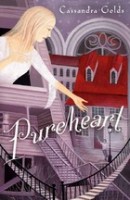
1pureheartI won’t write a proper blog post on this book because I’ve had the great privilege of reading more than one draft on the way to its final form, and don’t know if I can tell what’s actually on the page! It’s another brilliant tale of tortured female adolescence by the writer who gave us Clair de Lune, The Museum of Mary Child, and The Three Loves of Persimmon.

Cassandra Golds appeared on Books and Arts Daily recently, and gave an interview that all fans of her books should listen to.

Klaus Hagerup, Markus + Diana

Klaus Hagerup, Markus + Diana (1997, English translation by Tara Chase, Front Street 2006)

1932425594Klaus Hagerup is evidently a well known playwright, screenwriter and writer for children and teenagers in Norway. This book, whose original title translates literally as Markus and Diana and Light from Sirius, was the first of a popular series featuring 13-year-old Markus Simonsen. I don’t remember who recommended it to me, but I’m grateful to them.

The evocation of Baz Luhrmann’s Romeo+Juliet in the English title isn’t completely arbitrary: Shakespeare’s play is mentioned, but it would be a bit of a stretch to call this a tale of star-crossed lovers, or even a love story.

Markus and his friend Sigmund are fringe-dwellers among their peers, Markus because he is timid and awkward and a bully-magnet, Sigmund because he is supremely confident of his own genius and all-round superiority. As readers, we get to be deeply embarrassed by our association with them but – I’m sure Henry James said something about this being the purpose of fiction – we don’t have to suffer the consequences that association would have in real life. Markus writes highly imaginative (that is to say, lying) letters to celebrities cajoling their autographs for his vast collection. The Diana of the title is a glamorous Hollywood soapie star – Markus writes to her pretending to be a millionaire and things get weird when she writes an unexpectedly personal letter in response.

It’s very funny, carried mainly by the dialogue and the series of hilariously implausible letters. Teachers preside obliviously over a scene of mob cruelty; early teenagers struggle to master the arts of adult behaviour, and mostly fail ingloriously; boys on the cusp of puberty are fascinated by a glimpse of nipple in a photograph or through thin cloth. A lot of the time you don’t know whether to laugh at the characters or suffer with them. Mostly I did both, and in the end when – improbably expectedly, and cleverly – things turn out for the best, I wanted to cheer.

By Swapna Dutta

My friend Swapna Dutta is a writer, translator and editor, mainly of children’s literature, who lives in Bangalore, in southern India. The School Magazine published some of her stories when I was editor, and she and I have kept in touch over the intervening years. Swapna mentioned in a recent email that she had translated a children’s book, The Arakiel Diamond, from Bengali into English, and asked if I’d like a copy. Of course I was interested, and a couple of days later it arrived in my letter box, with three other books. It’s been a treat and an education to read all four.


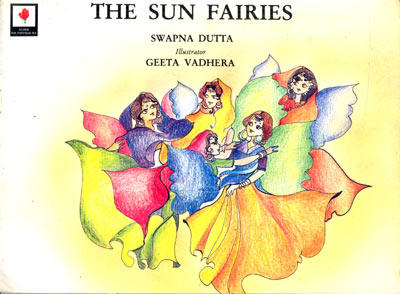
Swapna Dutta and Geeta Vadhera, The Sun Fairies (National Book Trust, India 1994, 2001)

The Sun Fairies is a tiny picture book that plays around with science and fantasy. That is to say, it’s a fanciful account of the origin of clouds – some fairies who live in the sun build castles in the sky so it won’t be so bare and empty – that ends up being a decorative but accurate account of how the water cycle works: the cloud castles are made from water, air and dust, and when they get too heavy they fall to the earth as water. The fairies have discovered ‘a never-ending game’. The illustrations, by Geeta Vadhera, are fabulous. I see from the Internet that Ms Vadhera has gone on to international renown. This may be her only children’s book.


Swapna Dutta, Plays from India, illustrated by Baraan Ijlal (Rupa & Co 2003)

In some ways each of the other books is a work of translation. In Plays from India three episodes from Indian history are shaped into dramas suitable for performance by school students. In my ignorance I don’t know whether the stories would be familiar to most Indian students, so I can’t tell whether the history or the theatre is the main point. I was interested in both.


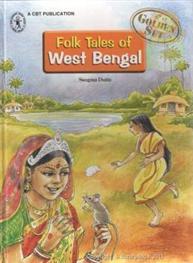
Swapna Dutta, Folk Tales of West Bengal , illustrated by Neeta Gangopadhya (Children’s Book Trust 2009)

Folk Tales of West Bengal retells sixteen tales. Swapna has an article at papertigers from which I learned that what the Grimms were for Germany, and Moe & Asbjørnsen for Norway, the imposingly named Dakshinaranjan Mitra-Mazumdar was for what is now Bangladesh and West Bengal. At least some of the tales here were collected by him in the first decades of last century. Unsurprisingly to anyone who has entered the woods of Re-enchantment, there’s a lot in these stories that’s familiar to a reader brought up on European-origin fairy stories: kings and princesses, talking animals, metamorphoses, riddles, lost and found children, supernatural beings who reward the humble and punish the greedy. There’s also a lot that’s different: the heroine of the first story, for instance, is not a seventh child but a seventh wife. This blending of familiar and unfamiliar makes for a delightful read.


Sucitrā Bhaṭṭācārya, The Arakiel Diamond, translated by Swapna Dutta and illustrated by Agantuk (Ponytale Books 2011)

The Arakiel Diamond is the only book in my swag that is not Swapna’s original work. It’s a detective story for young readers, one of a series featuring a Bengali housewife and her niece. A wealthy man dies. His most precious possession, the eponymous diamond, has gone missing, and almost everyone in his household – and there are many – has had motive and opportunity to steal it. The plot has exactly the twists you’d expect, but the detectives’ relationship and the details of their domestic life are well captured, and I learned a lot about the Armenian community in Calcutta, in a way that reminds me of grown-up detective writers (Sarah Paretsky comes to mind) who take us to a new subculture in each novel.


The four books had me reflecting on multiculturalism in children’s literature. We make fun of the way US children’s publishers, apparently believing that their intended readers would shrink from anything not immediately recognisable as of the US, re-edit books from elsewhere in the English-speaking world to remove unsightly exotica. They don’t just want a world where British characters spend dollars and cents, or Australians walk on a pavement, weird as such a world might be. I remember hearing of a New Zealand novel whose publisher suggested the book’s Maori issues might be more accessible to US children if the setting was changed to California – that author held firm and the book still found readers, even got made into a movie.

I wish now to acknowledge that I’m a bit of a kettle to the US publishers’ pot. Though I enjoyed the slight cultural disorientation I felt as I read these books, I caught myself thinking young readers would be put off by it. To make the books accessible to Australian 11-year olds, the unexamined internal argument went, you’d have to do something about lakh and crorelunghi, salwar shameez and rakhi, not to mention the nitty-gritties of the game of chess or a casual use of thrice in conversation. On reflection, I think that argument profoundly misunderstands how young people read. The only thing that universally distinguishes young from adult readers is that the young ones are younger. One result of this is that they know they don’t know everything about the world, and mostly when they read there are words they don’t recognise but have to guess from the context. (I loved and understood pulverise and invulnerable in Superman comics long before I could define them.) So you might not know what a lunghi is, but the context tells you it’s an article of clothing, and there’s even an illustration to help. Likewise, lakh and crore are obviously big numbers, and that’s all you need to know. As I remember back to my own childhood reading, I think such things would have added spice to the book: if I was young now, I might even have fun googling them. As for nitty-gritties and thrice, I do think we can trust young readers to recognise when a word or a turn of phrase belongs to a different place. (Both my sons say zed in spite of seeing quite a lot of Sesame Street when young.)

A launch

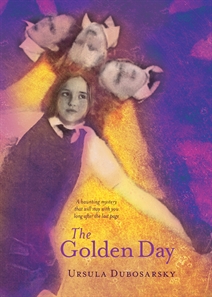
Ursula Dubosarsky’s new book, The Golden Day, was launched yesterday with a suitable sense of occasion. I’d spent the morning as an extra in a rap video clip (about which I may blog some other time), but no one at the launch seemed to notice that my usually shiny forehead was sporting a light dusting of make-up.

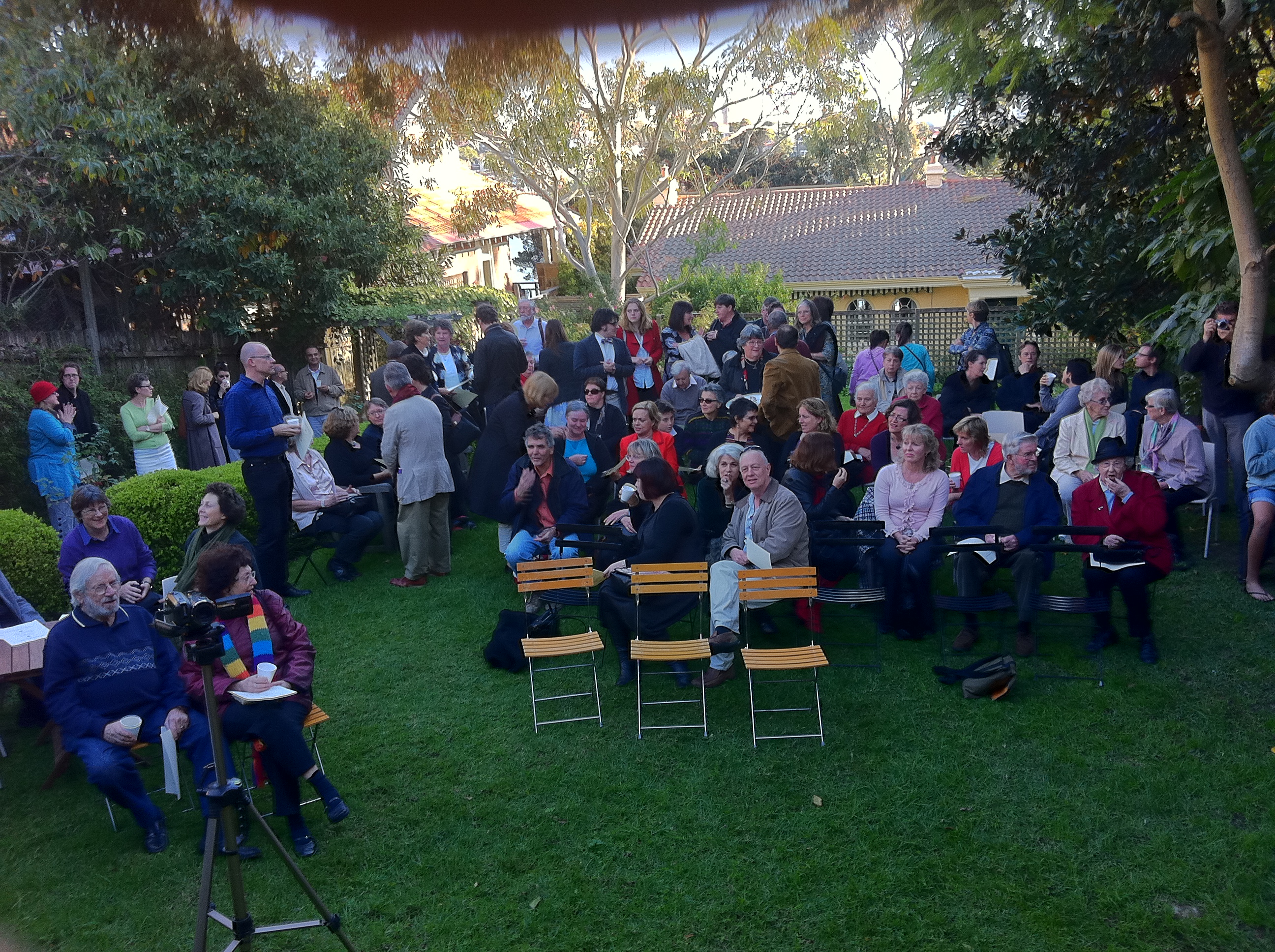
We were at Nutcote Cottage, home of May Gibbs, a lovely site for a launch. The golden light of a fine Sydney autumn afternoon, tiny muffins, cupcakes and Lamington slices would have made the mood celebratory even without a subject. As you see from the pic a new Dubosarsky book draws quite a crowd: from the publishing world, family, writers (not just for children), artists and illustrators, colleagues, Marrickville dwellers, the wife of a former Federal Minister, former students of SCEGGS Darlinghurst and even some of the book’s target audience, that is to say, children.

The Nutcote lawn

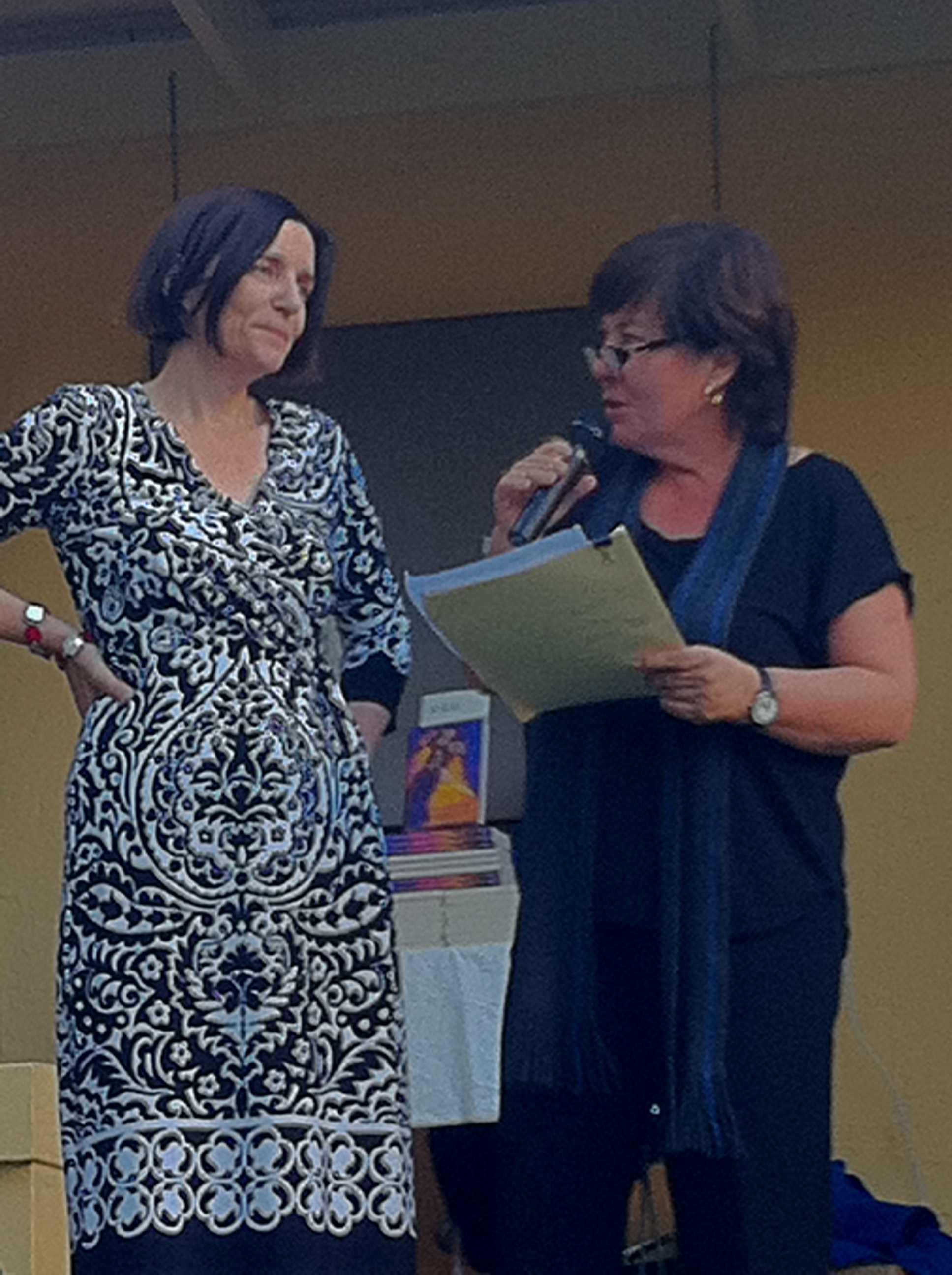
Julie McCrossin presided. Drawing on her experience as radio interviewer and stand-up comedian, she put Ursula through her paces, quizzing her about her inspiration for the book. It’s set in a genteel girls church school in the inner eastern suburbs of Sydney, a school that evidently bears an uncanny resemblance to SCEGGS Darlinghurst, of which both Julie and Ursula are alumnae. Calling on contributions from other Old Girls, they evoked a startling picture of uniformed schoolgirls making their way from the bus stop to the school gates though filthy streets where junkies and prostitutes hung out. One member of the class of ’78 was coaxed by Julie into saying that she didn’t remember much out of the ordinary, apart from an occasional flasher and the naked woman who appeared in a doorway one morning asking her to get help.

‘There are myriad kinds of writers,’ Ursula said, responding to Julie’s pressing her for the meaning of some of the incidents in the book. ‘I’m the kind of writer who lets herself go to the dream.’ I quote this because it rings so very true of Ursula’s work, but also because just a few moments later Julie referred to the ‘ ‘myriad of influences’ she detected in the book (Picnic at Hanging Rock, classical myth, etc), thereby adding a little fuel to the fire of a conversation I’ve been having recently about usage: Ursula the classicist uses ‘myriad’ as I do; Julie the journalist agrees with my journalist friend. (Are you reading this, L–?)

Julie: Might I suggest that there's an underlying theme of sexual awakening? Ursula: Oh, that's what my book's about!

Crispin: The Cross of Lead

Avi, Crispin: the Cross of Lead (Scholastic 2002)

Moving house is supposed to be one of the most stressful things you can do. It certainly claims a lot of attention, and I thought perhaps a mediaeval adventure for young readers would be an appropriately diverting read. Crispin: The Cross of Lead turned out to be just the ticket – it’s straightforward but intelligent, with enough authenticating detail, political savvy and period vocabulary (I’m familiar with terce, sext and none, can guess what a glaive is, and had to look up mazer) to be interesting.

The 13 year old hero – ‘Asta’s son’ – doesn’t even know his own name at the start of the book. He and his mother have been outcasts in their small village, and now that his mother has died he is almost completely alone in the world. Things get rapidly worse. For reasons he doesn’t understand his life is threatened, and he flees the village that is all he has ever known. He is taken under the wing of a traveling juggler who turns out, of course, to be more than he seems, and we get an age-appropriate taste of the kind of 14th century European politics that informed Umberto Eco’s Name of the Rose. There’s a twist involving the young hero’s identity that you might be able to guess even from that wispy outline, and would be unsurprising to most of the 10 to 12 year old target readership (a phrase that always reminds me of a Tohby Riddle cartoon where a cheerful adult is taking aim at the head of a small child with a book that’s about to become a projectile). The final scenes are awfully implausible, in way that suggests a tight deadline was being met, but that wasn’t enough to take away from my enjoyment of the book as a whole.

If you don’t know Avi’s work (evidently that’s not a pen name, but the name he was given by his sister when he was small it’s the only one he uses now in his early seventies), I’d recommend starting with The True Confessions of Charlotte Doyle, in which another 13 year old has equally implausible but wonderfully swashbuckling adventures on the high seas in the early 19th century.

The School Magazine on RN’s Hindsight

I received a text message yesterday afternoon: ‘You’re famous!’

Yes, the Hindsight program on The School Magazine went to air and my voice has now been heard by the vast multitudes who listen to the ABC on a Sunday afternoon, and the rest of the world can hear it on Thursday 16th at 1 o’clock in the afternoon. You can download it or listen to it here. My earlier post said it was scheduled for next Sunday – it was moved forward.

Lorena Allam, the producer, did a marvellous job. I expected her to use a couple of seconds of my semi-coherent ramblings, but it turns out there’s an awful lot of me in it, and she made me sound reasonably intelligent. Of course there are a dozen omissions, but since the program focussed on the period from 1950 to about 1980, it would have been a big ask to give Duncan Ball, Tohby Riddle or Joanne Horniman more than a passing mention, or to squeeze in a mention of Geoffrey McSkimming, Margrete Lamond, Kim Gamble, Di Bates, Judy Ridge, to mention only people who have worked for the magazine, let alone the writers who were first published there. And Oh, the poets!

But have a listen. There’s some lovely stuff there. I particularly like the way much is made, correctly, of Patricia Wrightson and Lilith Norman as formidable figures, and then Cassandra Golds, remembering herself as an opinionated 11 year old, says she had no time for them at all.

Added later: Joanne Horniman has written a blog post giving the long version of a major incident in the magazine’s history that was mentioned briefly in the program. It’s at http://www.secretscribbled.blogspot.com.

And later again: Another grace note from Joanne Horniman here.

Patricia Wrightson has died

There’s a tiny piece by Rosemary Sorenson in the Australian, but so far the death of Patricia Wrightson this week has gone unremarked in the media.

When I became editor of The School Magazine in the 1980s, I was awed by the knowledge that I was stepping into her shoes. As I understand her work, her central concern was with the disjunction for settler-society between on one hand the experience of living in Australia and on the other having a children’s fairy-tale heritage deeply rooted in European landscapes and histories. In books like The Nargun and the Stars and A Little Fear she set out to create fairy stories that were grounded in the Australian reality. She drew on Aboriginal motifs and, I heard her say in a lecture, was meticulous in consulting Aboriginal friends. I think most people these days would see the project as a noble dead end, smacking too much of appropriation. Certainly in my last months at the magazine, a reasonably ignorant education department functionary was at pains to explain to me that the Aboriginal stories of  ‘Judith Wrightson’ were not politically acceptable.

There will be much discussion of Patricia Wrightson and her work on the Internet over the next couple of weeks. ALA Connect, for example, is inviting people to post comments. I happen to have a photocopy of a wonderful letter she wrote in 1974 to a school principal, which I reproduce here for your pleasure and edification:

Dear Mr XXXXX

Thank you for your letter of July 11th regarding the phrase ‘wipe your bottom’ in the June issue of School Magazine Part 2.

I am sorry you found this homely phrase objectionable. It must be pointless to indicate that it was written by one of our leading poets and writers who is now Chairman of the Literature Board; or to ask whether ‘smack your bottom’ or ‘wipe your nose’ would have been so offensive; or to ask for a clear explanation of what is offensive in the phrase. I can only say that we cannot possibly undertake not to be offensive.

We continually offend. We offend by failing to keep in touch with the fast-moving world of young readers and by being too contemporary; by a rigid adherence to syntax and formal style, and by our disregard of them. Our verse is both too classic and too unclassic. We offend by speaking with respect of the church and the theory of evolution; the plight of captive nations and the achievements of communist countries; Anzac Day and the laws relating to Aborigines. We can only follow our usual policy of holding a balance between  these things while still aiming for honesty and life.

As to your use of School Magazine in the future, that is always a matter for your decision. Withholding the magazine from children is another matter. It is produced for the children, and those who wish to read it are entitled to receive it.

Yours faithfully

Mrs Patricia Wrightson
Editor
School Magazine

She was not a woman to mess with. At a children’s literature conference in the USA in the mid 1980s, a children’s librarian told me with awe about a lecture by Patricia: ‘She was a very wise and challenging lecturer, but at the same time as easy and comfortable as an old boot.’ As this letter demonstrates, she could also sink the boot when necessary. I never met her. I don’t know anything about the circumstances of her death. I mourn her passing.

The Happiness of Kati

Jane Vejjajiva, The Happiness of Kati (2003, translation by Prudence Borthwick, Atheneum 2006)

This book is a rarity: a children’s book written in Thai and translated into English. Perhaps that’s why it was recommended to me. It’s short, and I decided to read it as a gap-filler while waiting for another Book Group member to finish with my copy of Truth. This may not have been a mistake, but I do regret the disrespect: the book certainly wasn’t written to be a gap filler.

At the start of the book Kati is nine years old and living with her grandparents. Her parents are noticeably absent, and the absence of her mother is particularly stark because each of the first several short chapter headings has a subheading that mentions her. The first chapter, for instance, is ‘Pan and Spatula’ with a subheading, ‘Mother never promised to return.’ The chapter has quite a lot to say about the pan and spatula Grandmother uses to cook rice, but is silent about Mother. Just as one is beginning to think Mother must be dead, it turns out that she is very ill, and there’s the possibility of visiting her. It’s a very effective device – and the complete silence about Kati’s father, which lasts quite a bit longer, gains power from it.

I don’t think it’s too spoilerish to say that Kati’s mother has motor neurone disease (or amyotrophic lateral sclerosis, as it’s called in this US translation), and that she dies. I won’t go further into spoiler territory, except to say that if this were an Australian or US book, there would very probably be a big emotional death scene towards the end of the book, but here the death happens so quietly that I wasn’t sure it had happened until a couple of paragraphs later, and it comes at about two-thirds of the way through the book. This unexpected structure, as much as the unfamiliar food, plants and family relationships, made me aware I was engaging with a mind from a different culture. I enjoyed it and I’m glad it slipped through the net to reach English-speaking young people – though I notice that my copy was withdrawn from the Albany NY Public Library less than four years after publication without much wear and tear, suggesting that it didn’t reach very many of them.