
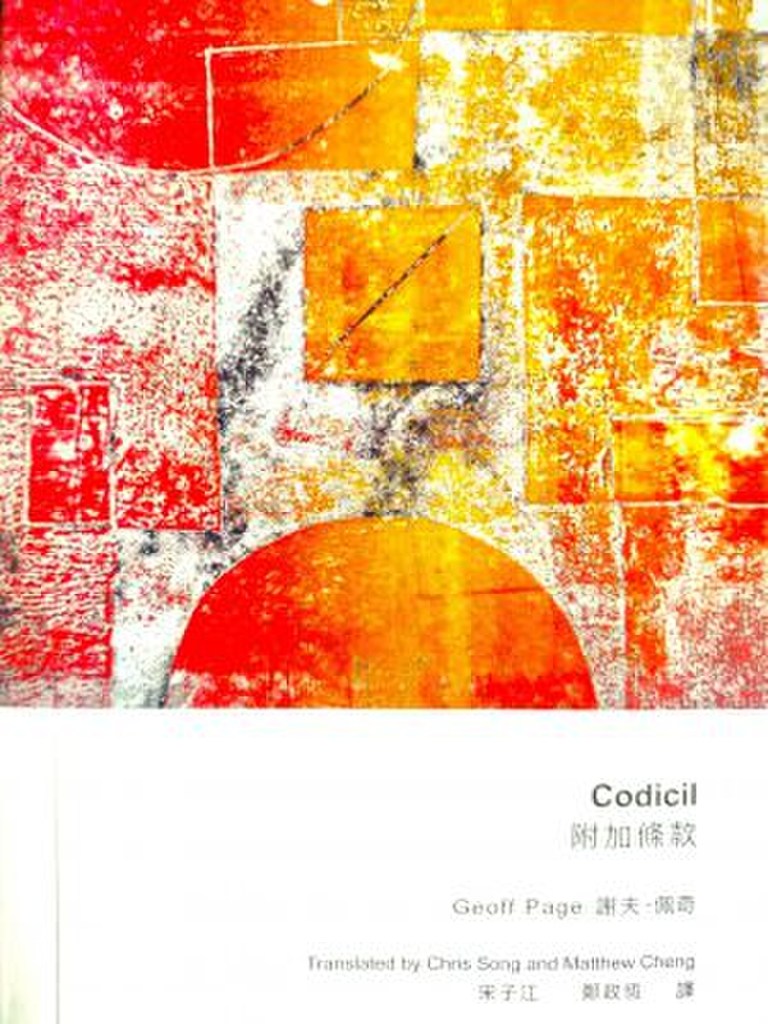
Geoff Page, Codicil, translated into Chinese by Chris Song and Matthew Cheng (Flying Island Books 2019)
It’s National Poetry Month in Australia. The Red Room Poetry site lists a plethora of events, workshops and competitions, promoted by ambassadors ranging from journalist Stan Grant to comedian Suren Jayemanne.
Codicil is the third book of poetry I’ve read so far in Poetry Month. I plan to read and blog about three more.
Geoff Page’s poetry has been around for a long time. I have an alarming number of anthologies of Australian poetry on my bookshelves, and his work appears in most of them, from Poet’s Choice (Island Press 1971, a limited, hand-set and -printed edition of 500 copies) to Contemporary Australian Poetry (Puncher & Wattmann 2016). His work is wonderfully accessible, using traditional forms without being trite or hidebound. For an intelligent discussion of his poetry, you’d find it hard to go past Martin Duwell’s review of his New Selected Poems (Puncher & Wattmann 2013). The whole review is worth reading, but I’ll just quote his description of Page as ‘a public poet who reflects the social concerns of the time of the Bicentennial and into the first decade of the twenty-first century’, and as a writer of personal poems with the ‘dominant image of himself as an outsider in a family he loves’.
Duwell’s description fits Codicil, which includes some new poems and at least three of his most anthologised poems, ‘Smalltown Memorials‘ (1975), ‘Grit’ (1979) and ‘My Mother’s God‘ (1988) – the links are to recordings of Page reading the poems on the Poetry Archive website. What I take to be the most recent poems here deal with ageing and the approach of death – the title poem is instructions for the disposal of the poet’s ashes on the Clarence River, where he spent his childhood.
I imagine that the poems were selected by the translators, themselves accomplished poets in Hong Kong, with the intention of introducing Page’s work to Chinese readers. I wish I could read Chinese, because I’d love to know how they have dealt with the frequent Australian idioms and throwaway references. Like this from ‘Three Akubras’:
Three Akubras in a row
my brothers underneath them
standing at the saleyards there
Or this, from ‘Severance’, an imagined speech to an employee being sacked:
User Pays and
Market Forces
are all the rhet-
oric you'll get.
(And what have they done with that weird hyphen that’s there for the sake of metre and rhyme?)
And I’d love to know what a Chinese reader might make of his occasional professions of allegiance to iambics, as in ‘I Think I Could Turn Awhile’, in which he imagines writing ‘like the Americans’, an heir to Whitman. But then:
I'd hear the clipped
iambics calling,
my template just
beneath the line
For me, alas, the bilingual aspect of the book amounts to a purely visual effect – and it is fascinating to see what these very Australian poems look like in Chinese characters.
Here’s an image of pages 77 & 78*:
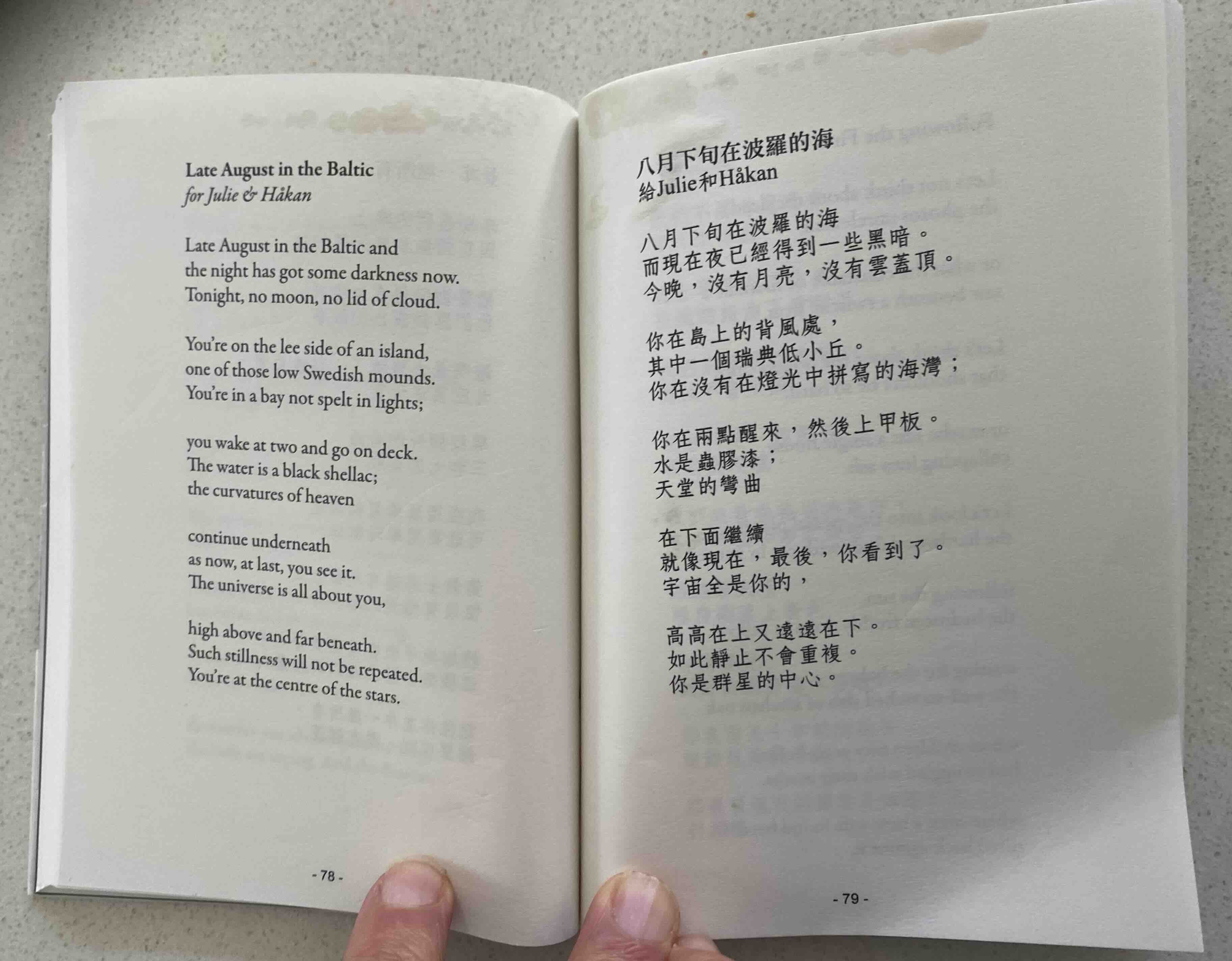
The poem, first published in Island magazine in September 2009, is neither a public poem dealing with issues of the day, nor a personal poem dealing directly with family or mortality. I read it as a letter to friends who are on a boat somewhere on the Baltic Sea, perhaps in response to a photo they have sent. Whatever, it’s a wonderful evocation of a still, moonless night on the water.
It’s almost a sonnet. The first eight lines paint the scene, and the almost perfectly regular iambic pentameters (de-dum de-dum de-dum de-dum) enact the calm of the night.
Late August in the Baltic
for Julie & Håkan

Late August in the Baltic and
the night has got some darkness now.
Tonight, no moon, no lid of cloud.

You're on the lee side of an island,
one of those low Swedish mounds.
You're in a bay not spelt in lights;

you wake at two and go on deck.
The water is a black shellac;
Then there’s a turn, so gentle, in mid stanza with just a semicolon to mark it. The lines get shorter, and the literal elements of the poem – the island, the time of year, the deck, the absence of lights on shore – give way to more fanciful language:
the curvatures of heaven

continue underneath
as now, at last, you see it.
Then the regular iambics re-establish themselves – as if a small wave of metaphor has momentarily disrupted the stillness of the poem, and it can now continue, but with a broader view:
The universe is all about you,

high above and far beneath.
Such stillness will not be repeated.
You're at the centre of the stars.
Pause for a moment to look at the second last line. Without it, the poem would have been a sonnet, and the bunching up of sibilants in ‘Such stillness’ strikes a dissonant note. I don’t think this is a flaw. What the line says – a warning not to expect life always to be like this – is unobtrusively reinforced by its comparative harshness and a faint sense that it disrupts the form. Whatever, it makes sure that what is to come in the last line is read as humbling rather than grandiose.
The last line gives us the word that has been implied but conspicuously missing from the first part of the poem: ‘stars’. It’s not completely irrelevant that this is the word that comes at the end of each book of Dante’s Divine Comedy.
We are at the centre of myriad points of light – not a narcissistic centre, but one who for this unrepeatable moment has a glimpse of the immensity and splendour of the cosmos. I’m reminded of Yayoi Kazuma’s infinity mirror rooms.
I’m in awe of Chris Song and Matthew Cheng for taking on the task of translating a poem that works so much through the rhythms and traditions of its native language.
I read Codicil on Wulgurukaba land, beautiful Yunbenun. I wrote the blog post on the land of Gadigal and Wangal of the Eora Nation. I acknowledge Elders past and present of all those Nations, and welcome any First Nations readers.
* My blogging practice is to focus on the page that coincides with my age, currently 78.


 Me fail? I fly!