
Claire G. Coleman, Enclave (Hachette Australia 2023)
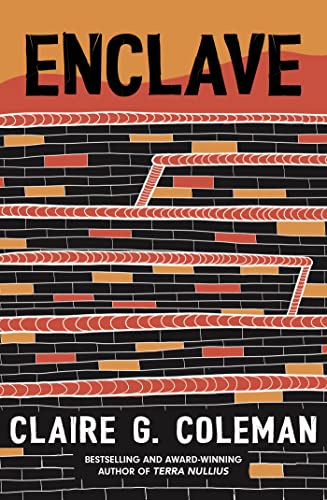
This is the first book I’ve read by Noongar writer Claire G. Coleman. Her first novel, Terra Nullius, won prestigious prizes and her poetry and essays appear regularly in journals I read. (If you want to plough through my earlier posts to see what I’ve managed to say about those earlier encounters, here’s a link.) So I was happy when I got hold of a copy of Enclave, her third novel. I enjoy science fiction, so the fact that it’s a dystopian genre novel was an extra cause for joyful anticipation.
The book delivered on both fronts – filling the spot in my heart reserved for intelligent speculative fiction, and expanding my acquaintance with Claire G. Coleman’s writing. If you want to read a proper review, I recommend Magdalena Ball at Compulsive Reader (here’s a link), Maggie Nolan on The Conversation (link), Bill Holloway at The Australian Legend (link)or all three.I’ll stick to my resolve of focusing on page 78*. As often happens, this arbitrarily chosen page reveals a lot about the book, and hints at a lot more.
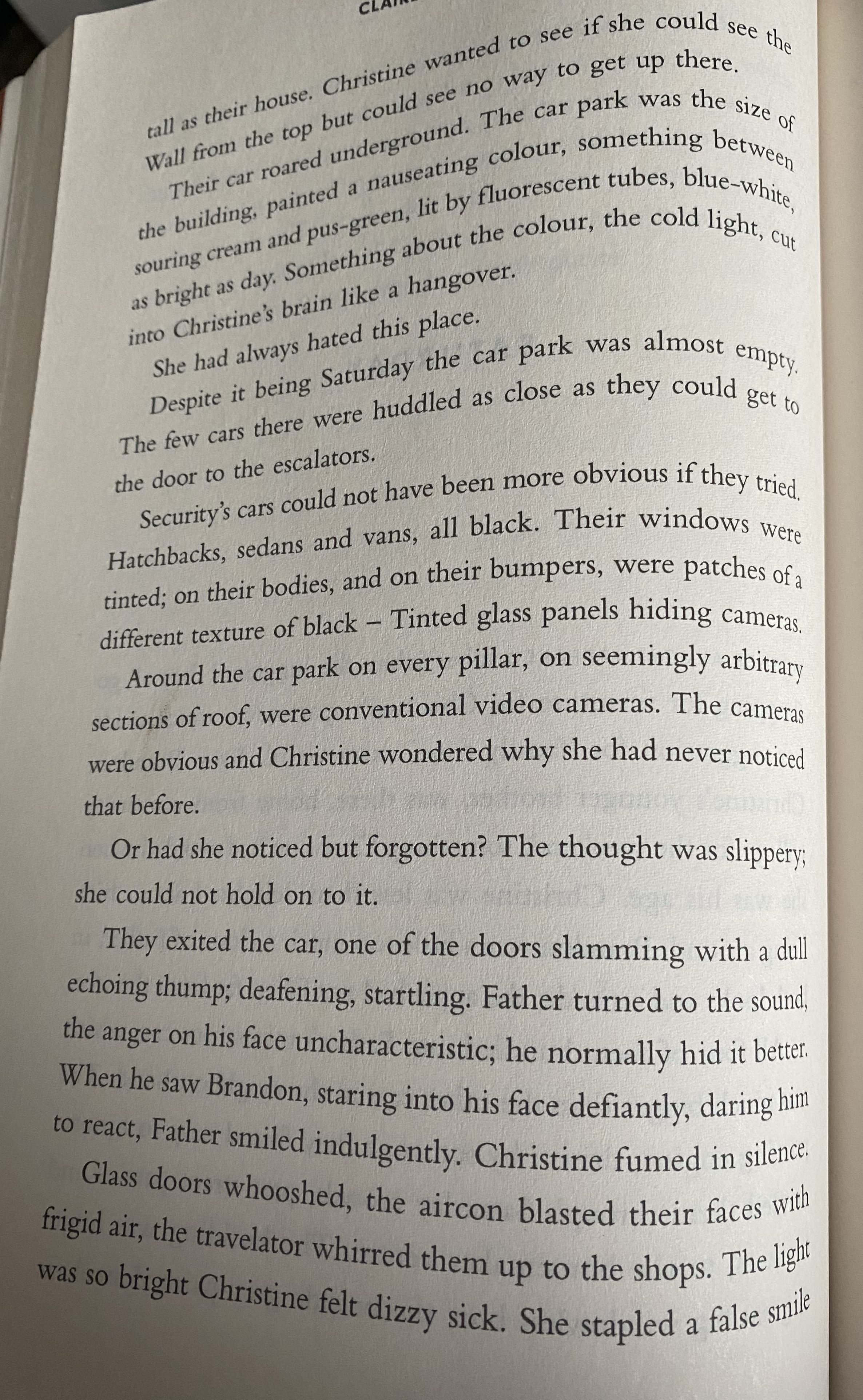
We are at about the one-quarter point of the narrative. Christine is the protagonist, a young white woman from an affluent family living in the walled city of Safetytown. Her father has bought her a new apartment as a reward for her success at university, and on this page her parents are taking her to ‘the homemaker centre’ to buy furniture, along with her younger brother, Brandon.
The building was huge. A great big windowless box, the outside grey-painted steel, as tall as their house. Christine wanted to see if she could see the Wall from the top but could see no way to get up there.
Their car roared underground. The car park was the size of the building, painted a nauseating colour, something between souring cream and pus-green, lit by fluorescent tubes, blue-white, as bright as day. Something about the colour, the cold light, cut into Christine’s brain like a hangover.
She had always hated this place.
The citizens of Safetytown are constantly being told how fortunate they are, how safe. Yet the adjectives here tell a different story: ‘windowless’, ‘grey-painted’, ‘nauseating’, souring’, ‘pus-green’. Even more significant is the ever-present Wall. It’s a powerful image, inevitably reminding us of Trump, Berlin and Israel–Palestine. Christine has always been told that beyond it is nothing but predatory violence, misery and chaos. In the otherwise sharply visual elements of this page, it is present to Christine as an object of curiosity even though it’s out of sight. She is beginning to suspect that she has been lied to: she is clear that she has always hated the homemaker centre, but a deeper discontent is brewing.
The next paragraph goes further into the reasons for her discontent:
Security’s cars could not have been more obvious if they tried. Hatchbacks, sedans and vans, all black. Their windows were tinted; on their bodies, and on their bumpers, were patches of a different texture of black – tinted glass panels hiding cameras.
Around the car park on every pillar, on seemingly arbitrary sections of roof, were conventional video cameras. The cameras were obvious and Christine wondered why she had never noticed that before.
Or had she noticed but forgotten? The thought was slippery; she could not hold on to it.
This first part of the novel is about Christine’s awakening. Here she’s noticing things she has never noticed before, in particular the ominously ubiquitous surveillance and enforcement. Not on this page, but part of the same process, she has noticed that one of the anonymous brown ‘servants’ is extraordinarily beautiful. These uniformed servants, all people of colour, are bussed in each day from beyond the wall and then out again in the evening. They ensure that the citizens don’t have to lift a finger to tend to the necessities of life. No one asks how they live on the other side, and in the early chapters they might as well be invisible, but like the women in the movie Conclave they are very present to the reader. Christine’s attraction to the woman servant is so outside the realm of what is considered possible that, like her ‘slippery’ thought about the cameras, it only fitfully enters her consciousness.
They exited the car, one of the doors slamming with a dull echoing thump; deafening, startling. Father turned to the sound, the anger on his face uncharacteristic; he normally hid it better. When he saw Brandon, staring into his face defiantly, daring him to react, Father smiled indulgently. Christine fumed in silence.
So much of what is to unfold is hinted at here. The benevolent father bestowing a brand new flat and furnishings on his daughter is suddenly enraged: not that he’s usually calm, but that he normally hides his rage. When he sees that it’s his son who has made the noise, he is pacified. It will come as no surprise, a few pages later, when the rage is unleashed against his daughter, while the son remains firmly in favour.
So Safetytown is authoritarian, sexist and – we know from earlier and will soon learn – intensely racist and homophobic. Christine is noticing at least some of it, and fuming.
The overall shape of the narrative is strongly implied on this page. Christine will incur her father’s wrath. Somehow she will find herself on the other side of the wall. Will she finally discover she has been lied to all her life? (Anyone who’s read any dystopian fiction would be astonished if the answer to that was no.) Will she escape or be exiled to the other side of the Wall? (See previous parenthesis.) Will she find a better world out there? (Likewise, you’d be pretty astonished at a no answer.) Will she find happiness with the beautiful brown servant woman, and will that woman have a name? (See previous parenthesis.) Will she play a role in bring Safetytown down? (One would certainly hope so, but that would mean she’d have to make giant strides out of her complacent self-absorption.) Perhaps most importantly for the success of the novel: are there any surprises? (No spoiler alert, but yes.) Does it get preposterous? (Yes – in many ways, but mainly in a delightful sequence that could only have been imagined by someone who lives in Naarm/Melbourne and loves it with a passion.)
Bill Holloway at The Australian Legend enjoyed this book less than Claire G. Coleman’s two previous novels, Terra Nullius (Hachette Australia 2017) and The Old Lie (Hachette Australia 2019). I take that as encouragement to go looking for them.
I wrote this blog post on land of Gadigal and Wangal of the Eora Nation. I acknowledge the Elders past and present of this country, never ceded.
* It’s my current age.


 Me fail? I fly!