Tag Archives: Clive Hamilton

Books I read in April [2007]

[7 August 2025: I’ve retrieved this post from my old blog because I’m currently reading a book by Geoff Page, and Lawrie & Shirley, reviewed here, is the only other book by him I’ve read since I started blogging]

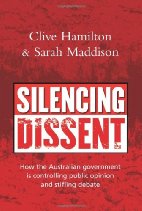
Clive Hamilton & Sarah Maddison, Silencing Dissent (Allen & Unwin 2007)
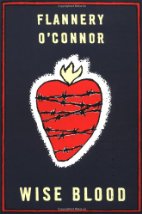
Flannery O’Connor, Wise Blood (1949)
Tim Baker (editor), Waves: great stories from the surf (HarperCollins 2005)
Geoff Page, Lawrie & Shirley: the final cadenza (Pandanus Poetry 2006)
Markus Zusak, The Book Thief (Pan Macmillan Australia 2006)
Leonard Cohen, Book of Longing (Viking 2006)
Heat 13: Harper’s Gold (starting)
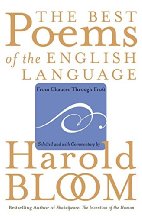
Harold Bloom’s Best Poems (continuing)
dissent

Gillian Leahy’s movie Our Park has a special place in my heart because the park in question is my local park. But it’s got an even stronger hold on my affections because of its uncomfortable, even gruelling depiction of democracy in action. As they struggle over what use should be made of a little patch of semi-derelict land, people disagree passionately, at times (off camera) come to blows, and (on camera) declare intense animosity for each other. But things are thrashed out. Many points of view are heard. Everyone owns the final result.

That’s not how democracy works in Prime Minister John w Howard’s Australia. People do get beaten up, of course, mostly off camera and with a legal requirement not to talk about it. But disagreement with the government’s policies doesn’t get much of a look-in. Silencing Dissent is a chilling look at the way dissenting voices have been systematically intimidated, bribed, excluded, marginalised or drowned out over the last decade or so. It lists the democratic institutions that have been undermined: the media, the senate, non-government organisations, intelligence and defence services, the public service, universities. Because it’s a book of essays all making the same point, there’s quite a bit of overlap and repetition, but for slow learners like me that’s all to the good. A young friend of mine is fond of saying that the Coalition are Fascists (he intends the term precisely) and that only cowardice stops people from saying so; the detail accumulated in this book makes him seem less hyperbolic.

wblood

To cheer myself up I moved on to a bit of fiction by Flannery O’Connor. I hope that sentence doesn’t make her turn in her grave, but paradoxically there is something cheering about Wise Blood. It reads to me as if it was written in a trance – as if some twisted angel had dictated it and the young Ms O’Connor just wrote it down, trusting it would amount to something. Most of its characters are all ‘a little bit off their heads’ and some are a big bit off the rails. Hazel Motes, played by Brad Dourif in the John Huston movie which I plan to watch again on DVD soon, is in obsessive revolt against the punitive and repressive Christianity of his childhood, and burns with an evangelical imperative to preach a Church of Christ without Christ (I would have said cacangelical but the word doesn’t seem to exist).

I remember reading a review of the movie that compared Hazel to the Monty Python character who was trying to train ravens to fly underwater. That comparison captures the bleak comedy of the book, but leaves out the appalling sense of waste and, in the end, awe that Hazel inspires. Flannery O’Connor was a Catholic living in the southern US. The characters in this book are all Protestant. Maybe she’s observing them from the other side of a sectarian fence and seeing them as wildly deluded, but the pervasive sense of intractable mystery, of not-knowing, and the lack of overt authorial commentary, makes a sectarian reading seem wide of the mark. I finished the last page with a sense that I’d been taken somewhere dark, weird and scarily believable.


waves

I read Waves as research for work. It reminded me in a roundabout way of an early review of David Williamson’s play The Removalists. As you probably know, in the course of that play, a man – Kenny – is terrorised and beaten up by two policemen. The review I’m thinking of by the late, magisterial H. G. Kippax, found fault with many aspects of the play, including the victimised man being described as a typesetter: according to Kippax, typesetters were not working-class yobbos like Kenny, but quirky individuals who were forever surprising their acquaintances with odd snippets of information. It came with the territory, you see: according to Harry, typesetters read much more widely, if also more shallowly, than normal people who weren’t handling other people’s words for their entire working lives. Like those possibly mythical beings, I often find myself acquiring information about the most unlikely subjects. Waves introduced me to a new world of specialised language: technical language for describing waves and related phenomena (lefties, beachbreaks, righties, peaks and barrels); jargon associated with surfing equipment and practice (coaming, mals, floaters, nosedives, guns); and the argot of the surfing culture, which includes but is not limited to the other two (groms, kahunas, charging and stoked).

The bit I enjoyed most was grand old champion surfer Nat Young’s 1974 encounter with Patrick White (whom Tim Baker describes disarmingly as a ‘gay literary luminary’). After Young is quoted as saying how important The Tree of Man had been to him, we are given this glimpse of Patrick White as filtered through a surfer sensibility:

This unlikely pair discovered they had a connection that went back twenty-five years. ‘He was living down at Werri at that stage, him and his boyfriend, and they were very much in love and they used to spend a lot of time walking on the beach. He said he used to watch surfing and watch waves. Werri, from my childhood, was very important because there was a golf club and it was abandoned and we used to go in and just stay there. And Patrick understood. He said, “Oh, we used to laugh about the way the golf club had turned into a derelict place and the surfers were squatting there on the weekends.” So he knew exactly where my head was at.’


lawrie

Lawrie & Shirley was a birthday present from my niece Paula.

Somewhere along the line I’ve absorbed, without really noticing it, the notion that poetry should be difficult – if it’s not difficult it’s doggerel; almost: if it rhymes and has a sense of humour, it must be bad. Not that I hold these assertions to be true, but they have insinuated themselves into my brain. But hell, if Lawrie and Shirley is doggerel, then let’s have lots more.

It’s a rhyming narrative, ‘A Movie in Verse’, about a relationship between a man in his early eighties and a woman who’s not a lot younger. Each of its 47 ‘scenes’ opens with screenplay-style directions of the ‘INTERIOR. DAY’ variety, and the story progresses mainly through visuals and dialogue. It’s light, funny, has an unsurprising range of characters (middle-aged children who see their inheritances threatened, disapproving former friends, etc), and manages to feel like an enjoyable romantic comedy, albeit a geriatric one. The great fear that hangs over the characters isn’t death – everyone knows that death isn’t far off – but disability, and more specifically dementia. I wouldn’t say it’s a major focus, but it crops up from time to time. Like this, where Shirley takes Lawrie to visit her aunt Ida in a nursing home – also a nice example of how the jolly dump-de-dum of the tetrameters can tilt over into genuine pathos:

Shirley looks around the room,
trying to locate the smile

she'll recognise as Auntie Ida's.
And finds her after quite a while

away off in a distant corner,
wasting quietly in a chair,

doing absolutely nothing,
no recognition in her stare;

no smile, no words like 'Hello, Shirley';
no formula like 'Hello, dear'.

Shirley stoops to take her hand
and, fighting back a hidden tear,

sighs to Lawrie, close beside her,
'There's no one in there any more.'

Eventually, they turn about
and walk back down the corridor.

Cross-fade to a final shot
of Ida's vacant, lunar face,

a kind of undiscovered planet
staring coldly into space.

thief

The Book Thief, another birthday present, is a terrific read. I guess it’s a YA title, though some of those famously nervous school libraries might have trouble with the swearing – even though it’s in German, it’s all meticulously translated. The action of the story takes place in a small community near Munich during the Second World War, and is narrated by Death, who doesn’t enjoy his work, is deeply curious about human beings and charmed by them even in the middle of the immense overwork of that period.

Such dark material, but delivered with delicacy, affection and even lightness. Some elements of the presentation might seem irritatingly tricksy to some readers, but they worked fine for me as something like aeration. There are two or three short books, lyrical graphic novels you might call them, within the book, and every now and then a short piece of text is separated from the body and printed in bold type with its own little heading: a key piece of dialogue, some background information on a character, statistics on parts of the war. I read a review somewhere online taking the book to task for trying to exculpate the German people over the murder of the Jews: that’s absolutely not how I read it. These are recognisably human people. They love their children; some take actions, small or huge, against the prevailing Nazis; all of them, willingly or by cruel force of circumstance, are complicit; and all of them suffer. The book has won awards, and it deserved them.


longing

Leonard Cohen’s book is a weirdly mixed bag. There are some memorable serious poems, introspective and embarrassingly honest; and one or two witty throwaways. There are the lyrics of songs, several of which are on his 2004 album, Dear Heather (I’ve just listened to them, and they’re fabulous as songs). But too much of it reads like excerpts from his notebooks – whingeing effusions about being fat, old, failing in love and as a monk, past his prime as poet and singer if he ever had a prime – adorned by innumerable variations on the same gloomy charcoal self-portrait, most of them accompanied by gnomic handwritten annotation. My sense is that if Leonard Cohen wasn’t a celebrity this book wouldn’t have seen the light of day, or at least would have been a much slimmer volume. I suppose we should be grateful that his celebrity status derives largely from his writing! The longing of the book’s title is everywhere, shot through with despair. Frankly, as a preacher in a Peter Cook sketch once said about sex and violence in the movies, we get enough of that at home. When the poem ‘Titles’ asked me:

and now Gentle Reader
in what name
in whose name
do you come
to idle with me
in these luxurious
and dwindling realms
of Aimless Privacy?

I was tempted to reply, ‘G-d alone knows.’ It’s a beautifully produced book, feels good in the hand, and there are some very good things in it. Deeply committed fans will almost certainly love it. I think his editor has let him – and us – down.

bloom

Sporadically I continue my way through the Bloom book: Edward Lear and Lewis Carroll made the cut, and make strange bedfellows indeed with Yeats, Hardy and the guy who wrote ‘Et in Arcadia Ego’ (‘I have been faithful to you, Cynara, in my fashion’). In his commentary, Harold does seem to like letting us know about intimate or passionate relationships poets have with people of the same gender.
heat13

I’ve just started the Heat. Gillian Mears has multiple sclerosis, and some years ago had an unrelated, horrific medical crisis that brought her close to death. When she was securely back from the brink, she bought an old ambulance and set off on a solitary adventure, driving and camping solo for many months. Her account of it is the first article in this issue, and it makes me hope that she has a book in mind: there are Walden-ish moments in the New South Wales bush, House MD-ish urgencies, a beautiful rendering of the way a mind does unexpected things in crisis …
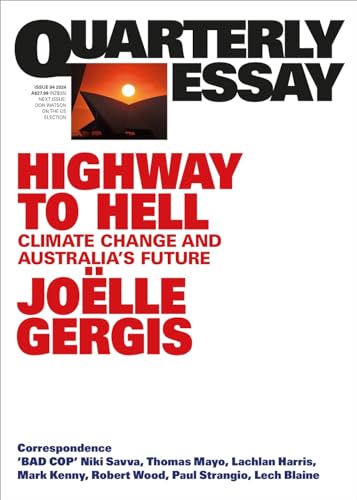
 

Joëlle Gergis’ Highway to Hell

Joëlle Gergis, Highway to Hell: Climate Change and Australia’s Future (Quarterly Essay 94, 2024) – plus correspondence in Quarterly Essay 95

I’ve worn a Peter Dutton mask with devil horns in street theatre outside Anthony Albanese’s office. I’ve asked awkward questions at the AGMs of fossil fuel companies, scripted by Market Forces. I’ve participated with gusto in Move Beyond Coal‘s campaign targeting banks that provide financial backing to new coal mines. I joined the People’s Blockade of the coal port of Newcastle last November and plan to join again this year. Do I need to read ONE MORE BOOK on climate change?

Well, yes, I do. I had pushed out of my mind the terrible events of Summer 2021–2022. I even wrote about Judith Beveridge’s poem ‘Choirwood’ as if it offered some kind of hope after those fires (at this link). After reading Joëlle Gergis’s essay, the poem is still brilliant, but it feels like so much whistling in the dark.

Joëlle Gergis is one of the 234 lead authors of the most recent IPCC Report. She is a climate scientist who, she tells us in this essay, has become so frustrated at the way the reality of climate change is downplayed or ignored by those in power that she quit her job as an academic scientist to become a public advocate. I’d say she has become a Cassandra warning of the dangers, except that Cassandra was doomed to be ignored, a fate I hope will not befall Joëlle, for all our sakes.

After noting the relief of seeing the end of the denialist Morrison Government (remember ‘Labor’s war on the weekend’, and ‘Don’t be afraid, this is carbon’?), the essay tackles the current situation – better, but a long way from hopeful. Here’s a key paragraph, on page 7:

The scientific reality is that, regardless of political spin used to justify the continued exploitation of fossil fuel reserves, the laws of physics will keep warming the planet until we stop pumping carbon into the atmosphere and begin cleaning up the mess. The situation is too far gone for renewable energy alone to save us. Pinning our hopes on carbon capture technology to justify the continued burning of fossil fuels is a disastrous gamble the world can’t afford to take. So, as this fateful moment approaches, we need to take an honest look at the government’s climate policy and realistically assess the situation we are in. Are the climate wars really over, or has a new era of greenwashing just begun?

As she goes on to say what the laws of physics are up to and to outline a range of future scenarios, she begs us: ‘Please, don’t look away. Thee isn’t a moment to waste.’

I won’t try to summarise the science, but if you’re looking for a solid, accessible presentation, I doubt if you’ll find a better one anywhere. It’s a gruelling read, from which my main takeaway is that I need to grieve for the corals of the Great Barrier Reef that thrilled me as a child, for the thousands of cattle and millions of wild animals that have died and are yet inevitably to die as the planet heats up, for the vast tracts of forest, including rainforest, that have already been devastated. I need to grieve and I need to treasure what remains – and be prepared to fight for it.

After a blistering account of carbon offsets and carbon capture and sequestration (CCS) in a chapter headed ‘Chasing Unicorns’, she asserts that we know what needs to be done, but such is the power of the fossil fuel lobby that Australian governments won’t do it. True, there has been significant movement in State governments, and outside of government. But it’s pretty grim, when the main message to the reader about what can be done is to stress the importance of voting in the next federal election.

Almost any paragraph from this essay is worth quoting and pondering. On page 47*, there’s this:

To its credit, the Albanese government has tried to support Australia’s emergence as a renewable energy superpower. [She lists an impressive number of initiatives taken since the ALP’s election win in May 2022.] While these are all steps in the right direction, the challenge is not to undo all of this good work by allowing the interests of the fossil fuel industry to co-opt the process and weaken real progress towards reducing global emissions.

Rather than ‘net zero’, the goal must be to achieve ‘real zero’, which can only happen once we stop burning fossil fuels. In fact, the science tells us that around 60 per cent of oil and gas reserves and 90 per cent of coal must remain unextracted if warming is to be limited to 1.5°C. There is no way around having to eventually face this scientific reality.

But instead of facing facts, in December 2023, the federal government caved in to lobbying from the oil and gas company Santos.


The correspondents in Quarterly Essay 95 mostly agree with and amplify the arguments of the essay. There’s an excellent piece by David Pocock, who is probably the parliamentarian that Gergis meets with early in the essay. He describes his shock as a senator now for a little over two years to see how ‘policy is consistently shaped by political considerations ahead of evidence and research’. Often he says, politicians ‘are not looking for genuine, long-term solutions, but for the next opportunity to back their opponents into a corner’.

A stand-out exception to the generally supportive tone is a grim piece by Clive Hamilton. He’s not the only correspondent to describe Joëlle Gergis as operating on an ‘information deficit’ model: if only people, including those in power, had correct information they would do the right thing. Scientists have been trained to look for solid, verifiable facts and to base their actions on what they find. But it’s a mistake to assume that that’s how people in general function. Hamilton dismisses the essay’s hope as wishful thinking, argues that nothing Australian governments do can have much impact on climate change, and generally sees the outlook as bleak:

After two decades of research into the psychological, social and political complexities of persuading people to recognise and act on the science of climate change, it’s wearying when another scientist comes along convinced that it’s only a problem of someone with authority communicating the facts. I’d be more energised if Gergis, as an IPCC lead author, had written an essay arguing that it’s time for a campaign of industrial sabotage.

I would love to know how Joëlle Gergis responds to Clive Hamilton. Sadly, no response from her is included in QE 95. Maybe in Nº 96? Or maybe she’s already out there like the main character in the movie Woman at War.


I wrote this blog post in Gadigal Wangal country, where it is my great joy to live. I acknowledge Elders past and present for their continuing custodianship of this land.


My usual blogging practice is to focus on the page that coincides with my age, currently 77. But as this Quarterly Essay runs to just 72 pages including notes, I’m looking at page 47, the year of my birth minus 1900.  

Heat 23, Overland 200 and Asia LR 17

The ‘dead white male’ critique of Western Civ […] did not lead, as many of us had hoped, to a new internationalism, but rather to a new form of nationalism that emphasised hyphenated Americans. Chinese-Americans and Chicanos were now part of  the intellectual universe, which was fine as far as it went, but Chinese and Mexicans were still excluded. Multiculturalism was, and is, not very multicultural at all.
(Eliot Weinberger, ‘The Post-National Writer’ in Oranges and Peanuts for Sale)

I’ve just read three literary journals whose roots lie respectively in a rejection of Australian xenophobia, in Communism with its commitment to internationalism and in a mission to publish Asian writing in English. Although we don’t do hyphens in quite the same way as the US, it seems reasonable to see how these journals stack up against Weinberger’s complaint.
***

Ivor Indyk (editor), Heat 23: Two to Go (September 2010)

This issue of Heat is atypical in not including any work in translation. Multicultural themes are addressed, but very little attention is paid to the world beyond our shores. There’s not even any travel writing, unless you count Vanessa Berry’s ‘Dark Tourism: Three Graveyard Tales’, in which the author visits two graves and strolls in a London cemetery (in a piece that might have been more accurately titled ‘Mildly Crepuscular Travels with my Mum’).

Turkish born, ethnically Greek Melburnian Dmetri Kakmi’s ‘Salam Cafe and the Great Burqa Debate’ might seem to fit Weinberger’s description of Clayton’s multiculturalism pretty well – a non-Muslim man joins the argument about what Muslim women should or shouldn’t be allowed or made to wear. But he puts the lie to that pigeonholing by acting as a conduit for Muslim points of view, drawing on his childhood memories of Turkey and his time as a student in Istanbul, and discussing burqa-related artworks by Muslims Shadi Ghadirian (a woman) and Kader Attia (a man, whose ‘Kasbah’ was shown in this year’s Sydney Biennale).

Weinberger’s aspersions might also seem to apply to Michael Mohammed Ahmad’s story, ‘The Hat Dance’, the piece that comes closest to the kind of hyphenation he dislikes. But this account of a dust-up in an extended family living in Western Sydney is so gloriously exuberant only some kind of Diversity Bean-counter could fail to relish it.

Of course, Heat doesn’t claim to fill a hypothetical Diversity Quota in every issue, and there’s no reason it should. Its characteristic approach to fostering diversity is by presenting crosscultural encounters, an approach I’m fairly sure Weinberger would approve of. Kakmi’s piece is an example of that approach. So is Michael Atherton’s portrait of Harry (christened Charalambos) Vatiliotis, who lives in the Sydney suburb of Croydon and makes classical violins in the manner of Stradivere, each one a unique work of art. Cassi Plate quotes from letters of Costas Tachtis, Greek novelist who lived for some years in Australia, and his friend Carl Plate, an Australian artist: ‘The letters,’ she writes, ‘take us into a cosmopolitan world within the heart of what is often assumed to be parochial 1950s Sydney.’ Maybe cosmopolitanism is a better word than diversity for the thing that Heat does so well.

Cosmopolitanism can incorporate voices from elsewhere, and also bring a sharp eye to bear on the local, as Peter Doyle’s fascinating ‘Bashful City: Sydney’s Covert Criminality‘ does to photographs from the archives of Sydney’s Justice and Police Museum.  It can also include intensely place-specific writing like  Mark Tredinnick’s review of  Judith Beveridge’s most recent book of poetry, in which, incidentally, he compares her to a shark and a Philip Marlowe thug, and convincingly means both as compliments.

I do worry about Heat‘s copy editing and proof reading. There’s curiousity, practicing (though correct Australian usage practises elsewhere), an umbilical chord. Someone is heard cluttering in his garage. In Robert Adamson’s delicately poised ‘The Coriander Fields of Long Bay Penitentiary’, a with is repeated over a line break – I know it’s poetry, but that’s just a mistake. One article has this near the beginning: ‘It is one of the great dividers between the civilised among us: those of impeccable taste.’ I wasn’t interested enough in the article’s subject – taxidermy – to endure whatever came after that.
****

Jeff* Sparrow (editor), Overland 200 (Spring 2010)

The first issues of Overland, published in 1954,carried the slogan ‘Temper democratic; Bias, Australian’, hardly a promise of cultural diversity or cosmopolitanism. But as a project of the mainly Communist Realist Writers’ Group, the journal had a commitment to internationalism. Surprisingly, there’s not a lot of that in this anniversary issue, unless you count a deference to Europe and the US. Not that there’s necessarily anything wrong with that: for instance, Alison Croggon’s ‘How Australian Is It?‘ talks with her characteristic clarity and generosity about the way much of our theatre has opened out to the world, freed from constricting preoccupations with national identity but distinctively Australian all the same. On the other hand, when Clive Hamilton characterises the Australian as an agent of ‘the Republicans’ war on climate science’, he implies – perhaps intentionally – that in this matter Australia is humiliatingly no more than an arena in which US battles are being fought. There’s a fair whack of ‘theory’**, enough to create a gnawing sense of Australia as a site for the application of theory developed elsewhere – no sign of Raewyn Connell’s Southern Theory here. (The most theory-rich piece, Alwyn Crawford’s ‘Permanent Daylight‘, which deals with the intimate connection between capitalism and anorexia, is nevertheless compelling reading because of a ballast of passionate personal testimony.) Christos Tsiolkas is the Literary Big Gun of this issue, with a short story about the market in European art, but I found it unreadable (that is to say, I couldn’t tell what the story was trying to do, whether it was a spoof or something else very dull). There’s no non-European voice, and little interest in non-European culture: one piece, by a non-Muslim, quoting no Muslim voices, uses the Western burqa debate as a springboard for theoretical reflections on the visibility or otherwise of women in the West; Jacinda Woodhead gives us an attractive profile of Melbourne rapper-comedians Fear of a Brown Planet (there’s a wonderful YouTube clip of one of them here); Kabul is mentioned in one article, but it’s in a quote from an organisation aimed at creating a market for US cosmetics there.

So Weinberger’s kind of internationalism isn’t overwhelmingly evident in Overland. The three outstanding pieces, in fact, aren’t even particularly multicultural. Chris Graham does a demolition job on Noel Pearson in ‘Telling whites what they want to hear‘. Graphic novelist Bruce Mutard re-tells a story from Overland 1: the story is ‘Nine O’clock Finish’ by John Morrison, a marvellous socialist realist writer, and the resulting 8-page comic is to weep. Janette Turner Hospital’s short story ‘Weird People’ is a tour de force centred on the captain of a tourist boat that takes mainly US tourists out to look at humpback whales off the coast of New South Wales – I suppose it could be read as a protest against our cultural client-state identity.

In Overland, though less so than in Heat, proofreading is a worry: ‘haute bourgeois’, the Communications Minster, and at least one article written in an academic style that apparently defeated all attempts to wrangle it into English.

* In a classic example of Mruphy’s law, when I first put this up, I misspelled Mr Sparrow’s first name – immediately after whingeing about someone else’s poor copy editing. I’ve fixed it now
**  Writers referred to include Ariel Levy (North American liberal feminist), Nina Power (British philosopher and feminist), Mark Fisher (British cultural theorist), Guy Debord (French theorist), Sheila Rowbotham (British feminist historian), Edward Said (the exception that tests the rule and finds that it holds up), Naomi Baron (US linguistics professor).

****

Stephen McCarty(editor), Asia Literary Review 17 ([Northern] Autumn 2010)

It’s a telling confirmation of Weinberger’s generalisation that the ALR’s web page header reads ‘Asia Literary Review – Asian American writing’, apparently promising US-ers that they can read it without danger of encountering anything genuinely foreign. Happily, it’s a false promise.

From the beginning, there’s no doubt that we’ve left the leisurely contemplation of anti-grand abstractions far behind. US-expat journalist Robbie Corey Boulet kicks off with a report on the first case tried – in 2009! –  by the tribunal set up to deal with ‘those most responsible’ for the crimes of the Pol Pot regime. Itself a fine combination of court-reporting, historical background and interviews with people still looking for answers about their murdered relatives, it is followed a few items later by a suite of poems by Peauladd Huy whose parents were murdered by that regime and who now lives in the USA. And it finds a grim echo at the end of the journal, in an excerpt from Frank Dikötter’s Mao’s Great Famine, which draws on archival sources to explore the terror and violence of the Great Leap Forward (‘at least 45 million people worked, starved or beaten to death’). There are other pairings, including a story and a photo essay about floods in the Philippines. A good bit of the ALR probably amounts to armchair dark tourism – much stronger medicine than the piece wearing that label in Heat.  The one actual piece of travel writing – about Mount Merapi, a Javan volcano –  has enough disastrous loss of life for the darkest tourist sensibilities.

There aren’t many laughs, but there’s plenty of wit and imagination: ‘Youth-in-Asia‘,  a story set in Korea by Canadian Ron Schafrick, delivers on its punning title; Priya Basil’s ‘Losing Their Religion‘ is a quietly entertaining memoir of religious conversion and un-conversion that spans three continents; GB Prabhat’s ‘The Silencer‘ gives us a clever inversion of  celebrity stalking.

There is no Australian presence, apart from two full-page ads, for the Melbourne Writers Festival (featuring a Hokusai wave) and Heat (‘Australia’s only international literary journal’) respectively.  Insert your own ironic comment.

One sentence leaps out to meet my eye.  Jonathan Watts, an English journalist, moved from Korea to Beijing in 2003. His interviewer James Kidd tells us:

The signs of conspicuous pollution made an immediate impression: a keen runner, Watts found himself wheezing after a short jog; a father, he was alarmed when his two daughters were not allowed outside during breaks at their Beijing school. It was China that taught him to fear for the future of the planet.

I’m not sure I can afford to keep up my subscriptions to all three of these journals. I was thinking of letting my subscription to Asia Literary Review lapse – but it’s teaching me to think in terms of the whole planet

A full day at the SWF

My yesterday was entirely devoted to the Sydney Writers Festival, and I had a great time, starting out at Walsh Bay, where my choices seemed to keep me away from the monster queues.


10 : 00 Poetry on the Harbour: Adam Aitken, Judith Beveridge and Kim Cheng Boey, with Ivor (‘I know they’re good poets because I published them’) Indyk in the chair.

In general I prefer to hear poets read their own work over having actors deliver sonorous, deeply felt renditions, because actors’ performances tend to narrow the range of possible readings. I also prefer poets’ readings that avoid the incantatory (though I’m delighted by the over the top bits of Yeats and Tennyson I’ve heard). All the same, all three of these poets read their work with such modesty and introspection that I longed for just a touch of the rock star, just a hint that they might be able to hold us in the palm of their hands and wring our withers.

It was an excellent reading nonetheless. Adam Aitken read his ‘Pol Pot in Paris’, and a poem taken from his father’s letters (introduced with, ‘I love my father, but he had colonial attitudes’) got actual laughs. Judith Beveridge began with an anecdote from Robert Creeley: at a school reading a child asked him, ‘Mr Creeley, was that a real poem or did you just make it up yourself?’ Among the poems that JB had made up herself was a lovely piece about a man washing himself at the railway station tap just outside Delhi. Of the extraordinarily cosmopolitan Kim Cheng Boey’s poems, I particularly liked ‘Stamps’, in which the poet converses with his little daughter.


11 : 30 First Nation Stories: Richard Van Camp and Boori Monty Pryor herded ‘like cats’ by Anita Heiss.

In introducing his poets, Ivor Indyk mentioned university positions and awards. In this session, Anita Heiss talked about which Indigenous Nations/mobs people came from, including herself. Both Richard and Boori perform and tell stories in schools. Richard gave us what I took to be one of his school performances; Boori talked about his. Both men were very funny, and Boori gets the Me Fail I Fly nomination for the most charming man on the planet. Yet with all the humour and charm he managed to put some hard truths. ‘This is the only country in the world,’ he said, ‘that mines a culture and sells it off to the world but doesn’t want to know about the people who produce it.’ He told of a group of preschool teachers who asked him for advice on how to tell Aboriginal stories to their charges. ‘Do you know about the 1967 Referendum? The Gurindji campaign? The reserves?’ he asked (though he probably named different specifics). ‘You won’t be able to tell the stories until you know about the fight to keep them alive.’


13 : 00 The Politics of Storytelling: Mike Daisey and William Yang, chaired by Annette Shum Wah.

I’m told Mike Daisy’s story was shattering, but I went to sleep during the loud, bombastic opening section of his monologue, which I guess was meant to be the warm-up (a baby cried, presumably at the sheer loudness, and was incorporated into the rant, to the delight of the fans in front of me but adding to my need to absent myself). William Yang showed a number of slides, and it was reassuring to see that his style worked just as well when taken out of the tightly controlled environment of his shows. The discussion was interesting – Annette asked about their provocativeness (William’s photos can be a bit rude, and Mike uses four-letter words, hardly confronting in Sydney I would have thought, but he did mention a show where a big bloc of the audience stood up and walked out – it’s on YouTube and his response is wonderful). William said that when he first did his shows he was part of an angry community. Now he might put in an occasional naughty photo out of impishness. These were such different men, yet their mutual appreciation was lovely to behold.


16 : 00 David Wessel, Meet Paul Keating with George Megalogenis

Note to anyone doing this kind of gig: it really really helps if you read up on the person you’re appearing with and can refer approvingly to his work. Both these men did that and it was a great leavening to what could have been a dry conversation about economics. David Wessell (economic editor of the Wall Street Journal, was able to drop a number of Keating’s famous phrases into his presentation (‘The recession we had to have’, ‘A shiver looking for a spine to run up’, etc). Wessell explained the causes of the GFC memorably as resulting from two false assumptions in the US: that house prices would never fall, and that extraordinary financial innovations spread risk in such a way as to diminish it to the point of negligibility. Keating, equally memorably described Chinese reserves as a great cloud full of water and electricity floating over the world, and Alan Greenspan building a copper pipe up into the sky to draw down the water. He also talked about Spain, Portugal, Ireland and Greece as having a big one-off party made possible by converting to the Euro and suddenly enjoying German interest rates. Right now we’re seeing the morning-after crash. Questions were probably intelligent, but were well above my head.


18 : 00 Have We All Been Conned?: An Emergency Town Meeting: Bill McKibben, Ross Garnaut and Clive Hamilton, with Tim Flannery as participating Chair, discussing the politics and science of climate change.

A case of false labelling. Of course, we all knew it was a Writers’ Festival event and not a political rally, so it was no surprise that it was, as my son described them, four bald men in glasses talking to an appreciative audience about the current state of affairs. No one was really concerned to plug his own book – it was, as Tim Flannery, said, a bit of a dream team.

Was Copenhagen a success or failure? Too soon to tell, but it has meant that developing countries are now taking on climate change rather than waiting for the developing countries to do their bit first.

How come Australia is the biggest laggard in climate change action, yet it has the most to lose? Ross Garnaut spoke with transparent obliqueness of lack of political leadership. Bill McKibben, I think it was, first mentioned Kevin Rudd by name. Clive Hamilton sunk the boot: Kevin Rudd thinks science is a lobby group, and he’s a manager not a leader.

What about the Greens’ rejection of the CPRS? A lamentable strategic error, seemed to be the consensus, rather than a grievous failure of principle as we have seen from federal Labor. Bill McKibben said wise words here. Coming from afar, he said, he had the luxury of responding without knowing or needing to know the details, but what we have to remember is that any victory, however small, is to be celebrated, and any victory, however large, is only a step forward. This is a struggle that will continue for our lifetimes and beyond.

Perhaps the grimmest note of the evening was the statement from, I think, Bill McKibben, that our challenge now is no longer to prevent climate change but to take action to deal with the new world we now live in.

In question time we reaped the consequences of the false advertising. Person after person took the microphone to tell us what they thought about the subject. One woman, from an outfit called A Hundred Percent Renewable, had even brought a banner, which she trailed after her disconsolately as she left the microphone, having failed to get a taker to hold up its other end.

And I’m off to another full day today.