
Esther Anatolitis (editor), Meanjin Vol 84 Nº 2 (Winter 2025)
(links are to the Meanjin website: I believe that they are now all accessible to non-subscribers)
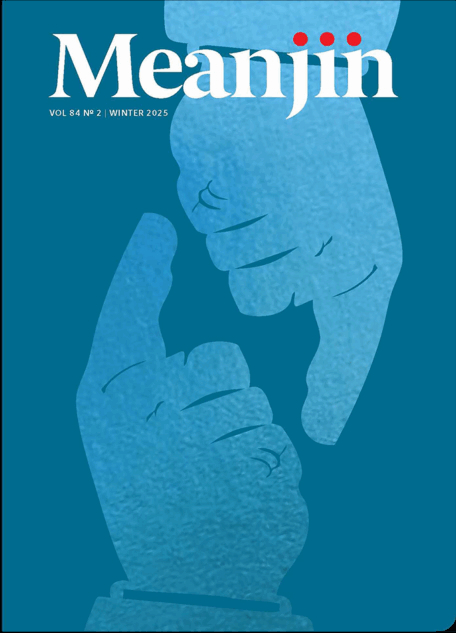
This is the antepenultimate issue of Meanjin as produced by Melbourne University Press and edited by Esther Anatolitis. Queensland University of Technology recently announced that they will bring about a resurrection, but who knows how much continuity there will be? So in spite of the good news, with this issue the journal is nearing an end.
However, though it encompasses plenty of gloom about the environment, democracy, world peace, the state of Australian literary culture and more, the journal itself shows no sign of imminent mortality.
As always it starts out with a piece by a First Nations person. This time it’s ‘I Am an Invisible Man’ by Djon Mundine OAM. Subtitled ‘This is how I became a curator’, this brief memoir acts as a brilliant summary of the rising awareness of Australian First Nations art over recent decades as seen through the lens of one person’s contribution.
I can’t be the only person who has a special place in his heart for Barry Jones, quiz champion in my childhood, then Labor Party eminence and parliamentarian, still going strong and writing with precision from a broad knowledge base. His article here about our dangerous times, ‘Courage, anyone?‘, ends with a call to arms that reads as a thinly-veiled reproach to our current Prime Minister:
In Australia, we have to be honest with ourselves about race, class, our history.
As citizens we have to engage, engage, engage.
The year 2025 is no time for deference and over-caution.
More than fifty years ago, Gough Whitlam used heroic advocacy to change Australian society. We must follow his example.
It’s time.
Alison Croggon is another commentator on Australian cultural life who is always worth reading. Her article, ‘Courage, imagination, understanding: Creative Australia in 2025‘, spells out the implications of Creative Australia’s ‘confounding decision’ to cancel the contract with Khaled Salsabi and Michael Dagostino to represent Australia at the Venice Biennale. She sings from the same sheet as Barry Jones:
At a time of mass species extinction, climate chaos, growing authoritarianism, economic inequity and war, the health of a culture may seem trivial. I persist in believing that it is far from triivial, that the insights and freedoms that art offers can not only help us recognise and combat the problems we have, but also survice them.
There’s an interview with Chinese-Australian poet Ouyang Yu, at his gloomy contrarian best. ‘In the future,’ he says, ‘the hope of mankind to defeat AI is its ability to err.’ And he means humankind’s ability to err, not AI’s. And later: ‘Posthumous existence is the only one that is tolerable and meaningfully available to a writer.’ His story of writing in both Chinese and English and the different relationships with his readers in those two language communities is fascinating.
Carl Sciberras, tasked with writing about ‘The Year in Dance‘, begins with – what I had completely forgotten, and which he claims not to have seen – Rachel Gunn’s breakdance at the 2024 Olympics. He does move on to less headline-grabbing, more excellent performances.
Bronwyn Lay’s article, ‘The climate crisis urges us to repair our broken constitution‘, whose argument is summarised in its title, gave me a new word, in purple (mine not hers) and helpfully defined in this quote:
Australia has a particular agnotology, a culturally induced ignorance, that denies our nation is founded upon violence against First Nations peoples and their Country. (p. 71)
Harry Saddler, in ‘Australia in three books‘, uses his platform to preach to the choir about current political culture (not the subject of any of his chosen books). But I am grateful to him for adding another excellent word to my vocabulary, a word whose dictionary meaning isn’t as scatological as the word sounds:
It’s impossible not to think of the ways the worst trends of American politics and public life have been and continue to be taken up eagerly by the kakistocracy that makes up so much of federal parliament. (p. 123)
Of the four short stories, I resonated most with is ‘Open’ by Jo Langdon, in which a woman narrator, her mother and her young daughter deal with bereavement, estrangement and each other. The little girl in particular is wonderful.
In ‘A refugee daughter’s pilgrimage‘, Lisa Pham visits locations that figure in her Vietnamese refugee parents’ story:
Discovering a piece of my family’s history and going back to the places they once inhabited has been transformational, healing, life-affirming. I no longer flinch when someone asks if my family were boat people: it is a part of who I am. Their story is also my story.
Of this issue’s poems, I enjoyed ‘Listening in‘ an ekphrastic poem by Lachlan Brown that sent me googling for Vic McEwan’s work The Unravelling (there are two photos some way down on this lnk), which in turn sent me back to the poem for a greatly enriched second reading. I also enjoyed ‘The Anthropocene is a geological epoch‘ by Sophie Finlay and ‘Waves Poem‘ by Toby Fitch: these poems are on consecutive pages, the first belying its title’s academic abstraction, and both of them evoking planetary subjects through minutely observed detail – of a blue-ringed octopus and waves in a bathtub respectively.
I am a man of settler heritage who has been alive for almost a third of the time that has elapsed since Arthur Phillip claimed this continent for the British crown. I wrote this blog post on the land of Gadigal and Wangal, where the nights are lasting longer and small lizards seem to be everywhere. I acknowledge their Elders past and present and welcome any First Nations readers of the blog.


 Me fail? I fly!