Tag Archives: Edwina Shaw

Asia Literary Review 24

Martin Alexander (editor) Asia Literary Review 24, [Northern] Summer 2012
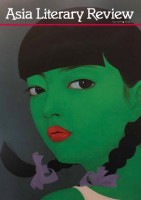
[Added in 2021: Most of the links in the blog post are broken, but the title above and the image to the left will get you there. The whole issue is available online to subscribers.]

I subscribed to the Asia Literary Review in 2009 for worthy motives: they had published a short story by my niece Edwina Shaw, and I wanted to support a publication that had faith in her; it also seemed a relatively painless way to ensure some cultural diversity in my reading. I’ve kept on renewing my subscription because every issue has something to delight – from a photo essay on Karen exiles living on the Thai–Burmese border to a splendidly simple pasta sauce recipe. The current issue doesn’t disappoint.

Martin Alexander’s editorial announces that this journal is organised around the theme of identity. The contributors, he writes,

reflect, and reflect upon, the multiplicity and complexity of their identities. Each piece was composed in isolation, but when brought and bound together their explorations of identity complement one another in unanticipated and intriguing ways.

I would add: in laugh out loud ways, and weird ways, and ways that make you want to weep. Many of the pieces are about dislocation – through migration, exile or invasion. Many are about the experience of being mixed-heritage. There’s a fascinating, kaleidoscopic effect as voices from China, Tibet, Sri Lanka, Japan, India, Thailand, South Korea, Afghanistan, Kazakhstan, Malaysia, the UK, the USA and Australia, Uyghur, Hawai’ian and Burmese voices, echo one another’s motifs, answer one another’s questions and question one another’s answers.

My precious blogging time is being taken up with doggerel endeavours these days, so I’ll limit myself to mentioning, pretty much at random, just a few highlights.

Kavita Bhanot’s ‘Too Asian, Not Asian Enough‘ asks if it isn’t a new form of Orientalism for so-called British Asians to simplify their identities and perform them rather than striving to understand and reveal their own complexities. The journal’s imprint page reveals that Madhvi Ramani’s short story ‘Windows‘ is taken from an anthology edited by Kavita Bhanot with the same name as her article. Ramani’s story illustrates beautifully the kind of thing Bhanot is advocating: it starts out with Mrs Sharma, close to the stereotype of the elderly, widowed Indian living in Britain, locked out of her home, and ends in a completely unexpected place.

In Win Lyovarin’s Rainbow Days, the Bangkok Reds and Yellows demonstrations are seen, to wonderful satirical effect, from the point of view of a barely legal Burmese street merchant. This is one of a number of pieces translated into English, in this case from Thai by Marcel Barang. Kim Jae Young’s ‘Elephant‘, translated from Korean by Moon-ok Lee and Nicholas Yohan Duvernay, is another: an impoverished and desperate little community of immigrants is seen through the eyes of a young boy, son of a Nepalese man and a Korean mother who has abandoned them.

There’s an interview with Donald Keene, pre-eminent expert on Japanese literature, who in his late 80s, not long after the tsunami, earthquake and nuclear accident last year, decided to leave the United States and become a Japanese citizen.

I’ve always thought that Chinese criticism of the Party and bureaucracy was inevitably an earnest affair. Jimmy Qi’s ‘Yu Li: Confessions of an Elevator Operator‘ (translated by Harvey Thomlinson, whose Hong Kong based Make-Do Press has a novel by Jimmy Qi in the pipeline) demonstrates definitively that this just isn’t so. At one level this story is a completely serious satire, but at another it’s an immensely enjoyable piece of silliness.

I plan to keep my subscription up.

Edwina reads

My fabulous niece Edwina Shaw recently had a Sydney launch of her YA novel Thrill Seekers. Here’s a video of her reading a chapter – taken, she says on her blog, by her children:

[YouTube=”http://youtube/FY8o6OL2SVg”%5D

Thrill Seekers live

The Art Student and I are in Brisbane, wagging it from our Sydney lives to cheer for my niece Edwina Shaw whose book Thrill Seekers had its Australian launch at The Avid Reader last night.

I’ve blogged about the book before. It’s published by Ransom in the UK as part of their Cutting Edge series for reluctant teenage readers, and it’s pretty strong stuff. The promo on YouTube gives you some idea of its credentials to be part of something called Cutting Edge – lots of booze, drugs, sex, risk taking and rock and roll. Its final image of a wide-eyed, possibly terrified boy gives a glimpse of the book’s heart:

Though the book is grim and cutting edge, the launch was cheerful. A huge crowd crammed into Avid’s courtyard in the warm Brisbane evening (unlike Sydney, Brisbane has been having a summer) to be greeted by a slide show of Edwina and friends being young in the 80s. Jeff Cheverton, CEO of Queensland Alliance for Mental Health, kicked things off with a short talk in which he wondered aloud if Douggie, the boy in the book who is diagnosed with schizophrenia, might have had a less cruel experience if he and his friends had had a language for what was happening, and if there had been places then as there are now (though he seemed to say only two in Queensland) where young people who are losing it could go for support without being taken into the embrace of the medical model. Or words in that general direction – I didn’t take notes and I have a sieve for a memory.

Venero Armanno gave an elegant launch speech. He was at pains to say that while a great strength of the book is that it draws on the writer’s experience, it would be a mistake to see it as biographical, and especially so to see the alcoholic mother of the novel’s dangerously acting-out teenagers as in any way representing the author’s mother. The possibility of readers’ leaping to such an assumption has caused a lot of grief during the book’s long gestation, so the clarification was welcome. All the same, in other places the line between history and fiction are a little blurred. The book is dedicated to Edwina’s younger brother, whose life had a lot in common with that of the tragic fictional Dougie, and it’s his photo that ends the YouTub promo. I asked the elegant young man and successful artist sitting in front of me if he was a model for any of the characters. ‘Oh yes, he said, ‘I’m the one from a sugar farm who used to kill cane toads with his bare hands.’

Edwina spoke, and read a short passage, of which the emotionally charged last line caught her off guard, and she had to struggle to finish. Which must say something about the power of the book: she must have read that passage a hundred times in the writing-rewriting-rewriting-editing-proofreading process, but it still has that power for her.

And then she signed and signed and signed.
20120309-200156.jpg
Because Ransom is a tiny publishing house, Edwina is handling the Australian marketing and distribution herself. Her website gives regular updates on where it’s available.

Edwina Shaw’s Thrill Seekers

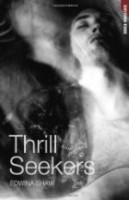
Edwina Shaw, Thrill Seekers (Ransom 2011)

This is a Cutting Edge title – part of a ‘gritty’ Young Adult series from Ransom Publishing UK. A gang of Brisbane children progress from mucking around in Oxley Creek to more risky adolescent thrills. In what might seem a standard children’s or YA literature trope, the father of the main characters dies in the first chapter, and their mother is pretty much lost in grief and alcohol. In what follows the young people go more and more out of control. There’s an awful lot of flagon wine (‘goon’) and marijuana, a range of other drugs, quite a bit of violence, some awful sex and a lot of wretchedness. The most vulnerable character goes horrifyingly, dangerously mad*. At the end there is a glimmer of hope.

That might make it sound like one of those ‘problem’ books for young readers that periodically stirs up the moral panic merchants. And maybe it is, but it’s a book with a lot of integrity. It treats its difficult subject matter without romanticising it, and without moralising. It resonated strongly with elements of three excellent books I’ve read recently: the dangerous play of Watch Out for Me, the heartbreak of After Romulus, the drugs and risk taking of The Life (blog entry to come when the Book Group meets), and the madness/psychosis/mental illness of all three.

Really, though, I can’t even pretend to write a sensible review, because the author is my eldest niece. It’s not that I worry I’ll seem nepotistic, and it’s absolutely not a matter of being tactful – as in, ‘I’m sure the target audience will love it.’ I can say up front that it’s a terrific book. But you know, even though Edwina is a mature woman, mother of two, teacher of yoga, blogger, disciplined writer, wise and warm lender of support to other writers including myself, she is still inseparable in my mind from the person whose exultant joy at being able to crawl I had the privilege of sharing more than forty years ago, and even though I know this book is fiction my avuncular heart recoils from following that cheerful little girl into these dark places.

Versions of some of the chapters have been published as short stories. You can read some of them online here and here. That last one didn’t make it into the book, and confirms my sense that, if anything, the world of the book has grown less harsh on its transition from book for general readership to a YA title.
——
* I’m deliberately saying ‘mad’ rather than ‘mentally ill’ or whatever . Raimond Gaita writes with characteristic acuteness about this kind of language in After Romulus (pages 71 to 74). Referring to the lines from King Lear, ‘Oh, let me not be mad, not mad, sweet heaven! Keep me in temper; I would not be mad!’ his discussion ends:

Lear’s cry is not heartrending because he suffers ‘social stigma’. And it would not move us as it does had he said, ‘Oh, let me not fall into bipolar disorder.’

Edwina’s story of Douggie includes the social stigma, but it also takes us into, using Gaita’s words again, ‘the unique terror that the word madness conveys’.

Asia Literary Review 14 and 15

Chris Wood (ed), Asia Literary Review, Nº 14 and Nº 15

I subscribed to the Asia Literary Review as an act of avuncular solidarity – I wanted a hard copy of issue 14, (northern) Winter 2009, which features ‘Broken’, a story by my niece Edwina Shaw. Having now read two issues, I’m a fan.

Asia, of course, covers a vast proportion of the Earth, from the Philippines in the east to the Arabian Peninsula in the west. The Asia (not ‘Asian’) Literary Review is a vast tent open to contributions from all of it and beyond. It’s an English-language journal, founded by Nury Vittachi in 1999, and currently edited by Chris Wood. It publishes work by writers and visual artists from Asian cultures in translation and originally in English, work by expat and former expat Westerners (like my niece), not all from English-speaking countries, work by Westerners who have engaged with Asia in other ways (there’s an extract from Henning Mankell’s The Man from Beijing in Nº 14), contributions from various Asian diasporas. There are interviews, both original and transcribed from The Book Show, and a wealth of illustration.

In Issue 15, just arrived in my letterbox this week, Hanif Kureishi (one of the interviewees) is quoted on racism:

It really is about language. It’s very traumatic to exist in a world of other people’s descriptions. Your own words have no force.

If he’s right, then the sheer multiplicity of voices here must be profoundly anti-racist. In Issue 14, ‘Noe’s Jiuta-mai’, a photo-essay by Bangkok based Xavier Comas on a traditional Japanese dance form, is followed by  ‘Nova Initia’, Thomas Lee’s first person narrative about a Korean man in the US learning about his father’s past, which in turn is followed by ‘Phallacy’, a laddish sonnet by England born Daljit Nagra (How oft do mates bang on at length about / how well they’re hung …). Issue 14 interviews Gao Xingjian, three times exiled from China for his writing and now living in France:

The writer is a weak individual and cannot overcome political oppression; he can only flee, or he has to write for the government. […] Dante fled Florence because he couldn’t write. Ibsen fled Norway; it wasn’t until Norway began to recognise him that he went back.

In Issue 15, dissident writer Liao Yiwu’s memoir ‘Go South, Go Further South’ concludes:

I had survived prison, while others had died within its walls. And I had survived a devastating earthquake while so many others perished. And hundreds of people are arrested or shot crossing the border. I don’t have a single reason to complain.
I accept my fate, which is to stay, and write.

Heroism has many faces. So does Asia. You get to meet a lot of them in this journal.

And in case I haven’t said it before, Edwina’s story can hold its head up in that multifaceted and exalted company.

December niece news

Since I seem to be posting regular notes about nieces, perhaps I should explain: I’ve got eight of them, and five of the eight have lived, or at least stayed for a while, with us over the years. Every one of them is a source of great joy. A number of them are meeting with a degree of success as writers and artists, and I’m shamelessly putting my blog to work as part of their publicity machines. (We have seven nephews, sources of no less joy, who have so far been more or less avoiding the need for publicity.)

Paula Shaw, whose memoir Seven Seasons at Aurukun received quite a bit of attention earlier in the year, and not just from me, popped up again in Inga Clendinnen’s article in the December Australian Literary Review. Although the article itself has attracted aspersions from Guy Rundle in Crikey, the reference to Seven Seasons as ‘a brave and honest book’ stands uncontested. Thanks to my avuncular Google Alert, I also came across a number of reviews by teachers – on the publisher’s web site, and a review by an Aboriginal reader who has the most negative response I’ve seen so far, identifying a ‘heart of darkness vibe’, but says all the same that it would be a ‘good read for anybody interested in contemporary life in an Aboriginal community in Australia’.

Meanwhile, Paula’s sister Edwina Shaw has been gracing the pages of the Griffith Review for a couple of years now – and grace is the right word for it, even though her stories deal with dark themes set in Joh-era Brisbane. She has a story in the current issue, along with Frank Moorhouse, Louis Nowra and other luminaries. She also has a story, about different youth altogether, in the current (Winter) edition of the Asia Literary Review, sharing the contents list with among others Henning Mankell.