Tag Archives: First Nations

Ross Gibson’s Seven Versions

Ross Gibson, Seven Versions of an Australian Badland (UQP 2002)
I finished reading this book a while ago but it’s taken me until now to write about because I took it very personally.

It’s a meditation on the so-called horror stretch, country north of Rockhampton in central Queensland that has a reputation as the setting for terrible events. Starting with a number of roadside murders in the second half of last century that made headlines all over Australia, Gibson explores the cultural factors, the ‘structure of feeling’, underlying the general fascination with those crimes. A ‘badland’ such as this, he says, is a way of localising and mythologising issues that are unresolved in the society in general. This description may lead you to expect something that reads like a bad translation from the French, with lots of stuff being inscribed on the landscape, and references to impenetrable theory. But no, it’s an engaging read, and becomes positively compelling as it moves back in time to the terrible first contact between Aboriginal people and settlers, forward again to the ordeals of Melanesian indentured workers in the sugar paddocks, and forward yet again to the White Australia Policy’s denial of the extraordinary diversity of the region.

‘Sooner or later,’ Gibson writes, ‘any society that would like to know itself as “post-colonial” must confront an inevitable question: how to live with collective memories of theft and murder. Sooner or later, therefore, acknowledgement and grieving must commence before healing can ensue.’ This must also be true of the individuals who are part of that society, and my sense is that for all the impressive scholarship and historical research that went into it, this project is at heart personal, a way of making personal acknowledgement and beginning the necessary grieving. At least, coming though I do from Innisfail, hundreds of miles north of the horror strip (and yes, I knew of it by that name in my childhood), that’s how I read it.

Things may have changed, but when I was at school, history happened mostly in England (and elsewhere in Europe for Catholic Church history), and what we were taught of Australian history happened in Sydney or Melbourne, or occasionally the other capital cities. The only North Queensland figures I remember being mentioned – and that was at home rather than school – were the explorer Edmund Kennedy, speared by ‘natives’ in 1848, and his faithful Aboriginal companion Jackey Jackey (whose real name, Galmahra, was never alluded to). The specific history of the arrival of non-Aboriginal settlers in the north was never even hinted at. As in the ‘horror stretch’, I’ve learned, this history involved mass murder by Native Police under white officers. Ross Gibson brings that history home, and has a good deal to say about our collective silence about it. Even at the time of widespread killing of Aboriginal people in the mid 19th century, he says, the officers

jinked a two-step of violent action and circumspect remembrance. They wrapped their deeds in dissembling verbiage and eventually they became their own twisted idioms, developing a ‘pathological’ disconnection between doing and declaring, a disconnection which gave them no way to see the world clearly.

That ‘circumspect remembrance’ is something that has lived on in the north ever since, as ‘white people simultaneously knew and refused to know the violence behind their everyday lives’.

Now here’s why I took this all personally: in an entry in this blog a few years back I said I didn’t know much about first contact between the Mamu people and the first settlers of the Innisfail region, and I gave a link to Innisfail’s web site. When I clicked on that link I found this:

The first incursion came in 1872. Survivors of the shipwreck Maria arrived on the coast near the Johnstone River. Some of the Indigenous people helped; others they opposed. Sub-Inspector Robert Johnstone’s search party came to rescue survivors and punish Aboriginal people who had abused them, and ventured up river from what are now Flying Fish and Coquette Points. Johnstone wrote glowing reports of the area, and with vigilante Native Troopers attacked the Mamu people with rifle fire as he escorted the explorer Dalrymple, charting the watercourse and having it named after himself.

When European cedar cutters and Chinese gold seekers arrived later in the 1870s and early in the 1880s, the Mamu fought them and inflicted serious casualties. Again the Europeans sent in the Native Police. Superior firepower broke up the Indigenous communities and dispersed or integrated the remaining original landowners.

The evidence is that I had read that and could still say I didn’t know what happened, yet its meaning couldn’t be clearer. Words like ‘punish’ and ‘dispersed’ are transparent euphemisms: the high moral ground assumed by one and the almost kindly feel of the other could mislead only the ignorant or, it pains me to say, allow the wilfully obtuse to ward off the obvious. It’s impossible to stay obtuse after reading this book. And a further confession: I must have blithely assumed that if Native Troopers and Native Police were involved things couldn’t have been too bad. Gibson puts that assumption to rest with his account of the way armed young Aboriginal men, uprooted from their own communities and freed of cultural restraints, were directed to kill and maraud. He lays bare the mechanism by which Indigenous people, under tight white control, performed the genocidal work of dispossession, leaving the settlers – good Catholics in the case of the first farmers of the Innisfail Estate – to move in with an illusion of clean hands, deploring the violence of the unruly ones who had made their settlement possible.

Gibson’s discussion of the Melanesians who worked on the sugar farms is also compelling. I recommend the whole book.

Anna the Goanna

Jill McDougall & Jenny Taylor, Anna the Goanna and other poems (Aboriginal Studies Press 2000)

This is a collection of poems written by a schoolteacher ‘in order to provide classroom reading material which reflected the daily experiences of her students’. That description, taken from Jill McDougall’s bio at the back of this book, could be a recipe for semi-literate, patronising disaster, all the more so when the students in question are Aboriginal. On the contrary, this collection is a delight, words and images both. Not that the opinion of a 65 year old urban middle class white men matters all that much, but I’d be surprised if this book didn’t go down very well indeed, in the classroom and out of it, performed for the students or by them or read in private, by curious non-Indigenous as well as Indigenous children.

Why did I read it? Well, reading the Kevin Gilbert books reminded me of how much I enjoyed his children’s poems, and this was a gift that has been sitting on my shelves for a couple of years now, waiting for a suitable child to turn up to be read to from it. I just decided to stand in for that hypothetical child.

As the title promises, there are silly poems about goannas. There are also mosquitoes, crows, flies, and a crocodile, but it’s not all animals. There are babies, big sisters, football and baseball, a sweet   comedy about the difference between Aboriginal and mainstream economics, and two pieces that depart from the general cheerful tone – ‘Too Many Drunks’ and ‘Sad Boys’ , the latter being about petrol sniffing.

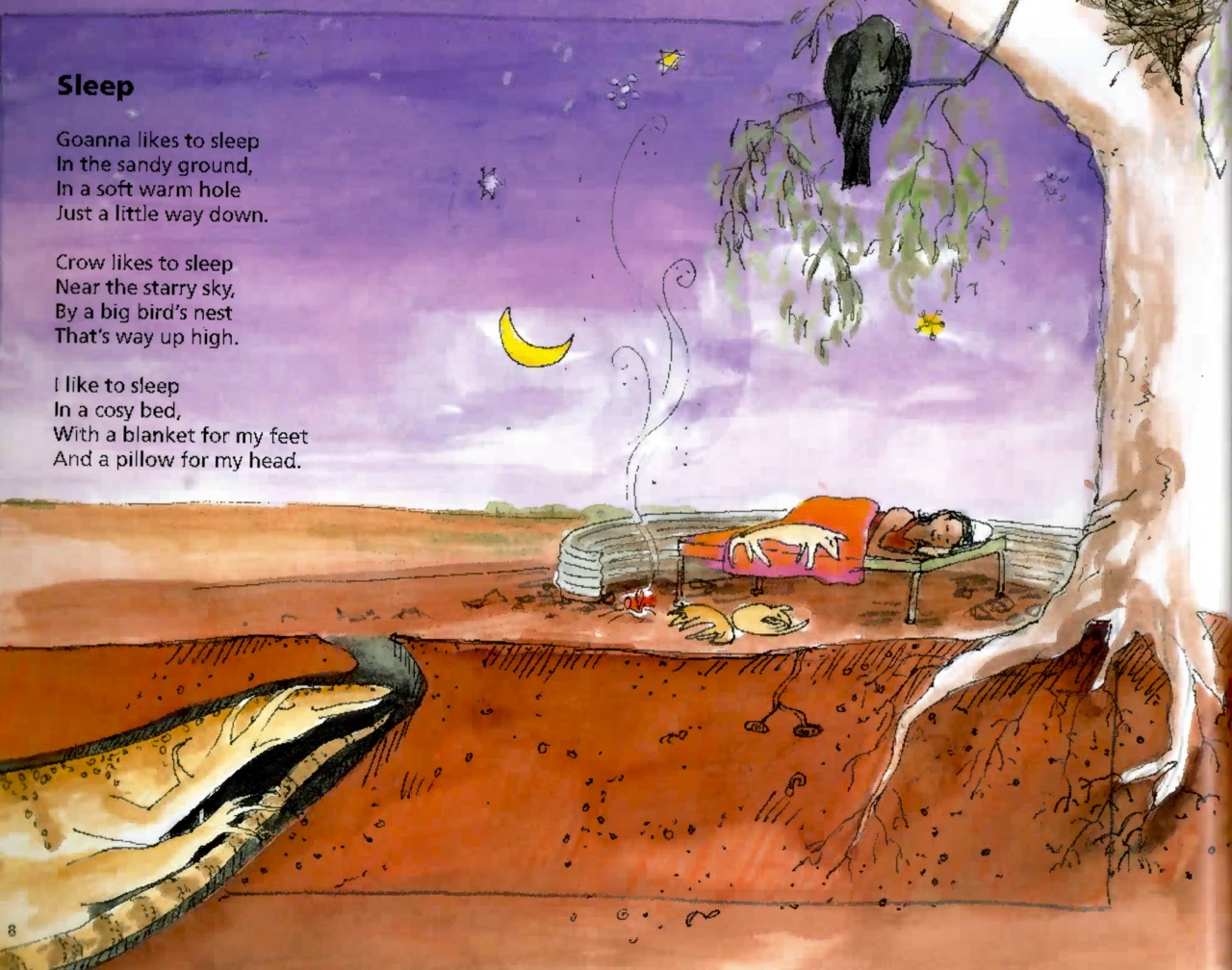
Jenny Taylor’s illustrations demonstrate just how important the interplay of text and image can be in a picture book. One page that struck me in particular was ‘Sleep’. The poem:

Goanna like to sleep
In the sandy ground,
In a soft warm hole
Just a little way down.

Crows like to sleep
Near the starry sky,
By a big bird’s nest
That’s way up high.

I like to sleep
In a cosy bed,
With a blanket for my feet
And a pillow for my head.

The final stanza could be spoken by any child, anywhere. One could easily think of a room with pastel wallpaper and shelves of stuffed toys. The illustration is a revelation about possible meanings for the word ‘cosy’:

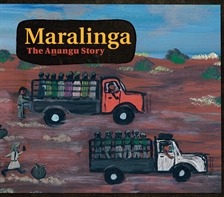
Maralinga, the book

Yalata and Oak Valley Communities with Christobel Mattingley, Maralinga, the Anangu Story (Allen & Unwin 2009)

Christobel Mattingley is well known in Australian children’s literature circles. Along with picture book creator Bob Graham she was nominated for the 2012 Hans Christian Andersen Award (aka the Little Nobel). The award went elsewhere, but these two national treasures were honoured by the NSW Branch of IBBY Australia (International Board on Books for Young People) at a Sydney event on International Children’s Book Day, 31 March. Both spoke wonderfully about their work. I learned that a whole generation of French people grew up thinking Bob Graham was French, and whatever his nationality he’s a modest miracle. But for me, Christobel Mattingley was the revelation.

Now in her early 80s, Christobel Mattingley has written an extraordinary body of work for young people and adults that deals with, for want of a better word, social justice issues. Two books in particular stand out: for something like eight years she laid her own writing aside in order to coordinate the landmark Survival in our Own Land—‘Aboriginal’ Experiences in ‘South Australia’ since 1836 (Australian Scholarly Publishing 1988, reprinted at least twice since), which incorporates oral history and archival material to tell the Nunga story of events that have otherwise been told almost universally from a settler perspective; and Maralinga, a smaller project, that looks at first blush like a children’s picture book and would certainly be accessible to most teenagers, but turns out to be a powerful, original and significant work of history. Both books leapt onto my To Be Read list. Marrickville Library had a copy of Maralinga.

As every schoolchild knows (or can look up on Wikipedia):

British nuclear tests at Maralinga occurred between 1955 and 1963 … A total of seven nuclear tests were performed, with approximate yields ranging from 1 to 27 kilotons of TNT equivalent …

The site was contaminated with radioactive materials and an initial cleanup was attempted in 1967. The McClelland Royal Commission, an examination of the effects of the tests, delivered its report in 1985, and found that significant radiation hazards still existed at many of the Maralinga test areas. It recommended another cleanup, which was completed in 2000 at a cost of $108 million. Debate continued over the safety of the site and the long-term health effects on the traditional Aboriginal owners of the land and former personnel. In 1994, the Australian Government paid compensation amounting to $13.5 million to the local Maralinga Tjarutja people.

Maralinga tells this story in some detail. As the subtitle – The Anangu Story – indicates, the point of view is not that of the scientists, the politicians, the bureaucrats or the journalists, but that of the affected Aboriginal people (for whose name I wouldn’t trust Wikipedia). It begins well before their country was deemed to be a good place to test nuclear devices (putting the lie to a rerun of terra nullius, you might say) and brings us up to the slow rebuilding of communities in the present. It begins:

Long time ago, before whitefellas came, Anangu lived on their lands for thousands and thousands of years.

There are old people at Oak Valley who can remember living a traditional life in the desert. But the book is not limited to oral history. It tells of the coming of whitefellas to Ooldea Soak: explorers including Eyre and Giles, then well-sinkers and surveyors, in 1912 the Transcontinental Railway, then Kabbarli (Daisy Bates), and the truly invasive United Aborigines’ Mission, whose abrupt departure in 1952 left the now-dependent local people distraught and at the mercy of the dreaded Aborigines Protection Board, to be forcibly removed to alien country at Yalata, on the coast.

While the dispossessed, disoriented desert people were grieving, spiritually lost in foreign country, rebuilding a few basic community structures from salvaged material twice recycled, a township for whitefellas was being constructed in their country … In 1953 the site … was named Maralinga by the whitefellas. This time they took the word from an Aboriginal language of northern Australia.

The power of the book’s text lies in the multiplicity of its voices. It’s one thing to describe the desert people as grieving and dispossessed. It’s quite another to read the words of Jack Baker and others to the 1985 Royal Commission:

We felt lonely about Ooldea, we were worrying for it. We tried to get back up there. Yes, we were worrying and … we were sad for all of the places that we were related to, and we were worried because these places had been spoiled … We were told we could not go back there.

And how telling it is to read first hand accounts like this from Kukika, who worked on Wallatinna Station homestead:

Smoke came from south, brought up by light wind. The sun became bad. People got sore eyes. We were weak in arms and legs, couldn’t get up and dig for rabbits. Blood came from people’s noses and mouths. My two grandmothers died, and my father and mother. Before the smoke we were all okay. We were without sickness. Tommy Cullinan [station manager] didn’t have a name for the sickness. Didn’t know what it was. I was burying people. Shifted camp again and again.

When this book was shortlisted for a number of awards in 2010, I don’t imagine I was alone in thinking of it as worthy, an excellent addition to a school library, but not exactly something to rush out and buy. But you know, it’s also a book that changes the way you see the world, and leaves you in awe of human beings, both the resilient ones who have come through a hundred years of brutal disregard, and the one who has sat down and listened deeply enough to bring their stories to us.

I saw Harry Bardwell’s Backs to the Blast: An Australian Nuclear Story when it came out in the early 80s, and it did include an interview with an unnamed Aboriginal woman. Here, the Aboriginal people are named, we have a sense of their personal and collective histories, and the vibrant illustrations throughout make it clear that they are not just informants, but they share the authorship of the book.

(Re-)reading Kevin Gilbert’s poetry

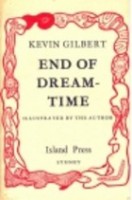
Kevin Gilbert, End of Dream-time (Island Press 1971)
and People Are Legends (UQP 1978)

According to his Wikipedia entry, Kevin Gilbert (1933-1993) was an ‘Indigenous Australian activist, artist, poet, playwright and printmaker’. His first play, The Cherry Pickers, which he wrote when in prison. made a splash in 1970 or thereabouts. A Wiradjuri man, he played a role in setting up the Aboriginal Tent Embassy and was part of the Black Power group. He wrote a book for children, Child’s Dreaming (1992), from which we published a number of poems in The School Magazine, and a sweet memoir for child readers, Me and Mary Kangaroo (1994).

I own a copy of his first published book, End of Dream-time, number 104 of the edition of 200, and it’s sitting on my desk as I type. It’s a beautiful object, handset and printed on creamy, textured paper, with illustrations by the author in a range of single PMS colours. Phil Roberts, the poet founder of Island Press, treated his early books as labours of love. Of those on my bookshelves, this is the one most lovingly laboured over. The presentation is a clear message to anyone tempted to read the poems as sociological specimens (a book by an Aboriginal man was a rare thing in the early 1970s, and any spurious sociological appeal was made all the greater by its having been at least partly written when Gilbert was in prison for murder). These poems, the design announces emphatically, are to be read and respected as poems.

So I was shocked to learn, all these years later, that Kevin Gilbert ‘repeatedly and publicly’ disowned his poems as published in End of Dream-time. It seems that Roberts did substantial editing without his permission. He may have done no more than he would have done for any first book, and the poems may in some sense be the better for it, but Gilbert’s bitter complaint was about the lack of consultation. Adam Shoemaker tells the story, and reproduces the original and edited versions of the short poem ‘People Are Legends’, in ‘The Poetry of Politics‘, a chapter of his Black Words White Page: Aboriginal Literature 1929–1988. Go to the link, read it and cringe: Roberts’s good intentions are clear, but even a whitefella like me who’s been an arrogant enough editor in my time can see why Gilbert would consider it a betrayal of trust. His poems are full of rage and despair at the callous, complacent attitudes of whites toward Aboriginal peoples. Shoemaker quotes him as saying:

I’ve adopted writing as a means of voicing the Aboriginal situation … I try to present as truly as possible the Aboriginal situation and the Aboriginal response.

And:

There is the need to educate White Australians to the present situation of Aboriginal people … I’m presenting it as honestly as possible – it’s not a pretty picture.

What bitter irony, when struggling to find a voice in this way, to have one of those in need of education inject his voice into the mix! (I know Phil Roberts is Canadian, but in this context that’s a distinction without a difference.)

So I went out and bought a copy of People Are Legends, published seven years later by the University of Queensland Press. The back cover describes these poems as written ‘in the language used by living Aboriginals, without editing, without politeness or hypocrisy as practised in “cultured” verse’ (my bold).

Neither book is a comfortable read. Rather than emotion recollected in tranquillity, we get harangues that feel shot off in the heat of the moment. Many of the poems are dramatic monologues, spoken not so much by characters as by exemplars, either of the misery and debasement resulting from genocidal oppression, or of morally contemptible individual escape. There’s a bush ballad that doesn’t quite scan, and quite a lot of satire that has a bitterly intolerant edge, directed not only against whites but, almost, against any Aboriginal person who pursues a politics that’s neither despairingly passive nor holding out the option of retaliatory violence. Even the Gurindji’s heroic stand against Vesteys in 1970 gets the treatment. One of the two poems named for them begins:

They fast
They silently fast
Eloquently silent
In their thundering cry for Right

But by the end that silence has been found sadly, even culpably wanting:

They should remember
Back in time: throughout history
Justice, deprived of a strong voice slowly,
Inexorably dies
And the seeker of justice dies with it
Or silently becomes a slave.

But then, these poems aren’t aiming to give me a good time or lay out a workable political agenda. This was trail-making work: I don’t know that anyone would try to write poems about ‘the’ Aboriginal situation and response these days, and that’s due in part to Kevin Gilbert’s rising to the challenge to educate, to speak as a representative.

Since the thing that prompted me to read these books was the near absence of modern Aboriginal poets from Geoffrey Lehmann and Robert Gray’s Australian Poetry Since 1788, it’s probably worth remarking that there are quite a number of poems here that wouldn’t have looked odd in those pages. The other ‘The Gurindji’ brought a new music into Australian poetry:

Poor fellow
Simple fellow
Sweet fellow
00Strong
Sittin' in the desert
Singin'  desert song

And I’m no expert, but I think ‘Trying to Save Joan Ella’ not only stands up well as a bush ballad, but manages to hold out a significant challenge to the whole tradition. It tells of an Aboriginal woman’s arduous and terrifying ride to fetch a doctor for a dying white baby:

Quick she rode to Thiraweena
And she brought the doctor back
But the child died – and the father
Cursed the slowness of the black
....
If this cursed gin had ridden
Faster, harder through the night –
But the blacks are bad and useless –
Can't be trusted out of sight!'
Mary bowed her head in silence
Thought: 'I wishit me had died
Rode two horses an' it killed 'em
Never stop't though me dead tired
Frightened too of horse bin fallin'
When I passed the old ones' grave
Shut me eyes with courage 'gammon'
When the ghosts rise I ain't brave!
Couldn't do no more I tried but
Kill'd two horses; rode to death.
Didn't stop! I kept on runnin'!'
And she wept beneath her breath

Really, it’s a poem that cried out to be anthologised.

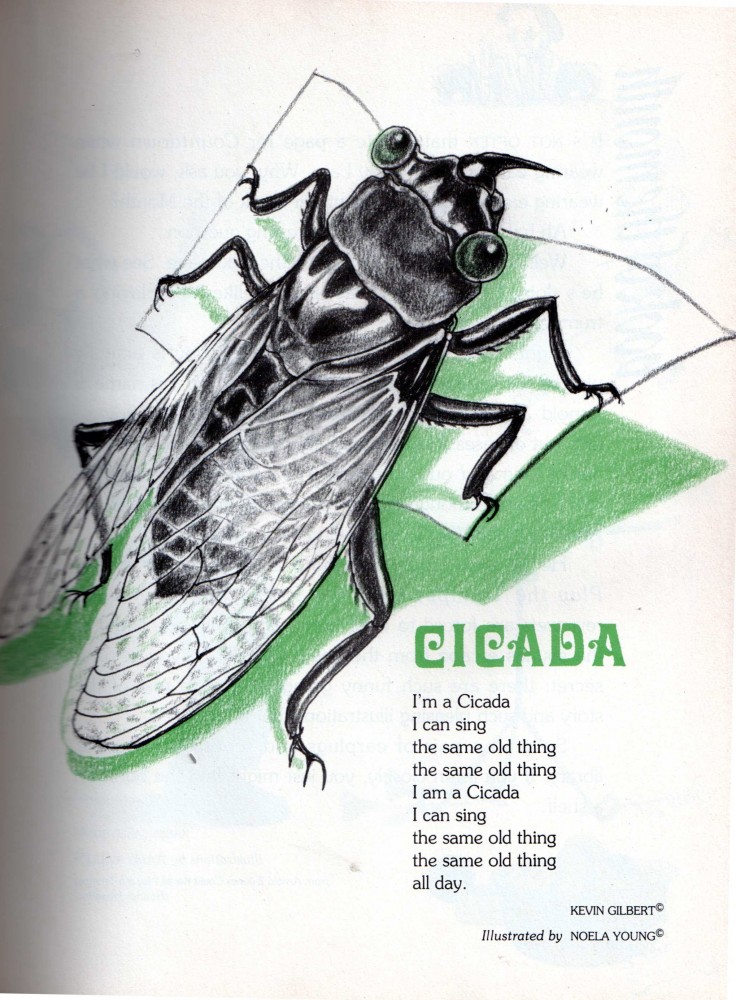
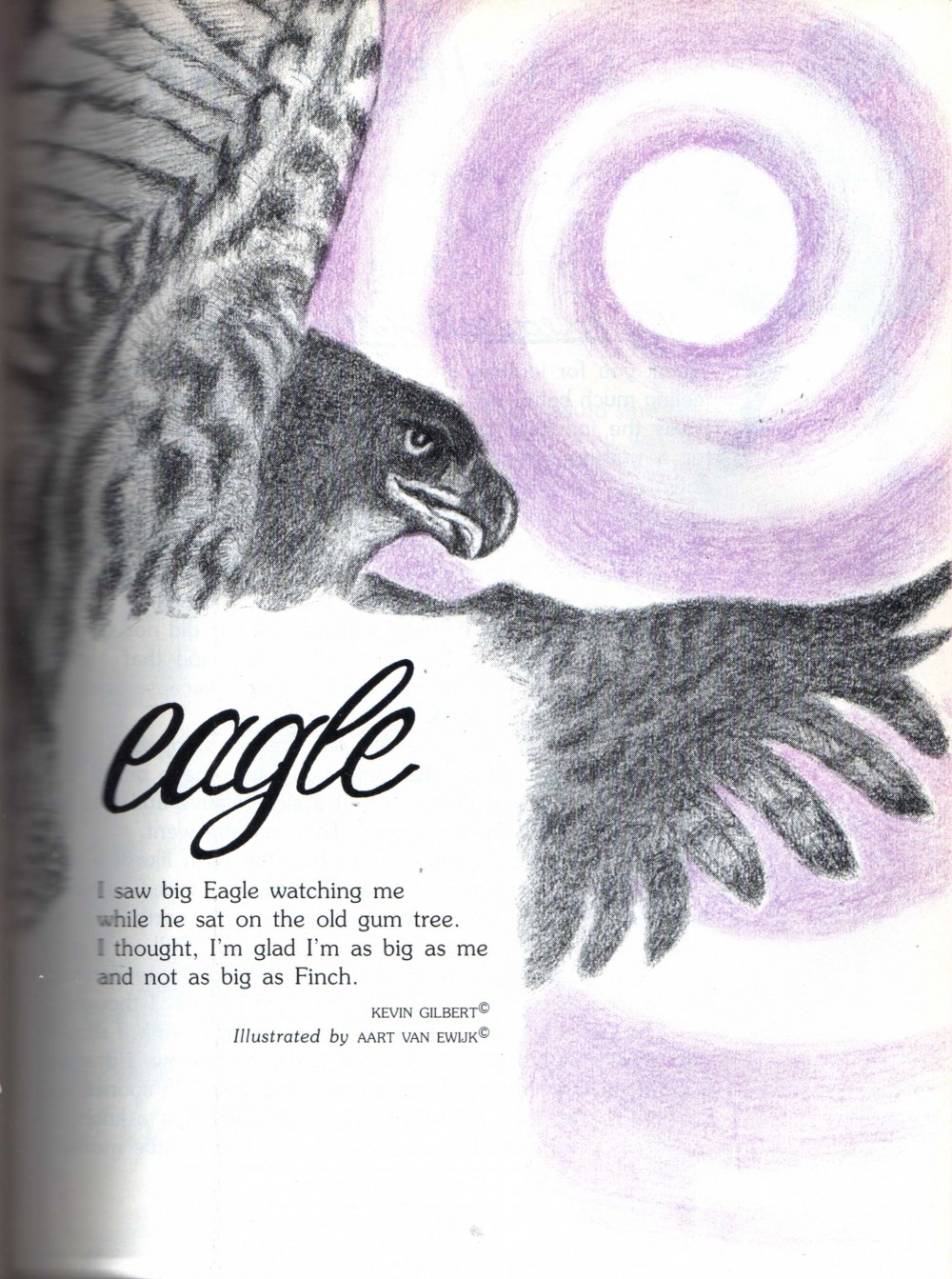
And one last note: in Child’s Dreaming, published a couple of years before his death, Gilbert showed that he could relax when the burden of being a representative was eased. There was still the element of protest, but without the same bitterness and despair (see ‘Emu and Koori’, as reprinted in The School Magazine  with an illustration by Arone Raymond Meeks, in the left-hand image below). ‘Cicada’ (image by Noela Young) may not be everyone’s cup of tea, but it’s given me much pleasure. ‘Eagle’ (illustration Aart Van Ewijk) is just plain genial.

Lehmann & Gray’s Australian Poetry since 1788: A first post

Geoffrey Lehmann & Robert Gray, Australian Poetry Since 1788 (UNSW Press 2011)

This was a thoughtful and generous Christmas present, and it’s a daunting 1080 pages. After a bit of dipping and checking, I started at the beginning on Australia Day (after all, the title implies that in this book Australian poetry began on or after 26 January 1788), expecting to take a year or so to read it in bits here and there. Rather than wait till next January or thereabouts to blog about the book all in one go, I’ll post now and probably a couple more times over the coming months.

It’s the age of the interwebs, so naturally before I’d gone much past the Introduction I went looking to see what other people were saying. It was no surprise to come across snippets of ‘poetry-war’ conversation. John Tranter called the book the Death Star and blogged some inflammatory sarcasm. Someone on The Rereaders called it the Grey Lemon. So far so expected. I followed a trail of links to a video of a lecture given by Peter Minter at a seminar last October, and suddenly we were out of the poetry wars (in so far as that phrase implies squabbles among the marginalised) and into serious cultural issues. Minter starts out by saying that as a poet you don’t often have to take a stand, but this is one of those moments, and even though some of the lecture, particularly the discussion of the endpapers, is gleefully sarcastic, the over all feeling is a kind of passionate no pasaran. The anthology, he points out, includes only two modern Aboriginal poets. [Have a guess who they are, and if you’re at all familiar with Australian poetry you’ll probably get one right, but almost certainly your other name is one of the excluded. If ten of my readers did this in a room together we’d probably come up with ten names – that is to say, it’s an obviously significant exclusion.] This wouldn’t be such a big deal if it wasn’t being sold as a grand canonising statement rather than a selection of stuff that a couple of men happen to like. As it is, though, the omission, along with the ethnographic treatment of the traditional Aboriginal songs that are here, amounts to a ‘disappearing of modern Aboriginal poetry’ (Minter’s phrase), a contribution to this country’s continuing genocide (my phrase, and though it’s intemperate I’ll defend it if need be). Minter lists numerous omissions beyond the Aboriginal poets, and says there are many errors in the commentaries (the only one he specifies is the description of the 1967 referendum as giving Aboriginal people ‘special recognition’ in the Constitution, whereas in fact it removed ‘special’ provisions). The video is well worth watching, even though it misses a lot because it doesn’t show us Minter’s slides.

Poor old Geoffrey and Robert! I’d heard one of them on the ABC’s late lamented Book Show being quietly pleased with the representation of women among their poets. ‘Whew!’ you could almost hear him saying. ‘We dodged that bullet.’ One mitigating factor is that while the book is generally being touted as in some way definitive, the actual Introduction presents it pretty unambiguously as a product of the compilers’ idiosyncratic tastes and preferences.

All the same, I gave quiet thanks for Edward Said’s notion of counterpoint (that is, roughly, rather than boycotting a work of art that is, say, racist, it is preferable to read it along side of work by the people it has belittled or slandered or erased), and promised myself that I would dig out my books of poetry by Lionel Fogarty, Kevin Gilbert, Samuel Wagan Watson and read them and other Aboriginal (and non Anglo, and so on) poets in parallel with this anthology.

The two Aboriginal poets who made the cut are Odgeroo Noonuccal and Elizabeth Hodgson. There are quite a few versions of Aboriginal songs and stories ‘as recorded by’ white men, and in the case of those recorded by Roland Robinson, the storytellers’ names are given. This doesn’t negate Minter’s main point, but it does indicate that the editors were more aware of Aboriginal people as cultural creators than his lecture might seem to imply.

LoSoRhyMo #8: Place names

I’ve recently discovered Luke Pearson’s @Aboriginal oz blog, which I recommend for smart, measured writing about hard subjects.

I stumbled across (not upon) it when doing some research on Massacre Island (also known as Murdering Island) near Narrandera. In a piece on the ‘History Wars‘, Luke takes off on a bit of grim comedy:

MURDERING ISLAND…. “and if you look to your left, you will see Kid Stealing Hill just behind Rape Road, and just after you cross Old Black Bastards Belong On The Other Side of The River Bridge…. which of course was replaced by the New Black Bastards Belong On The Other Side of The River Bridge in 2007. And of course the towns biggest tourist attraction, the Giant Prison Tree, which is still occasionally used just to keep the history alive!”

(It wasn’t until I cut and pasted that that I saw the mention of the Prison Tree, which I would have imagined was as much an invention as the bridges if I hadn’t fortuitously seen Rew Hanks’s linoprint ‘Whispers from the Prison Tree‘ at Watters Gallery last night.)

I can feel my compulsory November sonnet coming on:

Sonnet 8: Some Australian place names
Mount Despair, Cape Tribulation,
Misery in Port, Mount, Beach,
Shipwreck Creek and Desolation
Bay, Point Perilous: names teach
the sufferings, struggles of our past,
recall events and list the cast
of characters (Macquarie, Cook
are everywhere– just have a look).
But some names aren’t on Google Maps:
Massacre Island, Murdering Point,
Poisoned Waterholes Creek.* A Joint
Committee could be formed perhaps
to set things right. Now, sad to say,
My street’s named Look The Other Way.

In haste …

* These are all real places, and I couldn’t see any of them on Google Maps. In the interests of accuracy, I should say that the explanation I heard as a child for Murdering Point, at Kurrimine Beach in Queensland, is that survivors of a shipwreck were murdered by Aboriginal people – no mention was made of the monstrous actual retaliation.

Sarah Maddison’s Beyond White Guilt

Sarah Maddison, Beyond White Guilt: The real challenge for Black–White relations in Australia (Allen & Unwin 2011)

I’ve been having trouble blogging about this book – maybe I would have been better off writing one of those ‘X reads Y’ series of posts that take you through the book along with the blogger over the days or weeks it takes to read it. There was hardly a page when my mind wasn’t firing off in many directions, excited by one idea, quarrelling with another, irritated by an elliptical use of a reference, challenged and provoked and challenged again. But here you are, just one little blog post.

The book starts brilliantly. While strolling around her inner city suburb the author sees on the bank of the polluted and deformed Cooks River a tiny space that she imagines to be pretty much unchanged in the 200 and more years since white settlement. She pictures a group of people of the Eora nation going about their lives there, and is shocked by the mental image, not because it is new or surprising, but because she realises ‘that [she] had allowed [her] consciousness of that reality to fade.’ She goes on, ‘Unlike Aboriginal and Torres Strait Islander peoples, I could choose to “forget” or to deny or repress the reality of my place here.’

Such moments must have been experienced by every thoughtful non-Indigenous Australian – moments when, in shocking contrast to our habitual complacency, it becomes blindingly clear that our current lives rest on a history of colonial invasion and dispossession. Recounting this example in the Introduction implies a promise that the next 200 or so pages will unpack such moments: How and why does that forgetting happen? What would happen if we stopped ‘forgetting’ and began to live in the real world? How do we go about making that change? Is this a thing that we need to address as so many million individuals, is there a challenge we need to meet collectively, and if both how are they connected?

Coming from the author of Black Politics, a powerful account of the main themes and tensions in Aboriginal politics based on extensive interviews with a range of Aboriginal leaders, this implied promise feels anything but hollow.

I’m not confident that I can summarise the book’s argument adequately, but here goes:

  • When the British arrived on the continent of Australia in the late 18th century, they wanted the land, and took it, with devastating consequences for the people who were already living here. Some people baulk at calling what happened genocide, but it’s hard to see how that word is far off the mark.
  • As the Australian nation formed, and people took on the  Australian national identity, they needed stories of the nation’s origin that would allow them to feel good about themselves and the identity. Stories were told of pioneers’ hardihood, of Anzac larrikin heroism, of sporting accomplishments. The history of European–Aboriginal relations was marginalised or silenced. This version of national identity became entrenched both in public institutions and in people’s minds.
  • The objective reality is that all non-Indigenous Australians continue to benefit from the dispossession of Aboriginal and Torres Strait Islander peoples; and that Aboriginal and Torres Strait Islanders continue to struggle with the consequences of the huge and ongoing assault on their ancestors, their cultures and their communities.
  • We know this. We mostly ignore it, but we know it. [This has to be very confusing for us as children: the stories are told and discounted in the same breath.] This is a kind of anaesthesia, a dissociative story we tell ourselves.
  • To break through that anaesthesia and face the reality of our history involves emotional discomfort. Unless we face this discomfort we’re likely to either a) see the problem (if we admit there is one) as inherent to Aboriginal and Torres Strait cultures and so none of our business, or b) intervene in ways that  don’t challenge the assumptions that allowed the past and ongoing injustices to happen in the first place. [Her discussion of the Intervention is compelling.] Either way, we continue to live in a strange, dissociated state.
  • What has to change is us.
  • Real, effective change isn’t impossible. Australian history is full of examples. [She discusses  the 1967 referendum, the Reconciliation process of the 1990s, and the Sorry Books and the apology for the Stolen Generations.]
  • So what is to be done? We need a difficult conversation about remembering and forgetting. We need dialogue – as opposed to debate or just conversation – in which [I’m quoting Boori Pryor, not anyone in this book] ‘we see your tears, you see our tears’. We need to acknowledge our [now I’m quoting Sarah Maddison] ‘bonds of solidarity with the perpetrators of historical and human injustice’, and find a way to break them, that is, ‘to rethink who we are as a nation’.
  • ‘Relationships will be central to whatever path lies ahead’. An immediate opportunity is the referendum coming up in 2112 to include an acknowledgement of Aboriginal and Torres Strait Islander peoples in the Constitution.

It’s an important subject, and an important book. When you read it you may find my summary inadequate, and if so you’ll get no quarrel from me. The fact is, I found the argument hard to follow. My best guess as to why is that there are actually two books here struggling to co-exist. One is the one I’ve tried to summarise above. The other is a companion volume to Black Politics, which acknowledges and synthesises a vast body of thinking in a range of disciplines that addresses the issues of racism, colonisation and collective guilt. Notes and the bibliography account for nearly a quarter of the book’s pages. The text is studded with rich, provocative quotes, but at times it feels that no phrase, no concept can be used without deference to its originator. This may be sound academic practice, but the effect – at least for my kind of reader – is that hardly any time at all goes by without someone identified as political scientist A, legal scholar B, anti-racism educator C, political psychologist D, historian E … the list goes on … popping up, throwing a couple of words into the ring and then disappearing. I’d be going, ‘Who was that talking head? What  context did they use that phrase in?’ I would rather have read an overview of the scholarship,  White Politics, perhaps, and then moved on to Sarah Maddison’s argument. Or perhaps this is just a longwinded way of saying I found the scholarly apparatus distracting here.

Another reason for my difficulty is confusion about the word guilt. You’ll notice I haven’t used it in my summary. Is guilt a feeling or a legal verdict? Does it refer to a subjective state or a collective condition, or a vertigo-inducing combination? It seems to me that there are a number of quite distinct things rolled together in the one term here.

You can see Sarah Maddison speaking loud and clear in her own voice in a talk given at the Wheeler Centre here. I recommend it.

Why Bronwyn Bancroft Loves Australia

Bronwyn Bancroft, Why I Love Australia (Little Hare 2010)

I was given an iTunes voucher for my birthday on the understanding that I would use it to buy book. It’s taken a couple of months and a system upgrade, but I’ve bought this one. And of course now I want a dead-trees copy. It’s on the short list for the Prime Minister’s Literary Awards, and a good thing too. If like me you feel ever so slightly squeamish when you watch those Qantas ads, ‘I still call Australia home’, this is a marvellous antidote – a brilliant, bold, spectacularly beautiful acknowledgement of country.


Beyond White Guilt at Gleebooks

Last night we cashed in a couple of our Gleeclub vouchers to hear Sarah Maddison in conversation with Jeff McMullen about the former’s new book, Beyond White Guilt. A couple of years ago, Sarah’s Black Politics drew on interviews with 30 Aboriginal leaders to give a kind of map of Aboriginal politics (the link is to my blog entry, which outlines some of salient points on the map). This book could be seen as a sequel, looking at non-Indigenous Australians.

A quick look at Wikipedia’s entry on Jeff McMullen shows him to be an eminently qualified whitefella to converse on this subject. He kicked off the conversation with two lists: on the one hand, invasion, dispossession, genocide, stealing children, and on the other denial, loss of memory and guilt. ‘We struggle in Australia,’ he said at one stage, ‘to have an honest and direct conversation [about the relationship between Indigenous and non-Indigenous Australians].’ This conversation was refreshingly free of indirection or quibble. I won’t try to summarise, but can offer a couple of notes.

Asked why she chose to focus on guilt, which is after all often a useless, self-punishing emotion, Sarah Maddison cited Bernhard Schlink’s Guilt About the Past which argues in the German context that every generation that doesn’t make a substantive break with the atrocities of its forebears is standing in solidarity with them. Her book doesn’t advocate that non-Indigenous Australians should wallow in guilt forevermore, but that we should ‘sit with’ our guilt for a time, not run from it either by taking action or by denial. Facing that discomfort is a necessary step to understanding and making thoughtful progress. [I liked this. I know a Native American woman who urges non-Indigenous people to put our minds to answering the question, ‘How have I personally benefited from genocide?’]

She talked about ‘high-identifiers’ – people for whom it is extremely difficult to acknowledge any negative dimensions to their national identity. Such people tend to think that the continuing disadvantage of Aboriginal people must be their fault, specifically must be because there’s something wrong with Aboriginal culture. She talked about the need for adaptive change, the kind of change that requires a change of perspective rather than a technological fix.

The questions were all excellent. Perhaps for the first time in my life I heard a very long question that was neither primarily self-promoting nor bizarrely tangential to the topic in hand. The questioner spoke of the problematic nature of the phrase ‘white guilt’ both because non-Indigenous Australia is very diverse, and ‘white’ covers only part of it, because the ‘we’ who actually experience guilt, as opposed to, say, denial, is very hard to define (is it only liberals?), and because guilt is a pretty dead-end notion anyway. These were interesting issues to raise, and, as Sarah Maddison acknowledged, weren’t going to be resolved in an hour before dinner on a Friday night.

No doubt I’ll blog about this again when I read the book.

Dog Ear Cafe

Andrew Stojanovski, Dog Ear Cafe: How the Mt Theo Program beat the curse of petrol sniffing (Hybrid Publishers 2010)

Despite the subtitle, this is not a how-to book, but nor is it straightforward memoir. The author lived for more than 10 years at Yuendemu, a Warlpiri settlement in Central Australia. He worked for a number of different employers during his time there, but from the first months he saw his job as being to fill the whitefella (Kardiya in Warlpiri) functions in the campaign against the petrol sniffing that was devastating the young people, and imperilling the future, of the community. A number of qualities equipped him well for the job: he was young, and evidently possessed huge amounts of energy; he had studied anthropology, and was open to cultural differences; he had a deep seated, quasi spiritual yearning to know Indigenous Australia intimately as a way of understanding his own Australian identity; he wanted passionately to make a difference in the world. The book is as much his personal story as the story of the program.

Stojanowski says somewhere in the book that he has written it to fill his obligations to the people he worked with, so other people can learn from the Mt Theo success. I imagine any whitefella planning to work in a remote Aboriginal community would find useful information here: how to make sense of cultural attitudes and practices that derive their rationality from hunter-gatherer ways, and to come to see their counterparts that might seem like they’re simply rational as rooted in millennia of agriculture; the importance of non-violence if a white worker is to keep the confidence and trust of a traditional Aboriginal community; a little on the workings of Warlpiri skin-name system; how indispensably useful it is that a whitefella has ‘diplomatic immunity’ from the intricate web of avoidance and can’t-say-no obligations that bind initiated Warlpiri adults; that what a distant, bureaucratic perspective might see as ’empowerment’ can look like abandonment when seen up close; and much more.

The book is very readable. Its potential usefulness is fleshed out in wonderful anecdotes – yarns in fact. There are dramatic confrontations with young people out of their minds on petrol fumes, privileged visits to significant cultural sites, one or two ceremonies lyrically described, revelatory conversations with old men and women, places where Warlpiri and whitefella senses of humour are a perfect match. We get a richly textured picture of what it’s like to be a whitefella living and working closely and respectfully with Warlpiri people – elders and young people – in a Central Australian community. Stojanovski married soon after moving to Yuendemu, and his two daughters were born during his time there. He gives an unsparing, though tactful, account of the strain that his heroic dedication to the work placed on his marriage. I would have loved a chapter in which his wife told her story. As it stands, it’s hard to tell how much she was an equally heroic member of team Stojanowski, and how much a sufferer of collateral damage – though it’s fairly clear there were elements of both. I would also have liked a chapter from Peggy Nampijimba Brown, the old woman who challenged cultural norms by undertaking to look after other people’s children at Mt Theo, without whom nothing could have happened – but the detail of whose story Stojanovski can’t tell us. Those, of course, are other books.

In the shadow of the Howard–Brough–Rudd–Gillard–Macklin Intervention, which gives the message that Indigenous communities in the Northern Territory are so dysfunctional that only military force can bring order, and in the more specific shadow of recent headlines about payback violence and exile from Yuendemu itself, this book is a challenging source of genuine light and realistic hope. It’s also a ripping good read.