Tag Archives: Frank Bongiorno

Journal Catch-up 28: Meanjin Spring 2024

Esther Anatolitis (ediitor), Meanjin Vol 83 Nº 3 (Spring 2024)
(links are to the Meanjin website: some but not all of them are available to non-subscribers)
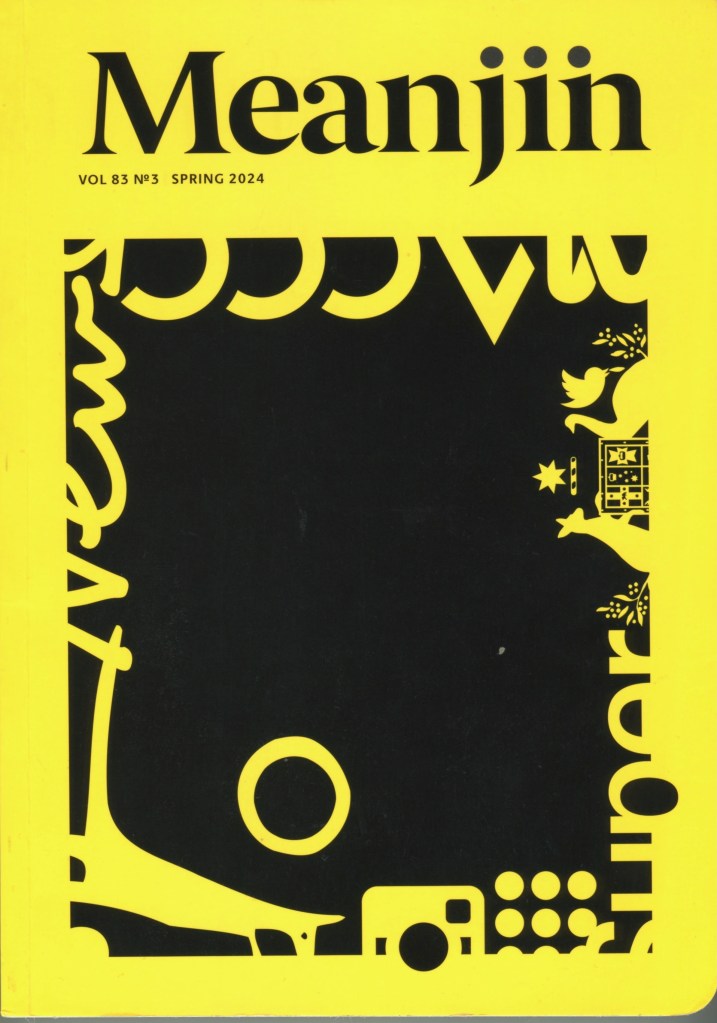
This Meanjin was published before King Charles visited Australia last year. This means Jenny Hocking’s blistering essay, ‘Remnants of Empire: Racism, Power and Royal Privilege‘, appeared well before Lidia Thorpe’s headline-grabbing outburst. The article, which amply fulfils the promise of its title, made me feel much more sympathy for the outburst.

There’s a lot else in this issue to delight and enlighten. Some pieces that I think of as necessary. Apart from Jenny Hocking’s, three that stand out are:

  • Well, It’s Beautiful Country, Really –‘ by Mike Ross. Each issue of Meanjin these days begins with a ‘Meanjin Paper’ – an essay by a First Nations person. In this one Mike Ross, an Olkola man who has been at the vanguard of land rights for the people of Cape York for three decades, talks about finding meaning in Country, about constantly learning
  • Lucky for Some‘ by Frank Bongiorno on the 60th anniversary of publication of Donald Horne’s The Lucky Country, which I read in tandem with Nick Bryant’s recent piece on the same subject in the Guardian
  • Jews, Antisemitism and Power in Australia‘ by Max Kaiser, which parses the way accusations of antisemitism have been used to silence important points of view. This article may have been published six months ago, but it feels hyper-relevant today as actual vicious antisemitism and and dubious accusations of antisemitism are ramping up.

There are pirces that may not be necessary, but they’re fun and educative all the same:

  • an interview with poet Ellen van Neerven (which I enjoyed even though it focuses on a book of theirs I haven’t read)
  • a scathing annotation of the Australian Constitution from First Nations writer Claire G. Coleman

There is some excellent fiction, including these two:

  • The Feeling Bones‘ by Lucy Nelson, which tells a family’s story in terms of their bone ailments; and incidentally informs me that ‘sits bones’, a term for the backside I had only heard used by my Pilates instructor, actually comes from the world of dance.
  • The Other Doctor‘, in which James Salvius Cheng finds a way to talk about the exhausting business of being a medical practitioner without coming across as a whinger.

A trio of memoirs call out to each other about disability, religion and sexuality:

  • Love Is Worship by Adrian Mouhajer, about finding peace in a Muslim family as a queer person
  • Dirty Things, Precious Things by Anna Hickey-Moody, about Catholicism, disability, family violence
  • Crocodile by Ella Ferris, brilliant, complex piece of writing which includes experiences of Aboriginality and disability

There are some excellent poems. The ones I warm to most (not necessarily the ‘best’) are:

  • ‘Mothertongues’ by Grace Chan, which begins ‘My son is starting to speak / in English’ and later, as she tries to teach him some Chinese, ‘our tongues stumble / in synchrony’
  • ‘The Women’s Shelter’, a rhyming sonnet by Claire Watson, in which a woman creates a knotted rag rug from strips of old bedsheets

There are things that aren’t my cup of tea: a smart-alecky essay on satire, an incomprehensible poem, some ‘experiments’, a review or two that convinced me not to read the books under consideration. But I can imagine each of those finding readers who will delight in them


I wrote this blog post on the land of Gadigal and Wangal of the Eora nation. I acknowledge their Elders past present and emerging, and gratefully acknowledge their care for this land for millennia, as once agin the sun is rising later in the mornings, and spiders are making their presence known in the bushes.

Laura Tingle’s High Road

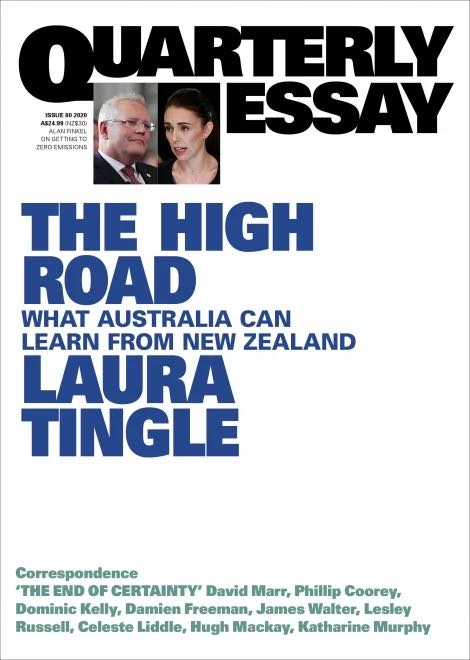
Laura Tingle, The High Road: what Australia Can Learn from New Zealand (Quarterly Essay 80) – and correspondence from Quarterly Essay 81.

The High Road is Laura Tingle’s fourth Quarterly Essay, making her possibly the series most frequent contributor. Great Expectations (QE 46 2012) dealt with Australian expectations of government, Political Amnesia (QE 60 2016) with failing institutional memory, and Follow the Leader (QE 71 2018) with political leadership in the modern world (links are to my blog posts). The High Road presents an abridged comparative chronology of Australia and Aotearoa New Zealand: both began as colonies of England, and both were cut adrift when the UK joined the EU, and they have taken very different, though parallel paths since then, while for the most part doing their best to ignore each other.

The essay begins with the stark contrast between Jacinda Ahern’s decisive response to the Covid crisis and Scott Morrison prevarication and ambiguity, and goes on to make broader comparisons between the two leaders that are all unflattering to Morrison. But when the essay goes back to sketch the histories of the two nations, the comparisons don’t always favour Aotearoa New Zealand.

Aotearoa New Zealand doesn’t have a written constitution. It does have the Treaty of Waitangi, which laid the basis for a mutually respectful relationship between Māori and Pākehā. The treaty was largely ignored by settler society until the second half of last century, but it has been since taken seriously and provided a basis for major advances in Māori status and conditions, and for compensation for past injustices. Compare this to Malcolm Turnbull’s offhand dismissal of the Uluru Statement from the Heart’s call for a makaratta and a Voice to Parliament. In Aotearoa/New Zealand politicians of all stripes speak of ‘honour’ in relation to the Treaty, a word we will wait some time to her in the Australian Parliament.

Neo-liberalism has come like a plague to both countries. It hit Aotearoa New Zealand harder. Because there is only one house in their Parliament, and there are no states, a Prime Minister with a majority can override opposition to an economic program, which is what happened with ‘Rogernomics’ – a ‘deregulatory frenzy’ in the 1980s, which has made New Zealand ‘a stellar example for those wanting less government, less tax and more markets ever since’, and has also brought about a huge amount of human suffering. On this side of the Tasman, when Hawke and Keating set out with similar aims they had to compromise and set up a certain level of protection for the vulnerable.

On the other hand, because Aotearoa New Zealand has an electoral system that makes it less likely than in Australia that any one party will have a clear majority, and though Jacinda Ahern has one currently she chooses to work collaboratively in the manner to which she has been accustomed. Their electoral system means that parties that appeal to the centre are more likely to gain power – unlike in Australia, where the major parties (especially the LNP?) can be held captive by their extreme elements.

Laura Tingle’s starting point is that most Australians are fairly ignorant about the history of our most similar near neighbour. She’s certainly right about me, and I’m less ignorant for having read the essay.

The correspondence in the following Quarterly Essay, Alan Finkel’s Getting to Zero – from historians and journalists from both sides of the Tasman, economists, lawyers and politicians – largely amplifies the thesis of this one, with some minor disagreements and several pointed anecdotes. Historian Frank Bongiorno, for instance, reminds us of the underarm bowl by Australian Trevor Chappell in a 1981 cricket match, saying this ‘ugly’ tactic was ‘the emblematic event in the trans-Tasman relationship’ of his childhood, even after New Zealand took a stand against US nuclear weapons and Australia remained supine.

The most telling pieces of correspondence are from First Nations writers.

In particular, Bain Attwood from Monash University and Miranda Johnson from the University of Otago argue ‘that relations between white settlers and Indigenous people in Australia and New Zealand did not actually follow a significantly different course after their beginnings’, that in both cases Indigenous people lost their resources or autonomy or both. As to the difference in the degree to which each country has sought to address historical injustice:

Rather than simply attributing this to the presence or absence of normative, moral, legal, philosophical and political forces in the governments, as Tingle does, it makes more sense to take note of the role played by material factors – for example, the fact that Māori are a much larger minority in New Zealand than Aboriginal and Torres Strait Islander people are in Australia or that there was less post-war non-British migration to New Zealand than to Australia. Unforeseen consequences of government policies and practices must also be taken into account. For example, the New Zealand Labour government in 1985 had no inkling that granting the Waitangi Tribunal the authority to hear cases about historical breaches of the treaty dating back to 1840 would lead to a veritable flood of claims and the compensation of many Māori iwi (tribes).

In her reply to the correspondence, Tingle focuses on the Covid pandemic and the difficulty of landing ‘a definitive portrait of my fleet-footed and shape-shifting subject, Australia’s prime minister’. Someone said journalism is the first rough draft of history. Laura Tingle is a top-ranking political journalist, and this essay is an excellent draft of significant history.


The High Road is the eighth book I’ve read for the Australian Women Writers Challenge 2021.