
Geoff Lemon, Katie Pase, Rhys Tate & Simon Cox (editors), Going Down Swinging Longbox (2015)
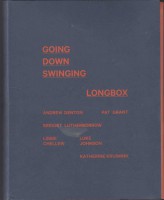 Faced with the recurring heartache of literary-magazine editors, of having to reject excellent material because it exceeds the magazine’s word count, the Going Down Swinging crew had the bright idea of publishing a boxed set of such rejects. And here it is, a collection of five slim books (for a range of values of the word ‘book’) enclosed in a paper box. It’s a beautiful artefact – like Maurice Sendak’s Nutshell Library, but for grown-ups. The separate pieces are:
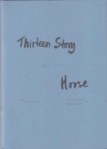 Bridget Lutherborrow, Thirteen Story Horse (illustrated by Harley Manifold)
Thirteen short stories set in a block of flats, each story bearing the number of its characters’ flat. There’s a talking horse who makes furniture out of egg cartons, a girl called Henrietta who has a mysterious supply of eggs (and useful egg cartons), a woman who irritates her neighbours by calling her husband’s full name when they’re having noisy sex, another woman who grows big hairy man hands when she drinks too much, someone who talks almost entirely in cliches, and so on. The stories are full of apartment living’s tangential connections and mysterious glimpses into other lives, with added weirdness and the horse providing a through line. Lovely ink wash drawings add a lyrical dimension.
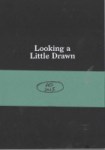 Andrew Denton (with a little help from Megan Herbert and David Squires), Looking a Little Drawn
Who’d have thought Andrew Denton had a whole other career in him? Yet here he is, with 30 original cartoons, each printed on a separate card, all but three executed with the skill level of a bright five year old. The resulting combination of sharp wit and primitive technique is totally disarming. The three exceptions, which are executed by Megan Herbert and David Squires (to help him, Denton says in an author’s note, ‘realise some ideas that neither the left nor right side of my brain knew how to draw’), wouldn’t be out of place in, say, the New Yorker. For example, a giant, radiant, bearded figure in a white robe sits on a throne in a supermarket with a tiny human on his lap; an onlooker says to a companion, ‘See? He really is real.’ How good it would be if The Monthly and/or the Saturday Paper started publishing such single-frame cartoons just for fun. Not that Denton totally avoids topicality: I ventured to reproduce one in my blog post on David Marr’s quarterly essay on Bill Shorten.
 Luke Johnson, Ringbark
Ringbark is an excerpt from Luke Johnson’s unpublished novel On Dead Highways. It’s an elegant 74-page book with a gorgeous cover drawing by Caroline Hunter, but I can’t tell you more than that because I have a policy of not reading excerpts from novels in newspapers or magazines. I’ll wait for the whole thing.
 Pat Grant, Toormina Video
A graphic novella–memoir in which Pat Grant tells the story of his alcoholic father. It’s pretty sordid, but it’s complex, and in the end respectful and full of love. The novella was first published on the internet two years ago, and you can still see that version at Pat Grant’s web site. Here, the 44 pages of the story are printed on 11 sheets of paper, each of which unfolds to reveal a single drawing and text on the other side, filling in details, responding to comments on the internet, meditating on art, addiction, family and other maters raised: the equivalent of DVD extras. I found it deeply satisfying, and I imagine that anyone who had a non-violent alcoholic parent would find it even more so.
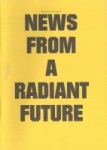
 Katherine Kruimink, News from a Radiant Future
Libbie Chellew, Protein
(both illustrated by Anthony Calvert)
Two dystopian novellas back to back. In Protein a city (country? world?) is under threat from a mysterious epidemic that shares some features of the zombie apocalypse. From a series of vignettes, we piece together a picture of what’s happening. Many questions are left unanswered, and the panic of the situation gets under the reader’s skin. At least it did mine. And then, the end, and we’re left with it. Katherine Kruimink’s story is likewise a patchwork – memos from a noticeboard, dialogue, what may be a diary entry by someone who is in 21st century terms illiterate. We are in the middle of things again – a small community of human survivors live in a compound, survivors of an invasion by Them (who are left undescribed apart from passing mentions of tentacles and technological superiority). Is it safe to leave the compound as the younger generation believe? Will the heroic sacrifice of two of the older generation come to anything? Will the group survive to another generation? All is left unresolved, brilliantly.
The package was produced with the help of crowd funding. My copy arrived as a fabulous surprise long after I’d made my donation. But you don’t have to have been a member of the funding crowd to own a copy. You can buy it online.
 Added later: Though they are part of a bigger bundle, Thirteen Story Horse and the Protein/News from a Radiant Future pair are the seventeenth and eighteenth books I’ve read for the 2015 Australian Women Writers Challenge.


 Me fail? I fly!