
George Megalogenis, Minority Report: The new shape of Australian politics (Quarterly Essay 96, December 2024)
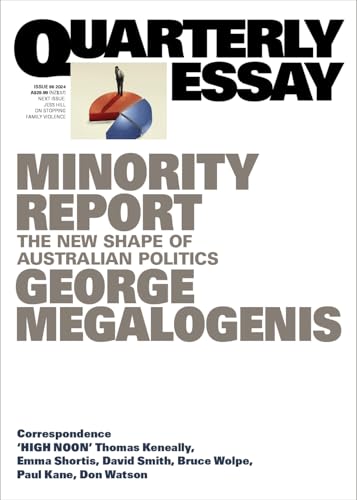
George Megalogenis takes Australia’s federal polling statistics and renders them into readable, even enjoyable prose. In this Quarterly Essay, he reads the data from elections since John Howard’s time up to the present moment, and attempts to make sense of the current political landscape.
The global financial crisis, the coming of the teals, Covid, the defeat of the Voice referendum, the genocide in Gaza, housing, the climate emergency, the hollowing out of the ABC: all are grist to the mill of this nuanced inside-baseball analysis.
The essay and the correspondence in Quarterly Essay 97 probably make a significant contribution to our general understanding of Australian electoral politics. But as I was reading it, I couldn’t help but be aware that it was written at the end of 2024, and if a week is a long time in politics, then the four months that have passed between then and now amount to an epoch. Even the correspondence was written before Donald J. Trump’s ‘Independence Day’. Who knows if, as Megalogenis projects, there will be a hung parliament in May? And if there is, who knows if he is right that it ‘offers perhaps our last best chance to restore purpose to our politics – and policymaking’?
Still, I admire and enjoy Magalogenis’ ability to communicate complex matter in a readable way. Page 47, which begins a section on the level of trust in government, includes an example:
In the wake of the 2010 federal election, I pinpointed the 2001 campaign as the turning point to a more trivial politics.
John Howard responded to warnings of electoral doom with a panic of handouts in the first half of that year. …
None of the bribes offered to voters in this period came with offsetting savings for the budget. They left a maze of entitlements and distorted market signals which stored up problems for the future, most notably in the housing sector, where prices boomed beyond the reach of the middle class, and in public infrastructure, which could not keep up with population growth.
Labor’s unforced policy errors on climate change and the mining tax in 2010 felt like the culmination of a decade-long trend which reduced the relationship between government and citizen to the question: how can I buy your support?
That general trend to trivialisation was interrupted first by the global financial crisis which, Megalogenis argues, created ‘a bubble of trust in our leaders and institutions, which burst once the existential threat passed’, triggering what he calls a ‘new super-cycle in our politics – pro-incumbent in the crisis and anti-incumbent in the recovery’.
There’s pleasure in discerning patterns of this sort. There may also be some usefulness.
In the correspondence, the stand-out for me is Judith Brett. She observes that the major political parties have been hollowed out, as their membership has declined and they have become ‘professional electoral machines’. When memberships were much larger, debate, negotiation and compromise took place within the parties. These debates connected with the lived experience, interests and prejudice of a range of electors. And when the legislation reached the parliament it was assured safe passage by the government’s majority:
What is happening, I think, is that the debate, negotiation and consensus-building is shifting from inside the parties back to the parliament, where they were for most of the nineteenth and early twentieth centuries … The conflicts of interest will be more publicly visible than they are when the resolution takes place inside the parties. This will be a magnet for media speculation and give the impression of dysfunction, but in my opinion it is no cause for alarm. The public will have a clearer view of the interests and arguments at play, and the government will have to negotiate. But it does not mean the end of effective legislation.
We’ll see.
I wrote this blog post on land of Gadigal and Wangal of the Eora Nation, where the day started out with rich blue sky, turned to heavy rain, fined up, and as I press ‘Publish’ is beginning to rain once more.. I acknowledge the Elders past and present who have cared for this land for millennia.


 Me fail? I fly!