
Jess Hill, Losing It: Can We Stop Violence Against Women and Children? (Quarterly Essay 97)
– plus correspondence from Quarterly Essay 98
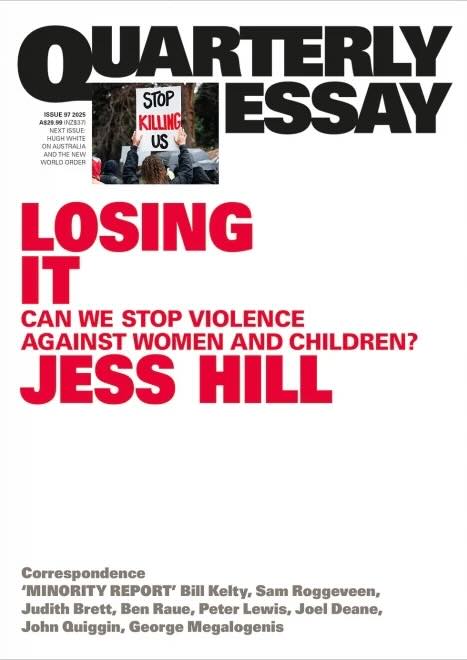
I came to this Quarterly Essay with a heavy heart, but I’m very glad to have read it, to know that there are people who are tackling a huge evil with intelligence, courage and compassion.
In the final chapter of her groundbreaking 2019 book, See What You Made Me Do (link is to my blog post), Jess Hill wrote:
The mission to transform attitudes to gender inequality and violence is laudable, and will no doubt produce important cultural changes. But as a primary strategy for reducing domestic abuse, it is horribly inadequate.
Losing It enlarges on that argument. Hill is all in favour of transforming attitudes to gender equality, but argues that an almost exclusive focus on giving that strategy leads to neglect of other significant factors and of strategies other than education and awareness-raising. In Nordic countries, where by most measures gender equality is more established than elsewhere in Europe, there is more violence against women. This is known as the Nordic paradox.
Hill gets into the nitty-gritty of Australian campaigns, and argues that they have stuck to an original plan in spite of evidence that it isn’t working. Although Australia is to be commended for leading the world in funding and developing primary prevention, we are not world leaders in actually preventing violence. The people responsible for developing strategies, she argues, are caught in rigid groupthink.
Advertising campaigns that intentionally or otherwise shame perpetrators can actually increase violence, because a lot of violence has shame somewhere at its root.
School education session on consent and gender equality are up against the enormous influence of internet personalities like Andrew Tate, and beyond them of ‘co-ordinated, strategic and incredibly well-funded’ organisations with anti-rights agendas around the world. Sexual violence is being reported by ever younger male perpetrators. On page 40, Jess Hill quotes Deanne Carson, an ‘external educator’ who teaches the Respectful Relationships program in Victorian schools:
Every single classroom I go into, I have children who have been raped. I have children who have sexualy abused other children.
Regulation of alcohol and gambling is needed; likewise more nuanced understanding of what is happening in the lives and minds of men who perpetrate violence. More attention is needed to the situation of child victim-survivors, especially when they are not accompanied by a victim-survivor mother. Something with the benign name of ‘alternative care accommodation’ can be a horror show.
There’s a ‘fifty-year-old turf war’ between the adherents to the ‘feminist’ model and the ‘psychopathological’ model. The quote marks are important: not all feminists and not all psychologists are in the trenches, but non-warriors tend to be sidelined in the policy debates. Hill argues for a ‘properly negotiated peace’ between the sides:
Australia’s prevention strategy should be alive to how gendered violence is driven by power imbalances – from gender inequality to homophobia, racism, economic inequality and ageism – as well as by suffocatingly narrow models for masculinity. But it must also strive to stop violence passing from one generation to the next, which requires a much stronger focus on preventing child mistreatment, helping children and victimised parents recover, placing more limits on harmful industries, helping men who are willing to do the work to heal, and keeping women and kids safe from the men who won’t. It’s only by integrating both viewpoints – feminism and psychopathology – that we can start to truly comprehend the phenomenon of men’s violence against women and children and find effective ways to stop it (pages 73-74).
Page 78* is in the six-page section ‘State of Neglect’, which discusses our collective failure to provide systems that would keep children safe, including people who get into violent intimate relationships in their teens.
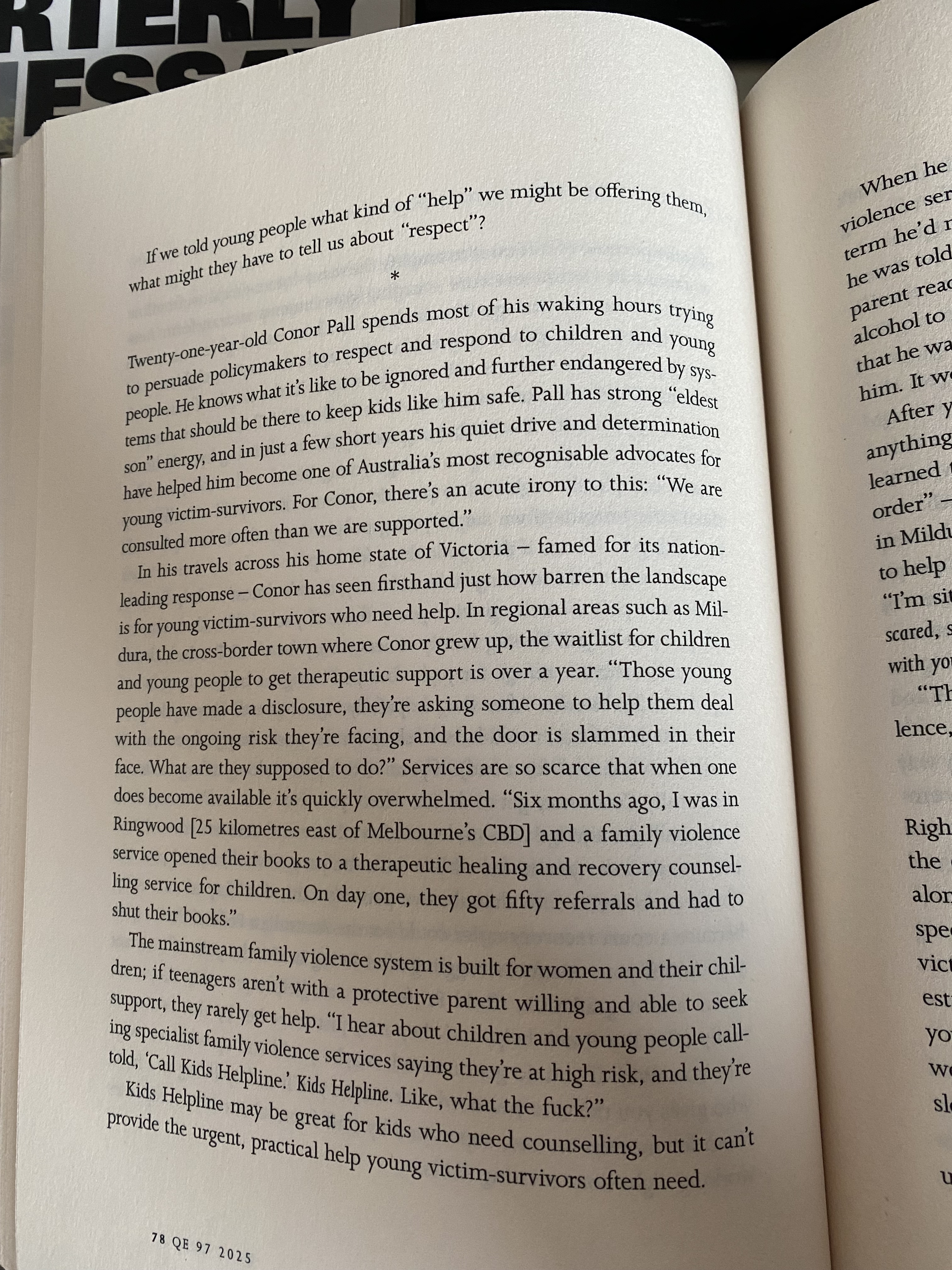
The previous page has given a list of appalling options. This page begins with a barb at ‘respect education’:
If we told young people what kind of ‘help’ we might be offering them, what might they have to tell us about ‘respect’?
The rest of the page is an excellent example of what Jess Hill has described, also on the previous page, as the purpose of the essay: ‘to amplify the many voices … urging governments to transform Australia’s prevention strategy.’
Twenty-one-year-old Conor Pall spends most of his waking hours trying to persuade policymakers to respect and respond to children and young people. He knows what it’s like to be ignored and further endangered by systems that should be there to keep kids like him safe. Pall has strong ‘eldest son’ energy, and in just a few short years his quiet drive and determination have helped him become one of Australia’s most recognisable advocates for young victim-survivors. For Conor, there’s an acute irony to this: ‘We are consulted more often than we are supported.’
….. The mainstream family violence system is built for women and their children; if teenagers aren’t with a protective parent willing and able to seek support, they rarely get help. ‘I hear about children and young people calling specialist family violence services saying they’re at high risk, and they’re told, “Call Kids Helpline.” Kids Helpline. Like, what the fuck?’
Kids Helpline may be great for kids who need counselling, but it can’t provide the urgent, practical help young victim-survivors often need.
Voice amplified, even before the brief description on the next page of Conor’s own experience ‘surviving after surviving’.
The correspondence in Quarterly Essay 98, Hard New World by Hugh White, is what you would expect, given the existence of a turf war. Some of the leading figures in the main government programs respond with understandable ire, saying the essay ‘lacks any nuanced discussion of the kinds of intersectional solutions needed’ and insisting that current strategies are based on sound research and wide consultation (Patty Kinnersly, CEO of the primary prevention organisation Our Watch); that it’s divisive, makes sweeping public critique of the workers in the field, is misleading and harmful (Helen Keleher, lead researcher and writer of the framework Hill criticises). I am absolutely in no position to judge the rightness and wrongness of the various arguments, but I do note that there’s a moment when Keleher accuses Hill of using ‘a recurring straw-man fallacy to position feminism as an obstacle to the prevention of violence against women’, which is itself a total straw man, as Hill doesn’t make that argument at all.
Of the other correspondents, the most horizon-broadening is a brief, revelatory essay on ‘how family violence is facilitated within Australia’s migrant and ethnically diverse communities’ by Manjula Datta O’Conor, a founding director of the AustralAsian Centre for Human Rights and Health and author of Daughters of Durga: Dowries, Gender Violence and Family in Australia. I’ll give her the last word here:
If we are to reduce the rates of family and domestic violence, we must look unflinchingly at all contributing factors. Mental health is one of them. That means rethinking how we design perpetrator intervention programs. It means integrating mental health support, not as an excuse but as a method of accountability.
I wrote this blog post on the still-beautiful land of Gadigal and Wangal of the Eora Nation. I acknowledge their Elders past and present.
* My blogging practice is focus arbitrarily on the page of a book that coincides with my age, currently 78. It’s like a lucky-dip sampling of the book.


 Me fail? I fly!