
Hugh White, Hard New World: Our Post-American Future (Quarterly Essay 98, 2025)
– plus correspondence in Quarterly Essay 99
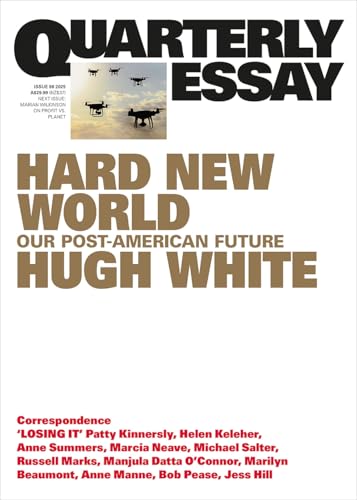
This is Hugh White’s fourth Quarterly Essay. As the titles, and especially subtitles, of his essays demonstrate, he has been on the same track for fifteen years (links are to my blog posts):
- QE39, August 2010, Power Shift: Australia’s future between Washington and Beijing
- QE68, November 2017, Without America: Australia in the New Asia [no blog post]
- QE86, June 2022, Sleepwalk to War: Australia’s Unthinking Alliance with America; and now
- QE98, June 2025, Hard New World: Our Post-American Future
The gaps between essays, like those between major bushfires, have been getting shorter, and his argument more pressing. The US isolationism of Trump’s second coming, the genocidal war crimes of the US ally Israel, and what looks like Vladimir Putin’s unending war on Ukraine all make his argument more cogent and persuasive.
In a nutshell, he argues that after the end of the Cold War in which two superpowers were in uneasy stand-off, and the period since then when there was just the one, we are now and have for some time been in a multipolar world. The USA no longer has the resources to dominate the globe, and nor does it have sound reasons to do it. In the past, when a single power could potentially dominate the whole of Eurasia, the USA had reason to be concerned for its own security. And when no other power hcould match the US’s economic heft, the US had the resources to do something about it. Now, as China’s economy is by key indicators larger than that of the US, it at the same time shows no sign of becoming a dominant force in the rest of Asia or Europe – India is a rising power, Indonesia isn’t far off, Russia would be a problem, and likewise Europe can if provoked present a united front. The US has neither the resources nor strategic reason to continue to invest in the security of the Asia pacific region. It no longer makes sense for Australia to depend on the US for its security.
There’s a lot more to his argument.
Something I found refreshing is the way, having made it clear that he considers Donald Trump to be sociopathic, he considers his approaches to global politics as being erratic and weird, but in essence correct as he ‘rejects the whole idea of America as the global leader, upholding and enforcing international order and promoting American values for the good of the world as a whole’. Specifically, he’s not going to take on China, and nor would it make sense to do so. To quote page 47*:
There is no evidence that Trump cares much, if at all, about the strategic contest with China in Asia. On the contrary, a lot of evidence points the other way. It suggests that Trump is happy to deal with China in the same way he deals with Russia, as a fellow great power in a multipolar world. That means conceding China’s right to an exclusive sphere of influence in its own backyard, just as he insists on America’s right to dominate the Western Hemisphere.
So, in strategic questions, Trump really isn’t a China hawk … He dislikes America’s Asian allies and has often dismissed the idea that America should defend Taiwan.
Xi Jinping’s great parade to celebrate the end of World War Two, with its attendant photos of Xi, Putin Kim Jong Un and Modi in cheerful togetherness hadn’t happened when this essay was written, but Trump’s Truth Social message to Xi, ‘Please give my warmest regards to Vladimir Putin, and Kim Jong Un, as you conspire against The United States of America,’ looks more like posturing for his base than any substantial evidence that Hugh White is wrong.
The essay ends with a draft speech for an Australia leader to communicate a necessary shift in policy. A few speeches like it, he says, ‘could start the national conversation we need to have, but which we have so far done our best to avoid’. The speech includes this:
In these very different circumstances we cannot expect America to keep playing the same role as hitherto in the security of our region and as Australia’s ally. That old order cannot be preserved by war or the threat of war. Our focus instead must be to help create a new order in Asia which fits the new distribution of power and best protects our core national interests, and to do whatever we can to help ensure a peaceful transition from the old order to the new. Then we must prepare Australia to survive and thrive in this new order. That starts by accepting that our relationship with America will change. It will remain an important relationship, but it will become less central to our security in the years to come as America’s laters and role in Asia change. We will rely more on our relations with our neighbours to help keep the region peaceful and minimise any threats, and we will rely more on our own forces to defend us from any threats that do arise.
All this will be demanding. The new world we face will be harder than the one we have known for so long. But there is no choice.
I’m well outside my comfort zone on the subject of international relations, defence, security, war and threats of war, but I found this essay compelling.
Correspondence on White’s previous Quarterly Essays included a number that dismissed him as simply wrong, a winner-take-all debater, selective with his facts and using little reason. I quoted a number of them in my post on QE 86. Perhaps it’s just that current and former prime ministers no longer engage in this kind of forum, but the correspondence on this one, published in QE 98, mainly from academics in relevant fields, is generally supportive of its central thesis.
I wrote the blog post on the land of Gadigal and Wangal of the Eora Nation at the moment the sky is clear but the ground is sodden with recent rain. I acknowledge Elders past and present, and welcome any First Nations readers.
* My blogging practice is to focus on the page that coincides with my age, currently 78.


 Me fail? I fly!