Stephen Sondheim, Finishing the Hat: Collected Lyrics (1954-1981), with Attendant Comments, Principles, Heresies, Grudges, Whines, and Anecdotes (Virgin Publishing 2010)
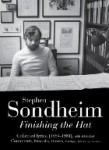 This was a birthday present from the Art Student. We’ve both been Sondheim fans since seeing the fabulous Sydney Theatre Company production of his collaboration with James Lapine, Into the Woods, in 1993. It’s not that I’ve been dying to pore over his lyrics, as I once did (and still occasionally do) over Bob Dylan’s, but the book’s subtitle promises much more than a set of songs drained of their music. And so it transpired: lyrics of songs you’ve never heard or recall only vaguely don’t make riveting reading, but a master craftsman’s unsparing reflections on his work, and that of his colleagues, collaborators, mentors and rivals is another story.
The comments of the subtitle turn out to be illuminating notes on the writing of particular songs and brief accounts the development of thirteen musicals – from Saturday Night in 1954 (not actually produced until 1999) to Merrily We Roll Along in 1981 (to be reshaped into a success for a James Lapine production in 1985). There are three principles: Content Dictates Form, Less Is More, and God Is in the Details, all in the service of Clarity. The heresies, grudges, whines etc, range from classic showbiz anecdotes (Hermione Gingold’s audition for A Little Night Music is my favourite, closely followed by Ingmar Bergman’s praise of her performance) to mini-essays on a score of eminent writers for musical theatre. There’s a list of the cardinal sins of lyric writing, a spirited advocacy of full rhyme, and any number of fascinating insights into the elation, heartbreak and drudgery of working on Broadway.
Approaching 80 when he wrote the book, Sondheim doesn’t mince words. You don’t have to agree with his evaluation of Noel Coward as the master of condescending blather or Lorenz Hart as gifted but lazy to relish his straight talk. Mostly, his frankness remains respectful: he may ‘cringe at the bloodless quaintness of the ballads’ of Gilbert and Sullivan and be baffled when he hears an audience laugh at one of their songs, but he acknowledges their importance in the history of musical theatre, and allows that his failure to enjoy them may reflect a lack in himself. On the subject of ignorant, lazy or arrogant reviewers and critics, though, he gives no quarter. In particular, he writes scathingly about the first production of Burt Shevelove’s The Frogs by academic George Brustein, who is portrayed as arrogant, self-serving, disingenuous and incompetent. (Brustein, incidentally, didn’t do himself any favours by writing an unconvincing alternative account of that production, though he did at least score a point by saying that while revenge may be a dish best served cold, Sondheim, who waited more than 30 years to tell his story, seems to prefer it frozen.)
This, along with the companion volume due out later this year, Look, I Made a Hat, is probably as close to an autobiography as Sondheim will give us. Although there’s almost nothing of his non-professional life, something of a pictorial biography emerges from the charming personal photos scattered among the images of manuscript pages, playbills, rehearsals and productions – beginning with him, aged about 5, serious at the piano in a school rehearsal, and ending with him grey-bearded and beaming at a theatre entrance.
The book ends on a cliffhanger. The Broadway premiere of Merrily We Roll Along was a flop, closing after 16 performances. Sondheim writes:
It was a show I adored and a deep disappointment in its first outing, and it marked an important period in my professional life.
But then I met James Lapine.
INTERMISSION
-33.875184
151.172380


 Me fail? I fly!