
Esther Anatolitis (ediitor), Meanjin Vol 83 Nº 3 (Spring 2024)
(links are to the Meanjin website: some but not all of them are available to non-subscribers)
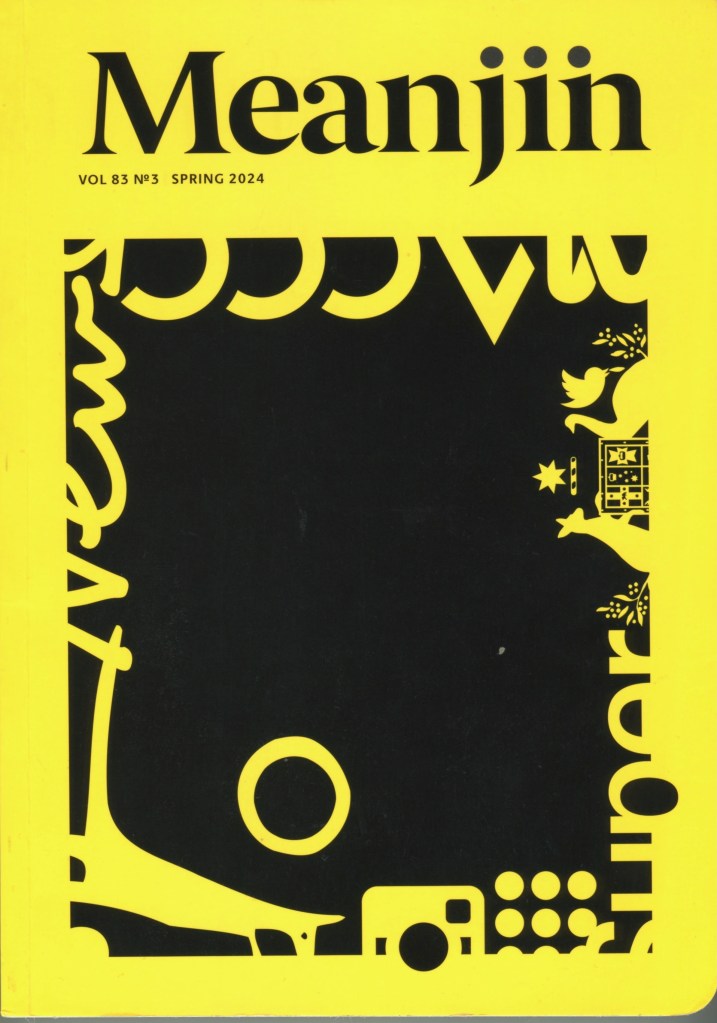
This Meanjin was published before King Charles visited Australia last year. This means Jenny Hocking’s blistering essay, ‘Remnants of Empire: Racism, Power and Royal Privilege‘, appeared well before Lidia Thorpe’s headline-grabbing outburst. The article, which amply fulfils the promise of its title, made me feel much more sympathy for the outburst.
There’s a lot else in this issue to delight and enlighten. Some pieces that I think of as necessary. Apart from Jenny Hocking’s, three that stand out are:
- ‘Well, It’s Beautiful Country, Really –‘ by Mike Ross. Each issue of Meanjin these days begins with a ‘Meanjin Paper’ – an essay by a First Nations person. In this one Mike Ross, an Olkola man who has been at the vanguard of land rights for the people of Cape York for three decades, talks about finding meaning in Country, about constantly learning
- ‘Lucky for Some‘ by Frank Bongiorno on the 60th anniversary of publication of Donald Horne’s The Lucky Country, which I read in tandem with Nick Bryant’s recent piece on the same subject in the Guardian
- ‘Jews, Antisemitism and Power in Australia‘ by Max Kaiser, which parses the way accusations of antisemitism have been used to silence important points of view. This article may have been published six months ago, but it feels hyper-relevant today as actual vicious antisemitism and and dubious accusations of antisemitism are ramping up.
There are pirces that may not be necessary, but they’re fun and educative all the same:
- an interview with poet Ellen van Neerven (which I enjoyed even though it focuses on a book of theirs I haven’t read)
- a scathing annotation of the Australian Constitution from First Nations writer Claire G. Coleman
There is some excellent fiction, including these two:
- ‘The Feeling Bones‘ by Lucy Nelson, which tells a family’s story in terms of their bone ailments; and incidentally informs me that ‘sits bones’, a term for the backside I had only heard used by my Pilates instructor, actually comes from the world of dance.
- ‘The Other Doctor‘, in which James Salvius Cheng finds a way to talk about the exhausting business of being a medical practitioner without coming across as a whinger.
A trio of memoirs call out to each other about disability, religion and sexuality:
- Love Is Worship by Adrian Mouhajer, about finding peace in a Muslim family as a queer person
- Dirty Things, Precious Things by Anna Hickey-Moody, about Catholicism, disability, family violence
- Crocodile by Ella Ferris, brilliant, complex piece of writing which includes experiences of Aboriginality and disability
There are some excellent poems. The ones I warm to most (not necessarily the ‘best’) are:
- ‘Mothertongues’ by Grace Chan, which begins ‘My son is starting to speak / in English’ and later, as she tries to teach him some Chinese, ‘our tongues stumble / in synchrony’
- ‘The Women’s Shelter’, a rhyming sonnet by Claire Watson, in which a woman creates a knotted rag rug from strips of old bedsheets
There are things that aren’t my cup of tea: a smart-alecky essay on satire, an incomprehensible poem, some ‘experiments’, a review or two that convinced me not to read the books under consideration. But I can imagine each of those finding readers who will delight in them
I wrote this blog post on the land of Gadigal and Wangal of the Eora nation. I acknowledge their Elders past present and emerging, and gratefully acknowledge their care for this land for millennia, as once agin the sun is rising later in the mornings, and spiders are making their presence known in the bushes.


 Me fail? I fly!