
This is my fourth post on books I’ve brought with me on my escape from Sydney’s winter, focusing as usual on page 76.
Jill McKeowen, Sunday Morning, Here (Flying Island Books 2023)
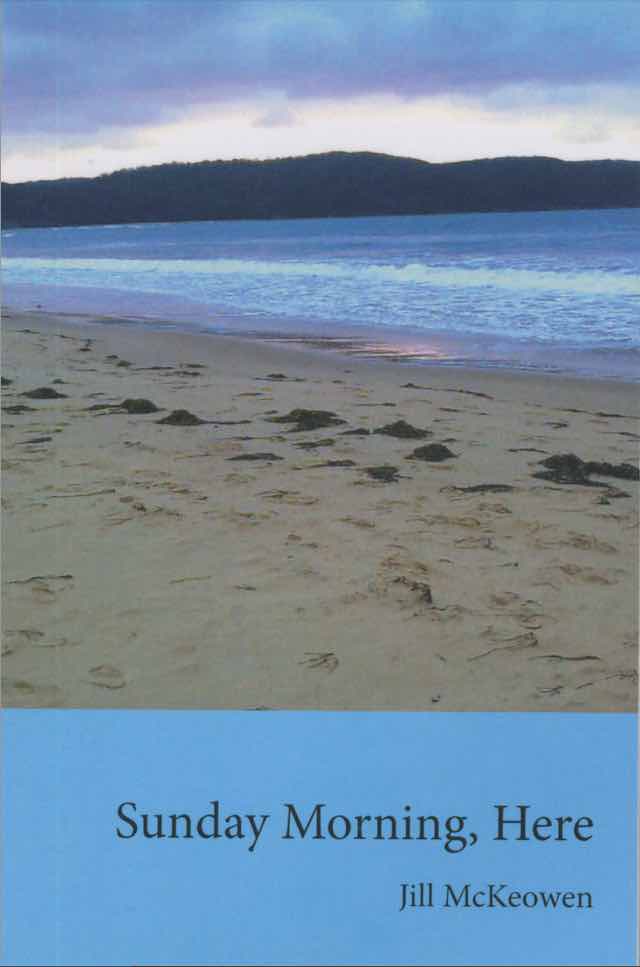
Sunday Morning, Here is another book in Flying Island’s hand-sized poetry series. Jill McKeowen’s bio tells us that, among many other things, she has been a regular reader at Newcastle Poetry in the Pub, and that this slim volume is her first book of poetry. I hope there will be many more.
It’s the kind of book that opens a window into the poet’s life: daily observations of life around her home on NSW’s mid-north coast, and on her travels up the coast and across the continent; some splendid poems about cockatoos; a whole section dealing with her father’s death and its aftermath; a section on her childhood family, then and now. Some poems suggest a disciplined practice of writing for an hour each morning. The poems are warm and genial, sometimes playing with form (there’s a nifty and heartfelt homage to Elisabeth Bishop’s The Art of Losing).
The title poem, ‘Sunday Morning, Here’, is partly a response to a Wallace Stevens poem, ‘Sunday Morning’, signalling that McKeowen expects to be read in conversation with other poets. Its first line, ‘Here there’s no complacency, but ease’, echoes the first word of the Stevens poem (‘Complacencies’), at the same time highlighting a recurring theme: the poet’s life is in the main comfortable and pleasant, but it includes an awareness of privilege: ease, but not complacency.
Serendipitously, the poem on page 76, ‘It’s still dark’, embodies many of these general characteristics.
It's Still Dark
I nudge the doona back, unwrap
my sleep to the cold, and drift
consoled in fleecy gown, pocket
feet into slippers, feel
my way on hushed carpet, spark
the gas heater to flame, flick
the bathroom into light, give
thanks for this convenience;

I fill the kettle from the tap,
strike a match to more gas,
slice ginger into boiled water,
put my night-dried dishes away,
sip the tea by fire glow,
watch the rising-falling breath
of curled cat, and write
a reckless page of adjectives.

A woman wakes by the road
close to a border town, her body
warmth still wrapped around
her sleeping child,
unseen
by armed militia.
She must look for water
while the dawn is pinned with stars.
Serendipitously, as I’m typing this I have on the table beside me a glass of ginger tea made from slices of ginger. I don’t wear slippers, my holiday rental has tiled floors, there is no cat, but the sense of simple luxury conveyed in the first two stanzas communicates beautifully. The four beat lines move smoothy, and the relaxed suggestions of rhyme (pocket/drift, spark/flick) and alliteration (water/away) hold the lines together, contributing to the sense of ease.
But not complacency.
The flow is disrupted in the second-last line of the second stanza, after the ultimate image of laziness – the ‘curled cat’ – comes a midline break in the sense, the first in the poem, and the line ends on just three beats, so that ‘write’ takes on a different, less indolent feel. Things are still easy but there’s a sense of purpose. Then ‘reckless’ confirms the change in mood. What is this reckless undertaking? It’s a writing exercise, perhaps a warm-up for something more challenging. Elsewhere in the book there’s a suggestion that McKeowen has a regular practice of writing in this way.
The third stanza takes the poem somewhere else altogether. It’s as if the act of putting words on paper ‘recklessly’ her mind is dragged from its early-morning drowsiness to awareness that her ease and comfort are an extraordinary privilege. The image of the woman who does not share her privilege bursts into the poem in lines of uneven length, with line breaks that do violence to natural phrasing (body / warmth, unseen / by armed militia). The other woman too has to find water, but in radically different, more precarious circumstances. We don’t need specifics of what country she is from: there are plenty to choose from.
I’m sure someone has said that good literature doesn’t provide solutions to problems, but helps to understand them. That’s certainly true of this poem. It gives us an unsettled and unsettling juxtaposition of two early-morning awakenings. A lesser poet might have gone on to spell out how the juxtaposition affected her – inspiring feelings of helpless guilt, say, or a decision to increase her regular donation to UNICEF. But that would have let the reader off the hook.
What we are left with is the final image of the dawn ‘pinned with stars’. As in those classical Chinese poems where the moon can be seen by the exiled poet and also by those who are far away, both women in this poem can see the stars. It’s a reminder of their shared humanity, and of ours.
I’m grateful to Flying Islands Books for my copy of Sunday Morning, Here.


 Me fail? I fly!