Tag Archives: Joëlle Gergis

Joëlle Gergis’ Highway to Hell

Joëlle Gergis, Highway to Hell: Climate Change and Australia’s Future (Quarterly Essay 94, 2024) – plus correspondence in Quarterly Essay 95
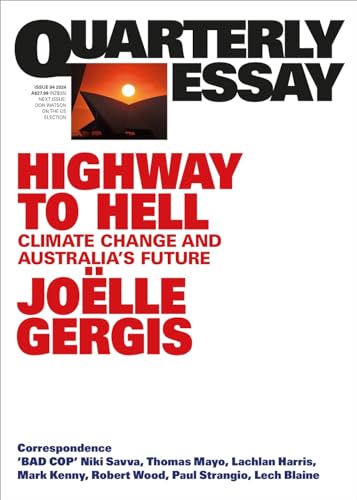
I’ve worn a Peter Dutton mask with devil horns in street theatre outside Anthony Albanese’s office. I’ve asked awkward questions at the AGMs of fossil fuel companies, scripted by Market Forces. I’ve participated with gusto in Move Beyond Coal‘s campaign targeting banks that provide financial backing to new coal mines. I joined the People’s Blockade of the coal port of Newcastle last November and plan to join again this year. Do I need to read ONE MORE BOOK on climate change?

Well, yes, I do. I had pushed out of my mind the terrible events of Summer 2021–2022. I even wrote about Judith Beveridge’s poem ‘Choirwood’ as if it offered some kind of hope after those fires (at this link). After reading Joëlle Gergis’s essay, the poem is still brilliant, but it feels like so much whistling in the dark.

Joëlle Gergis is one of the 234 lead authors of the most recent IPCC Report. She is a climate scientist who, she tells us in this essay, has become so frustrated at the way the reality of climate change is downplayed or ignored by those in power that she quit her job as an academic scientist to become a public advocate. I’d say she has become a Cassandra warning of the dangers, except that Cassandra was doomed to be ignored, a fate I hope will not befall Joëlle, for all our sakes.

After noting the relief of seeing the end of the denialist Morrison Government (remember ‘Labor’s war on the weekend’, and ‘Don’t be afraid, this is carbon’?), the essay tackles the current situation – better, but a long way from hopeful. Here’s a key paragraph, on page 7:

The scientific reality is that, regardless of political spin used to justify the continued exploitation of fossil fuel reserves, the laws of physics will keep warming the planet until we stop pumping carbon into the atmosphere and begin cleaning up the mess. The situation is too far gone for renewable energy alone to save us. Pinning our hopes on carbon capture technology to justify the continued burning of fossil fuels is a disastrous gamble the world can’t afford to take. So, as this fateful moment approaches, we need to take an honest look at the government’s climate policy and realistically assess the situation we are in. Are the climate wars really over, or has a new era of greenwashing just begun?

As she goes on to say what the laws of physics are up to and to outline a range of future scenarios, she begs us: ‘Please, don’t look away. Thee isn’t a moment to waste.’

I won’t try to summarise the science, but if you’re looking for a solid, accessible presentation, I doubt if you’ll find a better one anywhere. It’s a gruelling read, from which my main takeaway is that I need to grieve for the corals of the Great Barrier Reef that thrilled me as a child, for the thousands of cattle and millions of wild animals that have died and are yet inevitably to die as the planet heats up, for the vast tracts of forest, including rainforest, that have already been devastated. I need to grieve and I need to treasure what remains – and be prepared to fight for it.

After a blistering account of carbon offsets and carbon capture and sequestration (CCS) in a chapter headed ‘Chasing Unicorns’, she asserts that we know what needs to be done, but such is the power of the fossil fuel lobby that Australian governments won’t do it. True, there has been significant movement in State governments, and outside of government. But it’s pretty grim, when the main message to the reader about what can be done is to stress the importance of voting in the next federal election.

Almost any paragraph from this essay is worth quoting and pondering. On page 47*, there’s this:

To its credit, the Albanese government has tried to support Australia’s emergence as a renewable energy superpower. [She lists an impressive number of initiatives taken since the ALP’s election win in May 2022.] While these are all steps in the right direction, the challenge is not to undo all of this good work by allowing the interests of the fossil fuel industry to co-opt the process and weaken real progress towards reducing global emissions.

Rather than ‘net zero’, the goal must be to achieve ‘real zero’, which can only happen once we stop burning fossil fuels. In fact, the science tells us that around 60 per cent of oil and gas reserves and 90 per cent of coal must remain unextracted if warming is to be limited to 1.5°C. There is no way around having to eventually face this scientific reality.

But instead of facing facts, in December 2023, the federal government caved in to lobbying from the oil and gas company Santos.


The correspondents in Quarterly Essay 95 mostly agree with and amplify the arguments of the essay. There’s an excellent piece by David Pocock, who is probably the parliamentarian that Gergis meets with early in the essay. He describes his shock as a senator now for a little over two years to see how ‘policy is consistently shaped by political considerations ahead of evidence and research’. Often he says, politicians ‘are not looking for genuine, long-term solutions, but for the next opportunity to back their opponents into a corner’.

A stand-out exception to the generally supportive tone is a grim piece by Clive Hamilton. He’s not the only correspondent to describe Joëlle Gergis as operating on an ‘information deficit’ model: if only people, including those in power, had correct information they would do the right thing. Scientists have been trained to look for solid, verifiable facts and to base their actions on what they find. But it’s a mistake to assume that that’s how people in general function. Hamilton dismisses the essay’s hope as wishful thinking, argues that nothing Australian governments do can have much impact on climate change, and generally sees the outlook as bleak:

After two decades of research into the psychological, social and political complexities of persuading people to recognise and act on the science of climate change, it’s wearying when another scientist comes along convinced that it’s only a problem of someone with authority communicating the facts. I’d be more energised if Gergis, as an IPCC lead author, had written an essay arguing that it’s time for a campaign of industrial sabotage.

I would love to know how Joëlle Gergis responds to Clive Hamilton. Sadly, no response from her is included in QE 95. Maybe in Nº 96? Or maybe she’s already out there like the main character in the movie Woman at War.


I wrote this blog post in Gadigal Wangal country, where it is my great joy to live. I acknowledge Elders past and present for their continuing custodianship of this land.


My usual blogging practice is to focus on the page that coincides with my age, currently 77. But as this Quarterly Essay runs to just 72 pages including notes, I’m looking at page 47, the year of my birth minus 1900.  

SWF 2023: My third day

I’m not exactly live blogging the Sydney Writers’ Festival. It’s now Sunday and my festival is over, but the blog is still at Thursday.

On Thursday, we arrived an hour or so before any of our booked events and caught up with friends over lunch, then we were off.


2 pm: Climate Hope

This was billed as: ‘a trio of environmental experts examine promising developments, signs of hope and viable solutions for a greener, more sustainable future.’ It delivered on that promise.

Simon Holmes à Court, founder of Climate 200 (tagline ‘climate proofing politics’), was the chair. Other panellists were a scientist, an engineer and a community activist: Joëlle Gergis (Humanity’s Moment: A Climate Scientist’s Case for Hope), Saul Griffith (The Big Switch and the Quarterly Essay The Wires that Bind), and Claire O’Rourke (Together We Can: Everyday Australian’s doing amazing things to give our planet a future).

There was an awful lot to digest, or even grasp as it flew by. I hope it will turn up as a podcast – I recommend it.

Here are some of my takeaways:

Jöelle Gergis described how, after helping to write the IPCC report on the state of the climate, she was filled with despair. Technological solutions are pretty much all there, but there is little political will to implement them. This is no longer a scientific problem; it’s a social, cultural and political one. She found hope in looking to history. Many times in the past when there has been a major crisis, people have come together and created solutions. She gave a number of examples, but what I remember is Saul Griffith’s amplification of her point by mentioning Dunkirk: the Allied forces had been roundly defeated, and then Winston Churchill, who can be criticised on many fronts, inspired what could have seemed an irrational hope with his rhetoric (‘We will fight them with teaspoons’ – not an actual quote as far as I know), and the people famously rallied.

The motto ‘Reduce, Re-use, Recycle’ doesn’t point to the way out of the climate emergency. It puts the onus for action at the individual level, when what is needed is systemic change (though individual initiatives are important to achieve that). It can be paraphrased as, ‘If we just sacrifice a little, the world will be a little bit less fucked.’ (Numerous apologies for swearing were made to Saul Griffith’s mother who was in the audience, though if she’s anything like women I know who are mothers of people Saul Griffith’s age, she swears quite a bit herself.) in reality, if we do this right, we can get a good outcome and not sacrifice any of our standard of living.

Claire O’Rourke is already active in the social movement space. She gave example after example of ordinary people who have taken action and organised to bring about change at local and regional levels.

There were some great quotes:

Claudia Rankine (link to my blog post about her Citizen): ‘Every state of emergency is also a state of emergence.’

Bill McKibben (link to my 2007 blog post discussing his Deep Economy): ‘Winning slowly is losing.’

Rebecca Solnit (link to my blog post about her Hope in the Dark): ‘People today will determine the future of humanity.’

Saul Griffith recommended that each of us makes six big decisions about our lives in the next year in order to bring about systemic change: decisions about home heating, cooking, cars, nutrition and so on. Just a handful of major decisions, he means, not the hundreds of decisions involved in ‘lifestyle changes’.

Claire O’Rourke mentioned systems theory, said change happens most effectively through networks and recommended the All We Can Save Project.

Jöelle Gergis had the last word: The missing piece is a social movement.


I rushed off to arrive late and sit at the edge of the space set aside for ‘curiosity Lectures’ and ‘Beginnings’, the latter being sessions where people read the beginnings of books to the audience:

3 pm: Benjamin Gilmour on Taking Tea with the Taliban.

Among other things, Benjamin Gilmour is notable for the extraordinary film Jirga (2019), which he wrote, directed and shot in a tribal area of Afghanistan. He recently revisited Afghanistan for a new film documentary project, which if I heard correctly is to be called Taking Tea with the Taliban. In this Curiosity Lecture he told about interviews with members of the Taliban government and his time with villagers who told him of terrible brutality at the hands of Australian soldiers.

It was disturbing stuff. He relayed the Taliban’s protestations that the way they are portrayed in the western press is self-serving propaganda, that their treatment of women is misrepresented, and that it’s hypocritical for the west to condemn the Taliban for mistreatment of women when USA and Australian forces have destroyed so many Afghan lives, of women and children as well as men.

I couldn’t help thinking of those Australians who visited Stalin’s Russia and came back with glowing reports of happy workers at times when, it was later revealed, the gulags were filling up. All the same, he made a strong argument for governments to engage with the Taliban. ‘I did,’ he finished his talk, ‘and I’m just some guy.’

Benjamin Gilmour has a special place in my heart: we published a number of his poems in The School Magazine in the 1990s, when I was editor and he was a teenager. I introduced myself and we had a photo taken together. I’d share it here but I made the mistake of lowering my mask instead of taking it off altogether, and I look mildly deranged.


Then straight on to 4 pm: George Monbiot: Regenesis

A giant George Monbiot on video chatted with Rebecca Huntley. This was a brilliant talk. Monbiot’s ability to marshal facts and present a clear argument is breathtaking.

His central message was that the global food supply system is at risk of catastrophic failure. Not only that, but farming is contributing hugely to global warming. Second only to the urgent need to keep fossil fuels in the ground is the need to stop farming animals. It’s as if the scientists who have been researching this area have been shouting and waving their arms about, but have been doing it from behind plate glass, inaudible to the rest of us.

Although world hunger fell steadily from about 1960, in 2014 it began to rise again, and has been rising steadily ever since – even before the shocks to the food supply system that were Covid-19 and Russia’s invasion of Ukraine. This is because the food distribution system now works in such a way that even small shocks to the system can cause disproportionate price hikes in vulnerable communities.

He gave us a brief introduction to systems theory. Complex systems, such as the climate or the global food supply system, take a lot of understanding (and after this talk, I’m keen to learn more). There are six elements required for a complex system to be resilient:

  • diversity
  • asynchronicity
  • redundancy
  • modularity
  • circuit breakers (in this case regulatory constraints)
  • back-up systems

I imagine his book Regenesis spells out how the food system scores on these elements. From the talk I understood that concentration of the control of food in about four massive corporations makes for low resilience. Industrial farming likewise. Redundancy is so limited that if the Ever Given had been stuck in the Suez Canal a year earlier, when Covid was at a different stage, the result would have been disastrous.

It’s not a question of tightening our belts. He sees hope in technology, in what he calls a technoethical shift: when something becomes amendable it becomes intolerable. That is to say, if a food can be developed that has the nutritional value of meat and it’s flavour, texture and general appeal, we will be able to face the reality of what our meat-eating has been doing to our relationships with other animals and to the planet.

The technology that he favours is ‘precision fermentation’, in which single cell organisms are used for food: we already do it with yeast, and many other species are being explored. A naturally occurring pink microbe has been discovered in Europe that when grown in a culture looks, feels and tastes like sausage. He himself was the first person to eat a pancake grown from microbes – ‘One small flip for a man’ – and it tasted like a pancake. He surmises that this will lead to a culinary revolution as radical as the one produced by the development of agriculture. And food produced in this way uses a tiny fraction of the earth’s resources.


We went home for a vegan dinner, then caught public transport into town for our one event not at the Carriagework:

8 pm: Storytelling Gala: Letters to the Future

Not to cast shade on any of the readers or organisers but this ‘gala’ was a bit of a dud. A stellar line-up of writers got to read to a packed Sydney Town Hall. They had evidently been given the title ‘Letter to the Future’. Most of them gave us a piece that began, ‘Dear Future’, and too many wrote what could be summarised as: ‘Dear Future, we have fucked up the world. I expect Earth is posthuman/a disaster where you are. Please forgive [or forget] us.’ After hearing someone say in the 2 o’clock session that people find it easier to imagine a disastrous future than one where the problems have been solved, it was dispiriting to hear so many people take the easier path as if they were doing something serious.

There were exceptions.

Anthony Joseph (about whom more tomorrow) read two poems in a form known as the Golden Shovel, where the last words of the lines spell out a quotation. His first one took Kierkegaard’s ‘Life can only be understood backwards; but it must be lived forwards’: I was too busy trying to spot the line breaks to follow the poem, but it sounded great.

Shehan Karunatilaka spoke elegantly about the impossibility of the task and told a fable about a child refusing a hug to her father, thereby setting of a chain of events leading to disaster.

Nguyễn Phan Quế Mai wrote an imaginary letter from her ten-year-old self, bookended by fabulous a cappella song.

Jason Reynolds also read a letter from his past self: I found it hard to follow, but his performance was fabulously musical.

Nardi Simpson rejected the idea of the future, saying that as a First Nations person she has responsibilities to Now. It was striking how she echoed Alexis Wright’s talk on the opening night.

Tabitha Carvan got the only laughs of the evening with a comic bit about a leadership course where on the first meeting the participants wrote a letter to their future selves.


It was a day full of excellent things, and things that will bear thinking about and acting on for some time.