Tag Archives: John Tranter

November verses 13 and 14

My last two stanzas for this year are a Terminal, which I believe is something developed by the late John Tranter. The last word in each line is the corresponding word in two stanzas taken pretty much at random (Chapter 4, verses 30 and 31, if you’re interested) from Babette Deutsch’s 1943 translation of Eugene Onegin, which is online at Internet Archive. I think they make a kind of sense.

Verses 13 & 14: Religion
Hell was terrifying. Hades,
though a similar abode,
was not too rude for talk with ladies
even in a jokey mode.
Ancient gods just decorated
what we knew had been created
by our one true God. The pen
was weaker than the Word. Amen!
Now neither Zeus nor Yahweh win me
over. I just don’t inscribe
them on my heart. No diatribe
from either sounds alarms within me.
No need to be satirical
nor offer hymn or madrigal.

Yet I’ve been faithful in my fashion.
I don’t fear hell now, not a bit,
but David’s psalms and Matthew’s Passion,
Priam’s grief and Dante’s wit
speak to me of things that matter.
Life without them would be flatter.
As sunlight sets fine jewels aglow
and wine makes conversation flow,
these ancient tales hold my affection.
I know I've no immortal soul,
that death is death, and lives will roll
their course. Each adds to the collection:
wisdom, folly, grace. Update:
no gods, no providence, no fate.

Normal blogging will resume shortly.

Books I read in October [2007]

[27 May 2023: This was originally posted to my old blog on 1 November 2007, and not retrieved when I moved to the WordPress platform. I’m republishing it now because Bill McKibben’s name came up at the 2023 Writers’ Festival, and this blog post is where I made a note of my first impressions of his Deep Economy.]

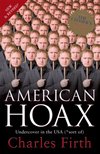
Charles Firth, American Hoax (2nd edition, Picador 2007)
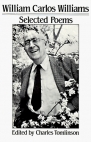
William Carlos WIlliams, Selected Poems (edited by Charles Tomlinson, New Directions 1985)
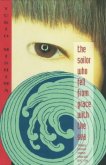
Yukio Mishima, The sailor who fell from grace with the sea (translated John Nathan 1965, Vintage 1994)
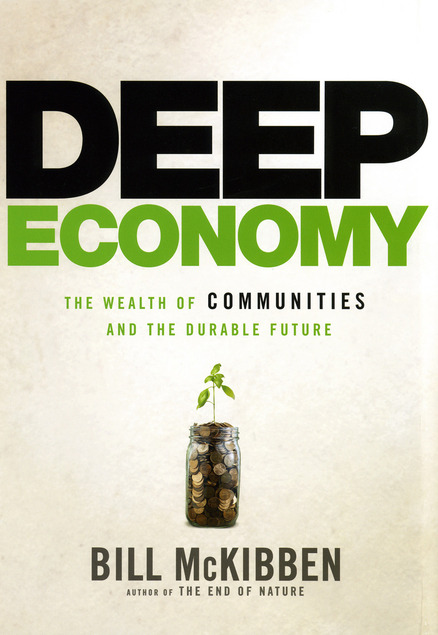
Bill McKibben, Deep Economy: The wealth of communities and the durable future (Henry Holt 2007)
John Tranter, editor, The Best Australian Poetry 2007 (UQP 2007)
Caroline Overington, Kickback: Inside the Australian Wheat Board scandal (Allen & Unwin 2007)
Geoffrey McSkimming, Cairo Jim and the Astragals of Angkor (Hachette Children’s Books 2007)

26435 PanMac_AmericanHoax.indd

Charles Firth invented five commentators, basing their opinions on top hits on Google, and set out as an experiment to see if they could make it in US public debate. One of them got a lazy, plagiarised, largely nonsensical article attacking Cindy Sheehan published, and others had moderate success in being taken seriously in Internet conversation. It’s a disturbing and intelligent book, but undermined by the author’s apparent commitment to his comedian identity. Clive James objects to being classified as a humorist. He wants his wit and humour to be elements of his essays rather than their purpose: the essays, he says, are serious attempts to communicate ideas. I’d like to see Charles and Clive get together for a quiet chat some time, and Charles come out from behind his relentlessly Chaserian persona.


1822730-m

Having acquired a BA (Hons) in the 1970s majoring in Eng Lit without ever reading any William Carlos Williams, I thought it wouldn’t be a crime now to read more than ‘The Red Wheelbarrow’ and ‘This is just to say’ … And indeed the book is an education and a joy. I did go hunting for learned commentary so as to deepen my appreciation of the poetry, and had the perverse pleasure of deciding that in some cases I would trust my own reading over that of the scholar. For instance, in an article on WCW’s most anthologised poem – essentially unparaphraseable eight short lines noting the existence of a red wheelbarrow and some white chickens – I found this:

This is a poem about the tension between regularity and irregularity, and it invokes irregularity on many levels: metrical, sexual, racial. Mouth/vulva, this ‘colored’ object beckons ‘white chickens’, which like the satyrs on Keats’s urn, approach but never touch, except in the palpable rhythms and vowels of the lines, which rise – but then fall again. After the phallic assertion of the emphatic iamb ‘upon’, the poem shifts to falling rhythms, and as the speaker and his Lucy roll forward like the wheel of the barrow (a tumulus or mound over a grave) in the twelve months/feet of the year with its four regular seasons/stanzas in their ‘diurnal course’, the speaker stammers in the long i’s of the final stanza: I . . . I . . . chicken out.

I would have solemnly, if disappointedly, accepted the Freudian reading of the wheelbarrow as a female symbol, but really: ‘upon’ as a phallic assertion! ‘barrow’ as tumulus! racial tension! the fantastical invocation of Keats and Wordsworth! I’m glad I don’t have to earn a living writing things like that. In fact the way I read the poem it’s pretty much a dismissal of that kind of discourse.


0679750150

I came to The sailor who fell from grace with the sea with quite a lot of baggage. Yukio Mishima committed ritual suicide when I was 23. This, along with his extreme right-wing politics and his reported preoccupation with body-building put me off. How could someone who was acclaimed as a great writer, a runner-up for the Nobel Prize for Literature, get things so bizarrely wrong? (I was 23, OK?). This is his one novel that I know about without looking, and from its perch on my Reproach Shelf (where it has sat unread with War and Peace and Pride and Prejudice) it exuded a kind of sulphurous glamour.

Without all that foreknowledge I might have thought this was a finely executed exercise in genre horror. It’s certainly well written, capturing beautifully the way people – adults and children, men and women – misunderstand each other’s silences. But it’s not an exercise: in this narrative the writer is fairly evidently struggling with his membership of a death-cult of one: mad, repulsive, deeply horrible, but in the end (for him, apparently) irresistible. It strikes me as being an adult version of the drawings young Mary Bell did in the days before she murdered that little boy: a cry for help. Like Mary’s, it went unheard.


deep

Don’t be put off by the title of Deep Economy. It’s a tremendously readable journey through the hope and terror of our times (not Terror with a capital as in suicide bombs, but lower-case terror as in the world going to hell in a handbasket). Someone once told me of a rule of thumb for comic writers that you need at least three laughs a page to keep up the momentum (a rule which – see above – I wish Charles Firth would ignore). Bill McKibben seems to work to a three-striking-bits-of-information-a-page rule. It was only great self-restraint that stopped me from constantly regaling (or should that be assailing?) companions or passers-by with tidbits.

The subtitle more or less says what the book is about: it challenges the single minded preoccupation with growth as the supreme indicator of economic success, and the ‘hyper individualism’ that that preoccupation involves; and advocates for a durable future as opposed to the likely outcome if things keep moving in the current direction with the current impetus. It’s a passionate, research-based argument for renewed – or brand new – attention to the local: in food production and consumption, and in all other economic activity. It piles up examples of the loss in human terms caused by the ruthless pursuit of economic ‘efficiency’ but it also accumulates a persuasive number of counter-examples, of people forgoing large profits for the sake of the common good.

We assume, because it makes a certain kind of intuitive sense, that industrialised farming is the most productive farming. I mean, if I sit on my porch whittling toothpicks with my Swiss Army knife, I can produce a hundred in a day. If I install a toothpick-whittling machine, I can produce a thousand in an hour. By analogy, a vast Mid-western field filled with high-tech equipment ought to produce more food than someone with a hoe in a small garden. As it turns out, however, this simply isn’t true. If all you are worried about is the greatest yield per acre, then smaller farms produce more food. Which, if you think about it some more, makes sense. If you are one guy on a tractor responsible for thousands of acres, you grow your corn and that’s all you can do: one pass after another with the gargantuan machines across your sea of crop. But if you’re working on ten acres, then you have time to really know the land, and to make it work harder. You can intercrop all kinds of plants: their roots will go to different depths, or they’ll thrive in each other’s shade, or they’ll make use of different nutrients in the soil. You can also walk your fields, over and over, noticing. … Does this sound like hippie nonsense? According to the most recent USDA Census of Agriculture, smaller farms produce far more food per acre, whether you measure in tons, calories or dollars.

It’s very much a US book, and I don’t know how much of the specifics is true of Australia (far too much, I expect); but it also looks at the global picture. It has felt like a lifeline as both major party leaders in the current federal election campaign bang on about upward pressure on interest rates in what is fairly blatantly baby-talk economics. Intuitively, to this uneducated mind the prevailing view that permanent growth is the only way forward looks like a recipe for disaster. Here is a substantial, reasoned, systematic move towards an alternative way of thinking about these things. Not that Bill McKibben is trying to pass himself off as a brilliant innovator; his brilliance lies not only in his throng of memorable stories to flesh out his argument, but also in the mass of telling quotes from an army of researchers, experimenters and thinkers.


4531778-m

I confess that with The Best Australian Poetry 2007 and me it was irritation at first sight. What does it mean to publish ‘best of 2007’ book in September? A quick look up the back of the book reveals that a couple of its poems were first published in 2005 and the rest in 2006.

Ok, that’s my first nitpick out of the way. Then I looked at the list on page 98 of ‘Journals Where the Poems First Appeared’ (the book is subtitled ‘a selection of the best poems from Australia’s literary journals’), and was a bit surprised to see that Quadrant didn’t get a guernsey. But it turns out that there are poems from that venerable right-wing rag, and from the equally venerable left-wing, though less well funded, rag Overland, which also doesn’t rate a mention on page 98.

And there’s more substantial cause for irritation: more than 40 of the book’s 120 pages are devoted to commentary: introductory material by and about the guest editor and the series editors, and then notes from the contributing poets about the poems, which reminded me inevitably of William Carlos Williams’s remark: ‘You should never explain a poem but it sometimes helps nevertheless.’ Some of the poets’ own commentaries here are witty, some are illuminating, but most are plain dull – this is not a criticism of the poets, since the poems themselves are presumably what they wanted to say.

My mounting irritation didn’t  put me in a mood to enjoy the forty poems, some of which, it turns out, are very good. Some, of course, left me cold and uncomprehending. Perhaps all the bumph is meant to deal with the all-to-frequent failure of a lot of post-modern poetry to grab the lay reader; sadly, it only adds to the alienation for this one.


4433196-m

Left to my own devices, I wouldn’t have picked up Kickback or Leigh Sales’s Detainee 002 (which I read in September). I’d read enough about both scandals in the newspapers as they were unfolding. But some members of our book club (really a Book Swap) do relish that sort of thing, and recommended these books strongly at our last meeting. I somehow came away with both of them. Caroline Overington’s epigraph, which turns out to be her punchline as well, is a found poem from the utterances of Alexander Downer, who I hope will soon be relieved of the burden of producing such gems:

What you don’t know, you don’t know.
And you can’t get to the heart
Of what you don’t know.

This is a book about last year’s headlines, but it contains a lot of the news that stays news. It’s largely a blow-by-blow account of shonky dealings – Iraq’s corruption of the UN’s Oil-for-Food program as aided and abetted by a highly reputable Australian company and the subsequent cover-up – involving hundreds of millions of dollars: illegal, immoral, carefully ignored for as long as possible by lily-white John Howard and shameless Alexander Downer (who seem to have people on staff whose job is to make sure they never actually see faxes, emails, cables and other inconvenient communications). This was an excellent follow-up to Deep Economy (which I intend to urge on my co-Book-Clubbers), as an extended case study of collateral damage from a single-minded pursuit of profit. I found myself drawing morals from the story:

  • For those who sup with the devil, no spoon-handle is long enough
  • If you have a conflict of interest with the USA, make sure you’re squeaky clean
  • When top members of your organisation go by nicknames like ‘Slug’, don’t let your guard down
  • Government organisations that are privatised may not be nastier than long-established capitalist enterprises, they may just be more likely to get caught
  • Too many Australian journalists take the government at its word too much of the time
  • Page 2 of the newspaper may contain gems
  • Not only ladies do protest too much
  • Seekers after the truth sometimes have vile motives
  • Seekers after the truth can expect to have vile motives attributed to them
  • Suppressors of truth sometimes have good intentions
  • Under the Howard government, the public service tradition of frank and fearless advice has taken a battering.

4545460-m

I read Cairo Jim and the Astragals of Angkor in a day, just after the final episode of The Sopranos was screened here, while Tony Abbott was impersonating an arrogant callus in his final days in office. As a finale, Astragals offers less closure but more certainty than the former, and inspires more hope and more sorrow than the latter.

In Cairo Jim’s world words like ‘flabbergast’ are part of normal speech, alliteration runs as wild as jungle creepers, similes (all more original than any I’m offering here) sprout like hairs in a mole, evil never wins the day but life would be much less interesting if it didn’t try. I think Geoffrey McSkimming may be the one who told me the rule about frequency of laughs I referred to above: and sure enough, even though this is a chase story with the fate of the world hanging in the balance, it’s the laugh lines that provide the momentum. These books have captured and sustained a loyal and ever-expanding following among their intended readership with no boost from awards and little notice in the press – quite an achievement.

Overland 220 and my November rhyme #6

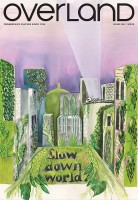
Jacinda Woodhead (editor), Overland 220 (Winter 2015)

220-cover

Almost a third of this Overland is given over to the winners of the inaugural Overland NUW Fair Australia Prize: two essays, two short stories, a poem and a cartoon.

The prize encourages artists and writers to engage with questions like: How does insecure, casual, precarious work affect a person and their community? What do you think a fair Australia looks like? How can we change Australia together? It’s not surprising, then, that there’s a certain sameness about the winners, but also a refreshingly straightforward sense that capitalism is a) brutal and b) not here forever. These 37 pages are a timely counterpoint to the recent publicity the NUW has been receiving from a Royal Commission.

As for the journal proper: Jacinda Woodhead’s editorial cites Slavoj Žižek (a Slovenian cultural critic – I had to look him up) as naming the four horsemen of the ‘apocalyptic zero-point’ of global capitalism as climate change, biogenetics, system imbalances and ever-increasing social divisions. The first and last of these figure prominently in the  rest of the journal.

The non-fiction sections put attention to a shopping list of pressing issues: misogyny and violence against women, the unsettled state of Europe, climate change, plus the politics of the science fiction ‘community’. It’s all worth reading, though some of it tends to be reporting on what has been written by someone else, and it sometimes feels that it might be better to just read the original. Three pieces stood out for me:

  • Anwen Crawford puts shoe leather into ‘No Place Like Home‘, an excellent piece of journalism about the destruction of the public housing community in the Rocks in Sydney
  • Jennifer Mills takes her fiction-writer’s skill to the abandoned buildings of a once great US city in Detroit, I do mind
  • In A person of very little interest David Lockwood adds his personal story to the growing body of funny but unsettling literature about ASIO’s activities back in the day.

Alison Croggon’s regular column is always a pleasure. This time she riffs on reading as a dangerous drug.

In the fiction section (and yes, Overland still presents its fiction and its poetry in two colour-coded clumps), it’s interesting to see Omar Musa – rapper, spoken word performer and author of the novel Here Come the Dogs – move away from the milieu of disaffected youth in an elliptic story, No breaks.

There’s some really interesting poetry. Two John Tranter ‘terminals‘ (a form that I believe he invented, in which he uses the end-words of other poems) are masterly, but create for me a nagging sense that the poem’s relationship to its ‘original’ is more important than the poem itself. I also enjoyed, and am in awe of, poems by Kate Lilley, Michael Farrell and Fiona Wright.

And now, because it’s November, I need to write a little verse. I went looking for the names of past editors (not as easy as you’d expect), and on the way I found a fabulous recent piece of invective against Overland that managed to include blatant sour grapes, sleazy innuendo, dubious history, straw-man arguments, weird illogicality, and one lovely typo. I won’t link to the invective (a search for ‘Overland’ and ‘cesspit’ will find it), but I’ve included the typo:

Rhyme # 6: On reading Overland No 220
Since 1954, when Stephen
Murray-Smith first sought to avoid
dread humourlessness, dogma, even
orthodoxy, we’ve enjoyed
two-twenty Overlands. The Party,
then the Green Left Literarti
gave the helm to Barrett Reid,
McLaren, Syson, then – new breed –
to Hollier–Wilson, Sparrow, Woodhead:
eight editors in sixty years,
provoke our thinking, laughter, tears
and even action. Here a good Red
is alive and well read. Long
may this voice sing its rebel song.

Sydney Writers’ Festival: My Day 1

By one count, the Sydney Writers’ Festival has been going since the weekend. The opening address, by all accounts brilliant, was on Tuesday night. My festival started yesterday.

My first event – a poetry reading in the English Department’s Common Room at the University of Sydney – wasn’t strictly part of the Festival, but two of the poets were in Sydney for the Festival, so I’m counting it. I had to leave early to catch a bus to the Opera House so I only got to hear one and a half poets, all of Fiona Hile and half of Kate Lilley. Sadly, I missed out on Louis Armand from Prague, and Pam Brown.

The room was full of poets. Overheard pre-reading conversations (there were nibbles and drinks) included happy reports of ‘having something accepted ‘ in a coming anthology. John Tranter recorded proceedings for the Penn Sound Archive. Vagabond Press was selling in a back corner.

I enjoyed Fiona Hile’s reading but I wouldn’t say I understood much of the poetry. Partly this was because she read fast, the room was a bit echoey, and I’m a bit deaf. Mainly, though, I expect it was because she’s what the Spoken Word people call a page poet, and even more an experimental poet, which tends to mean that meaning isn’t easy to grasp. There were lots of striking lines. I managed to jot down:

The lilliputian threads of the old ways make me want to lose a limb

and in a context to do with sheep:

That wolf you’re wearing goes with everything.

In introducing Kate Lilley, Fiona Hile conjured up a fabulous image. She said she used to think it was uncool to have heroes, but when she began writing her own poetry, she had four horsewomen: Kate Lilley, Pam Brown, Gig Ryan and Jennifer Maiden. I’d love to see the movie that has those four poets charging into battle.

Kate Lilley read from Ladylike, and was about to read from Realia when I reluctantly tore myself away to catch a bus to the Quay, have dinner and then climb the stairs to the Joan Sutherland Hall of the Opera House for:

7.30 pm: The Life and Times of Alice Walker, in which Alice Walker was interviewed by Caroline Baum and joined by Archie Roach. The SWF blog already has a report.

As is customary at the Sydney Writers’ Festival, the session bore little relation to its title. Alice Walker was in no mood to tell her life story, or to discuss her ‘times’ with any specificity. The tone was set right at the start when Caroline Baum asked, ‘Are you nervous at the start of events like this?’ and Alice Walker replied, ‘No,’ and waited serenely for the next question. CB bounced back by asking her to read us a poem, and she obliged with ‘You Should Grow Old Like the Carters’, which she read beautifully, giving each word its full weight, conveying the music , treating herself and the poem as worthy of our full, serious attention. That mix of awkwardness, resilience on Caroline Baum’s part, and weight on Alice Walker’s kept up for the whole session.

Part of the awkwardness came from the level of unaware racism in the room, or at least a reasonable expectation of it on Alice Walker’s part. She didn’t give her interlocutor the benefit of any doubt. For example (from memory, so probably missing a lot of nuance):

CB: So you grew up in a house without books and were part of an oral, story-telling culture.
AW: Oh, no, we had books. My parents got hold of old books that people had thrown out. But yes, there were lots of stories that everyone told, wonderful stories. [End of reply.]
….
CB: You read a lot when you were young. I believe your favourite books were … and Jane Eyre. What was it like the first time you read a book with black characters you could identify with?
AW: Oh, I identified completely with Jane. White people seem to think they can’t identify with black characters, but when we read it’s not about these divisions. It’s the spirit we identify with.’ [Applause]

Fortunately, Caroline Baum has a wonderful capacity for putting herself out there, and then bouncing back when she has her knuckles ever so serenely rapped.

Another reason the session seemed such hard work is possibly a problem of definition. Is Alice Walker at the festival as a writer, an activist, or a vague kind of celebrity?

Well, obviously, she’s a writer. But The Color Purple was published roughly 30 years ago, and I wonder how many people in that huge hall had read Possessing the Secret of Joy, or made it all the way through The Temple of My Familiar. As a poet she would draw a crowd, but not this big a one. Many of her essays are absolutely brilliant: ‘In Search of Our Mothers’ Gardens’, ‘Only Justice Can Remove a Curse’, her essays on Zora Neale Hurston and Bessie Smith, on olive oil, the scar in her eye … I can rattle those off without googling. And a new collection of essays – Cushion in the Road: Meditation and Wandering as the Whole World Awakens to Being in Harm’s Way – has just been published. But how many essayists can fill the Opera House?

As an activist, she has an impressive record. She campaigned very visibly against female circumcision a while back, and was part of the flotilla that was intercepted so dramatically on its way to Gaza. But as far as I know she’s not part of any activist organisation and her activist philosophy boils down to stressing the importance of having friends (a ‘circle’) you can be completely honest with, and meditation seems to fit there.

Celebrity seems to be the key. So although the conversation touched on many things, and Caroline Baum kept pulling the conversation back to the recently published book, my overwhelming impression was that we were in the presence of celebrity, who was dispensing her wisdom for our benefit. The most telling celebrity moment was when she was asked about her daughter’s very public statements that her activism had made her a neglectful mother. Her reply included no whiff of self doubt, no hint that her daughter might have had a legitimate point (as the children of many activists surely would). The problem was that her daughter suffered from ‘mental instability’, from which she had now mercifully recovered. This dismissiveness was cloaked in serious and valid reflections on the legacy of slavery on her family, but it was dismissive all the same. We were to make no mistake who was the important person in this conversation.

I’m sorry if that’s jaundiced. I’m still a fan. I will buy the new book of essays, and probably her new book of poetry as well. I’m seeing another session with her on my second day, and hoping I’ll have a change of perspective.

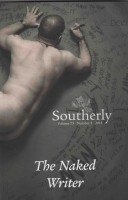
Southerly 73/3

David Brooks and Elizabeth McMahon (editors), Southerly Vol 73 No 3 2013: The Naked Writer

1nw

Alain de Botton was on the ABC recently arguing that we need to reclaim art (and by extension literature) from the academies and museums, to recognise its role in our ordinary lives. He was annoyingly persuasive, and had me wondering whether I really needed to read Southerly, which is after all solidly grounded in the English Department of the University of Sydney, largely written and edited by academics for academics. It seems to have stopped publishing poems by Jennifer Maiden, the regular appearance of which led me to re-subscribe a couple of years ago. So despite the fabulously daring cover, I approached this issue warily. What was in it for me?

It seems I enjoy reading about friendship. Alex Miller’s ‘A Circle of Kindred Spirits’ is a moving account of biographer Hazel Rowley’s career, seen through the prism of Miller’s long friendship with her, which they conducted almost entirely by email. Ann-Marie Priest’s ‘“Colour and Crazy Love”: Gwen Harwood and Vera Cottew’ explores a deep friendship between two women that has been sidelined in most discussions of Gwen Harwood’s poetry. It’s a beautiful essay, explicating some of the poetry and exploring the complex possibilities of friendship between women.

Scott Esposito’s ‘The Gate Deferred: J.M. Coetzee and the Battle against Doubt’ is interesting for similar reasons: at heart it’s about the relationship between readers and writers. The essay explores Coetzee’s engagement with Kafka. Far from writing dry academic analysis, Esposito begins by telling us how as a child of non-religious parents he (Esposito) experienced his own version of Pascal’s ‘le silence eternel des espaces infinis m’effraie’ (the Pascal reference is mine), then gives us a beautiful account of how in Coetzee he found someone with a similar sense of things, expressed in part by Coetzee’s engagement with Kafka. Coetzee, Esposito writes,

gives us not an answer to Kafka, nor an interpretation of him, but rather his experience of dwelling within Kafka’s mysteries.

Esposito comes close to dwelling within Coetzee’s mysteries. (I haven’t read enough of J M Coetzee – just Disgrace and the three volumes of quasi-memoir – to have an opinion on the validity or otherwise of Esposito’s reading, but that seems beside the point.)

Rowena Lennox’s ‘Head of a Dog’ is about another kind of relationship – that between dogs and humans. Her account of walking her dog made me wonder if she lives near me: could my collie be the one she describes as driving her kelpie-cattle dog cross to such paroxysms of exhilarated rage simply by existing behind a fence? Dogs ‘are the closest we have come to living with and knowing another species’, she writes, and whatever the cat brigade may say I think she’s right. The essay ranges widely, drawing on, among others, Frank Dalby Davison (Dusty), Jack London (The Call of the Wild), and Aboriginal elders Tim Yilngayari and Daly Pulkaa (as quoted by Deborah Bird Rose in Dingo Makes Us Human).

There are fine poems: Tracy Ryan has four on a hoard hidden and centuries later found;  Judith Beveridge (‘Peterhead’), Geoff Page (‘Angus’) and Stephen Edgar (‘The Sense of an Ending’) lend lustre (and just watch that Stephen Edgar use rhyme!); Ali Jane Smith (‘The Galapagos’), Simeon Kronenberg(‘Death of a Bull’) and Ross Donlon (‘Storm Water’) each do narratives it will be good to spend more time with.

There are fine reviews. I was especially glad of Anne Brewster on Melissa Lucashenko’s novel Mullumbimby, which I plan to read, and John Tranter being generous, illuminating and a little gossipy on Pam Brown’s Home by Dark.

That’s just some of the highlights for me. Other people may fall with cries of joy on the 42 page offcut from a forthcoming experimental novel by John A. Scott, Michael Buhagiar’s elegant discussion of Christopher Brennan’s debt to A. C. Swinburne, Robet Darby’s explication of the homoerotic content of a Martin Boyd novel, or … well, there’s quite a lot that I haven’t mentioned.

I’m going to finish with some whingeing, so feel free to stop reading now.

• First, does Southerly deliberately follow US spelling conventions for things like centre/center or the verb practice/practise?

• Second, is it just a little disrespectful to display a poet’s naked body on the cover and make no reference to him or his work except in the photo credit? If you’re interested, here’s a video of spoken word poet Randall Stephens full frontal, clothed and performing:

• Third, was it inattention or editorial illiteracy that allowed Ann-Marie Priest to go into print saying that

there is no mainstream literary tradition of female friendship, as there is with male friendship (think of Tennyson’s In Memoriam A.H.H., Achilles and Patroclus in The Illiad, and Jonathon and David in the Bible).

Maybe Ruth and Naomi just a few pages over from David and Jonathan ‘in the Bible’ don’t constitute a tradition, but surely they deserve a mention; even spellcheck knows how to spell The Iliad; and however many people name their children Jonathon, it’s Jonathan in the Bible. Even if you don’t count the ‘with’ that really ought to be an ‘of’, that’s an impressive error count in so few words.

Re-reading Vikram Seth’s The Golden Gate

Vikram Seth, The Golden Gate (1986, Vintage International 1991)

I don’t do very much re-reading, at least not of whole books. This one was an ambush.

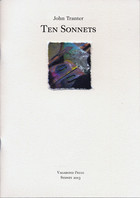
The copious notes in John Tranter’s Vagabond Press chapbook Ten Sonnets quote Wikipedia’s entry on the Onegin stanza, so called because Pushkin used it in his novel Eugene Onegin:

The work was mostly written in verses of iambic tetrameter with the rhyme scheme “aBaBccDDeFFeGG”, where the lowercase letters represent feminine endings (i.e., with an additional unstressed syllable) and the uppercase representing masculine ending (i.e. stressed on the final syllable).

That sent me looking for Vikram Seth’s novel in Onegin stanzas. Though it was this book that had launched my own excursion into sonnet land, and I had written and blogged quite a number of sonnets (for which, by the way, I don’t claim any great distinction) of what I thought was the Onegin variety, I had missed the crucial bit about the ‘feminine’ and ‘masculine’ endings (the quote marks are in deference to the Art Student’s objection to the gendered terminology). I went to see if Seth observed the aBaBccDD etc rhyme scheme, and indeed he did: each stanza has three feminine rhymes and four masculine, the feminine coming first in each of three configurations. That might sound awfully technical, but once you notice it you realise it accounts for the wonderful flow of the verse narrative – the feminine endings send the reader’s mind forward the way serifs in a typeface send the eye to the next letter, and the masculine endings have a kind of exclamatory effect, not necessarily stopping the flow but hitting a strong beat.

It’s a wonderfully seductive rhythm, and it had me in its grip again. I read whole slabs out loud to the Art Student as she was cooking dinner, and she who claims not to like poetry said, ‘It sounds as if he had a good time writing that.’

The narrative deals with relationships among a group of 20-somethings in San Francisco in 1980–81, with something of the feel of Armistead Maupin’s Tales of the City (written a decade earlier), but with significant differences. It’s the Reagan era: the threat of nuclear war forms a backdrop, which comes to the foreground in some heated arguments that threaten to destroy friendships, and at an anti-war rally where one of the speeches runs for close to 20 stanzas.  There’s a wonderful ill-tempered cat named Charlemagne, and some serio-comic conflict around religion and homosexuality (I don’t know how comic it was meant to be, but it made me laugh as well as rage). It’s not all froth and bubble by a long shot: there are birth and death, seasonal rhythms and harsh disruptions, silly spats and deeply wounding fights.

In one of the book’s few self-referential moments, Seth reflects on his chosen form, discusses both the use of feminine rhymes and the tetrameter (four beats to the line rather than the five beats used by Shakespeare). He then goes on:

Reader, enough of this apology;
But spare me if I think it best,
Before I tether my monology,
To take a stanza to suggest
You spend some unfilled day of leisure
By that original spring of pleasure:
Sweet-watered, fluent, clear, light, blithe
(This homage merely pays a tithe
Of what in joy and inspiration
It gave me once and does not cease
To give me) – Pushkin’s masterpiece
In Johnston’s luminous translation:
Eugene Onegin – like champagne
Its effervescence stirs my brain.

When I read The Golden Gate the first time I contemplated moving on to Les Murray’s verse novels, one of which is told in sonnets. I will read them one day, but they aren’t a natural successor to this novel. I have now downloaded an audio book of Eugene Onegin, in which Stephen Fry reads James E. Falen’s translation – not that of Sir Charles Johnston, which Vikram Seth so loved. It may be a while before I have ‘an unfilled day of leisure’ in which to listen to its 4 hours and 21 minutes, but I’m looking forward to it.

Tranter and Lilley: Rare Objects

John Tranter, Ten Sonnets (Vagabond Press Rare Objects Series No 90, 2013)
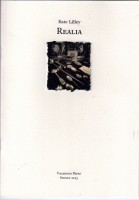
Kate Lilley, Realia (Vagabond Press Rare Objects Series No 91, 2013)

This series of elegant chapbooks finishes up this year at No 100, which means that John Tranter and Kate Lilley at 90 and 91 respectively are leading us into the straight – which may be the only straight thing about either of them (no reference to sexuality intended).

I went to the launch at Gleebooks on the weekend because I am generally baffled by the work of both these poets, and hoped for some guidance on how to read them, and I got it. John Frow, Eng Lit and Cultural Studies scholar, who did the honours, commented that in both books – and in The Tulip Beds by A J Carruthers, Rare Object No 92, which he was also launching – the poems were generated using a mechanism: in Tranter’s case the rhyming sonnet form and in Lilley’s a found-object framework.

10sonnetsFive of Tranter’s ten sonnets have an additional mechanical dimension: they list the five vowels and assign each of them to a colour. And other mechanical elements turn up in other poems: for instance ‘Poem Beginning with a Line by John Anderson’ was written, we’re told in a note, ‘while listening to a paper on his poetry given by Ella O’Keefe at the University of Auckland in March 2012’, and incorporates lines from Anderson and from Ms O’Keefe’s talk. (I hope she’s flattered by being incorporated into the sonnet rather than offended by the lack of attention.)

Speaking of notes, six of the books 16 pages are taken up with notes, which quote liberally from Wikipedia. It’s hard to tell for the most part whether these notes are meant to inform the reader, to mock the reader for wanting information, to slip an extended prose poem or two under the radar or simply to get the book’s pages up to a multiple of eight. One note explains what ‘Scuba’ is an acronym for, but is no help in explicating the couplet in which it appears:

U, olive green of underwater hair –
Scuba, the acronym, in a crowded room.

Another manages to compare Tranter’s work to Shakespeare’s, if only on the matter of complexity. On the other hand, a good half of the very long note on ‘Poem Beginning with a Line by Bunting’ is a lucid explication of a poem that at first I found impenetrable, which begins:

Boasts time mocks cumber Rome.
Roasts thyme scents set on ledge.

Interestingly enough, the note explains, that first line (from Basil Bunting’s ‘At Briggflatts Meeting House’) can be decoded into standard English. So can the second, but the rationale for its existence is that it echoes the first – it’s not clear if its sense matters at all.

realia001Following John Tranter’s lead, I’ll now quote Wikipedia and tell you that the great modernist American poet William Carlos Williams ‘summarised his poetic method in the phrase “No ideas but in things”‘. It’s tempting to say of the poems in Realia, ‘no ideas, just things’. The longest poem in the book. ‘GG’, is mainly a list of items from the estate of Greta Garbo sold at auction last December, presented without commentary:

Greta Garbo flatware
Greta Garbo cordial glasses
Greta Garbo Sherbet stemware
Greta Garbo Swedish butter press
__Viking mould imprints 14 5/8″ x 4 1/4″

and so on.

Of course, the art is in the selection. I looked up the actual 302 page catalogue, and the poem got even funnier. You can almost hear Kate Lilley saying, like Anna Russell, ‘I’m not making this up!’ The weirdness of starting each item with ‘Greta Garbo’ is not her invention. I didn’t check that everything in the poem is genuinely from the catalogue, but I did search for the line that most aroused my suspicions

Greta Garbo Stim-U-Lax Jnr Hand-Held

and there it was, hidden in plain sight:

ggm

Some liberty taken as befits a poet, but an honest steal.

Neither of these books appealed to me much on first contact, but when I came to write about them, even so spottily, I warmed to them both. My own fiddling with sonnets has taught me that there’s a lot of mechanics in poetic form, and it’s interesting to put the mechanism front and centre and see what you get. And listing found verbal objects without comment or interpretation can create interestingly comic or disturbing effects.

The Vagabond Press facebook page predicts another five titles by the end of the year, by Emma Lew, Bella Li, Emma Jones, Ania Walwicz and Jennifer Maiden. To be launched in Melbourne.

Tranter’s Choice

John Tranter (editor), The Best Australian Poems 2012 (Black Inc 2012)

bp2112My note on this book in the little blog where I keep a note of my reading provoked an anonymous comment full of rage and despair. (I’m linking to it, because it seems a pity that such passion should go almost unheard.) It may be that the commenter didn’t actually have this book in mind, since the poem s/he singled out for particular spleen is actually in last year’s Best Australian Poems, but it’s probably inevitable that any anthology claiming to be the best of something will annoy someone, especially if they’ve got a dog in the fight themselves.

Although I’d secretly love someone to decide that my November Sonnets were works of genius, I didn’t actually  have a dog in this fight. So I wasn’t annoyed. I can’t say that I was swept away either. I’d read and enjoyed about half a dozen of the poems, and was delighted to see them included. And there are fine poems by many writers whose work I know, and by many I don’t. John Tranter’s own contribution, at the conclusion of his introduction, is a kind of cento – an assemblage of lines and images from the chosen poems, but with Tranteresque impersonality they don’t form a coherent whole but are ‘chosen more or less at random’.

Some previously unpublished poems were submitted directly to this anthology. But most appeared previously in a wide range of publications, including books, literary journals and newspapers. Both Quadrant and Overland get a guernsey, likewise both Fairfax and Murdoch – a touch of poetry making the whole world kin? But why, I ask querulously, is there nothing from the paper I subscribe to, the Sydney Morning Herald? And I answer even more querulously because poems turn up in the Sydney Morning Herald only slightly more often than teeth in hens. SMH, Susan Wyndham, literary editor of the SMH.

Added a couple of hours later: I know this post isn’t a review. As it happens, Ali Alizadeh’s excellent discussion of the book went up on the Cordite Poetry Review site not long after I posted my little piece. I recommend it.

NSWPLA and NSWPHA Dinner

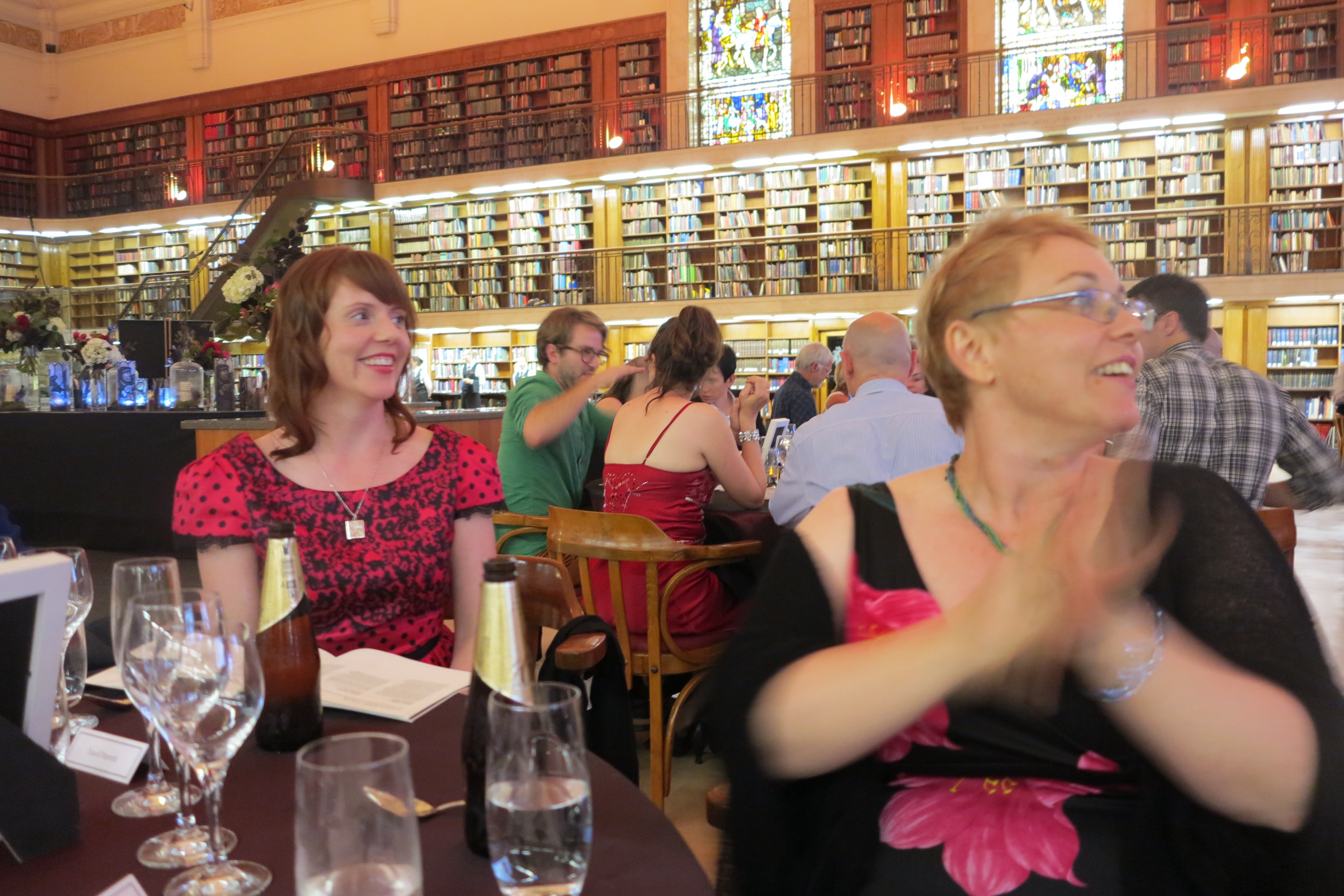
I didn’t expect to attend a NSW Premier’s Literary Awards Dinner this year. For a while back there it looked as if the awards might go the way of the Queensland equivalent, but the Liberal Party-approved panel’s unpublished report must have come down in favour of continuation, because here they were again last night, six months late, run by the State Library rather than the Arts NSW, charging $200 [but see Judith Ridge’s comment] for a book to be considered, and sharing the evening with the History Awards, but alive and kicking. And pretty special for me, because I got to go as my niece’s date, my niece being Edwina Shaw, whose novel Thrill Seekers was shortlisted for the UTS Glenda Adams Award for New Writing.

The dinner was held in the magnificent reading room of the Mitchell Library. Not everyone approved of the venue – I was in the Research Library in the morning when a woman complained very loudly that she had driven the four hours from Ulladulla only to find the Mitchell’s doors were closed for the day so it could be converted into a banquet hall. She must have been placated somehow because she stopped yelling, but there were other problems. None of the shortlisted books were on sale – Gleebooks had a table at this event for years [but see Judith Ridge’s comment], as the Library has its own shop, which wasn’t about to stay open late just for us. And library acoustics aren’t designed for such carryings-on: the reverberation in the vast, high-ceilinged room made a lot of what was said at the mike unintelligible at the back of the room. But those are quibbles. It’s a great room with happy memories for a good proportion of the guests.

Aunty Norma Ingram welcomed us to country, inviting us all to become custodians of the land.

Peter Berner was the MC. He did OK, but organisers please note: the MC of an event like this needs to be literate enough to pronounce Christina Stead’s surname correctly.

The Premier didn’t show up. Perhaps he was put off by the chance of unpleasantness in response to his current attack on arts education. The awards were presented by a trio of Ministers, one of whom read out a message from the Premier saying, among other things, that art in all its forms is essential to our society’s wellbeing. But this was a night for celebrating the bits that aren’t under threat, not for rudely calling on people to put their money where their mouths are.

The Special Award, sometimes known as the kiss of death because of the fate met by many of its recipients soon after the award, went to Clive James – whose elegant acceptance speech read to us by Stephen Romei necessarily referred to his possibly imminent death. He spoke of his affection for New South Wales, of his young sense that Kogarah was the Paris of South Sydney, and his regret that he is very unlikely ever to visit here again. He also said some modest things about what he hoped he had contributed.

After a starter of oyster, scampi tail and ocean trout, the history awards:

NSW Community and Regional History Award: Deborah Beck, Set in Stone: A History of the Cellblock Theatre
The writer told us that the book started life as a Master’s thesis, and paid brief homage to the hundreds of women who were incarcerated in early colonial times in the Cellblock Theatre, now part of the National Art School.

Multimedia History Prize: Catherine Freyne and Phillip Ulman,  Tit for Tat: The Story of Sandra Willson
This was an ABC Radio National Hindsight program about a woman who killed her abusive husband and received  lot of media – and wall art – attention some decades back. Phillip Ulman stood silently beside Catherine Freyne, who urged those of us who enjoyed programs like Hindsight to write objecting to the recent cuts.

Young People’s History Prize: Stephanie Owen Reeder, Amazing Grace: An Adventure at Sea
This book won against much publicised Ahn Do on being a refugee (The Little Refugee) and much revered Nadia Wheatley on more than a hundred Indigenous childhoods (Playground). It not only tells the story of young Grace Bussell’s heroic rescue of shipwreck survivors but, according to the evening’s program, it introduces young readers to the ‘basic precepts of historical scholarship’. It also looks like fun.

General History Prize: Tim Bonyhady, Good Living Street: The Fortunes of My Viennese Family
A member my book group rhapsodised about this book recently, comparing it favourably to The Hare with Amber Eyes. It’s a family history, and in accepting the award Bonyhady told us it had been a big week for his family because the lives of his two young relatives with disabilities would be greatly improved by the National Disability Insurance Scheme introduced by the Gillard government.

Australian History Prize: Russell McGregor, Indifferent Inclusion: Aboriginal People and the Australian Nation
This looks like another one for the To Be Read pile. Russell McGregor acknowledged Henry Reynolds and Tim Rowse as mentors.

After a break for the entrée, a creation in watermelon, bocconcini and tapenade, it was on to the literary awards:

The Community Relations Commission Award: Tim Bonyhady was called to the podium again for Good Living Street, but he’d given his speech, and just thanked everyone, looking slightly stunned.

The newly named Nick Enright Prize for Drama was shared between Vanessa Bates for Porn.Cake. and Joanna Murray-Smith for The Gift. Perhaps this made up to some extent for the prize not having been given two years ago.
Joanna Murray-Smith said she learned her sense of structure from the Henry Lawson stories her father read to her at bedtime. As her father was Stephen Murray-Smith, founding editor of Overland, she thereby managed to accept the government’s money while politely distancing herself from its politics. She lamented that her play hadn’t been seen in Sydney and struck an odd note by suggesting that the Mitchell Library and a similarly impressive building in Melbourne may have been the beginning of the Sydney–Melbourne rivalry: I wonder if any Sydney writers accepting awards in Melbourne feel similarly compelled to compete. Vanessa Bates couldn’t be here, so her husband accepted her award, with his smart phone videoing everything, perhaps sending it all to her live.

The also newly named Betty Roland Prize for Scriptwriting (and I pause to applaud this conservative government for honouring an old Communist in this way): Peter Duncan, Rake (Episode 1): R v Murray
Peter Duncan gets my Speech of the Night Award. He began by telling the junior minister who gave him the award that he was disappointed not to be receiving it from Barry O’Farrell himself, because he had wanted to congratulate Barry on the way his haircut had improved since winning the election. At that point we all became aware that Peter Duncan’s haircut bears a strong resemblance to the Premier’s as it once was. He then moved on to congratulate the Premier for instituting a careful reassessment of the Literary Awards and deciding to persevere with them. He expressed his deep appreciation of this support for the arts. (No one shouted anything about TAFE art education from the floor. See note above about this being an evening to celebrate the bits that aren’t under threat.)

The Patricia Wrightson Prize for Children’s Literature: Kate Constable, Crow Country (Allen & Unwin)
I hadn’t read anything on this shortlist, I’m embarrassed to confess. It looks like a good book, a time-slip exploration of Australian history.

The Ethel Turner Prize for Young People’s Literature: Penni Russon, Only Ever Always (Allen & Unwin)
Again, I hadn’t read any of the shortlist. But Bill Condon and Ursula Dubosarsky were on it, so this must be pretty good! Penni Russon’s brief speech referred to the famous esprit de corps of Young Adult writers: ‘You guys are my people.’

There was break for the main course to be served, and for about half the audience go wander and schmooze. I had the duck, the two vegetarians on our table were served a very fancy looking construction, only a little late. Then onward ever onward.

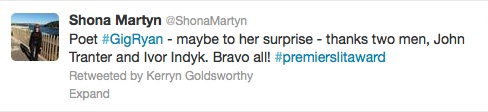
The Kenneth Slessor Prize for Poetry: Gig Ryan, New and Selected Poems
Again, I hadn’t read any of the shortlisted books, but wasn’t surprised that Gig Ryan won, as this is something of a retrospective collection. She speaks rapidly and her speech was completely unintelligible from where I was  sitting (like some of her poetry). However, someone tweeted a comment that got laughs from the front of the room:
tweet

The Douglas Stewart Prize for Non-fiction: Mark McKenna, An Eye for Eternity: The Life of Manning Clark
Another lefty takes the government’s money, and a good thing too.

The UTS Glenda Adams Award for New Writing: Rohan Wilson, The Roving Party (Allen & Unwin)
I know nothing about this book. Rohan Wilson is in Japan just now. His agent told us that when she asked him for an acceptance speech ‘just in case’, he emailed back, ‘No way I’ll win – look at the calibre of the others.’ The three writers on my table who were in competition with him seemed to think it was a fine that it had won:
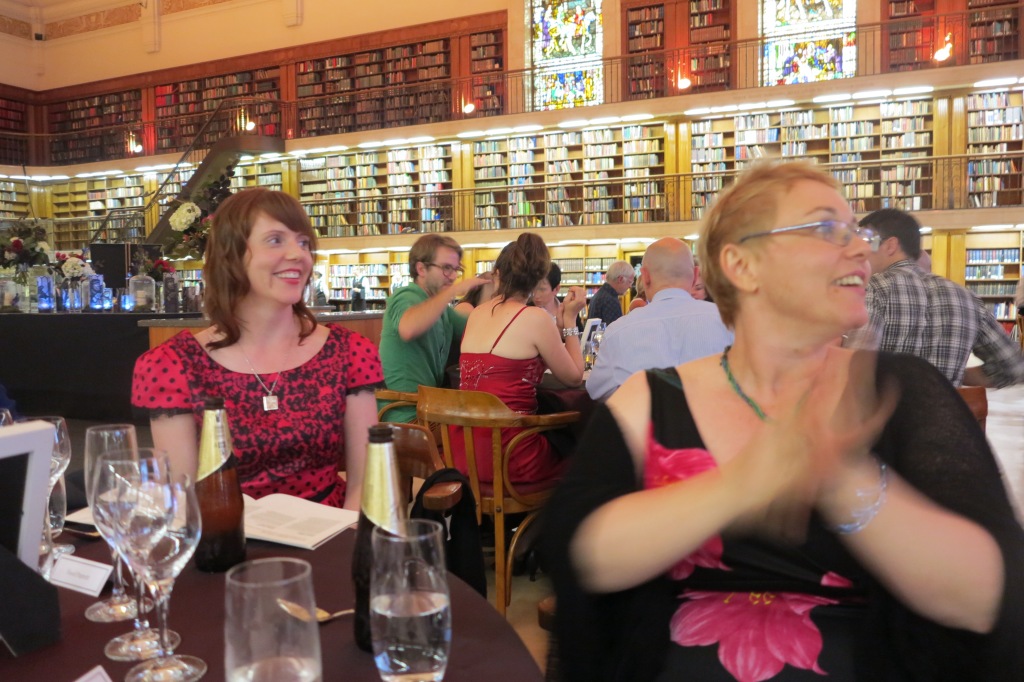
Favel Parrett and Edwina Shaw respond to not winning the UTS Glenda Adams Award for New Writing

Favel Parrett and Edwina Shaw respond to not winning the UTS Glenda Adams Award for New Writing

The Christina Stead Prize for Fiction was almost an anti-climax. It went to Kim Scott for That Deadman Dance. We had a small bet going on my table, and I won hundred of cents. Kim Scott’s agent accepted on his behalf.

There was dessert, layered chocolate and coffee cake, then:

The People’s Choice Award, for which voting finished the night before, went to Gail Jones for Five Bells. She was astonished, genuinely I think, and touched that her book about Sydney as an outsider should be acknowledged like this. I haven’t read the book yet, but I’m also a bit astonished, because what I have read of her prose is not an easy read.

Book of the Year: Kim Scott, That Deadman Dance. No surprise there!

No surprise, either, that the award to Clive James overshadowed all the others in the newspaper reports.

I believe that the judging panel for next years literary awards has had its first meeting. The dinner will move back to the Monday of the week of the Writers’ Festival, where it belongs.

Added later: Edwina has blogged about the evening.

Lehmann & Gray’s Australian Poetry since 1788: A first post

Geoffrey Lehmann & Robert Gray, Australian Poetry Since 1788 (UNSW Press 2011)

This was a thoughtful and generous Christmas present, and it’s a daunting 1080 pages. After a bit of dipping and checking, I started at the beginning on Australia Day (after all, the title implies that in this book Australian poetry began on or after 26 January 1788), expecting to take a year or so to read it in bits here and there. Rather than wait till next January or thereabouts to blog about the book all in one go, I’ll post now and probably a couple more times over the coming months.

It’s the age of the interwebs, so naturally before I’d gone much past the Introduction I went looking to see what other people were saying. It was no surprise to come across snippets of ‘poetry-war’ conversation. John Tranter called the book the Death Star and blogged some inflammatory sarcasm. Someone on The Rereaders called it the Grey Lemon. So far so expected. I followed a trail of links to a video of a lecture given by Peter Minter at a seminar last October, and suddenly we were out of the poetry wars (in so far as that phrase implies squabbles among the marginalised) and into serious cultural issues. Minter starts out by saying that as a poet you don’t often have to take a stand, but this is one of those moments, and even though some of the lecture, particularly the discussion of the endpapers, is gleefully sarcastic, the over all feeling is a kind of passionate no pasaran. The anthology, he points out, includes only two modern Aboriginal poets. [Have a guess who they are, and if you’re at all familiar with Australian poetry you’ll probably get one right, but almost certainly your other name is one of the excluded. If ten of my readers did this in a room together we’d probably come up with ten names – that is to say, it’s an obviously significant exclusion.] This wouldn’t be such a big deal if it wasn’t being sold as a grand canonising statement rather than a selection of stuff that a couple of men happen to like. As it is, though, the omission, along with the ethnographic treatment of the traditional Aboriginal songs that are here, amounts to a ‘disappearing of modern Aboriginal poetry’ (Minter’s phrase), a contribution to this country’s continuing genocide (my phrase, and though it’s intemperate I’ll defend it if need be). Minter lists numerous omissions beyond the Aboriginal poets, and says there are many errors in the commentaries (the only one he specifies is the description of the 1967 referendum as giving Aboriginal people ‘special recognition’ in the Constitution, whereas in fact it removed ‘special’ provisions). The video is well worth watching, even though it misses a lot because it doesn’t show us Minter’s slides.

Poor old Geoffrey and Robert! I’d heard one of them on the ABC’s late lamented Book Show being quietly pleased with the representation of women among their poets. ‘Whew!’ you could almost hear him saying. ‘We dodged that bullet.’ One mitigating factor is that while the book is generally being touted as in some way definitive, the actual Introduction presents it pretty unambiguously as a product of the compilers’ idiosyncratic tastes and preferences.

All the same, I gave quiet thanks for Edward Said’s notion of counterpoint (that is, roughly, rather than boycotting a work of art that is, say, racist, it is preferable to read it along side of work by the people it has belittled or slandered or erased), and promised myself that I would dig out my books of poetry by Lionel Fogarty, Kevin Gilbert, Samuel Wagan Watson and read them and other Aboriginal (and non Anglo, and so on) poets in parallel with this anthology.

The two Aboriginal poets who made the cut are Odgeroo Noonuccal and Elizabeth Hodgson. There are quite a few versions of Aboriginal songs and stories ‘as recorded by’ white men, and in the case of those recorded by Roland Robinson, the storytellers’ names are given. This doesn’t negate Minter’s main point, but it does indicate that the editors were more aware of Aboriginal people as cultural creators than his lecture might seem to imply.