Tag Archives: Jon Klassen

Reading with the grandies 33: The Skull and Madeline

This blog couldn’t possibly keep up with my grandchildren’s reading. The other day, the six-year-old pleaded to go to the library, and in the very small time we had there she chose a book about a girl called Paris who visits Paris. A little later a friend saw this book and offered to lend us her Madeline compendium. After I’d calmed down from reciting the first 10 pages or so of Madeline (which the Emerging Artist claims never to have heard of, so who knows how, when and where I got to know most of it off by heart), we accepted her offer.

Meanwhile, the grandies’ father brought home a new book by Jon Klassen, a writer and ilustrator of a very different kind.


Ludwig Bemelmans, Mad about Madeline: The complete tales (Viking 1993)
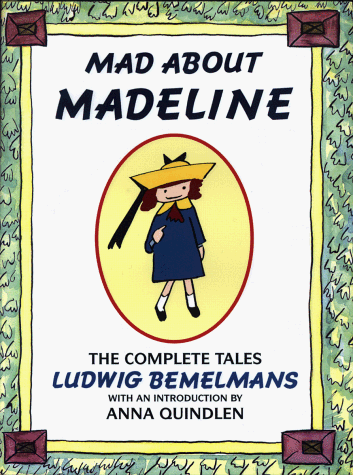
This huge volume includes all six Madeline books, in order of appearance here:

  • Madeline (© 1939)
  • Madeline and the Bad Hat (©1956)
  • Madeline’s Rescue (©1951, 1953)
  • Madeline and the Gypsies (©1958, 1959)
  • Madeline in London (©1961)
  • Madeline’s Christmas (©1956)

We read the first story to the three-year-old. The six-year-old was interested in other things, but her ears pricked up in the course of the reading – it may have been the insistent rhymes, or the sense of danger (‘To the tiger in the zoo / Madeline just said pooh-pooh’), but she joined us and then asked for that story to be read two, or maybe three, more times right then. She listened with intense concentration. Her little brother was interested in why Madeline said ‘pooh-pooh’, but her focus was a lot less scrutable.

In case you don’t know, Madeline is the youngest and boldest of 12 little girls (‘in two straight lines’) who lead a regimented life in an old house in Paris all covered in vines. In just a few lines of verse per beautifully illustrated page the story unfolds of her having her appendix out. When the other girls see the treats she receives in hospital, and the scar, they want to have theirs out too. The illustrations, meanwhile, amount to a guided tour of Paris’s famous sites. (The three year old didn’t care about Montmartre or the Eiffel Tower, but he loved the ambulance every time.)

That’s the first book. Of the others, I most enjoyed Madeline’s Rescue, where Madeline falls into the Seine. In the first book, the text ‘Nobody knew so well / How to frighten Miss Clavell’ accompanies an image of Madeline balancing precariously on a wall above the river. That’s repeated in Madeline’s Rescue, but the facing page image shows her falling, with the text, ‘Until the day she slipped and fell.’ She is saved by a dog, who then goes home with the little girls. There’s a riot in the dormitory over who the dog will sleep with. In the end, the dog, whose name is Genevieve, has twelve puppies and everyone is happy.

Page 76 falls in my least favourite of the books, Madeline and the Bad Hat, in which Pepito, who lives next door to the girls, behaves abominably. He is cured of his wicked ways in the end, but we didn’t get there in our group reading, as the six-year-old didn’t see why she should persist with the tale of misbehaviour – and the three-year-old had his own reasons for not being interested in someone else’s bad choices (a phrase heard too often at his childcare centre). But page 76 is a lovely example of Ludwig Betelmans’ artwork (click to enlarge), and the way it plays with the text:
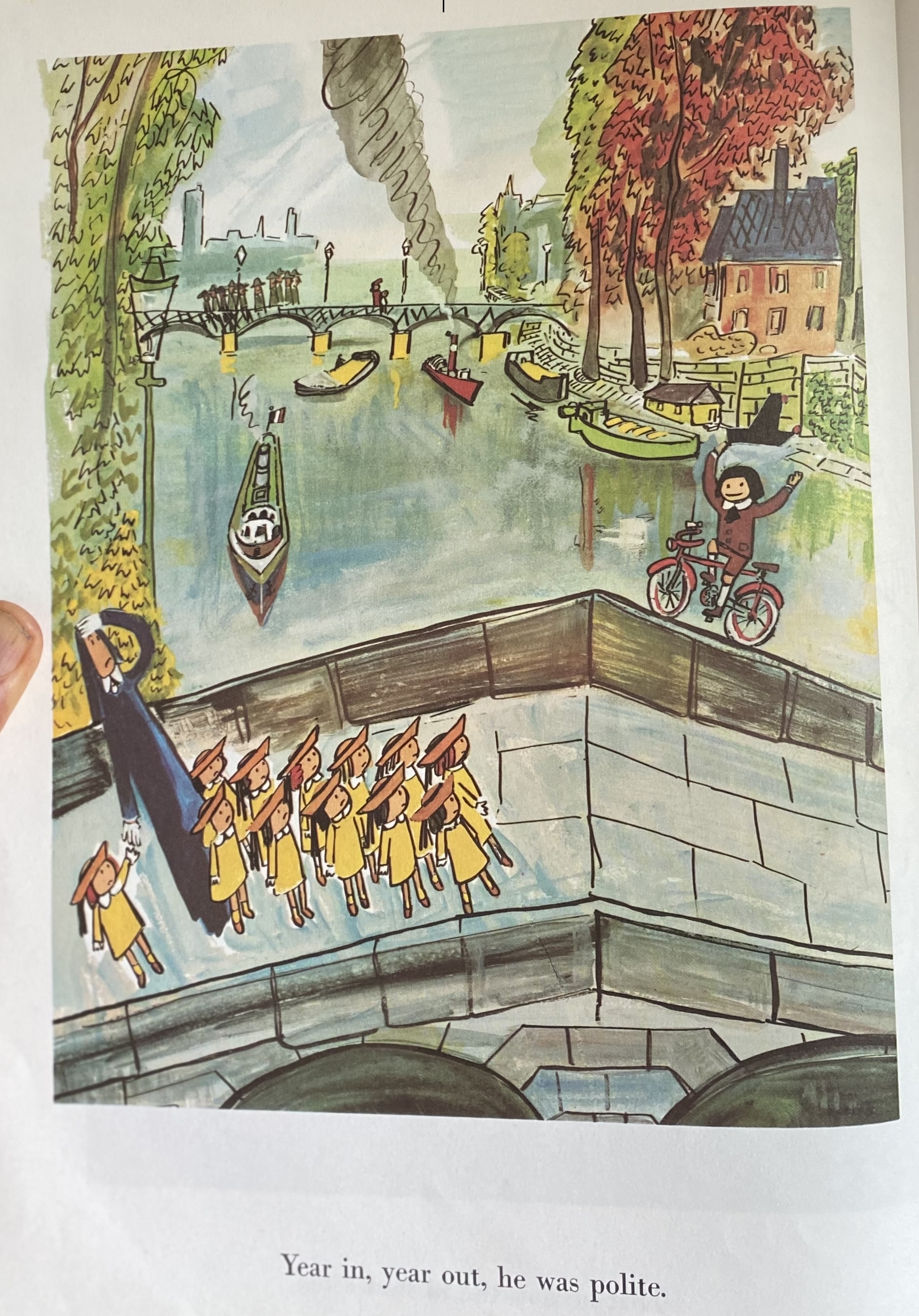
Pepito is riding dangerously on the edge of the bridge, causing Miss Clavell to clutch her brow (she does a lot of that, and she is often seen slightly off balance as she is here, holding Madeline’s hand) and alarming the little girls. However, as the text points out, he is raising his hat politely. Most of his bad behaviour, in fact, is seen in the images but either ignored or downplayed in the text – so we know he is sneakily bad, and mostly avoids adult retribution. On the next page, for example, the text reads, ‘He was sure and quick on ice,’ and we see him running rings around all the little girls at a skating rink, knocking them off balance. I begin to understand my granddaughter’s concentrated attention.

That’s all happening in the foreground. The background (gouache, I think) is where the charm of these books lies: the bridge itself, of course, is beautiful, then there is the other bridge across the Seine, the boats and the trees with their autumn colours.

This is one from the past that has survived the passage of time brilliantly.


Jon Klassen, The Skull: A Tyrolean Folktale (Walker Books 2023)
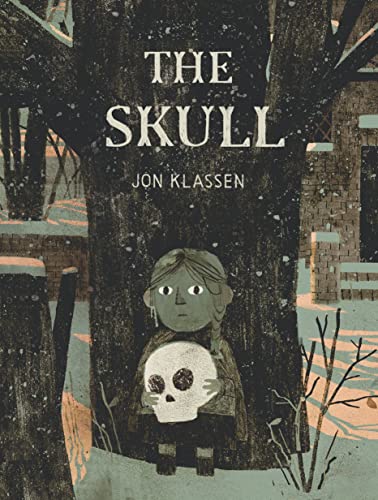
John Klassen is a favourite in our family. See, if you like, my blog posts on I want My Hat Back (2011), This Is Not My Hat (2012) and We Found a Hat (2016).

This book is less minimalist than those earlier ones, but just as grimly comic. In the folktale that it’s based on, a little girl befriends a skull, and a headless skeleton demands that she hand it over. In Klassen’s version the girl, whose name is Otilla, refuses to surrender the skull, manages to outwit the skeleton and dispose of it in a gruesome way that ensures it will never return. She and the skull, it is implied, live happily ever after.

I wasn’t at alI sure how suitable this story was for my squeamish granddaughter and vulnerable grandson. I read it with them once, and moved on as quickly as I could. I can only assume that their father and/or mother read it to them a number of times before we next saw each other, because they both started chanting, ‘Give me my skull. I want my skull,’ and then roared with laughter when, on the fourth or fifth repetition, they fell silent after ‘my’. In the book, that’s the moment when the skeleton falls off the castle wall and is broken up. I guess Jon Klassen is a better judge than I am of what children will enjoy.

Page 76 is blank, before the start of a new chapter, so here’s the preceding spread, to give you an idea of the storytelling:

This is just after the terrifying encounter with the skeleton that ends with it falling off the wall. Otilla is about to gather up its bones, smash them, burn them and throw them into a bottomless pit. But first there is this still, intimate moment. The tenderness of the text – Otilla carries the skull quietly and pats it gently – is beautifully realised in the warmth of the candlelight, the way the blanket covers the skull’s mouth, Otilla’s calm expression.

These books are unlikely blogfellows, but there’s an unexpected echo of Madeline on this page from The Skull. Aficinados will recall the final moment of the first Madeline book:

And she turned out the light –
and closed the door –
and that's all there is –
there isn't any more.

Ruby Reads (17)

It’s been a while since I’ve posted about books I’ve encountered when wearing my Poppa hat. Here are some of the wonders I’ve encountered since last I blogged about them.

Margaret Wise Brown, illustrated by Clement Hurd, Goodnight Moon (1947)

Anyone who has worked in children’s literature has heard of Goodnight Moon. It’s an absolute classic US picture book for young children, which I can now tick off my Shame List. The person who sold it to me said he’d had to hide his daughter’s copy because she demanded it so relentlessly. Yet he claimed to still like it. I don’t know what I was expecting – maybe something full of saccharine statements of maternal love – but actually it’s terrific. A tiny rabbit in a big bed says goodnight to all the wonderful things in the bedroom and outside the window.

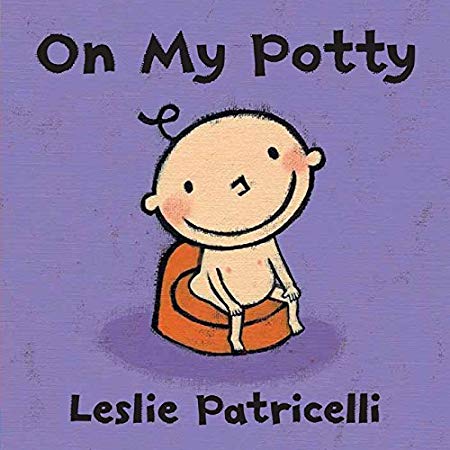
Leslie Patricelli, On My Potty (Walker Books 2010)

If Goodnight Moon can be read as a text with a manipulative subtext (a reading encouraged by a page at the end of our copy that list dozen hints for how to get your child to sleep), On My Potty can’t be read any other way. No actual potty has yet appeared in Ruby’s life, so the book is a bot on the theoretical side, but there’s no doubt that it’s meant as a tool for toilet-training. It’s charming and silly as well. Whether it succeeds in its aims remains to be seen in our case.

Laura Bunting, illustrations by Philip Bunting, Kookaburras Love to Laugh (Koala Book Company 2018)

I imagine all two-year-old people have enthusiasms. Ruby is loves kookaburras. Two of her recurring sentences are, ‘Kookaburra in tree’ (that one is sometimes a question, or perhaps a request) and, ‘Kookaburra fly away.’ The plot of Kookaburras Love to Laugh may be a little beyond her: there’s a serious kookaburra who leaves his family in search of more serious birds. He ends up with some garden flamingoes who are completely serious but utterly boring, and goes back home, converted to the enjoyment of laughter. So the plot is OK, especially given that his family also make adjustments to meet his needs, but the real appeal is page after page of kookaburras and the frequent need for kookaburra imitations from the reader.

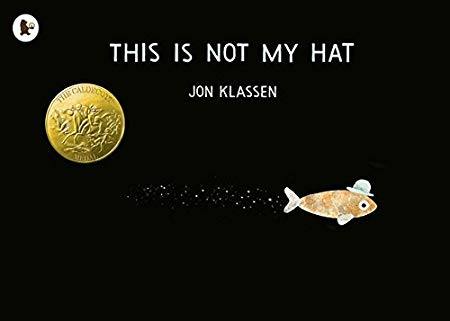
Jon Klassen, This Is Not My Hat (Walker 2012)

The second in John Kalassen’s wonderful minimalist hat trilogy. In the first book, I Want My Hat Back (link is to my review), a bear goes on search of his hat and finally finds and deals with the thief. This one tells a similar story from the thief’s point of view. A small fish has stolen the hat of a very big fish and is confident of getting away with it. But the reader who notices small details such as the direction the big fish is looking or the angle of a bystander crab’s nippers knows that the confidence is misplaced. The humour is sly, and the images are brilliant.

Jon Klassen, We Found a Hat (Walker 2016)

This is the third in the series. Two tortoises find a hat in the desert. One hat, two tortoises. They decide that that won’t work so they walk away, but one of them looks back longingly and when the other goes to sleep he sneaks back towards the hat … Unlike the other two books this one doesn’t end with retribution, but with a splendid, richly satisfying imagined resolution to this specific sharing dilemma. (We are witnessing many sharing dilemmas in playgrounds.)

Ruby’s father and grandfather both love these hat books. I think Ruby quite likes them.

Kookaburras Love to Laugh is the thirty-sixth book I’ve read for the 2019 Australian Women Writers Challenge.

More Ruby reads

So many books in Ruby’s house, so little time. I may be doing a weekly blog post for a while to come. Given that the projected life of a children’s book is alarmingly short, it’s heartening to see so many relatively ancient books here.

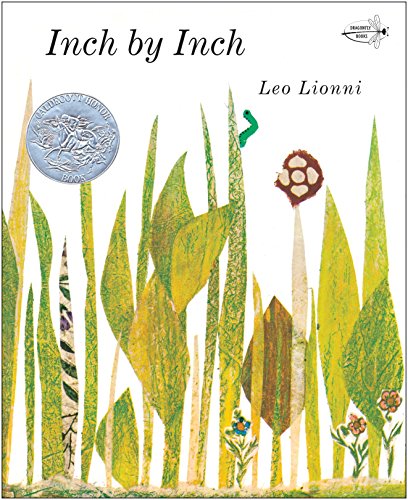
Leo Leonni, Inch by Inch (1962)

This was Leo Lionni’s first picture book. Not as spectacular as Swimmy, perhaps, it’s still splendid. The tiny inch worm saves itself from being eaten by offering to measure parts of various birds, and finally by rising to the challenge of measuring the nightingale’s song. For small readers, there’s a bit of a Where’s Wally thing going on as the tiny worm appears in every spread. For big ones (including grandparents) there are more sophisticated joys in the spare text and elegant paintings.

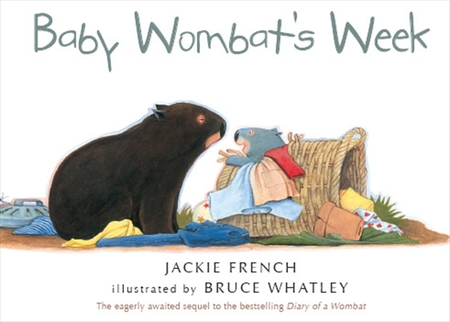
Jackie French and Bruce Whatley, Baby Wombat’s Week (Angus & Robertson 2009)

This is a sequel to Diary of a Wombat that won hearts and prizes all over the place in 2002. Who doesn’t love a wombat? And this one’s a baby. Again, the images are probably too complex and the humour too sly for tiny people. But this is wonderful.

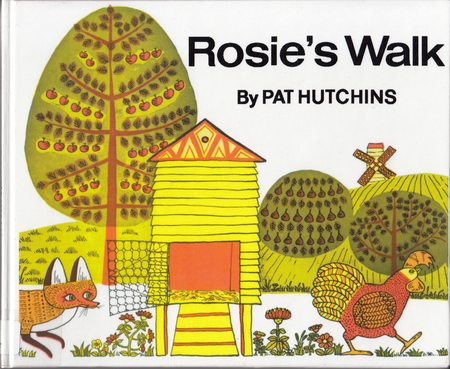
Pat Hutchins, Rosie’s Walk (Macmillan 1967)

This is a board book supplied by us grandparents. Its place in our affections is at least as firmly established as The Very Hungry Caterpillar‘s. It’s a classic example of illustrations telling a story of which the verbal text pretends to be oblivious. The bright, patterned illustrations are, of course, gorgeous.

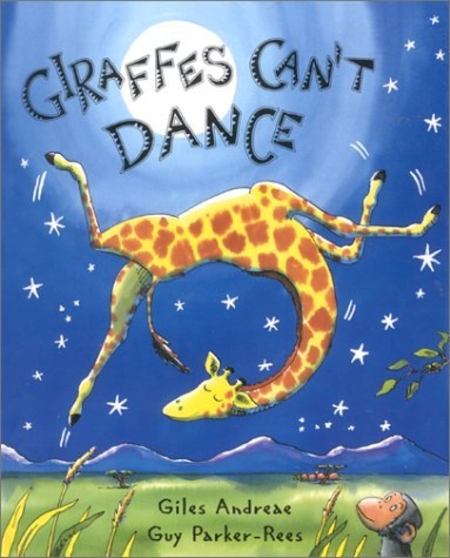
Giles Andreae and Guy Parker-Rees, Giraffes Can’t Dance (2001)

This one doesn’t appeal to me so much, but it’s on high demand in Ruby land, possibly because one of her favourite toys has been a squeaky giraffe named Sophie. The Giraffe in the book is mocked by the other animals because it can’t dance. It wanders off a communes with the moon and the wind, and soon is dancing spectacularly: given how very ungainly the giraffe is in the first part of the boo, there’s something dispiritingly unrealistic in the moral is that everyone can dance if the music is right.

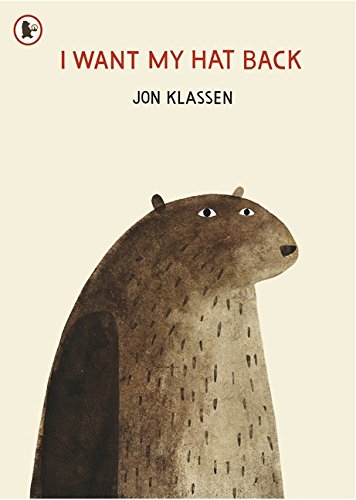
John Klassen, I Want My Hat Back (Walker 2011)

Jon Klassen is a Canadian minimalist picturebook maker. As far as I can tell this is the first of a trilogy about a bear and his beloved hat. The bear, who doesn’t change much from page to page, asks a number of other animals, some of them of indeterminate species, if they’ve seen his hat. We see the hat long before he does (another example of an illustration alerting the reader to something the text is unaware of), and there’s a bloodthirsty and punitive but funny twist in the tale, which I hope young readers generally miss.

Bob Graham, Vanilla Ice Cream (Walker 2014)

Bob Graham! Evidently he’s even more popular in France than in his native Australia. This picture book is the work of an assured master – possibly in his Late Style. A sparrow accidentally hides away in a bag of rice loaded onto a ship in an Indian port. When the ship arrives in a southern land (a non-specific Australian city), the sparrow emerges and flies to a nearby park. There, a dog leaps up towards him and knocks an ice cream out of someone’s hands. The ice cream lands in the lap of a baby in a stroller, and that’s the first time that baby tastes vanilla ice cream. A weird non-plot, you might say. But he pulls it off!

Julia Donaldson and Axel Scheffler, The Snail and the Whale (Puffin 2006)

A strange tail of a snail with an itchy foot who hitches a ride to exotic places on the tail of a whale and comes back to inspire the other snails to go adventuring, having saved the whale’s life by writing a message in slime on a classroom blackboard. Surrealism is alive and well in children’s picture books. This one is way too old for Ruby, but she has two copies, one in the profusion of books and toys in a corner of the living room and one beside her cot.

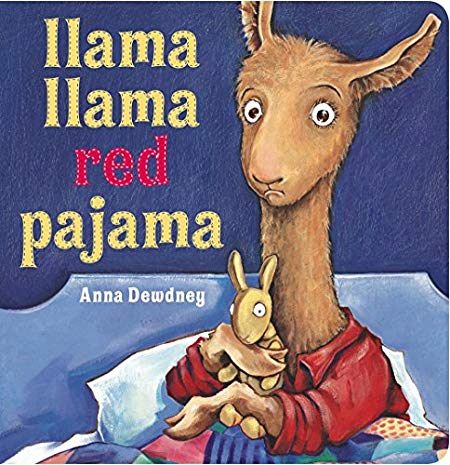
Anna Dewdney, Llama Llama Red Pajama (2005)

A gauge of the success of this book is that Mr Blue Pencil didn’t notice the US spelling in its title until I wrote it for this bog post. It’s a bedtime story with bright colours, bouncy rhymes (as long as you pronounce mama to rhyme with llama). There’s a fear-of-the-dark moment that might be a bit suggestive for some children. But the relationship between ht young llama and the llama mama is warm and loving, even if she does answer the phone when the young one needs her desperately at the bedside.

Baby Wombat’s Week is the seventh book I’ve read for the 2019 Australian Women Writers Challenge.