Tag Archives: Kate Lilley

SWF 2112: Poets, Harbour, pitches and more poets

This was my first day at Walsh Bay, and in striking contrast to recent weather, the sky was cloudless and there was no wind – perfect festival weather.

The tiny harbourside room generally reserved for poets at the Festival couldn’t have been a more appropriate venue for my first event of the day, Harbours and Rivers, with Robert Adamson, Neil Astley, Martin Harrison and Jennifer Maiden. I joined the uncharacteristically long queue with minutes to spare, and only when it became clear I wasn’t going to get in I realised I was in the wrong place: this time the tiny room had been given to young writers talking about the Second Novel Effect, and the poets had been given a much bigger and incidentally much darker space. I briskly walked the length of the Wharf and arrived part way through the introductions.

The poets, refusing as poets should to be pigeonholed, paid at best slant regard to their allocated topic. Jennifer Maiden read a long new poem, ‘The Uses of Powerlessness’, which she described as a diary poem but was actually pretty much a philippic on Julia Gillard, not in the ‘X woke up in X’ form, but a straightforward furious meditation. I wrote down one of many striking lines: ‘The Labor Party, like Gillard, is an obedience addict.’ Martin Harrison and Robert Adamson both spoke of the complex interplay between observation of the natural world and self-discovery. ‘All my harbours and rivers are internal,’ the latter said, somewhat disingenuously, ‘even though I live on a river.’ Among the poems he read was the sublime ‘Kingfisher’s Soul’, an intensely personal love poem that grows richer with each hearing. Neil Astley, advertised as editor of English publishing house Bloodaxe Books, turns out to be a poet as well. He was in Darwin for Cyclone Tracy, about which he read two striking poems followed by an excerpt from a novel that engages with an English countryside.
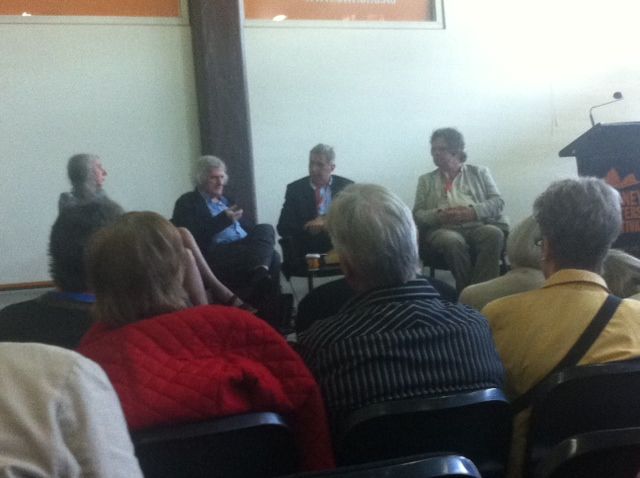
Jennifer Maiden, Robert Adamson, Martin Harrison and Neil Astley not far from the Harbour

In short, it was very good. Afterwards I ventured to introduce myself to Jennifer Maiden, but I was probably working so hard at no being too fanboyish for the conversation to have made much sense.

After a brief interval I went to the Club Stage for So You Think You Can Write, my first time to this a regular Festival event in which random audience members get to pitch a project to a panel of publishers.
The specially decorative lights for the Club Stage area – each bulb has an open book for a shade.

I don’t know that anyone who was at all savvy about publishing would participate in this, unless for the sheer fun of it. And it was mostly fun. A 15 year old boy pitched a detective story set among the Egyptian pyramids. There was an earnest tract for children aiming to foster leadership skills and an understanding of democracy. One or two pitches were for books that could have been anything, so broad were the descriptions. One woman had already had an iBook version of her project downloaded thousands of times. The winner – of nothing apart from the glory – was a psychological detective story in which the character realises a day of her life has gone missing and then is shown photos of herself taken on the missing day. The thing that won the audience and panel’s approval was that the photos were improbably and bizarrely orgiastic, involving vegetables and cigars in unspecified lewd ways. It may not be Scandi-Crime, but this audience loved it. You read about it here first.

And then off to the poets’ lightfilled room. Gig Ryan and Kate Lilley, feminist-identifying experimental poets, drew an overflow crowd, including Adamson, Harrison and Astley from this morning, plus John Tranter, Ivor Indyk, Toby Fitch and many faces familiar from the Sappho open mike nights. Each of the poets introduced the other. They read from recently published books and, on being requested by an audience member to  compose a poem together on the spot, they parlayed the request down to each of them reading a poem by the other – with interesting results.

I confess that I went to this session expecting to suffer. I’ve read very little of either of them and my experience has been that if I don’t know a poet’s work I have trouble hearing it when read to me. (A possible contrary experience was hearing Jennifer Maiden this morning, but I am familiar with her voice and preoccupations, so had a head start.) Gig Ryan reads quickly, and her language is very compressed: I had difficulty distinguishing the words, let alone grasping the connections between them. Kate Lilley has a gratifyingly expressive delivery, and the woman beside me kindly allowed me to look over her shoulder and read along as the poems were read. But I was still pretty completely mystified. Both women talked about how people in their lives met their work with blank expressions, so I didn’t feel too stupid, or at least not alone in my stupidity.

One of Kate Lilley’s poems, ‘Maisily’, consists of a string of about a hundred adverbs. This was the first time she’d read it aloud and it was quite a feat – all those lys. It seemed like pointless nonsense to me. Then she explained that it was made up of all the adjectives used by Henry James in What Maisie Knew. That made it seem like hi-falutin pointless nonsense to me. Then I remembered that it was part of an elegiac sequence about the poet’s relationship with her mother, and it no longer seemed so pointless – maybe I was finding an emotional subtext because that’s the kind of reader I am, but I did find one, like a deeply submerged nostalgia for childhood when the adult world was as inscrutable as to little Maisie in James’s novel. I wonder how it wold go if read, not as a near tongue twister, but with the rhythm of a tolling bell.

As if the poets had read my thoughts, their conversation turned to the business of reading poetry aloud. Lilley said she knew and loved her poetry long before she heard her read, but when she did hear her read it was a revelation. Maybe my difficulty is as much to do with my increasing deafness as with unfamiliarity with the poetry.

So the poetry was difficult, but the session was excellent. Both were very funny about the business of being poets, and how they see each other’s poetry. Even when they drew our attention to the complete absence of critical articles on Gig Ryan’s work, even though she is generally acknowledged as an important Australian poet, and surmised that this absence may well be because she is a woman, somehow that seemed richly comic.

On the way home in the bus, I ran into an old friend who had been to a panel with Peter Hartcher, George Megalogenis and a third journalist talking about Australia’s parlous economic situation. I felt I had been very frivolous, but I was glad of it.

Dorothy Hewett’s Selected Poems

Selected Poems of Dorothy Hewett, edited and introduced by Kate Lilley (UWA Press 2010)

When she launched this book at Gleebooks Gail Jones warned against becoming so fascinated by the iconic figure of Dorothy herself that we forget to actually read her poetry. Good advice, no doubt, but I’m probably no different from anyone who knew Dorothy at all in being completely incapable of reading these poems without feeling that I’m in the presence, not so much an icon as a … well, a presence.

Dorothy was a frequent visitor to Currency Press, where I worked in the 1970s. She commanded attention, was never dull, and was never stuck for words. Her first appearance in my time there was by way of a letter written to her good friend our editor in chief Philip Parsons, which he read aloud to the staff (all three of us). She was approaching 50, and wrote that she wanted to celebrate her birthday on a beach in Bali, laid out in a coffin surrounded by black candles. We were amused. When she saw the Currency edition of her play The Chapel Perilous (on the front cover a glamorous photo of  Dorothy when young, on the back a pensive Dorothy in her late 40s), she exclaimed,  ‘Time’s cruel!’ I really don’t need to say this, but Dorothy approaching 50 didn’t exactly lack glamour. We were amused again. In 1976 we published her much earlier play, This Old Man Comes Rolling Home, and I marked up the typescript for the printer. When you mark up a text you take it one word at a time and if it’s a play it tends to perform itself in your head. As I neared the end of my pencil-wielding way through This Old Man, tears were streaming down my cheeks. Dorothy walked into the office soon after I’d finished it, and I told her, with feeling, how much I loved the play. ‘Ah well,’ she said, rolling her eyes, ‘you work away for ten years and they still say your first thing was the best.’ Once, impertinent pup that I was, I told her she had misused a word in a piece published in Overland (writing bisexual but meaning, I said, androgynous). She didn’t slap me down: her eyes lit up, and we had an animated conversation. The last time I saw her was at the NSW Premier’s Literary Awards dinner in 2000, where she received the Special Award, and though she was ill and walked with difficulty, she was as commanding and glamorous a presence as ever, her hair still wild.

If you said that none of those random memories had anything to do with the poetry I couldn’t say confidently that you were wrong.  But it would be odd to quarantine Dorothy’s poetry from her plays and prose, or from what we know of her life. The subject matter of her plays and autobiographical writing is revisited here: her childhood in the Western Australian wheat belt, her sexual adventures and ordeals, her history with the Communist Party. As Kate Lilley writes in her introduction, Dorothy was a ‘magnificently unabashed poet of female narcissism’. (She’s also a magnificently unabashed poet of Australian Communism and disillusion with Communism.) In the poems, even more explicitly than in the plays, she puts herself on the … I was going to say ‘on the chopping block’, and I think I’ll stick with that. If this is narcissism, it’s a ruthless variety; if sometimes her laments over her suffering as a woman sound like self pity, there’s a pitilessness in the way she holds that emotion up to the light. Nothing is quarantined in these poems, and when I read them, I hear Dorothy’s voice.

I think I’m blathering.

Excerpts from the autobiographical  ‘The Alice Poems’ take up about a third of the book, and fill me with chagrin that the book Alice in Wormland is out of print. But the quieter poems of the last 20 pages, which look squarely at old age, the effects of cancer, and the approach of death, are the real treasure. From ‘The Last Peninsula’:

death in his blue cowl
takes one reluctant step away
while the suffering flesh
cut sewn and sealed
lies still in its narrow bed
the spirit looks down and is healed
Healed for what? says the voice
More of the same?
And the currawong sings Rejoice
I have called your name
.

I find the last poem in the book, ‘What I Do Now’,  intensely moving. After a quote from Frank O’Hara (‘I always wanted my life / to have some kind of meaning’), the poem walks us through the speaker’s day – lying in bed reading, getting up at 6 pm, watching television until midnight, and staggering back to bed. Then, with what might be read as desolation, but which to me sounds like a reprise in a minor key of Dorothy’s grimly stoic, eye-rolling response to the Chapel Perilous photos or my response to her early play:

–––––––––the wind howls
ripping my poems to shreds
the paper lantern whirls

I listen to the semis
changing gear
to tackle the 40 Bends
in the tapestry chair
the cat snores loudly
will I live to a great old age?
there are lots of mad old women
in these mountains
shut up in their houses dying.

Recent journals (1) – Heat 21

Ivor Indyk (ed), Heat 21: Without a paddle (Giramondo December 2009)

Some of the reasons why you should subscribe to Heat, or at least read it:

1. Worthiness. Your money and attention help to sustain cosmopolitan Australian literary culture.

2. Self-protection. Extracts from works in progress allow you to prejudge the finished work. I’ve decided to avoid a significant number of award winning books on the basis of such advance warnings, and I’m likely to steer clear of one or two foreshadowed in this issue. The poetry provides a similar warning function: poetry is so much a matter of taste, and journals like Heat can play the crucial role of taster. And there are the critical pieces: on the strength of Kate Lilley’s detailed exposition of Susan Howe’s The Midnight, I won’t go looking for it any time soon (far too rich and recondite for my thin blood); Peter Craven’s critical review has put me right off Brian Matthews’s biography of Manning Clark. But it hasn’t enamoured me of Peter Craven: he’s bracingly forthright in his judgements, and even when he’s completely wrong-headed he provokes interesting conversations, but he comes across as too full of himself and too pugnacious for me to actively seek him out.

3. Titillation. Then there are the poems and extracts from works in progress that have the opposite effect. Poems from, among others, Pam Brown, Ken Bolton, Chris Price make me want more.

4. Education. In this issue, Josiane Behmoiras embeds an introduction to the work of Paul Virilio, a cutting edge French thinker, in an account of her recent trip to France (complete with implied travel advisories on the stench of urine by the Seine and problems with Australian Visa cards on the Metro); where her discussion of his work descends from glorious abstraction, it seems to be arrive at important conclusions about how we should live, very close to those of Bill McKibben’s much less abstruse Deep Economy.

The four-colour section in the middle introduces us to the  painter Jon Campbell, and offers us a hand in understanding why we should be interested in his work.

5. Base pleasure. Maybe this is only for people who are or have ever been editors, but Heat can be counted on for regular hits of the sour pleasure of Other People’s Gaffes. The best one in this issue occurs in a poem: ‘a woman rides a / pink vesper that you could / park anywhere’. I’m reasonably sure the poet had a chic little Vespa scooter in mind rather than an evening star blazing to the kerb in the sky.

6. More substantial pleasure. This is of course the real reason for reading Heat at all.

Here, Jena Woodhouse interviews Michael Hofmann, poet and translator, and though her introductory paragraphs use rude words like polytropic, once we get to Hofmann himself the prose becomes a joy to read.

Luke Carman’s three prose pieces gathered under the title ‘The Easy Interactions of an Elegant Young Man’ have a wonderful, disturbingly comic cumulative effect. Part way through the second I realised I saw him read similar work at the Sydney Writer’s Festival earlier this year, and described his reading as rapidfire and surreal. It works that way on the page as well.

And then there’s James Ley’s ‘A Degree of Insanity’, a straightforward, intelligent essay on Samuel Johnson that is splendid in itself, not least because it quotes generously from Johnson’s sonorous prose. Its appearance in this journal gives added pleasure, as it seems to send ricochets out, pinging off the rest of the content. Peter Craven, for example, drops a couple of Johnson’s famous quips into his argument for no apparent reason other than to establish his own gravitas. The notion, from Johnson’s Rasselas, that ‘all power of fancy over reason is a degree of insanity’ bounces prettily off the mild derangement of Luke Carman’s pieces and some of the poetry. The excitement surrounding literary journals in eighteenth century London sparks reflections about the role of their descendants in our time, Heat among them.

Next:  Overland issue 197.