Tag Archives: Michael Hofmann

Journal Catch-up 34: Heat 21

Anna Thwaites (editor), Heat Series 3 Nº 21 (Giramondo September 2025)

I cancelled my subscription to  Heat a while back (after Series 3 Number 12), mainly because the handful of journals I subscribe to was getting to be quite a handful. Last September I received a complimentary copy of Number 21 with a note from the new editor Anna Thwaites inviting me to resubscribe. I am grateful for the gift, but since Southerly has revived and Meanjin will soon come back from the dead, I’m unlikely to take up the offer.

Mind you, if you want a conveniently sized literary journal that will introduce you to a diverse range of writers from Australia and elsewhere, including some in translation, you won’t find anything that suits you better than Heat.

This issue has two piece in translation. There’s a fable by Swiss writer Peter Stamm, translated by US-based Michael Hofmann, and a chillingly dystopian short story by Hong Kong author Hon Lai Chu translated by Jacqueline Leung. Heat seems to have a policy of not naming the original language of translated pieces – I’m guessing that these pieces were originally in German and Cantonese respectively. Hon Lai Chu’s story ‘Scrap‘ is available on the Heat website.

There’s an essay by Heat‘s founder and national treasure Ivor Indyk. Always interesting, he offers insights into the writing of Les Murray, Gerald Murnane and Alexis Wright. There’s a short story by the late Elizabeth Harrower, possibly her ‘last “new” piece of fiction … to reach readers’, as her biographer Susan Wyndham says in a brief introduction. Alongside these venerable and renowned contributors, Catherine Kaixin Yu, who grew up in Shanghai, has her first published essay, a richly elegiac account of visiting the dying village of her ancestors.

All that, plus poems by Londoner Alex Wong makes a good reading experience. What gave me most pleasure was a pair of poems by Melburnian Amy Crutchfield. In the first, ‘Nausicaa’, the poem’s speaker is a traveller on Corfu and visits Palaiokastritsa, traditionally the place where Odysseus met the nymph Nausicaa. The poem, in five short parts, is full of good things. I smiled a lot.. I’ll just mention an example of how line breaks can be important in poetry.

Section 4, ‘Taverna’ is quoted n the back cover of Heat, just the first three lines:

In the taverna
we choose the wrong foods
and sweat

That makes sense as a traveller’s tale. We chose something too spicy for our tastebuds. But the poem itself continues after the line break and turns out to be saying something quite different:

In the taverna
we choose the wrong foods
and sweat
over our one chance
to be typical.

It’s not about physical discomfort after all, but about the travellers’ awkward sense of standing out as odd. Or both!

Thanks you, Anna Thwaites.


I am a man of settler heritage who has been alive for almost a third of the time that has elapsed since Arthur Phillip claimed this continent for the British crown. I wrote this blog post on the land of Gadigal and Wangal, and crows are kicking up a fuss outside my window. I acknowledge Elders past and present and welcome any First Nations readers of the blog

Jenny Erpenbeck’s Kairos and the Book Club

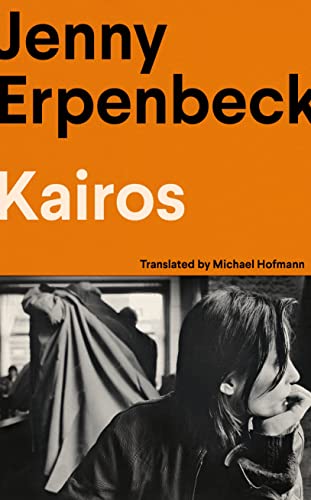
Jenny Erpenbeck, Kairos (translated by Michael Hofmann, Granta 2023)

Before the meeting: The Emerging Artist read this book before I did. She hated it, couldn’t finish it, and threatened to divorce me if I ended up liking it. Though I wouldn’t say I absolutely loved the first 166 pages, by page 167 (of 292) I was pretty sure our relationship was safe.

In a prologue, the book’s narrator, Katharine, learns that a former lover has died. She is unable to attend his funeral as she has promised, but soon after the funeral two boxes of material are delivered to her door by a weeping woman. Here’s how she describes the project that becomes this book:

Kairos, the god of fortunate moments, is supposed to have a lock of hair on his forehead, which is the only way of grasping hold of him. Because once the god has slipped past on his winged feet, the back of his head is sleek and hairless, nowhere to grab hold of. Was it a fortunate moment, then, when she, just nineteen, first met Hans? One day in early November, she sits down on the floor and prepares herself to sift – sheet by sheet, folder by folder – through the contents of the first box, then the second.

What follows, based on the contents of those boxes plus a suitcase of Katharina’s own memorabilia, is the story of her relationship with Hans, a married man who is ten years older than her father, 51 to her 19. Two things inclined my expectations against the Emerging Artist’s distaste. First, the set-up linked nicely to other recent reading – mainly Annie Ernaux’s The Young Man (link is to my blog post), a memoir of a relationship between the author and a much younger man. Second, it’s set in East Germany in the 1980s in the prelude and aftermath of the fall of the Berlin Wall, so I thought (correctly) that the book would capture something of the flavour of that time and place.

The book starts with a cute meet in a downpour in Berlin in 1985. There’s a period of mutual bliss, which blossoms all too quickly into a physically and psychologically abusive nightmare, to which Katharina is inexplicably committed, so that by page 167 without any explanation she has evidently consented to being tied up and beaten with a belt, and later with a riding crop. Until that point, the historical context was enough to keep me afloat as a reader. The hideous mind games move up a notch as Hans convinces Katharina that she is cold, selfish and deceitful and sends her a series of cassettes detailing how terribly she has made him suffer. Instead of pulling the plug, she listens to the tapes, takes careful notes (hence the narrator’s ability to recall them even though he destroys each hour-long diatribe by taping the next one over it), and writes a self- abasing reply, thereby provoking another cassette.

The hideous gaslighting continues for many pages. Several times the reader breathes a sigh of relief as it seems the relationship is finished, and then it’s on again with occasional moments of joy and endless rounds of blame and accusation on his part and wretched self-abasement on hers. Maybe its an allegory about East Germany, as Neel Mukherjee says on the back cover, but I can’t see it.

I’m glad I persisted, because a) the worm does finally turn, if ever so slowly and slightly, and more importantly b) there are several wonderful pages about how the reunification of Germany was experienced by the Easties. Maybe for German readers the relationship between the central relationship and the historical moments would be clearer, but I couldn’t see it as more than a gruelling account of a vulnerable young woman being exploited by a self-obsessed and cruel much older man, with the broad sweep of history barely impinging on their lives until massive change happens all around them.

Page 204: I usually blog about page 77. It would have been interesting to linger on that page in Kairos, where Katharina first visits the West, foreshadowing the final movement. But this time I want to give you a bit of page 204, which is the moment when I first began to hope for something other than abuse and submission, and catch a glimmer of the book’s intention to capture what it was like to have lived through first the Nazi and then East German Communist regimes. It’s the closest Hans comes to introspection:

The abolition of a pitiless world through pitilessness. But when does the phase after begin? When is the moment to stop the killing? … To be arrested or to carry out arrests and believe in the cause, to be beaten or to beat and believe in the cause, to be betrayed or to betray and believe in the cause. What cause would ever again be great enough to unite victims and murderers in one heartbeat? That it would make victims out of murderers and murderers out of victims, until no one could tell any more which he was? Arrest and be arrested, beat and be beaten, betray and be betrayed, till hope, selflessness, sorrow, shame, guilt, and fear all make one indissoluble whole … And if beauty can only be bought with ugliness, and free existence with fear? Probably, Hans thinks, turning aside, and hearing Katharina mutter something incomprehensible in her sleep, that’s probably what it took to produce the deeper experience that you can see here in every woman, every man, every child even.

After the meeting: After a pleasant meal of mussels and pasta, we dutifully turned to a discussion of the books (Paul Murray’s The Bee Sting was also on our agenda, blog post to follow). Only two of the five of us had finished the book. There was some discussion about whether Book Clunb members had an obligation to read the books. I think the position that ended up being accepted was that yes, they do, except if a book offends their value system intolerably. Kairos was such a case for at least one of last night’s non-completers.

Generally we agreed that it was an awful read. I tried to argue that the final section, in which the Wall comes down, made the whole book worth reading, but I didn’t even convince myself. I also argued that the eerie lack of internality in the characters was not a bug but a feature: the narrator is reconstructing a painful episode from her youth, which she no longer understands or perhaps can’t bear to imagine herself back into. So she meticulously recreates a narrative from the documents, including details of places, times, food eaten, drinks drunk, transport caught, the content of cassette tapes and letters, and leaves it to the reader to imagine the emotional content beyond the broad outlines of ‘love’. I pretty much convinced myself that this was an accurate reading, but no one else bought it.

We didn’t talk about the translation at all. I couldn’t help thinking, though, that the book would almost certainly speak more forcefully to German readers, not so much because of the language as because of their connection to the history.

In short, not a recommended read.


I wrote this post on Gadigal-Wangal land, not far from the Cooks River, in a place that was once wetland teeming with birdlife. I finished it after a long walk through Gadigal land to the waters of Sydney Harbour/Warrane on a beautiful autumn day. I want to acknowledge the people who have looked after this place for tens of thousands of years, their Elders past present and emerging.

Recent journals (1) – Heat 21

Ivor Indyk (ed), Heat 21: Without a paddle (Giramondo December 2009)

Some of the reasons why you should subscribe to Heat, or at least read it:

1. Worthiness. Your money and attention help to sustain cosmopolitan Australian literary culture.

2. Self-protection. Extracts from works in progress allow you to prejudge the finished work. I’ve decided to avoid a significant number of award winning books on the basis of such advance warnings, and I’m likely to steer clear of one or two foreshadowed in this issue. The poetry provides a similar warning function: poetry is so much a matter of taste, and journals like Heat can play the crucial role of taster. And there are the critical pieces: on the strength of Kate Lilley’s detailed exposition of Susan Howe’s The Midnight, I won’t go looking for it any time soon (far too rich and recondite for my thin blood); Peter Craven’s critical review has put me right off Brian Matthews’s biography of Manning Clark. But it hasn’t enamoured me of Peter Craven: he’s bracingly forthright in his judgements, and even when he’s completely wrong-headed he provokes interesting conversations, but he comes across as too full of himself and too pugnacious for me to actively seek him out.

3. Titillation. Then there are the poems and extracts from works in progress that have the opposite effect. Poems from, among others, Pam Brown, Ken Bolton, Chris Price make me want more.

4. Education. In this issue, Josiane Behmoiras embeds an introduction to the work of Paul Virilio, a cutting edge French thinker, in an account of her recent trip to France (complete with implied travel advisories on the stench of urine by the Seine and problems with Australian Visa cards on the Metro); where her discussion of his work descends from glorious abstraction, it seems to be arrive at important conclusions about how we should live, very close to those of Bill McKibben’s much less abstruse Deep Economy.

The four-colour section in the middle introduces us to the  painter Jon Campbell, and offers us a hand in understanding why we should be interested in his work.

5. Base pleasure. Maybe this is only for people who are or have ever been editors, but Heat can be counted on for regular hits of the sour pleasure of Other People’s Gaffes. The best one in this issue occurs in a poem: ‘a woman rides a / pink vesper that you could / park anywhere’. I’m reasonably sure the poet had a chic little Vespa scooter in mind rather than an evening star blazing to the kerb in the sky.

6. More substantial pleasure. This is of course the real reason for reading Heat at all.

Here, Jena Woodhouse interviews Michael Hofmann, poet and translator, and though her introductory paragraphs use rude words like polytropic, once we get to Hofmann himself the prose becomes a joy to read.

Luke Carman’s three prose pieces gathered under the title ‘The Easy Interactions of an Elegant Young Man’ have a wonderful, disturbingly comic cumulative effect. Part way through the second I realised I saw him read similar work at the Sydney Writer’s Festival earlier this year, and described his reading as rapidfire and surreal. It works that way on the page as well.

And then there’s James Ley’s ‘A Degree of Insanity’, a straightforward, intelligent essay on Samuel Johnson that is splendid in itself, not least because it quotes generously from Johnson’s sonorous prose. Its appearance in this journal gives added pleasure, as it seems to send ricochets out, pinging off the rest of the content. Peter Craven, for example, drops a couple of Johnson’s famous quips into his argument for no apparent reason other than to establish his own gravitas. The notion, from Johnson’s Rasselas, that ‘all power of fancy over reason is a degree of insanity’ bounces prettily off the mild derangement of Luke Carman’s pieces and some of the poetry. The excitement surrounding literary journals in eighteenth century London sparks reflections about the role of their descendants in our time, Heat among them.

Next:  Overland issue 197.