I cancelled my subscription to Heat a while back (after Series 3 Number 12), mainly because the handful of journals I subscribe to was getting to be quite a handful. Last September I received a complimentary copy of Number 21 with a note from the new editor Anna Thwaites inviting me to resubscribe. I am grateful for the gift, but since Southerly has revived and Meanjin will soon come back from the dead, I’m unlikely to take up the offer.
Mind you, if you want a conveniently sized literary journal that will introduce you to a diverse range of writers from Australia and elsewhere, including some in translation, you won’t find anything that suits you better than Heat.
This issue has two piece in translation. There’s a fable by Swiss writer Peter Stamm, translated by US-based Michael Hofmann, and a chillingly dystopian short story by Hong Kong author Hon Lai Chu translated by Jacqueline Leung. Heat seems to have a policy of not naming the original language of translated pieces – I’m guessing that these pieces were originally in German and Cantonese respectively. Hon Lai Chu’s story ‘Scrap‘ is available on the Heat website.
There’s an essay by Heat‘s founder and national treasure Ivor Indyk. Always interesting, he offers insights into the writing of Les Murray, Gerald Murnane and Alexis Wright. There’s a short story by the late Elizabeth Harrower, possibly her ‘last “new” piece of fiction … to reach readers’, as her biographer Susan Wyndham says in a brief introduction. Alongside these venerable and renowned contributors, Catherine Kaixin Yu, who grew up in Shanghai, has her first published essay, a richly elegiac account of visiting the dying village of her ancestors.
All that, plus poems by Londoner Alex Wong makes a good reading experience. What gave me most pleasure was a pair of poems by Melburnian Amy Crutchfield. In the first, ‘Nausicaa’, the poem’s speaker is a traveller on Corfu and visits Palaiokastritsa, traditionally the place where Odysseus met the nymph Nausicaa. The poem, in five short parts, is full of good things. I smiled a lot.. I’ll just mention an example of how line breaks can be important in poetry.
Section 4, ‘Taverna’ is quoted n the back cover of Heat, just the first three lines:
In the taverna
we choose the wrong foods
and sweat
That makes sense as a traveller’s tale. We chose something too spicy for our tastebuds. But the poem itself continues after the line break and turns out to be saying something quite different:
In the taverna
we choose the wrong foods
and sweat
over our one chance
to be typical.
It’s not about physical discomfort after all, but about the travellers’ awkward sense of standing out as odd. Or both!
Thanks you, Anna Thwaites.
I am a man of settler heritage who has been alive for almost a third of the time that has elapsed since Arthur Phillip claimed this continent for the British crown. I wrote this blog post on the land of Gadigal and Wangal, and crows are kicking up a fuss outside my window. I acknowledge Elders past and present and welcome any First Nations readers of the blog
I mistimed my reading of this book. I finished it just before we had to head off to the Book Club meeting, so I can’t do my usual thing of writing a bit about my own take on the book before reporting on the evening’s conversation. It turned out only two of the five of us had read the whole book, and the other completer had also just finished it that afternoon. Of the other three, two hadn’t looked at the book at all and one had read less than a hundred pages.
Nevertheless we had an animated conversation, partly because more of us had read Elizabeth Harrower’s novel The Watch Tower, and there are obvious points of connection between the two books.
Elizabeth Harrower (1928–2020) had four novels and a number of short stories published in the 1950s and 1960s. A fifth novel was accepted for publication in 1970, but she withdrew it in what she later describes as the moment she decided to destroy her life (page 156). From the early 1970s she was a self-identified writer who published nothing. She did go on writing, including copious letters and what she referred to as ‘something big’, which there is no record of anyone clapping eyes on. If the big thing actually existed, she must have destroyed it. Early this century she was rediscovered. Her novels and short stories were republished, or in some cases published for the first time, and in her last years, she enjoyed a degree of celebrity.
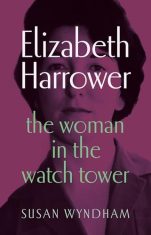
Two biographies were published in 2025. Before Susan Wyndham’s appeared, Latrobe University Press published Helen Trinca’s Looking for Elizabeth: The Life of Elizabeth Harrower. To add to the riches, 2024 had seen the publication of Hazzard and Harrower: The Letters, edited by by Brigitta Olubas and Susan Wyndham, consisting of four decades of correspondence between Harrower and Shirley Hazzard.
I’m sorry to say it, but at the end of our evening, none of us admitted to wanting to read further.
This was partly because Harrower tended to guard her privacy, and though she referred to herself as ‘a divorced child’ and much can be inferred about her early life from her novels, Wyndham’s account of her childhood is necessarily vague. Her piling on of whatever information she was able to discover – such as the fancy dress costumes young Betty wore – may be interesting to some readers, but to me they just feel like clutter. The clutter doesn’t end with childhood: there are lists of movies and plays that Harrower attends, descriptions of what she cooks for dinner, lists of dinner guests, and so on – the effect of which, for me at least, is that any broader narrative shape gets lost. Yet such details appear to be the only way available to flesh out the picture.
The portrait that emerges, in my reading, is of a woman who was bullied as a child and continued to see herself as bullied, misunderstood and under-appreciated for the rest of her life: bullied especially by her writer friends, including Patrick White, Kylie Tennant, Shirley Hazzard, Judah Waten and Christina Sread, all of whom loom large in this book. But I don’t entirely trust that picture as it seems to be drawn from her letters – and it may be a mistake to take someone’s bitching about one friend to another as a reliable indication of how that relationship really works.
I wasn’t the only one at our meeting to get a sense of Harrower as unpleasantly self-pitying. Someone asked a number of times, ‘Why did all those people keep being friends with her?’ On reflection, my guess is that it’s because – contrary to the image Susan Wyndham has extracted from the documents – she was actually good company, kind and interested in people, endlessly supportive of friends in need. (I learned a lot about the terrible sufferings of Kylie Tennant’s family, and about Shirley Hazzard’s mother whom Harrower befriended and cared for in trying circumstances). But if, as a biographer probably must, you focus on the toll such other-focused activity takes, you allow a sense of the person as a whingey self-sacrificer to emerge. Likewise with moments when friends complain about her: such moments may have been exceptional in life but come across as typical in the telling.
And then I remembered enjoying Susan Wyndham’s ‘Introduction’ in which she describes her own relationship with Harrower as a journalist and friend. Rereading it, I was struck by this paragraph:
Questions bubbled up in my mind from the depths of her past. How did this good-humoured woman write such disturbing novels? And why did she stop? They were questions she didn’t want to answer, or couldn’t after all this time. Later I realised they were the wrong questions. While I wanted to know about her childhood, her parents, her writing, her love affairs, she veered into talking about friends past and present. I should have taken the clue that her stories about Patrick, Christina and Judah were not just sentimental memories but the scaffolding of her adult life. She was a kind and porous friend, sometimes more concerned about the lives of others than was good for her. Her wide circles of friends were her family.
Perhaps that’s the version of Harrower’s life that is struggling to emerge from the welter of detail. It was a good life. There’s an implied criticism in the question, ‘Why did she stop?’ After all, she wrote five more novels than most people. Shouldn’t that be enough?
The Book Club met on the land of the Bidjigal and Gadigal clans of the Eora Nation, overlooking the ocean. I wrote the blog post on Wangal and Gadigal land as the wind outside my windows gradually died down to a gentle breeze. I gratefully acknowledge the Elders past and present who have cared for this beautiful country for millennia, and welcome any First Nations readers of this blog.
Elizabeth Harrower, The Watch Tower (1966. Text Classics 1996)
Before the meeting: I’m sticking to my resolve to write only about page 78*.
If you want a brief, thoughtful discussion of this book and its place in Elizabeth Harrower’s life work, there are plenty around. I recommend Kerryn Goldsworthy’s review, published in the Australian Book Review in 2012 (at this link). I particularly like this:
It is an accomplished and sophisticated novel of great power and intensity, but, as with most good psychological realism, the reader approaches the final pages with a sensation of exhausted, bruised relief.
It turns out that focusing on page 78 means paying attention to something I saw as of secondary interest on first reading.
This page features the book’s villain, Felix Shaw. (Sadly Elizabeth Harrower seems to have it in for Shaw men: a number of her villains have our family name.) For most of the book its main characters, Laura and Clare Vaizey, abandoned by their mother, live under Felix’s thrall, Laura as his much younger wife and Clare initially as a teenage girl in his care. There’s no romance, no love, and Felix is a misogynist in the full sense of the word – he actually hates women, and constantly torments, abuses and emotionally manipulates the two under his control.
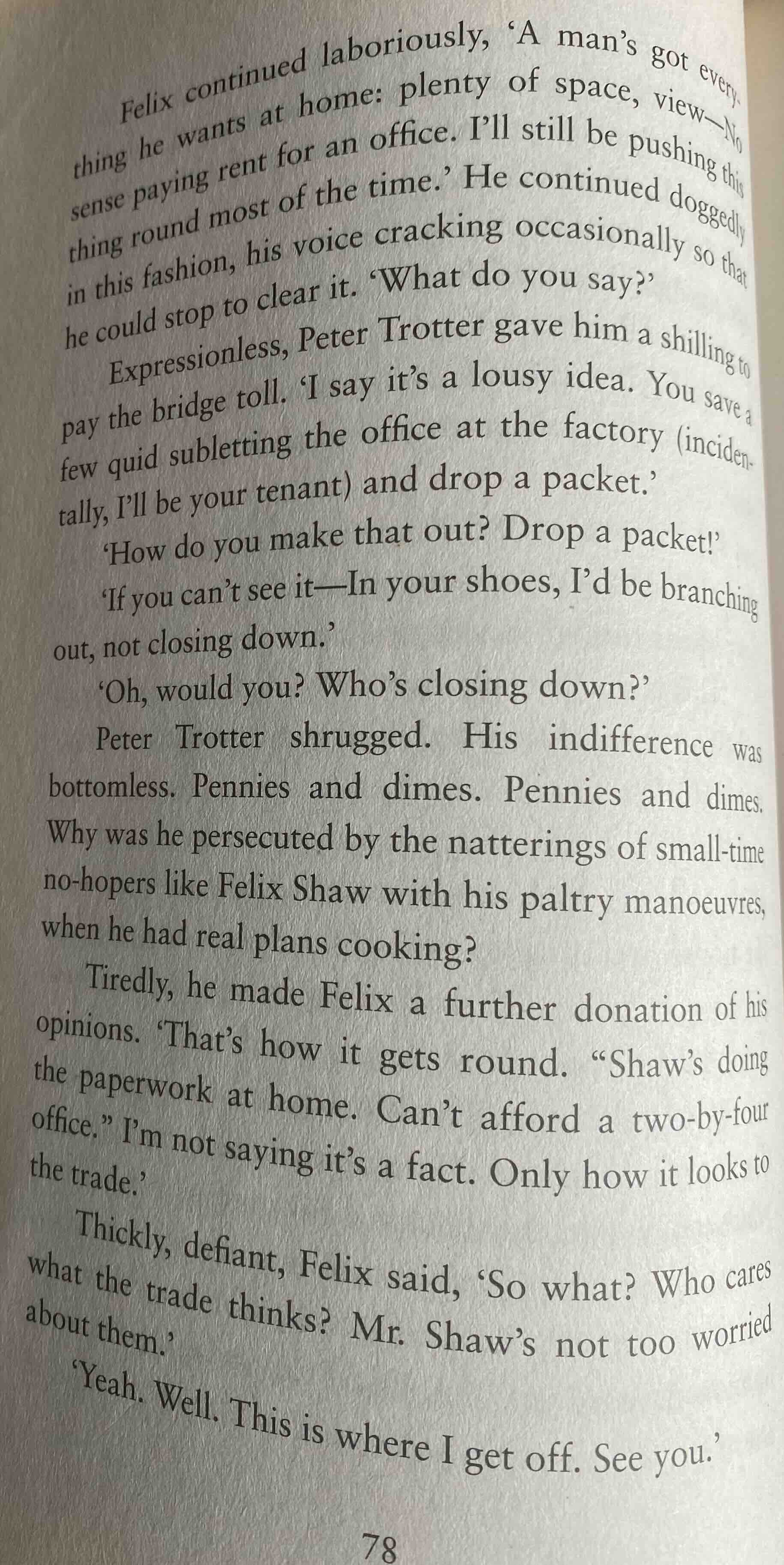
Most of the book focuses on the sisters’ wretched servitude and isolation, but the moments when we see Felix apart from them, like this one, are interesting to revisit. Here he is giving a lift in his battered old car to a former business partner, Peter Trotter, one of a string of younger men whom Felix befriends, entering into financial dealings that invariably end up with him losing money and them leaving him in their dust as their enterprises flourish.
Felix has just explained that he is moving his office from his factory to his home. At least part of his reason, we know, is to intensify what we would now call his coercive control over his young wife. After a bit of bluster, typical rationalisation of a self-destructive action motivated by weird spite, he asks Peter Trotter’s opinion. There is a minutely observed moment of the kind Elizabeth Harrower is celebrated for.
Expressionless, Peter Trotter gave him a shilling to pay the bridge toll.
‘Expressionless’ does so much work there. Even while Felix is pretending that all is well, there is this wordless abject moment when he accepts the other man’s contemptuous financial help. Then Peter offers what the reader knows is a sensible perspective, but which falls on resolutely deaf ears, while illustrating Elizabeth Harrower’s gift for vernacular dialogue:
‘I say it’s a lousy idea. You save a few quid subletting the office at the factory (incidentally, I’ll be your tenant) and drop a packet.’ ‘How do you make that out? Drop a packet!’ ‘If you can’t see it – In your shoes, I’d be branching out, not closing down.’ ‘Oh, would you? Who’s closing down?’ Peter Trotter shrugged. His indifference was bottomless. Pennies and dimes. Pennies and dimes. Why was he persecuted by the natterings of small-time no-hopers like Felix Shaw with his paltry manoeuvres, when he had real plans cooking? Tiredly, he made Felix a further donation of his opinions. ‘That’s how it gets round. “Shaw’s doing the paperwork at home. Can’t afford a two-by-four office.” I’m not saying it’s a fact. Only how it looks to the trade.’ Thickly, defiant, Felix said, ‘So what? Who cares what the trade thinks? Mr Shaw’s not too worried about them.’ ‘Yeah. Well. This is where I get off. See you.’
And that is the end of a relationship.
This page repays a close look. Felix’s reference to himself in the third person makes me realise that Harrower’s depiction of a self-involved, wildly irrational man with bombastic self-belief and demand for absolute loyalty from those he sees as his subjects is alarmingly relevant to the mid 2020s. But it also, surprisingly to me, evokes the reader’s pity for Felix: this man we experience mainly as a controlling monster is, from another perspective, a small time no-hoper with paltry manoeuvres. This pity is dangerous: though she doesn’t use such terms, Laura, terribly abused and exploited, also sees that Felix is a small-time no-hoper, a man whose sometimes alcohol-fuelled violence is born out of deep self-hatred and lack of self-confidence, and her pity for him (she does use that word) is part of what binds her to stay with him.
None of Felix’s attempts to manipulate young men into dependency succeed because on the whole men aren’t vulnerable economically and socially the way young women are in that era. Towards the end of the book, a young male employee named Bernard collapses at work and Felix ‘kindly’ takes him into his home. At last, a vulnerable man to join his toxic household! He deploys the same emotional blackmail and bewildering switches of mood to exert control over Bernard as he has used successfully on Laura, and through Laura on Clare. There’s genuine, chilling suspense: will Bernard succumb or will he escape, taking one or both of the women with him to freedom?
Evidently publicity for the first edition used the word ‘homosexual’. I didn’t pick up any hint that Felix’s yearning for young men was knowingly sexual. But there is something forlorn in the way Felix yearns for friendship with them and in his violent rages at home when they go their indifferent way.
After the meeting: There were five of us. Three had read the whole book, one had reached the 57 percent mark on her kindle, and the fifth – who was the only one to read Joan London’s introduction to the Text Classics edition – hadn’t got that far. None of us found it a pleasant read, but the conversation was interesting.
S– saw Felix as a cipher for coercive control, and admired the way the novel was an early describer of that phenomenon, about which we know so much more now. She hadn’t read Susan Wyndham’s biography of Elizabeth Harrower, which was also prescribed reading for this meeting, and was curious to know how much the book reflected Harrower’s lived experience – it was hard to believe that she didn’t have first-hand knowledge. (A couple of us were able to satisfy her curiosity.) I would have agreed about Felix as cipher if I hadn’t lingered on page 78. I think there was more to him than that, but it’s true that the narration never takes us inside Felix’s consciousness – we see mainly the chaotic vindictiveness of his behaviour.
K– thought the book was not only painful to read but was badly written. (Gasps all round!) In her view, Elizabeth Harrower’s reputation as a great Australian novelist came mainly from her friendships with members of the Australian literary pantheon – Kylie Tennant, Judah Waten, Shirley Hazzard, Christina Stead, Patrick White. (But that’s getting ahead to the discussion of the biography.)
I talked about two moments that produced a frisson in me. The first was the chilling moment when Laura, the older sister and wife of Felix, transitions from being Clare’s ally in victimhood to being his agent in cajoling/coercing her to bend to his will. I thought this was a richly complex turn in the narrative. Others just didn’t buy it. The second was when (possible spoiler alert), starting the book’s final movement, Clare decides to give up the week escape she had been planning in order to care for the ailing Bernard. The profound ambiguity of this moment made the book come alive for me: Clare sees herself as being able for the first time to make a difference to someone else’s life, and is decides to do it with a sense of elation; but the reader sees that for years she has been coerced into putting her own needs aside to attend to Felix’s whims, and it’s simply impossible to tell whether what she sees as her new dignity isn’t a variation on the servitude she has been enduring. In my reading the remaining pages are animated by that ambiguity, and the resolution (no spoilers this time) is perfect. S– thought there was no ambiguity at all: she was just falling into the same trap with a new man.
The conversation moved on to Susan Wyndham’s Elizabeth Harrower: The Woman in the Watch Tower, about which I will blog next.
The Book Club met on the land of the Bidjigal and Gadigal clans of the Eora nation, overlooking the ocean. I wrote the blog post on Wangal and Gadigal land sheltering from unusual summer heat. I gratefully acknowledge the Elders past and present who have cared for this beautiful country for millennia, and welcome any First Nations readers of this blog.
* My blogging practice is to focus on the page that coincides with my age, currently 78.