
Katharine Murphy, Lone Wolf: Albanese and the New Politics (Quarterly Essay 88, 2022)
– plus correspondence in Quarterly Essay 89
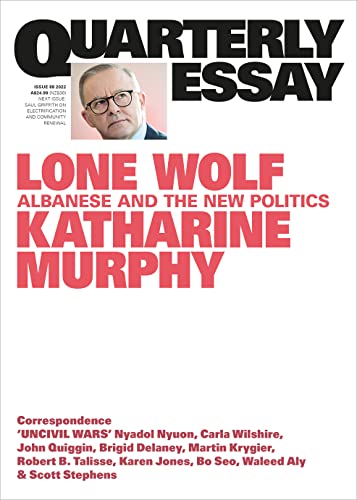
Katharine Murphy is Guardian Australia’s political editor. I always find her political commentary enlightening, and it’s a pleasure to read this Quarterly Essay, where she does a terrific job of making sense of what happened at the May 2022 federal election, which ended a decade of Liberal–National Coalition government, ousted Scott Morrison from the prime ministership, replaced him with Anthony Albanese and an Australian Labor Party majority, and increased the cross benches significantly.
A good half of the essay is devoted to the Albanese story, in particular the way he developed from the ‘lone wolf’ who once said he was in the parliament to ‘fight Tories’, to the man who, having decided he wanted to win the prime ministership, became a great unifier and team leader. Albanese’s starring offscreen role as ALP heavyweight in Robin Anderson and Bob Connolly’s excellent 1996 doco, Rats in the Ranks, gets a passing mention, but the Albanese who emerges into the spotlight in this essay is not so much a heavyweight as a lightfooted dancer, always with a plan.
The essay also, as announced in the second part of its subtitle, describes how Climate 2000 provided resource to a number of independent candidates (the so-called Teals), and how their electoral success, along with that of the Greens, has changed the nature of Australian parliamentary politics.
Page 76* is part of a short section subtitled ‘Big Tents and Unifying Theories’. The section begins by explaining that Australia’s major political parties are ‘big-tent actors’. The ALP and LNP Coalition each embrace a wide range of perspectives but, unlike the major political parties in the USA, have tight party discipline: they ‘model the reality that deliberation and compromise can lead to progress’. The section goes on to ask how these parties will respond to ‘political disrupters’ like the Teals and the Greens, as well as Pauline Hanson and Clive Palmer’s parties, that tend of offer uncompromising positions (as I was drafting this I saw a Greens poster for the NSW election: ‘All Pokies out of Pubs and Clubs’). The section warns against making firm predictions on the basis of Grand Unifying Theories; it hopes that Peter Dutton’s opposition will aim to (re-)build a diverse electoral community rather than allow its extremist rump to call the shots; and it ends with a line from elected independent Zoë Daniels, not necessarily quoting Bob Dylan on purpose: ‘Something is happening here.’
Katharine Murphy has a terrific ability to explain complex issues in memorable language, and she doesn’t indulge in pseudo-objective ‘balance’. Here are some bits from this page:
Democratic parliaments are not iTunes or Spotify. Citizens can’t curate their own playlists. Parliaments cannot possibly reflect the will of every individual citizen. They model the art of the possible.
…
In the positive, disrupters mirror the gnawing hunger among engaged people for a more perfect democracy as a bulwark in uncertain and dangerous times. In the negative, the mirroring engages with voter grievance or alienation.
…
Not every minority parliament will function as cooperatively and productively as the Gillard parliament, because not everybody enters politics to get things done.
…
There is a school of thought that Coalition governments – particularly Abbott’s and Morrison’s – existed largely to stop Labor doing things rather than to do anything much themselves.
As usual with the Quarterly Essay, the correspondence in the following edition casts further light on the argument, some disagreements, some amplifications. The first response is from Christopher Pyne, whom Katharine Murphy describes as ‘another wily factional veteran’ and Albanese’s friend and rival. He is sceptical about any ‘new politics’ – and sees politics as still, and always, about winning and losing. Michael Cooney, among other things a speech writer for Julia Gillard, has interesting things to say, but I am gratified that he also notes Katharine Murphy’s gift with a telling phrase – he says she ‘saw the election in haiku’.
Perhaps the most interesting piece of correspondence is from Simon Jackman, one of the principal investigators of the Australian Election Study. This study has surveyed a representative cross section of the electorate after every federal election since 1987 and, Jackman writes, is ‘an authoritative source for assessing what is “new” about the new politics’. Mostly he cites data that validates Katharine Murphy’s analysis. The data especially puts a rocket under the notion that Scott Morrison’s unpopularity played a role, showing him to be the least popular PM or Opposition leader ever seen in AES data. The information about ‘new voters’ is also interesting: ‘Only about 1 in 4 voters under the age of forty report voting for the Coalition in 2022.’ [Someone on the NSW election commentary last night said 1 in 5 millennials do so – presumably a version of the same research finding.]
Katharine Murphy’s response to correspondents is gracious and generous. It ends with a postscript correcting a minor factual error. That postscript leaves the final word to Dr David Champion, the rheumatologist who attended Albanese’s mother: ‘Young Anthony was an inspiringly good son from my perspective.’
The essay isn’t hagiography, but you do come away from it with a deep respect for Anthony Albanese, and a sense that Katharine Murphy likes him.
* Currently when blogging about books I have a policy of taking a closer look at page 76, chosen for the arbitrary reason that it’s my age.


 Me fail? I fly!