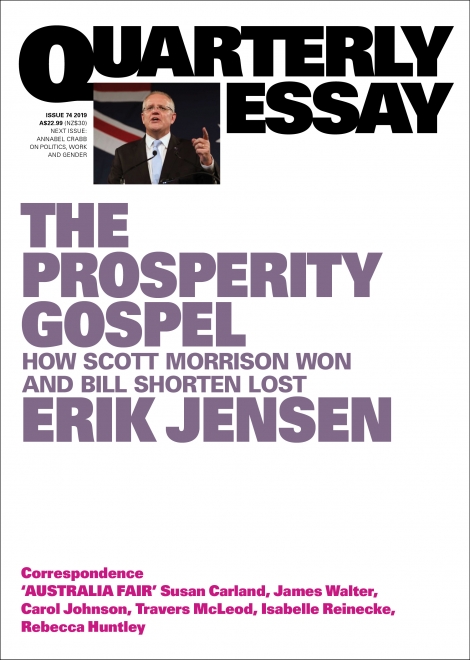
Erik Jensen, The Prosperity Gospel: How Scott Morrison Won and Bill Shorten Lost (Quarterly Essay 74), plus correspondence from QE 75
I approached this Quarterly Essay with reluctance. Did I really need another inside-baseball, after-the-event reading of the tea-leaves about the May federal election? That’s how I felt when the essay came out, and my already-faint enthusiasm has only waned since. But I did read it, three months after the event as has become my custom.
It’s mercifully short. It consists mainly of finely crafted snapshots, mainly of the party leaders in action, from both sides of the election campaign with occasional snippets of commentary, and no sustained argument as such. An essay for the distractible perhaps. Or one that met an impossible deadline, to be published within weeks of the events it deals with. That’s not to say it lacks insight (‘Bill Shorten’s gamble is that you can replace popularity with policy’). But it’s impressionistic rather than discursive, and narrative rather than analytical. It was written on the campaign trail. Bill Shorten gave a generous interview; Scott Morrison refused to be interviewed. There’s no doubt which of the two men emerges as the more likeable, but he is the one who is accorded the most devastating summing-up:
The great truth of Bill Shorten is that he doesn’t know himself. He hasn’t settled his character.
Morrison on the other hand, though his religious belief and his deep commitment to his family are noted, is described in the essay’s final words as ‘a hardman who says everything is simple and some of you will be okay’. Both those summations are beautifully concise, and they’re far from stupid, but neither is justified by the essay that precedes them.
It’s a strange essay, reading sometimes like diary notes from the campaign trail: along with the oft-seen moments like Morrison’s Easter observance, speeches are summarised, mostly without comment; we’re told what books people carry in their luggage; there’s a scattering of off-the-cuff witticisms from staffers; the behaviour of the wives of both candidates is described; sometimes unrelated passers-by are mentioned.
Much of the narrative simply sits on the page, without resonance or further implication that I could discern. An outstanding example is in the account of Morrison emerging from a Healthy Harold igloo (part of a program of health education for children):
Morrison rolls his shoulders when he stands. The tail of his tie not quite to his sternum. He has taken off his jacket: his paunch is oversatisfied and his nipples are erect
(page 48)
This reminded me of a piece by Mungo MacCallum in the Nation Review some time in the early 1970s. Describing Gough Whitlam emerging from a swimming pool, he commented that the honourable gentleman appeared to be very well endowed. That was funny in a transgressively adolescent way, and it chimed with the writer’s clear view that Gough was an attractive big man in other ways as well. Here, the point of mentioning the state of Morrison’s nipples, if there is one, seems to be to tell us that the writer was very close to the action and noticing details, however meaningless. The length of his tie doesn’t even have that, and what does the personification of Morrison’s paunch even mean?
In fact, as a guide to understanding what happened in the election, the essay is eclipsed by the 25 pages of correspondence about the previous Quarterly Essay, Rebecca Huntley’s Australia Fair (my blog post here), which offer a number of interesting and plausible hypotheses about how the progressive-leaning population described so convincingly by Huntley could have delivered the result when it acted as an electorate.
And now perhaps the existence of Jensen’s essay is justified by what turns out to be an excellent correspondence about it at the back of QE 75 (Annabel Crabb’s Men at Work, which I look forward to reading in three months’ time).
Shorten’s speech writer, James Newton, gives an unrepentant insider’s account of Shorten’s campaign, including his now-near-forgotten town hall meetings. Journalist David Marr and scholar Judith Brett offer their analyses. Barry Jones offers the perspective of a grand old man of the ALP. Elizabeth Flux tells us what she learned from being ’employed as a subeditor with a focus on Australian politics’ throughout the campaign, Kristina Keneally writes interestingly about the possible role of religious background. Patrick Mullins & Matthew Ricketson offer historians’ insights. Lawyer Russell Marks gestures towards ‘the deep structures operating through Australia’s political and electoral systems’.
These contributions mostly include evidence that they have read Jensen’s essay. Some of them actually grapple with it, as distinct from using it as a launching pad for their own commentary. Here are some quotes to balance my own underwhelmed response:
James Newton: ‘Instead of wasting words on pseudo-psephology, Erik Jensen gives us telling sketches of the two major-party leaders, their campaigns and the choices Australians faced and made.’
David Marr: ‘The drift of the press is to cut everything short. This guts argument. … The great pleasure of The Prosperity Gospel is to be immersed in the language of the campaign and reconsider the state of politics in this country knowing that what was dismissed as blather in those weeks worked so well on election day.’
Elizabeth Flux: ‘The Prosperity Gospel helped me understand why I found the election result so difficult to come to grips with. It wasn’t that “my team” didn’t win. Or that I liked Shorten more. It’s because it wasn’t a case of one side’s policies winning over the other’s. People were happy to vote for no policies at all, because we’d rather have a strong man selling nothing than a quiet one trying to make changes which he truly believed were for the better.’
Kristina Keneally actually engages critically with the essay, finding it unsatisfying in three areas: ‘First, while Jensen introduces the distinctly different religious foundations for each leader’s policy and political approach, he does not wrestle with what it means that Australia voted for one over the other. … Second, Jensen’s profiles of Morrison and Shorten are incomplete, or at least unbalanced. … Third, he could have explored the role religious affiliation and identity played in the election.’
Patrick Mullins & Matthew Ricketson wonder on paper if people will still go to this essay for insight in the future, say in the lead-up to the 2019 election. They argue (unconvincingly in my opinion) that they should.
Russell Marks laments that while the essay’s subtitle promises an explanation for the election result, ‘Jensen never really expands beyond what is mostly a literary answer.’ He goes on to speak, not quite disparagingly, of political journalists making ‘literary attempts to match leaders’ characters to the nation’s and to find in the intersections why publics endorse one leader and not another’, and then speaks quite disparagingly of ‘armchair psychoanalysis’, though he doesn’t accuse Jensen directly of that.
Tellingly, Jensen’s ‘Response to Correspondents’ ignores them all and makes some observations on what has happened in the months since the election.



 Me fail? I fly!