Tag Archives: Niki Savva

Lech Blaine’s Bad Cop

Lech Blaine, Bad Cop: Peter Dutton’s Strong Man Tactics (Quarterly Essay 93, 2024) – plus correspondence in Quarterly Essay 94
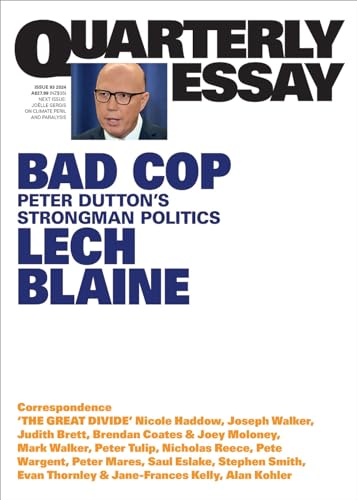
Peter Dutton eats bleeding-heart lefties for breakfast. He is tall and bald, with a resting death stare. His eyes – two brown beads – see evil so that the weak can be blind. His lips are allergic to political correctness. Peter preaches the gospel of John Howard with the fanaticism of Paul Keating. He wants to do the Labor Party slowly, slowly, slowly, and defeat the woe-is-me heroism of identity politics.

That’s the start of this Quarterly Essay, and it was nearly enough for me. Life’s too short and the times are too perilous, I thought, to indulge in another witty hatchet job on a dangerous politician. And I was grumpy with a heavy cold.

But I persevered, partly out of a QE completist compulsion but also because I’d heard Lech Blaine talking to Richard Fidler on the Conversations podcast (link here), where he said some interestingly complex things about Dutton.

Much of the essay, it turns out, is a slog. It follows the ins and outs of Dutton’s life and career, along with the vicissitudes of the Liberal Party and Queensland’s Liberal National Party and the internecine leadership struggles on that side of Parliament over the last 40 years or so, with occasional glimpses at what’s happening in the ALP. Blaine has done a shedload of research, including many interviews with key players and interested observers. There’s far too much going on to enable a coherent narrative, and that’s not counting the brief look at Dutton’s squatter ancestors who were in the tiny minority of their class who stood up for First Nations in Queensland.

The reader is never left in any doubt that Blaine doesn’t like Dutton or his politics – and Dutton has thoughtfully provided a steady stream of pithy quotes to justify those dislikes.

In Blaine’s account, everything Dutton says and does is calculated for its electoral usefulness, but at least some of his outrage has a germ of personal truth to it. His projected identity as a Queensland copper, unlike Scott Morrison’s ‘ScoMo’ persona, is based in actual experience, specifically his nine formative years in the Queensland police force. He was genuinely affronted when someone on Twitter called him a rape apologist, as his dealing with horrific instances of rape as a policeman had been a major formative experience. It’s not just a matter of convenience that he doesn’t spruik his subsequent decades as a property wheeler and dealer, even though that experience, that unacknowledged identity, lies at the back of many of his policy positions.


The correspondence in Quarterly Essay 94 kicks off with a brief, resounding endorsement from Niki Savva, the Queen of Liberal Party Coverage. Encapsulating much of Blaine’s essay, she says, ‘I call Abbott Terminator One and and Dutton Terminator Two.’ Thomas Mayo underlines Dutton’s role in defeating the Voice referendum, quoting Noel Pearson: ‘A heartless thing to do – but easy.’ Other correspondents join the argument about Dutton’s strategy to become the next Prime Minister – interesting, but largely ‘inside baseball’ discussion.

Paul Strangio, an emeritus professor in politics who is currently working on a study of ‘Australia’s best prime ministers’, add some interesting perspectives. He reminds us of that other Queensland copper who was leader of the Federal Opposition, Bill Hayden:

Despite the similarities in their back stories, the differences between Hayden and Dutton could hardly be starker. Arguably, the contrast is a disturbing marker of the degeneration of the political class across generations, of the retreat from a milieu of enlightened social-democratic optimism to irrational conservative populist pessimism, and of the decline of a political sensibility of compassion and empathy to one of stony-heartedness.

Strangio reminds us that Dutton’s strong man approach to politics is part of a planet-wide phenomenon. And he puts his finger on the thing that I experienced as a vague discontent with the essay. Blaine’s view of Dutton, summed up in his final words – ‘Tall and strong at first glance, but when you watch him for a long time, you can see that the man is small and scared’ – isn’t strongly substantiated. The reader is left with the suspicion that it ‘springs as much as anything from a distaste for his subject, a distaste that he struggles to disguise’.

I agree. This essay works brilliantly as a reminder of the many ways Peter Dutton has shown himself as the ‘strong man’ of the Australian parliamentary right-wing, there are hints of how he got to where he is, and a persuasive account of his current campaign to become prime minister, but Dutton the breathing, feeling man remains a mystery.

SWF 2023: My sixth day

Another early start with 10–11 am: Barrie Cassidy & Friends: State of the Nation

Veteran journalist Barrie Cassidy has been a regular at the Sydney Writers’ Festival, but this is the first time I’ve been to one of his sessions. He was on stage with what the festival program calls ‘his hand-picked squad of the country’s sharpest pundits’: Amy Remeikis, Niki Savva and Laura Tingle. They’re all regulars on current affairs TV, but I don’t think I’d seen any of them in person before.

The subject was politics, that is to say mainly electoral politics and the state of the major parties. The most telling comment was towards the end when Barrie Cassidy said, ‘When there’s consensus between the major parties, the media doesn’t chase it up.’ This means that the press doesn’t do a lot of interrogating of the AUKUS deal – is it actually in Australia’s interest or is it a matter of us serving the interests of the UK and the US? Similarly, coverage of climate issues through a party-political lens can often miss the point.

Nikki Savva’s subject seems to be the Liberal party. She sees the current dominance of Labor in Federal parliament and in all mainland states is largely due to the decline of the Liberals as a fighting machine and also as representative of a population. They are ceasing to be an effective opposition, or even an opposition at all. Peter Dutton’s survival strategy depends on three things: the failure of teh referendum on the Voice; an economic crash; and the rise of intolerance. Hard to cheer for him, then, and she says many dyed in the wool Liberals can no longer bring themselves to vote for what the party has become since Howard.

Amy Remeikis, introduced by Barrie Cassidy as political correspondent for The Australian much to the amusement of the Guardian readers in the audience, thought Labor’s ascendancy had something to do with changing demographics. Millennials now outnumber boomers, and in addition to the tendency of people to be more progressive when young, there’s the fact that life is particularly tough for the young these days.

Laura Tingle added that politics tends to go in cycles. This is Labor’s time for dominance, it was at rock bottom in 2014.

All agreed that there is a growing disconnect between the political class – politicians, political journalists, people who turn up for panels like this one – and the rest of the community. People are doing it hard, inequality is bigger than it’s ever been, our sense of common life is being eroded (not as badly in the USA, yet). Things are better than they were before last year’s election. The people in charge now are there with good motives, but business as usual could lead to disaster. We need grown-up conversations about tax and climate policy, and we’ve got a way to go for that.

A non-party-political subject that got some airplay was the recent resignation of Stan Grant after he was subjected to vicious and sometimes racist attack for giving a Wiradjuri perspective on the British Crown. Laura Tingle, as recently elected member of the ABC’s Board, said she had been out of action for a couple of weeks because of a bereavement, but deeply regretted Stan’s lack of support from management and the Board.

I haven’t ever watched Insiders, which used to be Barrie Cassidy’s Sunday morning show on the ABC. I imagine this was a slightly generalised version of that. One of the questions at the end referred to the fact that over a number of years not one non-white panellist had appeared on that show (the questioner didn’t need to point out that all the panellists today were white). Barrie did the only thing he could do and said it had been a mistake.


11 am: Osman Faruqi on Australia’s War Against Hip Hop

I listened to this Curiosity Lecture almost by accident. I know almost nothing about hip hop, and I guess I skip over headlines saying that it has been banned in venues including Sydney’s Royal Easter Show.

Osman Faruqi’s exasperated plea could have been meant specifically for me: ‘For once, listen to some art that doesn’t come from Bondi or Balmain.’ (Though, to be honest, I don’t know when I last listened to music from either Bondi or Balmain.)

He told us that NSW Police have taken steps to ban particular hip hop performers saying, nonsensically, that their music is used to ‘procure’ members for criminal bikie gangs etc. This censorship, he said, is ‘the greatest example of artistic suppression in Australia’s history’. If Nick Cave, who is white and part of the music establishment, sings about murdering every woman he sees, no one bans his song as inciting murder. When Bill Henson’s photographs are taken down, there’s an outcry. But if a brown rapper uses violent imagery they are banned from performing and police have their videos removed from YouTube, and there is resounding silence from the art world, including from successful white rappers.

Showing my age: in the 1970s the campaign against censorship focused on erotic material, because the banning of material deemed pornographic (the famous example if Lady Chatterley’s Lover, but Norman Mailer’s Why Are We in Vietnam was also banned). You don’t have to love pornography or be a fan of drill-rap to be uneasy about what’s happening now


12–12.30 pm: Beginnings: Remembering Robert Adamson and Frank Moorhouse

There were a number of ‘Beginnings’ sessions. It’s a nice idea: people read the beginnings of their favourite books, or perhaps their own books, on the assumption that writers put a lot of attention to their opening paragraphs.

This short session used the format to honour Frank Moorhouse and Robert Adamson, who both died in the last 12 months. I wonder if it would be an idea to plan a couple of elegiac sessions along these lines for every Writers’ Festival. Spaces could be left blank for people who die too late to be included in advance publicity. John Tranter, who died on 21 April this year, might then have been honoured.

As it was, Annabel Crabb and Mark Mordue read to us.

Annabel read the opening pages of the first two ‘Edith’ books, the first line of the third, and then the final pages, Edith’s death scene, from Cold Light, the third book. It was shockingly good.

Mark Mordue opened with a letter found in Adamson’s papers in which Frank Moorhouse responded warmly to one of Adamson’s poems. He spoke briefly about Adamson’s life, including his time in prison, his drug addiction and the role of his wife Juno Gemes. He finished with a poem that Adamson wrote for her, ‘The Kingfisher’s Soul’, which Adamson himself read at at least one previous Sydney Writers’ Festival. It ends:

_________________________ the future awaits you.
I stepped into the day, by following your gaze.

I want to make a final small observation about acknowledgements of country.

My initial prompt for this was an acknowledgement that was gobsmackingly perfunctory: the presenter didn’t look at us, but read hurriedly from a clipboard, stumbling slightly over the words. Disrespect may not have been intended, but it was certainly there.

I started to notice how other presenters made their acknowledgements personal. For example:

  • Michael Williams spoke briefly of how the land was unceded and so the issue of sovereignty was unresolved
  • Omar Sakr noted that some people object to the acknowledgements and responded that words – words like ‘genocide’ and ‘sovereignty’ – matter, that words give rise to actions
  • Sisonke Msimang made acknowledgement first in her own mother tongue and then in English
  • Felicity Plunkett quoted two lines about the power of country from First Nations poet Ellen van Neerven
  • Barrie Cassidy drew our attention to the coming referendum on a First Nations Voice to Parliament.

I was born on Mamu land in what is now North Queensland, and my father remembered as a child hearing ceremony down at the river behind our place. I’m writing this on Gadigal-Wangal land. Both places make my heart sing.

And the Festival is over, bar the podcasting.