
Kenzaburō Ōe, Death by Water ( 2009, translation by Deborah Boliver Boehm 2015)
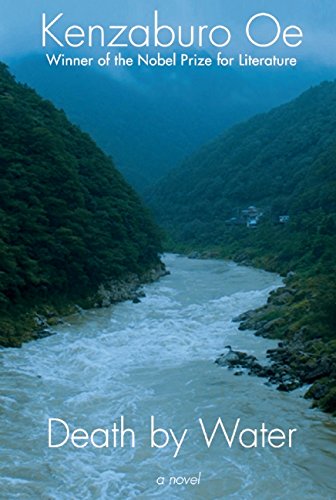
Before the meeting: In flagrant disregard for established practice, our current Designated Chooser nominated two titles, to be read for successive meetings. The first, Edward Said’s On Late Style, was not exactly a triumph (the link is to my blog post), though it has been working away in the back of my mind ever since I read it. This is his second pick.
Kogito Choko is a writer in his eighties who revisits his childhood home with the intention of writing a novel about his father’s death by drowning when he was a child. What he thinks of as ‘the drowning novel’ had been one of his earliest projects, which he had laid aside because his mother wouldn’t give him access to the red trunk that his father had with him on the fateful night. Now, ten years after his mother’s death, the chest is released to him. An experimental theatre group who are passionately interested in his work are developing a project that will involve a dramatisation of his complete works, and hope to incorporate the process of writing the long awaited drowning novel. The theatre group has a signature audience-participation process featuring soft toy dogs and vigorous disagreements.
That’s the set-up. Nothing goes to plan. At one stage a character describes Mr Choko’s recent novels as ‘serial slices of thinly veiled memoir’, and that isn’t a bad description of some aspects of this one.
Kanzburō Ōe has a lot in common with his protagonist: same age, same childhood locality, same artistic medium (though Mr Choko doesn’t seem to have won a Nobel Prize as Ōe has), several novels in his back-catalogue with the same names. According to Wikipedia, Death by Water is Ōe’s sixth novel featuring Kogito Choko and his brain-damaged son Hikari (Ōe’s own brain-damaged son is named Akari). The novel’s imagined reader probably knows all this: I’m coming in very late, so shouldn’t complain if I feel disoriented at times. Which I do.
The novel progresses in an apparently haphazard way. The drowning novel is abandoned (a development it took me many pages to accept) and Mr Choko is persuaded to help write the script for the theatre group’s new project. A different theatre production is described in great detail. His wife is hospitalised and pretty much disappears from the book. He has a terrible falling out with Hikari and the problem of how to provide for Hikari’s needs remains on the agenda until the end. Key characters turn up well after the midpoint of the novel. The final movement deals with historical and remembered rape, incest and abortion – issues that have hardly even been hinted at earlier. It feels like one damned thing after another.
We learn about much of the action by way of letters to Mr Choko or conversations with him. Many words are spent describing theatrical performances and interpreting dreams and poems, though some of the dreams, we’re told, may actually be memories even though they involve a flying boy. Other characters tend to talk at Mr Choko, often offering him unflattering analyses of his personality or work, and they keep on talking in the absence of any verbal response, even one meant only for the reader. Mr Choko is asleep during the dramatic climax, and when his sister tells him (and us) what has happened she can only infer the action from what she has heard and overheard. The very final moments are Mr Choko’s imaginings of what might be going to happen.
At times it was like watching one of those Japanese movies that you can’t take your eyes off but which leaves your Western mind floundering.
My ignorance of Japanese history is part of the problem. Two historical uprisings feature strongly. The theatre group’s project is a stage play based on a film about an uprising during the Meiji Restoration, led by weeping children and warrior women. And Mr Choko’s father was involved in an ultra-nationalist plot to kill the emperor after the end of World War One. The incest-rape-abortion theme is linked to the first of these, and has a definite, though unclear to me, political meaning.
There’s also something about the tone of the writing that doesn’t travel well. For example, Masao, the artistic director of the theatre group, asks Mr Choko to reply to a questionnaire to help with the theatre project. What follows is several pages in which Masao delivers a series of monologues expounding on Mr Choko’s creative intentions and mental states at various points of his career. At the end of each monologue Mr Choko replies briefly to say, ‘Yes, that’s correct,’ ‘That’s exactly right,’ ‘You may very well be right about that, too,’ and so on. In a movie, no matter how deadpan the performance, this would be comic. But it’s just not funny on the page. Something isn’t translating.
But I’m not blaming the translator. I was disconcerted by a number of US-isms: a mention of a character’s ‘trail of tears’, for example, had me wondering why Ōe was referring to that terrible event from US history, until I realised he probably wasn’t. But other unsettling language is most likely just as unsettling in the original. I had to return my copy to the library so can’t give examples, sorry.
Mr Choko plans to write a book in a ‘catastrophic late style’ à la Edward Said (who was a friend of his), and perhaps this is Ōe’s version of the same. Perhaps this is Ōe’s ‘drowning novel’.
Having written a first draft of this blog post, I re-read the last ten pages of the book before returning it to the library, and realised that for all the book’s opacity and apparent incoherence, it does hang together. It comes back again and again to the main image of Choko’s last contact with his father, just before the father drowned. The boy’s unresolved feelings about that moment are the novel’s engine, echoed by a young woman’s need for resolution about her experience of rape and incest: it’s a tortuous, and tortured, path for both of them, but in very different ways they each find some sort of resolution.
After the meeting: There was a terrifying moment when it seemed out host, who was also the Designated Chooser, wouldn’t be able to come to the meeting because of a family crisis. Happily – both in terms of the crisis and for the good of the group – he did turn up, and was able to deal with our general bafflement with lucidity and grace.
But first: my bafflement was generally shared. One man said that he had never experience so strongly a sense that he and a book were travelling along separate, parallel lines. His partner got exasperated with his moaning and told him to abandon it and read A Gentleman in Moscow by Amor Towles instead – advice he was happy to follow. He wasn’t the only one to jump ship.
Our host agreed that some elements of the book were mystifying, but they didn’t determine his response. For him it worked as a comedy – the protagonist is an unreliable narrator, who thinks of himself as a distinguished novelist, perhaps a national treasure, but is in fact pretty much a has-been: the theatre group, which he thinks of a celebrating his legacy, is actually using his work as a springboard for something very different – devoted though they may be. He is managed by the women in his life – his mother, his sister and his wife; is useless at dealing with his son’s difficulties. And alongside this comic aspect, our host was enthralled by the way the images of forest and water are woven through the book, so that he was thrilled by the final moments (which I felt were clumsy and arbitrary).
I don’t know that he persuaded any of us to go back and reread the book, but it was a wonderful to have someone lay out a very different response to a book. One of us would say, ‘But what do you make of [blah blah]’. ‘Oh that,’ he’d say, ‘that’s something from Japanese culture.’ It’s no good argung about taste, as my Latin teacher used to say (but in Latin, De gustibus non est disputandum), but you can definitely learn a lot from talking about where different tastes take you.


 Me fail? I fly!