Tag Archives: Overland

Ordinary Affects

Kathleen Stewart, Ordinary Affects (Duke University Press 2007)

This starts most inauspiciously:

Ordinary Affects is an experiment, not a judgement. Committed not to the demystification and uncovered truths that support a well-known picture of the world, but rather to speculation, curiosity and the concrete, it tries to provoke attention to the forces that come into view as habit or shock, resonance or impact. Something throws itself together in a moment as an event and a sensation; a something both animated and inhabitable.

Whooee! It’s going to be a rough ride, with tortured syntax, unconventional semicolons and words that don’t seem quite to mean what one would expect. It doesn’t get any more comfortable, but I persisted because it was a Book Club book, and Book Club books are meant to take me places I wouldn’t necessarily go if I just followed my nose.

A couple of pages in, I decided that even though this is a scholarly work, probably belonging to the discipline of postmodern anthropology, I lack the background to be able to read it in a scholarly manner. Instead, I let it kind of break over me. I read it as if it was poetry. And I enjoyed it. I can’t tell you what it’s about, mind you. It abounds in anecdotes, ranging from a pleasant but odd encounter in a check-out queue to horrific violence, bizarre plane travel incidents to odd things seen from the car. It offers fascinating reflections on public responses to big events – the OJ trials, the Columbine shootings, child care sex abuse scandals, nuclear waste disposal, 11 September 2001. It positively bristles with gnomic utterances that would make great epigraphs for poems (‘The ordinary can turn on you,’ or ‘Dream meets nightmare in the flick of an eye’) or citations in other scholarly works (‘Like a live wire, the subject [which I think here means a person] channels what’s going on around it in a the process of its own self-composition. Formed by the coagulation of intensities, surfaces, sensations, perceptions and expressions, it’s a thing composed of encounters and the spaces and events it traverses or inhabits’).

By chance, the first thing I read after finishing this book was Raewyn Connell’s characteristically incisive essay in the current issue of Overland, in which she says:

Any system of doctrine, any powerful concept, becomes in time an excuse for not thinking: Marxism, radical feminism, deconstructionism, post-colonialism, the lot. … We need harder thinking, not fluffier thinking, about social reality – and that includes rethinking the ideas earlier generations of socialists worked with.

I think Kathleen Stewart would agree with that (even while, being from the US, she might flinch at the word ‘socialists’), but Ordinary Affects deals in something that precedes thought: ‘The ordinary can happen before the mind can think.’ (Let me share with you the pleasure I felt in using that limp word ‘something’ here. It’s a word that Stewart uses often and interestingly, usually in the phrase ‘or something’, as if to insist on the provisional nature of her thinking.) Before we can rethink, we need to re-see, and re-feel, re-attend, and at least part of what Stewart means by ‘ordinary affect’ is what happens when we pay attention, how we integrate, or not, the many influences on our perception, our emotional responses, our unreflective thoughts.

I found myself remembering the only lines I know from the US poet Muriel Rukeyser:

PAY ATTENTION TO WHAT THEY TELL YOU TO FORGET

The capitals are hers.

If I get a chance I’ll re-read this book, though I expect it will be a matter of letting it break over my head again.
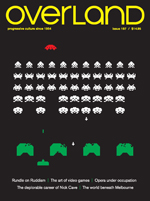
Recent journals (2) – Overland 197

Jeff Sparrow (ed), Overland issue 197 (OL Society December 2009)

overland 197I initially intended to write a single post about the three journals that arrived in my letterbox this month, but after rabbiting on about Heat at such length I decided I’d better split them up.

In a world where passionate anti-Communist Robert Manne  has been described as a preeminent lefty, there’s clearly a crying need for Overland, whose Communist Party origins flutter from its masthead in the slogan, ‘Progressive Culture since 1954’ (and smirk on the back cover in a quote from The Australian describing it as ‘loopy-Left’). Even before the recent online Subscriberthon I’d been thinking of subscribing – I loved (and blogged about) the biography of Guido Baracchi, Communism: a Love Story, written by current editor, Jeff Sparrow, and I have been a freeloader (ie, online reader) for some time.

After the mainly elevated austerity of Heat, Overland‘s direct speech is refreshing. You won’t find essays here that begin as dauntingly as ‘It was while reading Jean-Paul Sartre’s monumental study of Flaubert, The Family Idiot, that I fell into an “epileptiform” state’ or ‘I have long associated landscape with passion and solace, and with the urge to record it’. Instead, we get ‘Last Sunday I went to church to be with my father, to say goodbye,’ or ‘Sometimes in life you get lucky.’ Not that the Overland pieces lack heft. The former introduces ‘My Father’s Body‘, Francesca Rendle-Short’s moving and, for my money, profound essay on her relationship with her father who has Alzheimer’s. The latter leads in to Fiona Capp’s ‘The Lost Garden‘, an extract from her My Blood’s Country, which promises to demonstrate Judith Wright’s continuing relevance (‘These hills and valleys were – not mine, but me …’).

There is some engaging fiction, some punchy argument (a trenchant go at Nick Cave, who is a closed book to me so I don’t mind one way or the other), short reviews, engaging essays (Sophie Cunningham, just popping over from Meanjin, visits the drains of Melbourne; Thomas Rye visits an island in Arnhem Land), a swathe of poems. There’s nothing I recognise as loopy-Left, though there are two very interesting articles – one on Ruddism and the other on education as export and its relationship to border control –  written in learned-Left language that makes for hard going (‘The CFMEU and other Left trade unionists wish to increase control of the borders of their labour markets at the point of intersection with the borders of the nation, and definitions of “Australians”‘).

The whole content is available online. I’ve linked to the articles I particularly liked.
—–
I’ve been lamenting the frequent copy-edit and/or proofing mistakes in Heat for a while. I kept my carping eye peeled for Overland as well. Interestingly enough, although Overland doesn’t include a credit for a copy editor (as Heat does), it doesn’t have anything like the same incidence of irritating and sometimes perplexing mis-edits and typos. There is a spot where lay and laid are used in place of lie and lay , but as this happens consistently over a number of paragraphs I’m willing to put it down to a difference of opinion (in which, of course, they are completely wrong!) rather than sloppiness or ignorance.

Shuttling wind

I’m genuinely sorry that Quadrant‘s Literature Board grant has been cut. Quadrant is one of a tiny handful of publications that has actually paid me money for stuff I’ve written. But Keith Windschuttle doesn’t do anything for his reputation, such as it is, for distinguishing between verifiable fact and self-serving opinion or even pure invention when he asserts, ‘This Literature Board has made a patently political decision.’ He characterises Meanjin, Overland and Australian Book Review as ‘overtly left-wing publications’ and asserts that they carry only a fraction of Quadrant‘s literary content.

Well, Meanjin and Overland may come out less frequently than Quadrant, and Overland may be described in the pages of The Australian as loony left. But for what it’s worth, I think Windschuttle is blowing smoke. I’m most of the way through the current Overland, and at a rough count I’d say all but 10 of its 104 pages are taken  up with literary content, as opposed to roughly a third of the 96-page issue of Quadrant I have to hand (March 2007). If Quadrant comes out twice as often as Overland, that suggests something like 64 pages of literary content to Overland‘s 90. Of course, it depends what you call literary: I’m including an analysis of the art of computer games in one publication and some intensely political book reviews in the other. Also of course, 90/64 is still a fraction, so Windschuttle’s assertion may still be literally correct. It’s been a while since I read an issue of Meanjin. I had a look at a copy in Gleebooks the other day and was deterred from buying it by the sheer number of words: tiny type and hundreds of pages. Good luck to them whose eyes are up to  it, I thought. Windschuttle’s claim looks even less plausible there.

As for the overtly left-wing qualities, I would have thought that Overland‘s left perspective was at least as unwelcome in Kevin Rudd’s parlour as Quadrant‘s right. Overland published Germaine Greer’s intemperate criticism of Rudd earlier this year, and the current issue’s one piece of political commentary, Guy Rundle’s ‘When the rubric hits the Rudd’ (terrible title), includes this:

Ruddism is a mode of post-social democratic labour adapted to Australian conditions and history, one that displays no real interest in challenging an atomised neoliberal social order and must therefore explore increasingly specific coercive measures in the management of a population.

Yes, Keith, one can just see Kevin on the phone to his minions at the Australia Council: ‘Send that man a pile of gold.’

On being a responsible sceptic

I’ve been mulling over the weirdness of public conversation about climate change, trying to figure out what ‘sceptic’ means in this context. Mark Bahnisch  on the Overland blog and more succinctly on his home turf at Larvatus Prodeo proposes, scarily and almost certainly accurately, that ‘there is no public sphere of reason to which we can unproblematically appeal’. That means, for example, that it doesn’t advance any cause to say that denialist senator Nick Minchin also chose not to believe the science linking smoking and lung cancer, or that Tony Abbott was mildly nonplussed when a TV interviewer pointed out that the scientific paper he was quoting actually arrived at a conclusion completely at odds with the one his selective quotes appear to support. Belief does come into it. The belief that reason will triumph, Mark says, is ‘also a belief – and it’s one that will only come true if it’s fought for’.

So here’s a little tale about a man who did believe in reason.

My friend and teacher, H–, loved full cream milk. He drank a glass with every meal. He loved food fried in butter. He ate lots of ice cream. He also had heart problems – he’d had severe angina for years, then a massive heart attack and open heart surgery. When people urged him to go easy on the saturated fats because they were bad for his heart, he would – either politely or with a snarl – tell them to stop nagging him. When they said he was in denial and just didn’t want to give up his food addictions, he harrumphed that most nutrition advice in the public domain was corrupted by vested interests, and he simply didn’t trust the consensus on this matter.

Two friends who happened to be doctors realised that ‘nagging’ wasn’t going to get anywhere. It may even have been at his suggestion, in fact: they scoured the scientific literature for the major studies that established the link between heart disease and saturated fats, and presented him with a stack of paper about a foot high, saying that he should read the science for himself and then decide what made sense. One of H–’s central and most admirable qualities was his commitment to living rationally, to acting on the basis of what he reasoned out to be right rather than on impulse, on the bidding of emotion or the dictates of authority. They’d backed him into a corner. He read the literature – grumpily no doubt – saw that there was indeed strong empirical evidence that his eating was seriously risky, and became a man of salads, grilled lean meat, and just occasionally a single bite from an ice cream cone.

I cherish his example of what it means to be a sceptic – as opposed to a denialist – when the stakes are high.