
Jeannie Baker, Desert Jungle (Walker Books Australia 2023)
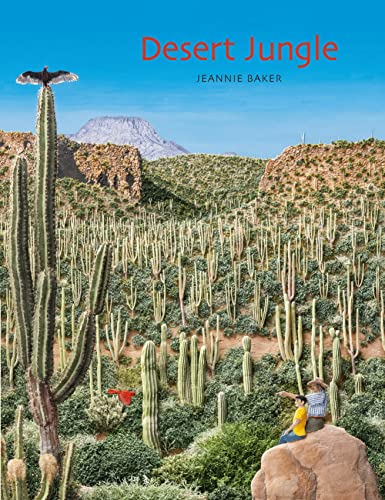
There are no books quite like Jeannie Baker’s. For four decades she has been creating picture books that are immediately recognisable as hers. Where the Forest Meets the Sea (1988) was the first one I encountered. In it, a small boy wanders through the Daintree rainforest in North Queensland. The forest is recreated in collaged materials, most of them gathered in the real-life rainforest, to stunning effect. The book is meant for young readers, but readers of all ages are intrigued and delighted by the extraordinarily detailed work that has gone into the images.
Since then, every couple of years, a new book using similar collage techniques has appeared. All of them reflect a deep concern and love for the natural environment. Window (1991) traces the changes to a rural environment brought about by urban sprawl as seen through a child’s window. The Story of Rosy Dock (1995) features a beautiful but destructive invasive weed. Circle (2016) is about migratory birds.
Jeannie Baker has made short films of Where the Forest Meets the Sea and The Story of Rosy Dock – both of which are available from the National Film and Sound Archive. And there have been many exhibitions of her original artwork.
Which brings me to Desert Jungle. I read the book at the Penrith Regional Art Gallery, at an exhibition of the collages for this book. The gallery website describes the work (and the book) in these terms:
In this new story, Jeannie explores the Valley of the Cirios in Mexico, through the perspective of a young child and his grandfather. In parts of the Valley, towering stands of Cardon Cactus – some of the largest cacti on Earth – and Elephant Trees, mix with Cirios and other unique desert plants as a ‘forest’, almost a desert jungle. These cacti and other plants form both subject and material for Jeannie, who incorporates clippings from plants in her intricate and stunning works
https://www.penrithregionalgallery.com.au/events/jeannie-baker-desert-jungle/
The collages are in effect dioramas, displayed behind perspex that is curved to accommodate their depth. Part of the fascination is to read the labels, to see that most of the images are made from parts of the plants they represent. Even, in an image of the young boy sitting with his grandfather, the hairs on the old man’s arm are actual human hair meticulously glued in place.
In the context of these wonders, the book’s story is almost of secondary interest. When the boy visits his grandfather, he doesn’t like to go out into the surrounding desert because he’s afraid of coyotes, so he stays by the house and plays on his tablet. A coyote steals his precious technology and when he wanders out to search for it, he finds the desert isn’t so scary after all. He even encounters the coyote and nothing bad happens. It’s an understated little drama about facing one’s fears, and at the same time has something to say about the importance of engaging with the natural world.
I haven’t read it with a small child yet. I’ll be interested to see how it goes.


 Me fail? I fly!