Tag Archives: Quarterly Essay

Audacity and education

Noel Pearson, Radical Hope: Education and equality in Australia (Quarterly Essay Nº 35, Black Inc 2009)

qeradicalhopeOur household is the kind where people yell at the television. When Noel Pearson came on screen recently to talk about the subject of this essay, there was yelling. The aroma he acquired from cosying up to John w Howard in a previous era hasn’t yet dissipated, so them that yelled weren’t about to give him the benefit of the doubt when he seemed to be denying the effect of, say, foetal alcohol syndrome of school results. And Pearson’s regular attribution of a multitude of Aboriginal ills to what he calls the middle-class Left isn’t designed to win friends.

It’s harder, though not impossible, to yell at the printed page, and a sustained piece of writing stands a chance of being more carefully reasoned than a TV sound bite, so I approached this Quarterly Essay with cautious optimism. And indeed, there’s a lot of very good stuff in it. There’s quite a bit of deliberate provocation as well, such as:

Over the years I have often told people that there is a rough rule of thumb when it comes to examining the nostrums and prescriptions of the middle-class Left (black and white): whatever they say our people should do, we should look at approximately the opposite, because that will usually be the right thing to do.

I’ve always found it hard to read straw-man arguments, and surely that’s what this is. Coming to the essay pretty much ignorant of current educational debates, I am in no position to evaluate the detailed heart of its argument about what is to be done about Aboriginal inequality in education. I hope that beneath the occasional pugnacity, it plays a useful role. I know nothing, for instance, about Siegfried Engelmann’s Direct Instruction approach to education of young people from disadvantaged backgrounds, in which Pearson places great theoretical and practical store. Pearson portrays him as a lone, successful evidence-based educationalist crying in the wilderness of vested (middle-class Left) interests that constitutes the educational establishment. He may be right. How would I know? Yet Pearson’s account of the DI approach sounds awfully like the explicit and systematic approach to literacy of the National Literacy Strategy., which as far as I know is being assiduously promulgated, even prescribed, by that same educational establishment. It makes me wonder if the lone voice strategy might not be counter-productive, as well as a little disingenuous. As Pearson writes, on page 77:

Many debates about reality and its characterisation are relatively healthy and rational and we can readily agree that they should submit to scientific resolution. It is when interests are strong that irrationality and ideology come to hold an awesome sway, and science, even when it offers illumination, is gamely denied.

Pearson’s interests are strong, and it would be weird if they weren’t. His concern to transform the hideous circumstances facing Aboriginal people on Cape York and throughout Australia is palpable. This essay’s faults come at least in part from that passionate concern. It’s confrontational, demanding and sarcastic, as well as erudite, personal and engaged. While its main thrust is practical, it often broadens out in surprising ways. I love this, from the final paragraphs:

The Enlightenment was not and is not at its core a European illumination: it is a human illumination. Its origins in Europe should not blind us to its human meaning and implications. The Enlightenment forced the Europeans to change their  societies and cultures in fundamental ways. It forced societies and cultures beyond Europe  to make the same change. The Enlightenment never mandated deracination or ethnic or religious assimilation or cleansing – all societies that have made this change  have left space enough for religion and social and cultural diversity. […] Radical hope for the future of Aboriginal Australia … will require the bringing together of the Enlightenment and Aboriginal culture. This reconciliation is not of necessity assimilation: just ask the Jews.
Me on Annabel on Malcolm

What might have been a blog entry grew up to be a paid review.

Guy Pearse re-visions the quarry

This blog post is retrieved from my earlier blog, Family Life, first posted 31 March 2009. Judith Brett’s Quarterly Essay Nº 78 is in part an update of Guy Pearse’s Nº 33.

Guy Pearse, Quarry Vision: Coal, climate change and the end of the resources boom (Quarterly Essay Nº 33, 2009)

01d.jpg

This essay made me think of Marshal McLuhan’s famous piece about Edgar Allan Poe’s ‘Descent into the Maelstrom’. In the Poe story, when a mariner’s boat is wrecked in a giant whirlpool, he manages to survive because he stops to observe the way the vortex works. The water spirals slowly swallow all objects, but some of them return to the surface. The mariner clings to one of these recurring objects and survives. McLuhan offers this as a model for how to meet the challenges of a rapidly changing and potentially destructive environment. In Quarry Vision, Guy Pearce doesn’t single out any obvious floaters, but he certainly takes a clear-eyed look into a maelstrom and, to muddle my metaphor beyond salvage, cuts through a world of spin to argue that clinging to coal is not going to save anyone.

I approached the essay expecting that my virtue in reading such a worthy piece would have to be its own sole reward – but in fact it’s a completely engaging essay, full of pleasures, if it’s possible to speak of something as frivolous as pleasure in such a dire context. The essay argues that we have been lied to, or at least deliberately misled, assiduously and at great expense, by representatives of the big carbon emitters and particularly the coal-miners and exporters.

Not one credible piece of economic research suggests that making deep cuts in emissions by 2050 would cause even a temporary recession, let alone ‘crash’ the economy, or ‘cut GDP’, or send energy prices spiralling, or cause whole industries to shut down or flee our shores. Every serious study of the costs finds that deep cuts would delay the trebling of the economy and doubling of real wages by a few years at most later this century. The same analysis finds that acting sooner generates about a quarter of a million jobs more than would delaying, and many of the steps that reduce our exposure to carbon prices save rather than cost money.

However, you’d know none of this from the apocalyptic language that dominates the political debate.

‘Policy,’ he says, and presents evidence, ‘is contaminated by patronage at every turn.’ The Garnaut Report was full of potential loopholes, carve-outs and escape clauses. The Green paper didn’t stop them up and the White Paper, which is what we’re up to now, continued in the same vein:

It was a surrender to the same forces in whose interest John Howard had governed, but with one important difference. The question of whether emission cuts would occur was now gone, because, unlike Howard, Rudd was agreeing to take on obligations commensurate with a 60 per cent reduction by mid-century. The policy agenda had shifted markedly. How deeply and quickly Australia should cut emissions was still contentious, but quantity and timing were no longer the central issues. The big questions now were to do with the quality and morality of Australia’s emission cuts: where the emissions were cut, who made the cuts, how the cost of the cuts was apportioned, and whether the answers to these questions would be made with the short- or long-term interest of the nation in mind.

The answers that Pearse comes up with are dispiriting. He argues in the end for the ‘unthinkable’ proposition that Australia should phase out coal exports over the next couple of decades. If we were to do that, we would be playing an authentic leading role in the ‘Climate Change War’, on the side of humanity, rather than being a significant player on the other side as we now are and will continue to be under current policies.

It’s hard to believe that an essay that cuts through the bull and obfuscation as clearly as this will not have a powerful effect on the course of events. I’ve written to my local member and to the Prime Minister. I think we can expect a huge increase in the vote for the Greens at the next Federal election.

A footnote: Quarterly Essays are edited by Chris Feik, who does a brilliant job. Like many if not most good editors he renders himself almost invisible. I consider him (I’ve just gone Internet hunting and seen that he’s male, and was or still is ‘a young academic’) one of the unsung heroes of our time.

Posted: Tue – March 31, 2009 at 04:28 PM

Quarterly Essays

[This post first appeared on my old blog on 2 October 2005. I’m making it public in this one in September 2021 because I want to link to it.]

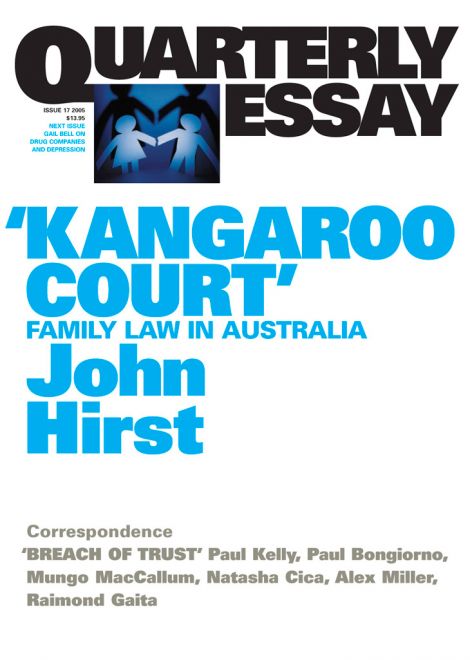
John Hirst, Kangaroo Court’: Family Law in Australia (Quarterly Essay 17)
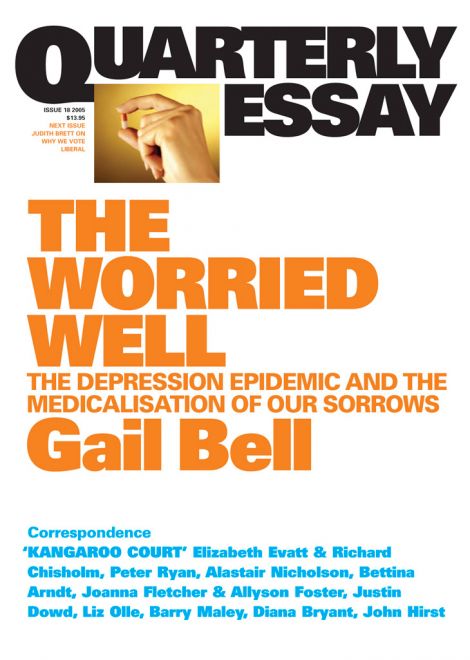
Gail Bell, The Worried Well: The Depression Epidemic and the Medicalisation of our Sorrows (Quarterly Essay 18)
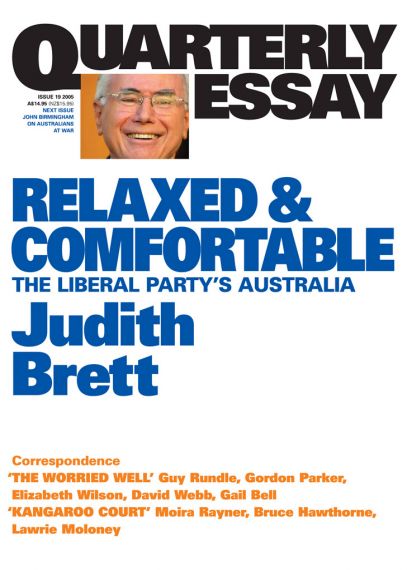
Judith Brett, Relaxed & Comfortable: The Liberal Party’s Australia (Quarterly Essay 19)

Let me sing the praises of the Quarterly Essay. Published by Black Inc in Melbourne, it’s a series of substantial papers on matters of public interest, generally thoughtful, often polemical and, of the ones I’ve read, always readable. The last three have been historian John Hirst on the Family Law Court, writer and pharmacist Gail Bell on depression and pharmaceuticals, and political historian Judith Brett on the political success of John Howard and the Liberal Party. In a time when public discussion so often consists of sound bites or prolonged slanging matches (culture wars, history wars, poetry wars, not to mention the Latham diaries and the recent political and nearly personal destruction of John Brogden), this series stands out like a beacon.

Not only does each issue present a sustained piece of argument, it also includes correspondence on previous issues. So there have been replies from the people most fiercely criticised by John Hirst, as well as thoughtful additions and contextualisations of his argument; and responses to Gail Bell’s piece that range from defences of Big Pharma to two pieces that argue she didn’t go far enough in her critique.

The Art Student reckons that Judith Brett’s essay is the best thing she’s ever read about Australian political history, and that it should be made into a film or a comic book so as to have the widest possible readership. And QE20, due out in December, can reasonably be expected to have the very best that anyone can come up with by way of rebuttal, expansion, derision. I don’t suppose we’ll hear from John Howard himself, but I’m confident there’ll be something other than the lurid rantings of columnists like Andrew Bolt or Miranda Divine.

It gives one hope for something like a civil society.