Tag Archives: R S Pine-Coffin

The Confessions of Saint Augustine, third and final report

Saint Augustine, Confessions (approx 400 CE, translated by R S Pine-Coffin 1961, Penguin Classics edition): pages 191–347 , from Book IX chapter 6 to Book XIII chapter 38
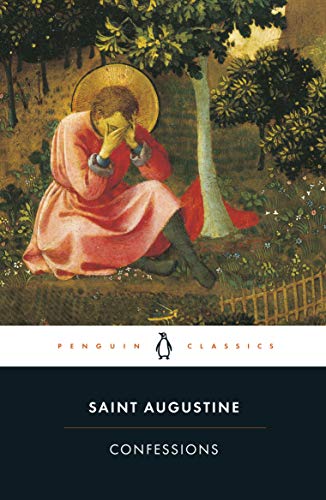
A month ago, when Augustine finally gave himself over to God, I was half expecting the remaining third of his Confessions to be pious anticlimax. I was partly right.

There’s a moving account of the death of his mother, which makes a point of her not wishing to be buried in her homeland. I wonder if this marks a point in the history of the west when people stopped seeing themselves as inextricably bound up with their place of origin, their Country – a disjunct that in the anthropocene we may be trying to reverse.

The rest of the book is given over to philosophical and theological argument – about the virtuous life, the nature of time and memory, the nature of God and eternity, the creation of the world, the meaning of faith. I let a lot of this go through to the keeper, happy to half-understand the intricate arguments. My impression is that his overarching project is to reconcile Platonist philosophy with the Christian scriptures and the doctrines of the Church – a major contribution to the development of Western thought, but not exactly a barrel of laughs.

Some bits grabbed my attention.

There’s a long passage where Augustine goes through the five senses and talks about how to best renounce the pleasures associated with them, or at least not enjoy them for their own sake (because after all you have to eat, and you can’t help but smell nice things). It’s a pretty perverse project that cast a long shadow – my own Catholic childhood and adolescence fairly bristled with notions of self-denial and discipline of the senses, and the ‘examination of conscience’ we were taught to perform from the age of seven could have been based on Augustine. I was struck by the hard intellectual work he puts into it. As he says:

I am working hard in this field, and the field of my labours is myself. I have become to myself like land that a farmer works with difficulty and with much sweat.
Ego certe, domine, laboro hic et laboro in me ipso: factus sum mihi terra difficultatis et sudoris nimii.

(10:16, pages 222–223)

I love it that he clearly had experienced the pleasures which he was renouncing. He protests a bit too much about the awfulness of sensual pleasure, but lesser pleasures can be acknowledged. For instance:

What excuse can I make for myself when often, as I sit at home, I cannot turn my eyes from the sight of a lizard catching flies or a spider entangling them as they fly into her web? Does it make any difference that these are only small animals? It is true that the sight of them inspires me to praise you for the wonders of your creation and the order in which you have disposed all things, but I am not intent upon your praises when first I begin to watch. It is one thing to rise quickly from a fall, another not to fall at all. And my life is full of such faults.
quid cum me domi sedentem stelio muscas captans vel aranea retibus suis inruentes inplicans saepe intentum me facit? num quia parva sunt animalia, ideo non res eadem geritur? pergo inde ad laudandum te, creatorem mirificum atque ordinatorem rerum omnium, sed non inde intentus esse incipio. aliud est cito surgere, aliud est non cadere. et talibus vita mea plena est

(10:35, page 243)

It’s interesting, by the way that where the translation has ‘such faults’ at the end there, the Latin has ‘such things’, leaving the possibility open that it may not be a fault at all.

Possibly because I’m currently doing an online course in modern and contemporary American poetry (‘ModPo‘) which has a focus on close reading, I’m fascinated by Augustine’s extended discussion of the first verses of the book of Genesis. Some readings, he argues – probably against his former companions the Manichees – are just wrong. But there is room for different interpretations: the text is open, as the ModPo teachers would say, and it’s impossible for anyone to know what was in the mind of the human author (whom he takes to be Moses). There’s something wonderfully modernist about this, for example:

For my part I declare resolutely and with all my heart that if I were called upon to write a book which was to be vested with the highest authority, I should prefer to write it in such a way that a reader could find re-echoed in my words whatever truths he was able to apprehend. I would rather write in this way than impose a single true meaning so explicitly that it would exclude all others, even though they contained no falsehood that could give me offence.
ego certe, quod intrepidus de meo corde pronuntio, si ad culmen auctoritatis aliquid scriberem, sic mallem scribere, ut, quod veri quisque de his rebus capere posset, mea verba resonarent, quam ut unam veram sententiam ad hoc apertius ponerem, ut excluderem ceteras, quarum falsitas me non posset offendere.

(12:31, page 308)

Mind you, quite a lot of Augustine’s readings are so tortuously allegorical as to surpass the most fanciful offerings of today’s poetry readers. He somehow manages, for instance, to make ‘God made the birds of the air’ signify something about God allowing ideas to float in humans’ minds.

It’s a shame that towards the very end he says that, although ‘in mind and rational intelligence’ women have a nature the equal of men’s (‘in mente rationabilis intellegentiae parem naturam‘), ‘in sex’ they are physically subject to men (‘sexu tamen corporis ita masculino sexui subiceretur‘). Perhaps it was a mercy to the women of his time that he chose a life of celibacy.

But I don’t want to leave on such a sour note. Here’s a passage from Book XIII chapter 9, which illustrates both the way his reasoning works and the way he presents himself:

A body inclines by its own weight towards the place that is fitting for it. Weight does not always tend towards the lowest place, but the one which suits it best, for though a stone falls, flame rises. Each thing acts according to its weight, finding is right level. If oil is poured into water, it rises to the surface, but if water is poured on to oil, it sinks below the oil. This happens because each acts according to its weight, finding its right level. When things are displaced, they are always on the move until they come to rest where they are meant to be. In my case, love is the weight by which I act. To whatever place I go, I am drawn to it by love.

The Confessions of Saint Augustine, second report

Saint Augustine, Confessions (approx 400 CE, translated by R S Pine-Coffin 1961, Penguin Classics edition): pages 111–190, from start of Book VI to Book IX, chapter 6

This month’s reading of Confessions included the book’s most famous prayer, ‘Give me chastity and continence, but not yet.’ Here it is in context:

As a youth I had been woefully at fault, particularly in early adolescence. I had prayed to you for chastity and said, ‘Give me chastity and continence, but not yet.’ For I was afraid that you would answer my prayer at once and cure me too soon from the disease of lust, which I wanted satisfied, not quelled.
at ego adulescens miser valde, miserior in exordio ipsius adulescentiae, etiam petieram a te castitatem et dixeram: da mihi castitatem et continentiam, sed noli modo. timebam enim, ne me cito exaudires et cito sanares a morbo concupiscentiae, quem malebam expleri quam exstingui. 

(Book VIII Chapter 7, page 169)

Interestingly enough, Augustine’s struggle with sexual desire isn’t his main story. He does go on about it a bit, and he never shakes off the Manichees’ demonising of the body, but it’s not that much more interesting than his gambling addiction, which was relatively easily kicked. His true interest is in the convoluted mental and emotional process of conversion. He disentangles himself from Manicheism, comes to devalue academic success, and renounces what we might see as a perfectly decent de facto relationship, to embrace mainstream Christianity. He describes himself as wanting to go in two directions, one towards what he understands to be a life well lived, and the other to stay with what he has. It’s a beautiful anatomy of the process of getting to decide to change one’s life (‘a hundred indecisions, … a hundred visions and revisions’).

The moment when he finally makes his decision is brilliant. He is overwhelmed by an emotional storm, an ‘agony of indecision’, and goes away from his friend to weep, because ‘tears were best shed in solitude’ (so men’s conditioning has stayed constant in some regards for at least 1600 years). He has a really good cry, and then there’s the other bit I was told about in my childhood::

I heard the singsong voice of a child in a nearby house. Whether it was the voice of a boy or a girl I cannot say, but again and again it repeated the refrain ‘Take it and read, take it and read’. At this I looked up, thinking hard whether there was any kind of game in which children used to chant words like these, but I could not remember ever hearing them before. I stemmed my flood of tears and stood up, telling myself that this could only be a divine command to open my book of Scripture and read the first passage on which my eyes should fall.
audio vocem de vicina domo cum cantu dicentis, et crebro repentenis, quasi pueri an puellae, nescio: tolle lege, tolle lege. statimque mutato vultu intentissimus cogitare coepi, utrumnam solerent pueri in aliquo genere ludendi cantitare tale aliquid, nec occurebat omnino audisse me uspiam: repressoque impetu lacrimarum surrexi, nihil aliud interpretans divinitus mihi iuberi, nisi ut aperirem codicem et legerem quod primum caput invenissem.

(Book VIII chapter 12, page 177)

I got the impression from the nuns, priests and brothers of long ago that the voice was that of a disembodied spirit, an angel. But Augustine himself suggests no such thing. God’s instrument here is an actual child – otherwise why linger on the child’s indeterminate gender? I also thought this was the first time Augustine read the Christian scriptures, but he has been studying them for years, and already believes they are sound. In the actual Confessions, this is a moment of serendipity, and his going to read the first passage he sees (from Paul’s epistles, it turns out) has a lot in common with the ‘pagan’ practice of the sortes Virgilianae, in which the pages of Virgil’s Aeneid were opened at random to see the future.

This morning’s reading ended with more tears, of gladness this time as he is baptised and his life is turned around. He is accompanied by his son Adeodatus, now 15 years old, whom he clearly treasures.

I’m about two thirds of the way through the book, and I’m expecting the rest to be pious anticlimax. But these last 20 pages are brilliant and completely explain the book’s enduring status as a classic.

The Confessions of Saint Augustine, first report

Saint Augustine, Confessions (approx 400 CE, translated by R S Pine-Coffin 1961, Penguin Classics edition): pages 1–110, from beginning to end of Book V

If St Augustine invented the literary form of autobiography, he did it by accident. The impression I have so far is that in Confessions he is telling the story of his life as a teaching device. The message seems to be that humans depend on the mercy of God for everything, from mother’s milk to the ability to read. Secondary to that, humans are born sinful. So far at least, quite a lot of his ink is spilled in arguing with the Manichees, and a lot of that argument is pretty opaque to the casual reader, by which I mean me.

Still, it’s quite a thing to spend 10 minutes or so each morning in contact with a mind that was alive nearly two millennia ago. Two moments grabbed me in the very early chapters.

In writing about his early schooling, even while saying he was a wicked child (for wanting to play rather than study!), he argues against against harsh physical punishment as a teaching tool. After saying he hates Greek but likes Latin, he explains that he learned Latin from his mother and nurses, and Greek from his stern school teachers. He generalises:

This clearly shows that we learn better in a free spirit of curiosity than under fear and compulsion.
hinc satis elucet maiorem habere vim ad discenda ista liberam curiositatem quam meticulosam necessitatem.

(1:14)

A little further on, after arguing that the innocence of childhood is a myth, he comes face to face with Jesus’ apparently contradictory view in Matthew’s Gospel, and offers this bit of ingenious argumentation:

It was, then, simply because they are small that you used children to symbolise humility when, as our King, you commended it by saying that the kingdom of heaven belongs to such as these.
humilitatis ergo signum in statura pueritiae, rex noster, probasti, cum aisti: talium est regnum caelorum

(1:19)

If I’m just going to quote the bits that stood out for me from amid the theologising, I can’t go past this wonderful paragraph about friendship:

We could talk and laugh together and exchange small acts of kindness. We could join in the pleasure that books can give. We could be grave or gay together. If we sometimes disagreed, it was without spite, as a man night differ with himself, and the rare occasions of dispute were the very spice to season our usual accord. Each of us had something to learn from the others and something to teach in return. If any were away, we missed them with regret and gladly welcomed them when they came home. Such things as these are heartfelt tokens of affection between friends. They are signs to be read on the face and in the eyes, spoken by the tongue and displayed in countless acts of kindness. They can kindle a blaze to melt our hearts and weld them into one.

(3:2)

I had expected confessions to loose living. So far, the main wickedness he confesses to is his adherence to the Manichean heresy. He does mentions a de facto wife, but when he goes from Carthage to Rome, he doesn’t tell us if she comes with him.

This morning, his career as a teacher of literature has led him to Milan, where he is deeply impressed by the lectures of (Saint) Ambrose. He finally makes a break from the Manichees. He’s impressed by ‘the academics’, but doesn’t throw in his lot with them. Nor does he embrace the Catholic Church (which is R S Pine-Coffin’s translation of catholica ecclesia, and fair enough, though the capital letters may be a bit misleading), but he becomes a catechumen, which I understand to mean he sees himself as under instruction.

To be continued.

Beginning the Confessions of Saint Augustine

I’ve become attached to the practice of reading a few pages of a classic text first thing in the morning. À la recherche du temps perdu kept me busy for nearly two years. The Iliad and The Prelude followed. Then Middlemarch, which I finished a couple of weeks ago. Now that I’ve stopped missing Dorothea, Will, Celia, Lydgate and even Rosamond, it’s time to move on to my next morning project.

Over the protests of the Emerging Artist, who has barely tolerated my occasional morning chat about Middlemarch (I say occasional; she says far too frequent), I’ve decided to tackle St Augustine’s Confessions next. I hereby resolve to keep any enthusiasms to myself, or at least not inflict them on my nearest and dearest.

This is a book that has been around in my life for a very long time, but it hasn’t occurred to me until now to actually read it. Good Counsel College in Innisfail – which I attended aged 9 to 13 – had the Latin motto, Tolle lege, which translates as ‘Take up and read’. Regardless of what personal meaning it might have had to students – it has pretty much become my life’s motto – we were told that the phrase came from a moment in the life of Saint Augustine: when he was living a dissolute life in the fleshpots of Egypt he heard an angelic voice telling him to pick up and read a book he saw lying on a window ledge. The book was a Christian Bible, and the text that he read in obedience to the voice turned his life around. I guess I’m about to find out if that story comes from the Confessions, and if it does, how much of my childhood recollection is true to what the man himself wrote.

I’ve garnered other bits of information about Augustine and this book over the years. That’s one of the things that makes a book a classic: you don’t have to have read it to know a thing or two about it.

I feel as if I’ve always known that Augustine lived a debauched pagan life while his Christian mother wept and prayed for his conversion. His prayer is famous: ‘Lord, make me virtuous, but not yet.’

At one stage of my life his injunction, ‘Ama et fac quod vis’ (‘Love and do what you will’) was a welcome antidote to the rule-bound Catholicism of my childhood.

Augustine invented the concept of original sin, the blight of many young Catholic lives – though James Carroll, in Constantine’s Sword, an excellent book about anti-semitiism in the Catholic Church, argues that for Augustine the concept was about embracing human imperfection rather than condemning us as innately evil.

I’e bought a copy of the Penguin Classics edition, translated in 1961 by the wonderfully-named R S Pine-Coffin, and I’ve found a Latin text on line in case I decide to be linguistically adventurous. I’ll report back in a month …