
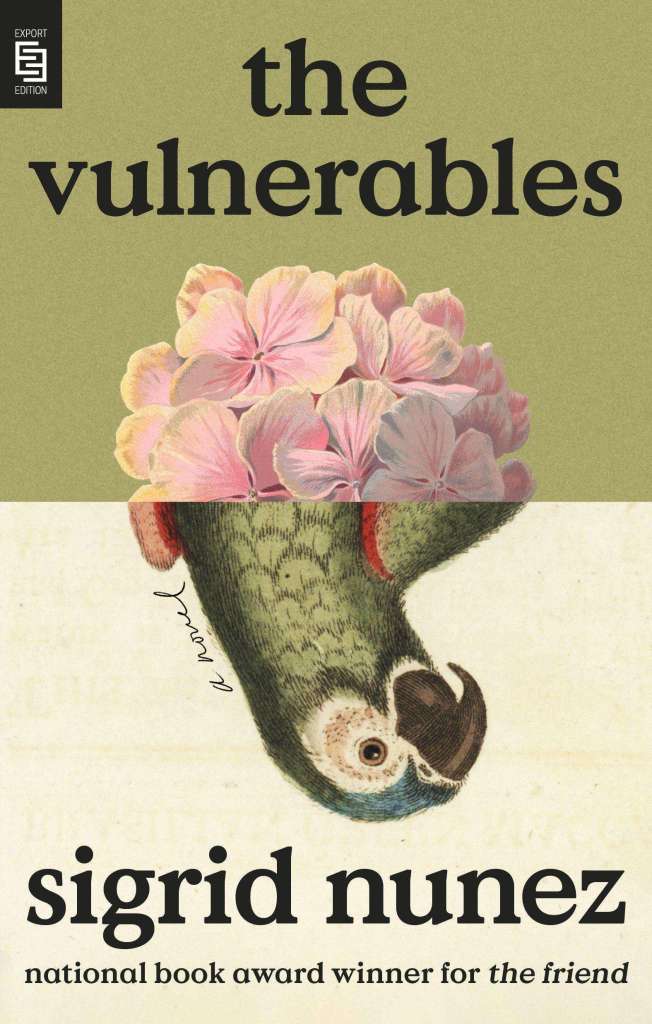
Sigrid Nunez, The Vulnerables (Riverhead Books 2023)
I first heard the notion that there are two Americas articulated at a Sydney Ideas lecture in 2008. Canadian writer Ronald Wright expanded on the idea in his book What Is America? (link is to my blog post), but the simplified version I took away from his lecture is this: there are two competing versions of America, each insisting that it is the true one.
The idea seems to have come into its own in the era of MAGA.
The Vulnerables inhabits one side of the divide. It’s literate, self-aware, alert to issues of class, race and gender – and it’s kind, while just outside the pages of the book the Covid pandemic and forces of violent unreason rage.
The narrator, a woman writer of a certain age who may well be Sigrid Nunez, stays in Manhattan during the worst of the Covid epidemic. Iris, a writer whose publisher is the narrator’s friend, has been stranded in California by travel restrictions, and the narrator agrees to look after Eureka, Iris’s macaw, eventually moving into Iris’s luxurious apartment to do so, lending her own apartment to a respiratory physician friend who has come to New York to help with the pandemic.
Circumstances lead to her sharing Iris’s apartment with a troubled young man, whom she calls Vetch. The pair don’t exactly hit it off at first, but (of course) that changes.
The tragedies of Covid and Trump are always there in the background, manifesting in the immediate narrative mainly in the narrator’s inability to apply her mind to any substantial writing project.
That’s the story. Add in some terrific scenes with a group of long-term woman friends, a plethora of quotes about writers and writing, a couple of detailed synopses of other works, including Craig Foster’s My Octopus Teacher, and you’ve just about got it. Back to my point about the two Americas: it’s interesting that the narrator dwells on My Octopus Teacher rather than the TV show that got a lot of attention at that time, the odious Tiger King.
I couldn’t put it down. (I lost patience only once, when the narrator tells us about a writing exercise that non-writers can perform well, and then proceeds to do the exercise.)
The writing is clear, unhurried, compassionate, and though the narrator ruminates on literary issues (as on page 277 – ‘Growing consensus: The traditional novel has lost its place as the major genre of our time’), it doesn’t go anywhere near disappearing into its own navel.
At page 76 (that’s still my age) the narrator has agreed to look out for Eureka, but hasn’t yet moved into Iris’s apartment. Pausing on this page, it turns out, highlights some interesting qualities of the book.

First it sets up the situation: the apartment block is empty, and the narrator is to visit for several hours a day. (I recently spent a week looking after a friend’s cat in her apartment with a spectacular view of the Pacific Ocean. Though Jennifer the cat didn’t raise any of the social/ethical issue that Eureka the macaw does, I identified strongly with the narrator.) Up to now, there have been stories of the writing life, childhood would-be boyfriends, a recently deceased friend’s love life, and a sense that Covid is narrowing the narrator’s world. Here we have a substantial, tangible narrowing: she must spend several hours a day in this one place. It’s a turning point in the narrative.
Then the page’s main work is to introduce Eureka as a character – first in Iris’s account of his needs and personality:
He does need daily physical and mental exercise – and a whole lot of admiration. He really likes to strut his stuff. He’s seen himself in the mirror, and he knows how gorgeous he is.
Then in the narrator’s physical description:
His name was Eureka, and he was a miniature breed, only about half the length of most full-sized macaws. All green except for a dab of scarlet on each shoulder and white patches around his eyes. A shade of green so bright and lush it was refreshing to look at, like a clump of tropical flora. One of those breeds famous for being able to mimic speech …
That’s Eureka, made graphically present.
We also learn something about Iris’s character. She remains offstage throughout, and although she feels real enough, in her absence she comes to represent a certain way of life: she writes books about design, and her apartment is beautifully designed, including a whole room painted like a tropical rainforest to make Eureka feel at home. There’s no doubt about where she sits in terms of the two Americas. There’s this, immediately after the last bit quoted above:
… but, according to Iris, not much of a talker.
We were never really into that, she said, the way so many other parrot owners are. All those people who get such a kick out of teaching their birds to swear. We love looking at him and playing with him and of course we talk to him, but we never tried to train him to repeat after us.
Paraphrase: we are not part of the vulgar crowd.
Later, Vetch is scathing about this: Iris and her husband think they are being enlightened in their treatment of the bird, but it’s still an imprisoned wild thing that they see as a possession. The narrator doesn’t endorse his high moral tone (he comes from a privileged background), but here she makes a similar point – as urbane, elliptical mockery, but still making it. (As I write this I’m reminded of the Renoir movie, La règle du jeu, whose aristocrats are so charming and loveable that you almost don’t notice that the film despises them.)
There are two more things on this page that weave it into the fabric of the novel. First, the little comment in brackets after Iris says Eureka knows how gorgeous he is:
(That parrot is a peacock.)
This loops back to a playful moment much earlier. The narrator has been trying to identify the colour of certain breeds of hydrangea – lavender, perhaps, or lilac:
But, because lilac and lavender are also kinds of flowers, you can’t say, The hydrangea is lilac, or The hydrangea is lavender. It would be like saying, That cat is sick as a dog, or His eyes are his Achilles’ heel. (I did not make those up, I read them somewhere.) … That hog farm is a pigsty. He uses his wheelchair as a crutch.
(Pages 22 and 25)
This running joke is a deft way of keeping front and centre the narrator’s identity as a writer.
Second, the first para on the page is a wry social observation:
Though the residents were gone for now, the building staff had been designated essential workers and were showing up every day. Just one of countless bizarreries of lockdown life: an entire luxury boutique building and a full staff, all for one little old bird and me.
This is a reminder that the official response to Covid has a class dimension. Elsewhere the narrator quotes a social media meme: ‘What lockdown? It’s just the middle class going into hiding while the working class wait on them.’ She doesn’t endorse the stridency of that, but nor does she disagree with it. She reminds us every now and then that she is a woman of colour and comes from a relatively disadvantaged background. She doesn’t make big deal of it, but it’s an undercurrent, a constant unease that occasionally surfaces, most clearly when she digs out statistics of the elementary school she attended and sees that, among other things, 93% of students were ‘Eligible for free lunch’.
As I notice these elements of the book, I’m reminded of Edward Said’s brilliant essay on Jane Austen’s Mansfield Park in Culture and Imperialism (1995). He points out that when Sir Thomas is absent, leaving a space for the young adults to indulge in scandalous theatrical activities, he is in fact visiting his plantation in the West Indies: his authoritarian behaviour on his return is a shadowy reflection of what we can assume he has been doing as a slaver. Patricia Rozema’s 1999 movie makes the connection explicit by having the heroine Fanny Price discover a portfolio of horrific charcoal drawings of African heritage people in distress. Perhaps a movie of The Vulnerables would have the camera linger on tent hospitals and ‘essential workers’ living dangerously.
One last question: who are the vulnerables? The short answer is, Everyone:
- The narrator and her friends, as women of a certain age
- Iris, who has a baby in California
- Vetch, a young man whose wealthy parents are a case study in how to eff up a child
- Eureka, of course, emblematic of all those pets abandoned during and after Covid
- the essential workers
- the narrator’s doctor friend, who (not a spoiler really) does get Covid
- the boys who took the risk of declaring their love of the narrator when she was a ruthless child
The list could go on.
This book was lent to me by a kind friend as part of a care package when I had a positive RAT. My symptoms were mild, and back then my lockdowns were mild as well, but reading the book in these circumstances made me particularly receptive to it.


 Me fail? I fly!