Tag Archives: science fiction/fantasy

Posthumous Tiptree Jr

James Tiptree Jr, Meet Me at Infinity (Tor Books, 2000)

I got hold of this book as part of my Science Fiction/Fantasy self-education project. In years long gone, I’d read two Tiptree novels and a collection of short stories, so already had a healthy respect for her. (Yes,  James Tiptree Jr was a woman. However, in this book she’s identified primarily by her male pseudonym rather than as Alice Bradley Sheldon or Raccoona Sheldon. And that’s as it should be: she kept writing as James for roughly ten years after she was outed, and the pieces by Raccoona collected here are pretty forgettable. There are precedents: I’ll bet you struggle, as I do, to remember the real life name of Henry Handel Richardson or George Eliot.) This is a posthumous gathering of previously uncollected stories and essays, so might have turned out to be a grab bag of offcuts of interest only to completologists. I’m glad to report that it’s not so, not by a long shot.

In the fiction section, roughly the first half of the book, most of the pieces do turn out to be of mainly completological* interest. But two of the stories, specifically ‘Trey of Hearts’ and ‘The Color of Neanderthal Eyes’, are vivid reminders of Tiptree’s ability to portray intimate sensuality (including, as in the first of these stories, graphically described sexual encounters) between beings from different planets. If only I’d read the former story before my Book Group’s evening on erotica!

At the start of the non-fiction section, in which Tiptree is maintaining, sometimes strenuously, her male persona, I was reminded of Jennifer Maiden’s reference (in her poem in the current Heat) to

Wilde’s old aphorism that a man
is least himself in first person: give
him a mask and he’ll tell the truth.

These pieces were mostly written for fanzines – some of which were produced by the book’s editor, Jeffrey D Smith, whose notes explain for us visitors from the mainstream the nature of fandom and fanzines. The pieces are appropriately informal, ‘Uncle Tip’ telling traveller’s tales, dispensing advice to his younger co-fans and generally shooting the breeze in playfully overwrought language. You get the impression the writer was having so much fun creating, or being inhabited by, this male character that she allowed herself to say all sorts of things about creativity, science fiction, ageing, the environment (including, more than 20 years ago, a lament about carbon dioxide and climate change) and anything else that crossed her mind, things she might not have said in her own person. Some of it is embarrassing, as when ‘Tip’ writes with self-deprecating comedy of his lustful admiration for a young Mayan woman. But there’s a lot that’s eminently quotable. Like this, on the Doomsday theme in science fiction, in 1973:

Ever since things got serious, ever since we realised that we really are in danger of killing ourselves, of bombing or poisoning or gutting or choking the planet to death or – perhaps worst of all – of killing our own humanity by fascist tyranny or simple over-breeding, science fiction has been the only place we could talk about it. The mainstream took one look at it in Orwell’s 1984 and promptly caponised itself. It’s too terrible. Don’t look. Tell me Jesus saves.

Or this, which must surely be quoted in any discussion of women in science fiction (the emphasis is in the original):

I know now why women have always attracted me, you see: They are the real aliens we’ve always looked for.

A year or so later, edging closer to emergence from behind the male mask, she wrote, ‘I have changed my mind, by the way: Of course it is not women who are aliens. Men are.’ In that same piece, a compilation of contributions to a symposium on women in science fiction, ‘he’ responded sweetly when invited by the famously pugnacious Joanna Russ to bow out of the discussion on the grounds of his gender.

The book gets really interesting with his/her unmasking, in a number of ways. First, the real Alice Sheldon steps out onto the stage, and although she talks in a number of pieces of how disappointed her readers must be when the writer they’d suspected of having lived a daring life (a spy, or something worse?) turns out to be a nice elderly lady (‘At least I hope I’m nice’), she did have a very interesting life – starting with accompanying her parents on major journeys of exploration as a very young child. Second, her writing changes, becomes more straightforward, less florid, if perhaps also slightly less adventurous. And third, she reports on what she has learned about gender in science fiction, about sexism in general, from her masquerade and unmasking: all too often what can be heard with respect if said by a man, if said by a woman is understood to be whining. As ‘Tip’ she could suggest to a male anthologist (pen-)friend that he ought to include some women in his collection; the same suggestion from Alice would probably be heard as pure self-interested.  And so on. Without the male persona, she writes passionately about the situation of women, and about the importance of male allies in the struggle against sexism. But always with style, oddness, modesty, spark and a weird kind of grace.

* I didn’t make that word up. I just googled it, and got one hit.
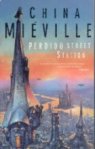
Perdido Street Station

China Mieville, Perdido Street Station (Pan Macmillan 2000)

perdidoKim Stanley Robinson (you know who he is, right?) is quoted in a recent Guardian, in the context of a spray about the insularity of the Booker Prize judges, that ‘the best British literature of our time’ is science fiction. I can’t say I share his disparagement of historical novels, still enjoying the afterglow of Wolf Hall as I am, but he has a point. Certainly I feel more nourished by Perdido Street Station, a full-on chaotic, phantasmagorical, dystopian, steampunk boy’s-own-adventure-with-interspecies-sex-and-reanimated-cadavers than by any number of sensitive and self-important explorations of guilt, memory and adultery.

It’s very long, and there was a bit towards the end where I wished he would just get on with it, but it sustained me very well through a very long plane trip and subsequent jet lag. I do feel when I read a genre work like this that I’m something of an outsider and can’t tell what’s original to it and what is a common trope. (I recognise echoes of Terry Pratchett and Neil Gaiman, for instance, but have no idea whether they are actual references or simply drawing on the same meme pool.) But when it’s done as well as this, that becomes an academic question.

If you’re looking for a long, light, engaging read, I doubt you could find better.

Les voies d’Anubis

Tim Powers, Les voies d’Anubis (J’ai Lu 1986; translated by Gérard Lebec from ‘l’americain’, original title The Anubis Gates)

2290020117When this turned up on BookMooch en français I decided to seize the chance to brush up my French at the same time as crossing an Apollo Award winner off my TBR list. The plan worked out excellent well. The novel is a fabulously over the top fantasy, like an extended episode of Doctor Who, only there’s no Doctor to help out when the quantum mechanical (or in fact magical) time travel to the England of Coleridge and Byron, and beyond, goes horribly wrong. Or it could be likened to a Cairo Jim adventure with an organisation very like the Old Relics Society and a time-travelling Eng Lit scholar cum pseudo-werewolf in place of Geoffrey McSkimming’s poet-archaeologist: it’s got Egyptian gods, animated statues, history mysteries, but sadly no animal companions. It’s a vastly inventive, rip-roaring picaresque adventure, with a lovely array of grotesque villains, some almost Shakespearean crossdressing, and much derring-do.

Reading it in translation reintroduced me to the childhood pleasures of incomplete comprehension, guessing meaning from the context, sometimes with a fair degree of confidence, occasionally looking a word up, every now and then having a word’s meaning emerge into clarity with repeated appearances, and even – once in a while – knowing what a word means without knowing the English for it (I had to look up embarcadère, for instance, to translate it as landing stage, but I knew what structure it referred to without benefit of dictionary).  I could just about feel my neurons reconfiguring.

The other pleasure came from pace: I was forced to read slowly, so slowly that by the time I’d finished the prologue and the first chapter, I felt as if I’d read a whole book, so in effect I got four or more books for the price of one. This effect was helped, of course, by the episodic structure.

I probably missed a lot, though I did laugh out loud more than once, which means I got at least some of the jokes, and that’s supposed to be the hardest thing when you’re reading in a language you’re not fluent in. In fact, there was at least one joke that might easily have been tailor-made for my situation: a character says at one point ‘Psaume en chemise sans cote de quarte?’ and I wracked my brains (‘Psalm in shirt on side of quad?’ Really?), only to be relieved five lines later when the character articulates carefully, ‘Sauté en mille six cent quatre-vingt-quatre’ (‘Jumped to 1684?’ which is simply reiterating incredulously what someone else has just said). [I just Looked Inside This Book at Amazon, and found that the original poorly articulated line was ‘Jutmoop sidskeen eftee door?’, gibberish which I don’t think would create the same puzzlement in someone who knew English as well as I know French.]

If this had been a ‘serious’ literary work and I’d enjoyed it this much, I’d probably feel that I ought now to read it in the original. While I now have Tim Powers on my list of authors to look out for, I’m happy with one reading of this, happy to recommend it as a constantly surprising and delighting romp either in French or in English.

Anathem, Heavy

Neal Stephenson, Anathem (Atlantic Books 2008)
14f4541I approached this book with enthusiasm (based on my love of everything by Neal Stephenson I’ve ever read) tempered with guilt (is it the best use of my time to read a 900 page science fiction novel?) and resentment (surely he could have told his story in fewer pages than that, and given us something not quite so heavy to lug around). Three hundred pages later, resentment was a dim memory, guilt had faded to irrelevance, and enthusiasm was transformed into something like exhilaration.

Imagine a cross between Harry Potter and The Name of the Rose, with a substantial dash of A Brief History of Time thrown in, and the faintest possible hint of The Da V*nci Code. A group of adolescent (that is, awfully earnest but also charmingly naughty) members of an religious order set out to solve a mystery, not of a murder but of an invasion from outer space, and uncover a secret conspiracy that’s thousands of years old – only it’s not a religious order exactly, but a vast enclosed community devoted to reason, debate and theoeticcal (theoric in the world of the novel); it’s oversimplifying to say that the invasion is from outer space, and the conspiracy … well, I’m not sure I quite grasped what was going on there, something you could never say about D*n Brown’s plots). There’s maths, there’s physics, there’s philosophy, all redolent of what we know on earth but twisted into new and strange shapes. There are space ninjas (sort of), time travel (sort of), 7000 years worth of back story, and more diverging alternative realities than you can poke a Diana Wynne Jones at. In fact, just when you think you’ve got the measure of this book, it does some kind of athletic sault (oh yes, it makes you want to do that sort of thing to language) and you’re casting about for a new measuring device. The sheer energy of Neal Stephenson’s mind is amazing. His erudition is matched only by his playfulness. His acknowledgements page more or less wrings its hands, says there’s not enough room, and refers the interested reader to 4700 words or so on the web. He can make a fifty-page conversation about the philosophical idea of multiple cosmi not just readable, but fun, though I confess that in that part of the book I was occasionally tempted to skip. But it’s hard to skip when the text is so thick with invention he coins the term Artificial Inanity to describe something that sounds very like spam, for example, and one of his ‘aliens’ says incomprehensibly alien things such as  ‘say zhoost’ to signify agreement or ‘monyafeek’ to express admiration. For those who enjoy an in joke, the marvellously long-lived Enoch Root, a character from earthbound novels Cryptonomicon and the Baroque Cycle, makes an appearance here – he has a different name, but there was no mistaking him.

I marked this passage at about the half way mark, just because I liked it. Interestingly, I think it comes close to articulating what the book, beneath all the prolixity, the explosions and the mind boggling theorics, is about:

Thousands of years ago, the work that people did had been broken down into jobs that were the same every day, in organisations where people were interchangeable parts. All of the story had been bled out of their lives. That was how it had to be; it was how you got a productive economy. But it would be easy to see a will behind this; not exactly an evil will, but a selfish will. The people who’d made the system thus were jealous, not of money and not of power but of story. If their employees came home at day’s end with interesting stories to tell, it meant that something had gone wrong: a blackout, a strike, a spree killing. The Powers That Be would not suffer others to be in stories of their own unless they were fake stories that had been made up to motivate them.