Tag Archives: Sydney Writers’ Festival

SWF: Saturday

11.30: The Book of Rachael

‘What’s a nice secular Jewish girl like you doing writing a book about Jesus?’

That’s how Irina Dunn kicked off this session in the Bangarra Mezzanine room, swimming in morning light and vibrating to an occasional passing jet ski. Leslie Cannold, the nice secular Jewish girl in question, was there to discuss The Book of Rachael, one of a number of books at the festival to address religious issues from the viewpoint of respectful non-believer.

I’d been keen to attend this session. I love Dory Previn’s song, ‘Did Jesus Have a Baby Sister?’ and a novel about just such a sister has a huge appeal. It turns out that Leslie Cannold has written a number of non-fiction books, to do with abortion and other feminist issues. She was watching a series about the life of Jesus on television, and had a moment when the narrator said that, though Jesus almost certainly had sisters, nothing is known about them. She decided to write an essay bringing those sisters back to history. She headed off, full of resolve, to an institution called something like the Melbourne Theological Library, only to discover that when someone is forgotten it means they are forgotten, that we know nothing about them and never will. She decided to write a novel. Fortunately no one warned her how difficult that would be.

As she was completely ignorant of religion, her research involved reading the entire Bible, both the Hebrew Bible and the Christian Bible, but not too much interpretation of it, though the limited amount she read included daunting texts such as Elisabeth Schüssler-Fiorenza’s In Memory of Her. She drew a parallel with the process in which hints and silences in the official histories must be interpreted to unearth the the histories of subject peoples – ‘women have essentially been a subject people’. The project of telling the story of Jesus’ sister ran into many difficulties, among them being the way Jesus’ story kept drifting into the foreground, as it did a couple of times during the discussion.

Irina Dunn did a lovely job of letting Ms Cannold shine, and supplied a couple of sweet theatrical moments when she tried to discuss elements of the plot, and had to be almost physically restrained. ‘But I never mind if people tell me a book’s plot,’ she said, genuinely astonished that people should object to spoilers. ‘It’s the writing that matters.’

One lovely thing I wrote down:

I love and respect all these characters. I assume they are believers and respect that about them, but I needed to tell their stories in a way that made sense to me, and I don’t believe in miracles.

The book was sold out when I tried to buy itbut I did embarrass myself by approaching Leslie Canold at teh signing table and singing a few bars of Dory Previn to her.

1 pm: The Director’s Notebooks
Former National Gallery of Australia director Betty Churcher chatted with Terence Maloon about her new book about the drawings she did of beloved paintings when she thought ahe was going blind. This was a marvellous session, not least for the unabashed affection these two people showed for each other. To kick things off, Maloon read a passage from early in the book, where Betty describes herself aged eleven being enchanted by a painting (in a serendipitous echo of the spirited intelligence of Leslie Cannold’s Rachael). It was a lovely passage, and when he finished reading, Maloon simply sat and beamed at the writer of it. After a long moment, she said, ‘That was the start of it,’ and the conversation was under way.

4:00: The Big Reading
This is a regular event where a big theatre full of people is read to by an all-star international crew of novelists, with SBS’s Annette Shun Wah as ring mistress.

Kei Miller read from his first novel, The Same Earth. Introducing him, Annette made a teasing reference to the Caribbean accent as impenetrable. In fact he was brilliantly articulated, as much a pleasure for the music of his voice as for the slightly fabulist text.

David Mitchell and Michael Cunningham read from works in progress, the latter explaining that reading published works feels to him like showing a cucumber that won a prize at a county fair several years ago. It didn’t seem to occur to him that this might seem to be disparaging his companions on stage. Still, both WIPs were intriguing.

Téa Obreht, originally from the former Yugoslavia and now living in the US, read from The Tiger’s Wife, a piece that blended vampire elements with tales of the recent Yugoslav wars.

Kader Abdolah, sporting an impressive Mark Twain moustache, was an established novelist in Iran, but now lives in The Netherlands and writes in Dutch. He was the stand out of the session, reading us a short story that was a lightly fictionalised account of his refugee journey – this was both affecting and funny. Then he read the first paragraph from his new book, The House of the Mosque, and held the book up, saying that he had been missing Iran for many years, but had finally been able to go there again, ‘in this book’.

We had an excellent and surprisingly cheap Lebanese meal watching the sunset over Walsh Bay, then walked up George Street to the Town Hall for:

8:00: We (Still) Need to Talk About America
This was the fizzer of the festival for us. Four interesting people on the panel, with an idea that sounded promising: the US sometimes seems scarily incomprehensible from the outside, and this was a chance to hear what it’s like inside. Michael Connelly is a crime novelist who engages with live issues. Téa Obreht is a young novelist who arrived in the US as an immigrant when she was (I think) 12 years old. Daniel Altman is an economist with an interesting résumé. Gail Dines is a sociologist who takes on the influence of porn. It went nowhere. From the front stalls it looked as if Anne Summers mishandled the moderator role, moving doggedly through her list of things that are weird in the US – the cheering of the killing of Bin Laden, the failure to introduce gun laws, disenchantment with Barack Obama, and so on – asking questions that couldn’t help but make the panelists defensive, and jumping in too often to display her knowledge of things USian, in effect clamping on the brakes whenever any momentum seemed to be developing among the panelists. Dines and Altman, sociologist and economist, gamely worked up some edgy sparring, and they both had interesting things to say, but for me the dominant mood was encapsulated in this exchange:

Summers (to Connelly): I saw you smile. You had a thought there.
Connelly: No, I was just waiting for this to pass.

My guess is that the whole thing would have gone better if a moderator had opened with a brief statement to the effect that many things about the US are incomprehensible to outsiders, maybe giving a couple of examples, then having each of the panelists take 5 minutes to respond what it looked like from their vantage point. And trust them to take it somewhere interesting.

Still, we had plenty to talk about in the long wait for a bus.

SWF: Busy Friday

I had tickets for a 10 o’clock session yesterday morning. One of the participants was prevented from being there by the Chinese government, and I was kept away by an act of vandalism (see previous post). There’s a photo of Liao Yiwu on a chair in the Gleebooks shop, but I got my whole body to Walsh Bay in time to spend a little money and queue successfully for

11.30 am: The Fascinator
Delia Falconer, Ashley Hay and Gail Jones have all recently written books set in Sydney. With Jill Eddington in the chair, the three of them – one a lifelong Sydneysider, one here since she was about 20, one a very recent arrival – chatted interestingly. Jill Eddington recommended reading all three in succession because the effect was like three movements in a piece of music. She imagined a movie that might be made of the three of them wandering the Harbour foreshores, going in and out of the Mitchell Library, walking in each other’s footsteps, almost meeting. The conversation that followed was a nice contradiction to the myth that writers are essentially in vicious competition with each other: Ashley Hay, for example, said that when her book was finally with the printer, reading Delia’s, which covered so much of the same territory but from a very different perspective, was like a special reward.

I tore myself away early, just as they were playing with possible readings if the session’s title: were we meant to think of the Harbour as a hat or an evil enchanter from a Margo Lanagan short story, or – the preferred option – both? I left reluctantly so as not to risk missing out on the Francis Webb session at 1 pm. This turned out to be a wise move, and brought a sweet bonus: I was hailed by a friend I hadn’t seen for 40 years, and while I kept one eye on the Webb queue we snatched a quarter of an hour to get reacquainted. When the growing queue vanished into the dark, we promised to follow up on Facebook, and I skedaddled to:

1 pm: The Lost Poetry of Francis Webb
This was in a much bigger venue than other poetry events, and we were told that it could have filled a space twice the size. It was one of a series of events around Australia to celebrate the recent publication of the UWA Collected Poems. The book’s editor, Toby Davidson, has organised and chaired the events, in which local poets read poems by Webb and speak briefly of their connections to him.

Toby D is a young man whose enthusiasm for his subject wouldn’t have shamed a revivalist preacher. He wants us all to read Webb, in solitude and aloud to our friends. He recommends the practice of carrying a book of his poems everywhere with us (which Bob Adamson told us later he actually does). He kicked things off by reading ‘Ball’s Head Again’. He didn’t read badly by any means, but he did demonstrate the difficulty of Webb’s verse and gave us a yardstick by which to judge the other readers.

By any measure they were all brilliant.

Judith Beveridge spoke of the texture of Webb’s language, its compression and richness, and read ‘Images in Winter’ and ‘For My Grandfather’.

Brook Emery quoted a speaker from an earlier session who referred to ‘songs that please the ear and songs that please the heart’ and said he would add ‘songs that please the mind’ – Webb’s poems, he said, are always reaching for meaning. He read ‘Night Swimming’, the first poem by Webb I ever read, when I was 24 or so, and ‘Nessun Dorma’.

Johanna Featherstone, easily the youngest of the poets, struck a blow against the view that Webb is a poet’s poet, read only by scholars and fellow poets. She takes poetry into correctional centres, where prisoners, possibly influenced by knowledge of his time in institutions, believe him. She read ‘The Runner’ and ‘Harry’.

Craig Powell, a psychiatrist in his day job, told a little story of his acquaintance with Webb when in a psych hospital in Melbourne. He read ‘Five Days Old’, prefacing it with the story of its creation: a psychiatrist in England took Webb on an outing, and asked him to hold his little baby for a moment. Powell almost spoiled the moment by asking with a snigger, ‘Who would hand their baby over to a certified chronic schizophrenic?’ But he gave us the poem with sound and heart and head. He also read ‘Hospital Night’.

Robert Adamson talked about the stigma of ‘mental illness’, quoting an eminent poet-critic-media-personality’s description of Webb as ‘the maddy’. When they met, Webb asked Adamson, ‘Are you a Communist?’ ‘Why?’ ‘The long hair.’ He read ‘Bushfire’, ‘Black Cockatoos’ and ‘End of the Picnic’. As a final comment he said that whereas a lot of discussion of Webb’s poetry focuses on his ‘mental illness’, the poetry itself is full of hope and lucidity.

The young Bulgarian woman sitting next to me said she’d loved the poetry, though there were many words she didn’t understand. Me too.

As I was on my way to the next session, I accosted Bob Adamson and said how much I’d loved his reading. He reached into his briefcase and gave me a book! So, dear reader, when someone does something that delights you, make a point of thanking them.

2.30 pm: The Merchants of Doubt
Naomi Oreskes’s eponymous book (can you say that?) is an exploration of the doubt-mongering techniques developed by the Marshall Institute in the US to defend vested interests against the implications of scientific research. They began with the connection between tobacco smoking and cancer, and progressed to a range of environmental issues, reaching some kind of peak with climate change They don’t have to lie (though they do anyway), but they do systematically create disinformation. She was in conversation with Robyn Williams, and they are clearly kindred spirits, science journalists passionately concerned about the current attacks on science.

I won’t try to summarise. Robyn recommended a BBC doco, Science Under Attack. In a neat echo of Adamson’s anecdote, he told of meeting one of the doubt-mongerers at a conference, and being asked of his journalist colleagues, ‘Are they all Communists?’

My main take-home point was that scientists (and, I would add, others) have a deeply held belief that the facts will speak for themselves. But this is manifestly not so on matters with big emotional charges on them.

The Book Group, the Finkler Question and the SWF by night

Howard Jacobson, The Finkler Question (Bloomsbury 2010)

This won the Booker Prize last year. Howard Jacobson lectured on Dickens to at least one member of my book group at Sydney University in the 1960s. He’s a guest at this year’s Sydney Writers’ Festival and we’d decided to combine our group meeting with a visit to the festival. Even if three members of the Book Group weren’t gentiles married to Jews, this book, which is broadly speaking about gentile–Jew relationships, would have been a logical choice.

Before the group meeting:
When I’d read to about page 80 I wrote a draft blog entry explaining why I didn’t finish the book. Mainly, I found the central narrative thread, in which a gentile man obsesses over the implications of having been mugged and called a Jew, to be both flimsy and ponderous. That wouldn’t have mattered if it was funny – and after all, much has been made of the Booker going to a comic novel – but I didn’t laugh once. Too often a character is given just enough two-dimensionality to allow the writer to take a satiric pot shot at her/him. There are jokes. Our gentile hero (he’s a serial romantic, Treslove by name, get it?) is in love with a woman who confesses that she’s ‘a bit of an arsonist’, and in the morning he wakes to ‘twin realisations’:

The first was that she had left him. The second was that his sheets were on fire.

Boom-tish! or Clunk! You be the judge.

In that draft I said, with only slight exaggeration, that a two page account of a Google search was the most interesting thing in the book up to that point. I did read on, hoping only for a cute line to quote as the point where the book and I parted company.

It was not to be. The Google search – “Anti-Semitic Incidents” – foreshadows a transition to something much more interesting. The unfunny humour keeps coming, and all but one or two of the characters stay paper thin, but from about the halfway point the book begins ringing the changes in a tantalisingly complex way on themes of Jewish identity and culture, Judaism, anti-Semitism, internalised anti-Semitism, Zionism and anti-Zionism. Viewpoints multiply, transmogrify, collide, dissolve. Just as you think the book is coming to a settled view, a telling incident or a forceful argument challenges that view. It’s not just the familiar ‘two-Jews-three-opinions’ thing, though it includes that. It becomes a dramatisation of intractable complexity.

Raissa Maritain, Russian Jew turned French Catholic philosopher, wrote what could have served as an epigraph to the second half of The Finkler Question: ‘To every argument can be opposed an argument, and thus appears the futility of all argument.’ Or perhaps it wouldn’t serve, as she was talking about faith as superior to reason. Up to a point, the arguments are tested here, not against faith but against the characters’ experiences – of love, loss, betrayal, disappointment, kindness, stupidity, brutality – but the characters are so thin it’s hard to believe the testing is real.

Yet other people, including the Booker judges, have loved the book. I came away feeling that I’d somehow missed the point, much as Treslove does throughout the book.

After the group meeting:
We met at a pizzeria in the wharf precinct. Three of the seven of us came straight from Howard Jacobson at the Sydney Recital Hall. Those three and I had read the book, a third had reached page 225 and was enjoying it. All the others had a much better time with than I did. One said that like me he’d noticed page 79 as the point where things became interesting, but unlike me he’d found what came after that funny in the I’ve-got-to-read-this-to-my-wife way. Others related strongly to Treslove. When I said there was almost nothing to the character they agreed, but saw that as a brilliant depiction of a certain kind of personality: ‘There’s a little Treslove in all of us.’ Someone related strongly to the theme of men of a certain age (he said ‘our age’) looking out for each other when their wives have died. Sex scenes that I found weirdly unfunny and not much else were to other people touchingly intimate. The scenes towards the end that I read as competently introducing some much needed pathos (please note the emotional distance in that way of saying it) made St least one grown man cry.

I found myself conceding that I’d enjoyed more of the book than I’d been willing to admit. But mainly it was interesting to see that the book spoke so personally to the others who had read it. Evidently I was right – I’d somehow missed the point. And the thing is, if I were to reread the book, I expect I’d miss it again. I’m the wrong horse for that course.

Our plan had been to go to the Chaser’s Empty Vessel  show at  nine o’clock, but by the time we got to the venue it was half past, and the person in orange T-shirt told us it was sold out. Some of the others went on to the poetry reading at the Number One Wine Bar. I came home.

SWF 2011: Bombs and Poetry on Thursday

After I uploaded my sketchy report on last night’s SWF event at the Town Hall I searched for #swf2011 on Twitter and saw that everything I’d quoted had been tweeted to the universe within seconds of being uttered. Undaunted, here I am again, lumbering along with my antiquated longwindedness to bring you My Thursday at the Festival Part One: 10 till 2.

10 am: The Poetry of War with Daniel Swift and A C Grayling
Daniel Swift’s grandfather flew in planes that dropped bombs on German cities in World War Two. He failed to return from a bombing mission in 1943 when Daniel’s father was four years old. The book, Bomber County, tells of Daniel and his father visiting the grave. Daniel, by my calculations now 34, wanted this small story to open out into a bigger picture. He sought out and interviewed participants in bombing missions, and people who were in the cities bombed by his grandfather on the nights of his missions All this, plus an exploration of World War Two poetry, which anyone (else) will tell you barely exists, fed into a project of considering the bombing campaign, not to praise the heroism of the men or condemn or defend the atrocity involved, but to try to imagine – resurrect was Swift’s word – the human experience.

A C Grayling , when he’s not busy being the nice one of the current crop of aggressive British atheists, is an ethicist. His book, Among the Dead Cities, deals with the ethics of those same missions. The focus of this session was on Swift’s book, which Grayling clearly loves. They claimed to disagree on the ethical question, but I couldn’t spot any disagreement. The conversation was lovely in many ways, not least for the spectacle of an eminent professor putting his considerable intellectual heft into recommending the work of a much younger man. The air fairly crackled with respect – mutual between the speakers, from both of them to the men who flew on the mission, and during question time to the rambler and the autobiographer.

11.30 am: Antipodes: Poetic Responses
Antipodes is an anthology, edited by Margaret Bradstock, of Aboriginal and non-Aboriginal poets addressing the relationship between Aboriginal Australians and settlers – the survivors of genocide in conversation with the perpetrators, descendants and beneficiaries, as it were. The facilitator, Martin Langford, said it was the first book of its kind, and warned us that some of the sentiments, especially in the early settler poems, might be repugnant to modern readers – the book is meant to be read as whole. In order of appearance we were read to by:

Anna Kerdijk Nicholson, who read a number of poems from Possession. It was good to hear them read, though my impression was that the poet was intimidated by the context. I wouldn’t have objected if she’d explained the universally cryptic titles of her poems, but she just read and then sat down.

Lionel Fogarty: again I was very glad to hear him read, as I have a copy of his New and selected poems : munaldjali, mutuerjaraera but haven’t been able to read very much of it. Now that I’ve seen and heard him I may have a better chance. He read a semi-rap, ‘True Blue, Didjeridoo’, which he and his son wrote when Nicole Kidman was culturally insensitive enough to play a didjeridoo on television.

I don’t know the work of either Margaret Bradstock or Brenda Saunders. They both read well, but I have trouble absorbing non-narrative poetry that I’m hearing for the first time. Ali Cobby Eckermann, a little of whose work I’ve read in anthologies and journals, read us excerpts from an unpublished verse novel, Killing Fields, a massacre story. ‘You’re privileged,’ she said.

Anita Heiss read last. With her brilliant control of tone she had us laughing and devastated from moment to moment. A woman of many talents, she thanked the organiserd for calling the writing in her book I’m Not racist, But poetry. ‘It’s not really poetry,’ she said, ‘but it’s not prose because it doesn’t go to the end of the line.’

I’m not sure what this anthology is. It may be intended for schools. Not that there’s anything wrong with that of course, but it does make me hesitate to rush out and buy it for myself.

1 pm: The Poetry of Three
This was Mark Tredinnick, Kim Cheng Boey and Cate Kennedy. Mark is a nature writer, and the poems that worked best in this context dealt with the nature of a parent-child relationship. I particularly liked ‘House of Thieves’. Kim Cheng, whose work I know only from his readings last year, was again delightfully urbane. Cate’s poems are narratives, and went over like a charm. I plan to buy her book.

Probably the strongest visual image from the Festival is the huge queues, all of which today seemed to have Bob Ellis in them. The queues for poetry were all short, and at each poetry session one of the readers expressed gratitude and surprise that so many people turned up.

SWF 2011: A Good Leader is Hard to Find

The reason I am not a politician is that I want to understand.

That’s what the French political scientist Raymond Aron said when asked why he hadn’t gone into politics. The remark came to mind when I saw the number of politicians and ex-politicians in this year’s Sydney Writers’ Festival line-up. Maybe there’s room for a separate Sydney Politicians’ Festival, or a Sydney Politicians’ and Political Journalists’ Festival.

Whatever misgivings I might have had, I turned up with 1600 or so others at the Town Hall last night to hear Lenore Taylor, Bob Ellis, George Megalogenis, Bob Carr, Barrie Cassidy and Kerry O’Brien chat under the heading, ‘A Good Leader Is Hard to Find’. Kerry O’B was moderator, and the first thing he did, whether deliberately or not, was to reframe the discussion. He announced the title as ‘Good Leadership Is Hard to Find’. I breathed a tiny sigh of relief, as the shift away from the personal made it a bit less likely that we’d be treated to misogyny-flavoured wit at Julia Gillard’s expense.

The composition of the panel – four political journalists, five if you count Bob ‘Sui Generis’ Ellis, and a former politician who was also once a journalist – made it inevitable that the discussion would focus on the relationship between politicians and the media. There seemed to be consensus that we lack effective or convincing leadership in the Australian parliament, that the interplay between the politicians and the relentless 24-hour news cycle is partly to blame, and that the attention both of them pay to opinion polls adds toxin to the brew. Our leaders are so busy feeding the media beast they don’t have time to think. They’re reduced to selling a message rather than advocating a case, performing rather than communicating. Political coverage is dominated by opinion polls, leadership challenges and early election speculation, with not a lot of room forin depth analytic conversation. Gone are the days when the Prime Minister would chat with journalists at the end of a long day and explain his/her thinking about proposed legislation – when Paul Keating would say to Lenore Taylor, ‘Love, this is what you need to know. The discussion was refreshingly free of blame: the way the media works has changed, and neither the politicians nor the journalists have figured out how to deal with the new reality.

There were no revelatory insights, but it was an interesting evening. Ellis and Carr stood out as phrase-makers, Carr describing himself as an amateur historian, Ellis enacting his familiar contrarian persona. For example, Carr:

In a democracy the normal relationship between people and their elected representatives is mistrust and dissatisfaction. It’s the job of the people to be disillusioned. It’s the job of politicians to disillusion.

Ellis, when asked why the ALP doesn’t adopt what he had just described as an obvious strategy

They do research instead of thinking.

It’s not that the others lacked flair, but as working journalists perhaps they were a little more willing to let the facts get in the way of a good story. So after Bob C made his fourth or fifth remark on the theme that things may be bad but they’ve been ever thus, George M said, ‘I’ve followed many election campaigns but this was the first one where the main candidates feared the electorate.’ And when Ellis spoke of the minority government as ushering in a new era of negotiation and persuasion in parliament, Lenore challenged him: ‘And you’ve seen this happen with which piece of legislation?’

The journoes have their own unrealities. George M told us how his faith in the electorate had been restored when ‘they’ decided to choose neither side of politics at the last election, but to have a hung parliament. No one on the panel said, ‘George, you’re talking nonsense. No one made that decision. All the millions of actual deciders chose one or the other. There was no “Neither” option on the ballot paper.’

There was half an hour of questions. Only one person mistook the microphone for a soapbox.

Gallery

NSWPLA Dinner, a report from the trenchers

Last year a woman premier presented the NSW Premier’s Literary Awards at the Art Gallery. Tonight a non-Labor premier, just as rare a beast in the 10 of these dinners I’ve been to, did it at the Opera Point Marquee, … Continue reading

Reading about Francis Webb

Bill Ashcroft, The Gimbals of Unease: The poetry of Francis Webb (Centre for Studies in Australian Literature 1996)
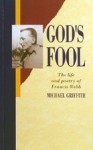
Michael Griffith, God’s Fool: The life and poetry of Francis Webb (Angus & Robertson 1991)
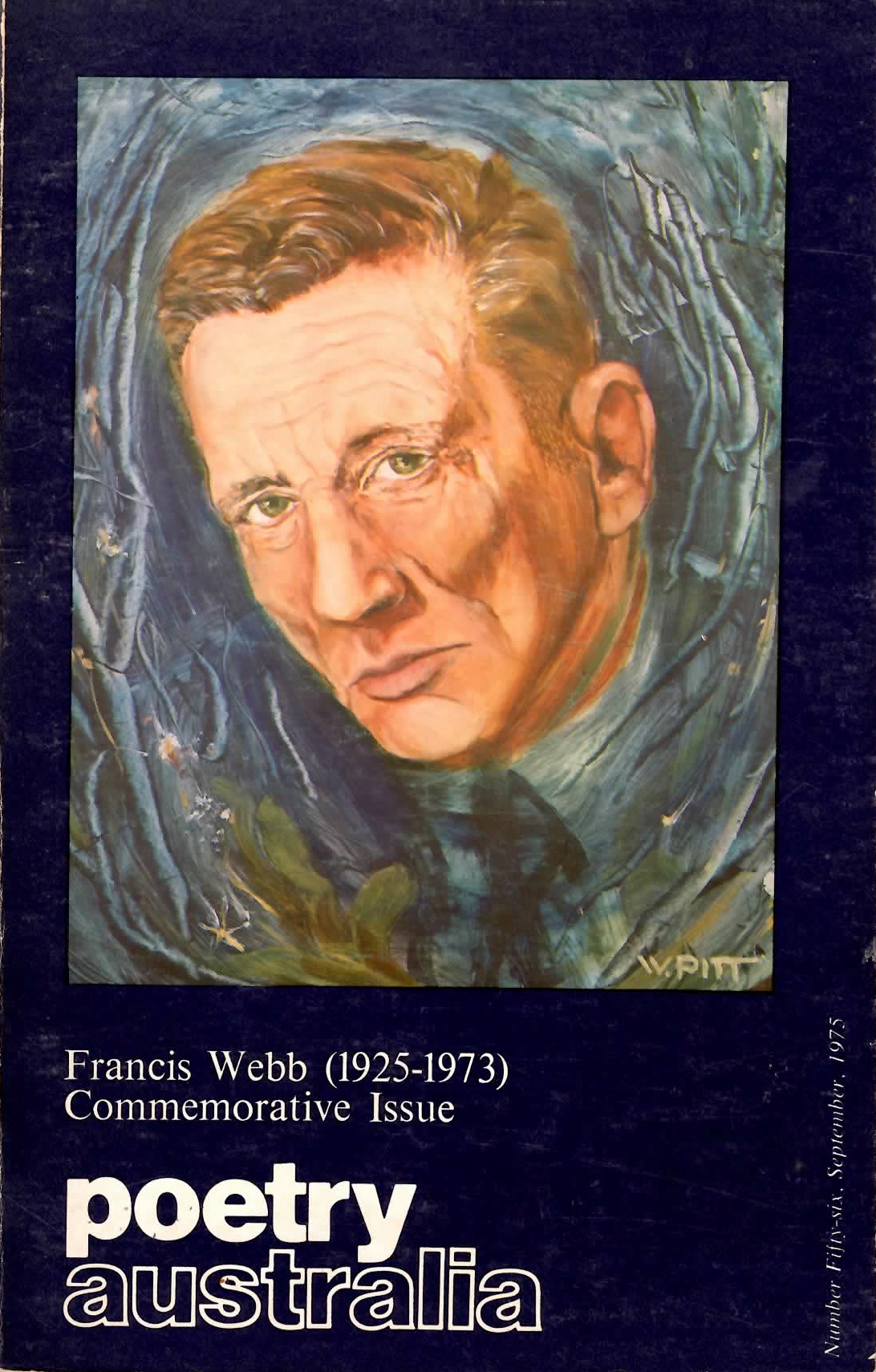
Poetry Australia September 1975: Francis Webb (1925–1973) Commemorative Issue
Peter and Leonie Meere, Francis Webb, Poet and Brother: Some of his letters and poetry (Old Sage Press 2001)

Having recently re-read Francis Webb’s collected poems, I didn’t want to just put the book back on the shelf. In order to be as booked-up as possible for the Sydney Writers’ Festival session on Webb next month, I got hold of three books about him, and dusted off my copy of the 1974 Poetry Australia commemorative issue. I can now assert that I have read every book published on the subject of Francis Webb.

Bill Ashcroft was writing an MA thesis on Webb in the Sydney University English Department in the early 1970s when I was a postgraduate student there. Michael Griffith was also in the Department then, and interested in Webb. Both of their books were published in the 1990s. Poetry as dense as Webb’s yields its riches slowly, so I was interested to read the results of such long gestations.

Bill Ashcroft’s emphasis is on explicating the poetry. He talks about Webb’s use of language, and about Webb as Catholic, as schizophrenic and as explorer. I believe Bill approaches Catholicism as an outsider, since he seems to miss references to Catholic liturgy and lore, but his analysis may be all the more useful for that, as he goes instead to major spiritual and intellectual traditions within Catholicism (namely the Thomist–Ignatian and the Augustinian) and locates tensions between them in the poetry.

His discussion of schizophrenia reads as if it was mostly thought through in the 1970s when R D Laing and the anti-psychiatry movement hadn’t lost the battle with Big Pharma for domination. In my opinion it’s all the better for that. He argues that Webb’s extraordinary use of metaphor is intimately connected to the condition for which he was repeatedly hospitalised, drugged and subjected to electroconvulsive therapy; that people diagnosed as schizophrenic often don’t distinguish, as others do, between metaphoric and literal ways of thinking, that this is generally a brilliant way of dealing with impossibly painful situations rather than the symptom of an illness. In the section on Webb as explorer, he argues that Webb’s poetry is groundbreaking post-colonial work, holding ‘a balance between the European spiritual roots and the post-colonial vision’.

According to the book’s back cover, Bill Ashcroft has been a trailblazer in post-colonial studies. As might be expected, then, his prose is heavy with theoretical ballast, and occasionally reaches dizzying heights of abstraction. I expect book would repay close, careful study, but at least for now I’m happy to have read it in a companionable way: I might not understand a lot of what this bloke says, but it’s good to have listened to him talk at length.

Michael Griffith co-edited Cap and Bells, a selection of Webb’s poems that came out the same year as God’s Fool, so he’s probably done as much as anyone to keep the poetry in print for the last 20 years. This book is an offshoot of Griffith’s PhD Thesis. ‘In reducing the work from its longer academic form,’ he writes in his introduction, ‘I have tried also to introduce some aspects of Webb’s humanity which had less place there.’ For this departure from academic rigour, I for one am grateful.

When I studied Eng Lit we did a lot of close reading, and the idea of approaching literary work by way of the author’s biography was sneered at. Bill Ashcroft deals with such potential sneers by talking about the poetry and the poet’s life as two intersecting texts that illuminate each other. Michael Griffith doesn’t see the need for such justification, and just gets on with the illuminating. He does do some explicating of the poetry, but I found much more value in his delving into Webb’s life story than in any tight focus on the text. He draws on Webb’s letters and other documents, including two ‘Hospital Confessions’ written as part of campaigns to have him released from institutions. He quotes correspondence with Norman Lindsay, Douglas Stewart and David Campbell among Webb’s elders, and Rosemary Dobson, Nan Macdonald, Vincent Buckley and others of his contemporaries. One day a collection of Webb’s letters may see the light, but in the meantime this book draws on those that have been preserved by colleagues and family to show us a working poet who, in spite of long periods of incarceration and serious difficulty in coping outside of institutions, was a cherished and active member of a creative community. In particular, it is fascinating to learn details of his early connection to Norman Lindsay, and to consider his poetry of the 1950s in the context of the resurgence of Christian, even Catholic, themes in Australian poetry and art at that time.

The September 1975 issue of Poetry Australia was devoted to Webb, who had died nearly two years earlier. As well as several previously unpublished poems (all of them now available in Toby Davidson’s 2011 Collected Poems), it includes essays by Griffith, Ashcroft and other scholars, but its enduring interest lies in contributions from Webb’s fellow poets who knew him and appreciated his work – Rosemary Dobson, A D Hope and Vincent Buckley among them. There is also a poignant memoir by Sister M. Francisca Fitz-Walter, a Good Samaritan Sister who befriended Webb.

These essays are a striking reminder of how the language of literary criticism has changed in the last 40 or so years. Compare Vincent Buckley, in his essay ‘A Poet of Harmony’:

He was a great phrase maker and 
there are phrases, sentences, cadences in poem after poem that are quite 
unforgettable. He was a great master, and sometimes a victim, of metaphor, 
the most metaphor addicted poet in this country, I would say, and it is noticeable that time and time again the energy of those very ample driving
 rhythms is also the energy with which metaphors are picked up, created
 and extended through the stanza.

with Bill Ashcroft, 30 years later:

The compatibility of schizophrenia and the post-colonial, or to put it a different way, the schizophrenic discourse of post-colonialism, is seen most markedly in the similarity between the absence of the metacommunicative mode in schizophrenic language and [the] metonymic gap [of post-colonial discourse].

I don’t discount the importance of Bill’s theorising – on the contrary, it opens up great vistas of understanding. But Vin (as Webb called him) says a lot more about the immediate experience of reading the poetry.

Francis Webb, Poet and Brother is a labour of love, compiled and self-published by Webb’s younger sister and her husband in 2001, when they must have been in their 70s. It includes a number of poems that had not been previously published – but which are mostly in Toby Davidson’s collection. Its appendices include an impressive bibliography of critical writings about Webb; nearly 60 pages listing all his poems, the place and date of first publication, the place of composition where that’s known, and all subsequent publications; and 12 pages listing errors in those publications and in writings about Webb. All this will probably be of interest to scholars, but then there are the letters – 56 of them, written to his three sisters and his brothers-in-law from 1943 when he was 18 to a month before his death in 1973, with linking passages by the Meeres, including occasional quotes from other sources, such as for example Vincent Buckley’s memoir Cutting Green Hay – a quotation which, incidentally, tells a story of youthful drunkenness that Buckley hinted at but declined to tell in his Poetry Australia essay. If Webb’s letters to colleagues are as compelling, and poignant, and interesting as these, someone really ought to be getting a collection together.

Four things shine through: Webb’s great affection for his family, especially for Leonie and Peter Meeres; his Catholic piety (almost every letter ends asking to be remembered in the recipient’s prayers, and promising to remember them in his); his single-minded dedication to his calling as poet; and his mental anguish. The reason for his repeated confinement in psychiatric institutions remains (of course) obscure: he repeatedly insists that he is completely non-violent, but the letters are peppered with references to incidents such as ‘a silly brawl’. Whatever the reason, it’s heartbreaking to read his pleas for help, his assurances of his harmlessness, his wretched descriptions of himself as a no-hoper, and towards the end his warnings not to upset and possibly damage children by bringing them to see him in his abject state – and through it all, his piety, his affection and his hunger for solitude and peace enough to write poetry.

The Japanese artist Yayoi Kusama lives in a mental hospital in Tokyo, and is able to go to her studio regularly. It may be that Francis Webb needed to be kept apart from the general community, for his own or other people’s safety, but that he lived a life of such deprivation must surely stand as a reproach to the way people labelled mentally ill have been treated in this country. Yet the miracle of it is that he too created marvellous works:

Are gestures stars in sacred dishevelment,
The tiny, the pitiable, meaningless and rare,
As a girl beleaguered by rain, and her yellow hair?

Rereading Francis Webb

Francis Webb, Collected Poems (Angus & Robertson 1969)
Toby Davidson (ed.), Collected Poems: Francis Webb (UWA Publications 2011)

I reach for Francis Webb’s poetry fairly regularly – mainly the same handful of late poems. After listening to pieces about him on the Book Show and Poetica (parts One and Two), both on the ABC, having wept at the superb readings on the latter and been stung by Geoff Page’s describing the poetry as defective on the former, I decided to re-read the whole book. I started out on my 1969 edition, with its copious pencilled annotations by twenty-something me, but about a third of the way in I bought a copy of the new edition and switched to that. One learned person, according to my faint pencil notes, wrote that ‘reading Francis Webb is like wrestling with an angel’. No one would disagree that wrestling is involved: just decoding the syntax can be a challenge in many of these poems, then there are compacted metaphors, elusive rhyme schemes, buried religious references, and an expectation that the reader will be as alarmingly erudite as the poet. Just have a look, say, at the first lines of ‘Stendhal’:

Italy, and a nom de plume – better than in the van
Of France defeated: his clean scarlet brain
Must work in a pure detachment over man
Who was nothing without his D.R.O.s again.
Love, hate, ambition mustered at his bugle,
Sorties of good and evil were in vain.
With watchful eye and towerings of the eagle
He must disarm the priests, immobilize pain.

To which I admit I don’t have much more to say than ‘Huh?’

The angel part is harder to describe – the exciting part, that makes you feel you’ve been through the wringer, but that the world is somehow clearer, richer and more harshly beautiful because of it. He writes about sunsets, fog and wind as if they contain all the deepest struggles of the cosmos.

If you haven’t read any of Webb’s work, I recommend you start with the relatively straightforward ‘Five Days Old’. My mother, no lover of difficult language, wrote to me in a 1972 letter: ‘”Five Days Old” is sweet. I have to concentrate to read poetry so I haven’t read the others yet.’ More ambitiously, you might try the two sequences, Eyre All Alone and Ward Two. (If you’ve got plenty of time, I recommend reading Edward John Eyre’s Journals of Exploration as interesting in itself, but also, as my pencilled notes remind me, because it sheds interesting light on Webb’s poem, which at some points comes close to paraphrasing passages from it.) I’d skip the radio plays about Hitler (Birthday, this one was broadcast on the BBC in 1955), the Holy Grail (The Chalice), the anthropogenic end of the world (The Ghost of the Cock) and the man who invented electroconvulsive therapy (Electric).

One of the things that I loved about Webb’s poetry from the start is that it’s work. You can feel the labour of getting the words down, squeezing meaning onto the page, into the shape of the poem. Even at his most difficult, he is working at communication, never being difficult for its own sake.

Forty years ago I went searching for the first publication of his early poems, and found one or two that hadn’t been collected, and others that had been substantially edited on the way to being collected. The former and one or two of the latter are in the new collection, but my favourite example of revision isn’t. Here are the first three stanzas of ‘The Day of the Statue’, in which fishermen catch an ancient statue in their nets, as they appear in both Collected Poems:

You look for prodigies leaning on the sill of storm,
Or loose in the yellow gap at a candle’s end,
But here was patience: fishermen out on the bay,
Work and silence inching with the minute-hand.

Moored in a lulled spinny of sun and shadow,
With an impotent tremor in the sails, the ketch nosed down
To the long lunge of the swell, rose dripping, gasping
As if with eagerness to suck in air again.

And the men, snug in this casual pediment of time,
Their gestures grouped and restricted and interlocking,
Felt the haul stubborn to their hands, an eye-tooth wrenched
From the iron gums of the sea-bed, shuddering and aching.

Compare the first five stanzas of the version published in the Bulletin on 8 October 1947, when Webb was 22 years old:

You look for prodigies leaning on the sill of a storm
Or loitering about the wake of a snuffed-out light;
But such things are apt, as you know, on these days of full sunshine
To be quietly pocketed or else shoved clean out of sight.

Certainly, three fishermen out on the bay
And the shaping of a miracle are rarely aligned,
History bells hours only, clock on the walls of speeches:
Work and silence tick unnoticed with the second-hand.

Moored to drifting banks of sun and shadow,
With an impotent tremor in the sails, the ketch nosed down,
plunged to the bowsprit in the swell, rose dripping, gasping
As if with eagerness to suck in air again.

And the men grouped snugly in this leeward pediment of time,
With their slow gestures of toil, felt a curious lagging in the strands
Of their sunken net, as if parallel action under the water
Passed on a sort of nerveless shock to the hands.

Your touch on a net-load of fish short-circuits life:
The cargo is arteries stabbed in their element and shaking,
But this haul yielded stubbornly like an eye-tooth wrenched
From the iron jaws of the sea-bed, shuddering and aching.

I love the way he pared those stanzas down, even at the risk of making his meaning harder to grasp. And the revisions towards the end of the poem are even more telling. The last stanza changed from

Beauty comes baleful as a skull, comes riven from the sea:
Well to consider the mortal, the native token
Before you polish, incise – before you replace
What that bronze arm once clutched that time has broken.

to

There were some to roll back the heavy stone of the sea;
There was none to ponder the mortal, the living token.
But later, men polished, incised, established at last
What that raised hand once clutched and years had broken.

With great economy, the resurrection of Christ is invoked, and the contrast between the practicalities of dragging up the statue and understanding it is conveyed as a further piece of narrative rather than in a slightly priggish address from the author.

Ramona Koval said she’d never heard of Francis Webb. That’s a great shame. The Sydney Writers’ Festival has a session on ‘The Lost Poetry of Francis Webb’. I’m assuming that phrase refers to his whole body of work rather than to the handful of previously uncollected poems that begin and end Toby Davidson’s collection. I plan to be there.

Anna Kerdijk Nicholson’s Possession

Anna Kerdijk Nicholson, Possession (5 Islands Press 2010)

I picked this up because it’s shortlisted for the New South Wales Premier’s Literary Awards. I’m pleased to report, however, that I read it without Barry O’Farrell in mind, not even a bit.

The subtitle, ‘Poems about the voyage of Lt James Cook in the Endeavour 1768–1771’ seems to promise a book that’s squarely in the Australian Explorer Poem Tradition (AEPT). Kenneth Slessor’s ‘Five Visions of Captain Cook‘, James McAuley’s Captain Quiros, some of R D Fitzgerald’s poems dealt with sea exploration, and used to be studied at universities, and land exploration has grabbed the attention of many of our poets, notably Francis Webb (in whom I’m currently immersed). The book’s apparatus seems to confirm this promise: the page before the table of contents quotes from the Lords of the Admiralty’s instructions to Cook to ‘proceed to the southward in order to make discovery’ of the fabled Great South Land, and the poems are followed by a seven page chronology, beginning with his birth and ending 56 years after his death, with the death of his widow Elizabeth.

It’s true the book engages with Cook’s voyage of ‘discovery’, but it does so with a postmodern, post-colonial sensibility. There is a sense of overall unity, but no grand narrative, no unifying point of view, certainly not an unambiguous sense of Cook as hero. Unlike the main works of the AEPT, it doesn’t shy away from the less than honorable episodes of the voyage, or from the devastation it brought to many people – peoples, in fact. The 31 poems fall roughly into three kinds: most of them are addressed to Cook, with headers giving place and date, referring to incidents on his voyage (‘You imagine the scent of South Sea fruit on your fingers / and the lustful smells of fresh roast pig and cocoanut.’). A second kind are set in the early 21st century, mainly in Kangaroo Valley in New South Wales, and feature the poet, sometimes but not always with her mind on James Cook. And then there are half a dozen with the page header ‘Extracted from notes on a lost manuscript’, which are generally more elusively reflective: the first of these has the look of a found poem – a dictionary definition of ‘explore’, with etymology, not as dull or as neutral as you might expect.

I’m enjoying the book so far. It’s like a music album, that you need to play a few times before you’ve absorbed it, and maybe you’ll go back to it from time to time and find something new each time. I’m still at the absorbing stage. For example, the acknowledgements page tells us that the titles of individual poems ‘make reference to the poetries of’ five poets. None of the titles rang any bells for me, and Google shed no light, so evidently they aren’t direct quotes from those poets. Maybe one day I’ll come across the references, but for now I’m happy to stay in the dark, for the titles to remain a tease. That dictionary definition poem, for example, is titled ‘Each object we name and place leads us’ – I have no idea whose poetry that makes reference to, but it sits in nice tension with the poem.

This teasing intertextuality – which is echoed in the often oblique relationships between the modern and historical poems – is hardly in line with the cafe poet-in-residence program described in today’s SMH, which aims to ‘demystify the work of poets and deliver it to a broader audience’. But it’s fun – probably even more fun for people who get the references. I look forward to hearing Anna Kerdijk Nicholson read and perhaps talk at the Sydney Writers’ Festival next month.

Sonnets according to ‘m’

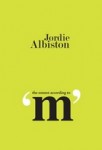
Jordie Albiston,  The sonnet according to ‘m’ (John Leonard Press 2009)

The M in these poems is not from Fritz Lang (‘When out of grace in Peter Lorre’s eyes’?) or the James Bond franchise (‘If gin and vermouth stirred not shaken are’?), but is, as the back cover blurb tells us in a manner ominously reminiscent of the  labels in contemporary art exhibitions, ’emblematic of recurrence and precipitousness’. It’s a commonplace that poets nowadays don’t generally have a huge audience. The most recent variation I’ve heard was from David Brooks, at a Sydney Writers Festival workshop: the world is desperate for poetry but poets aren’t writing the poetry that the world wants. It’s almost as if, he said (but blame me if this is crudely expressed, I took skimpy notes), you have to choose between writing for poets or writing for the public. As a reader, I definitely identify as part of the public, and Jordie Albiston’s clever play with the sonnet form in this book tends to intimidate and alienate me rather more than it delights. Yet, there is delight here, and a little sharpening of attention brought rewards.

There are at least three Ms: ‘me’, Marsi  and em. Marsi, the acknowledgements page informs us,  was the poet’s maternal grandmother, whose diary, kept for a month in 1959, provides the basis for 12 of the book’s 54 sonnets.  Em is Emily Skinner, Jordie’s paternal great-great-grandmother, whose memoir lies behind another four of them. I found the use of these sources fascinating. At the Sydney Writers’ Festival, Adam Aitken read a poem based on his father’s letters, so perhaps this kind of familial translation is a common practice. It’s certainly an interesting one, and here the Marsi sonnets in particular provide a kind of rootedness. They tend to observe metrical and rhyming conventions, not strictly, but more so than the ‘me’ poems, and the quiet intelligence they bring to the concerns of a 50s housewife  demonstrate Albiston’s range marvellously:

well we have waited twelve months to see
what the nuns would do with the old wood
house 00 a noise at last from the sainthood:
the roof is coming off! 00 now of course we

are curious to know What Next!

and so on. Compare this to the ebullient play with form in ‘mandatory’ (all but the ’em’ poems have titles beginning with  m):

well you gotta be good 00 but
you gotta be bad 00 you gotta
be both glad & sad 00 yep you
gotta be human it says in the
book but look! 00 there’s that
creature inside! 00 you gotta be
nothing you gotta be all 00 you
gotta be both great and small

Would you have picked that as the octet of a sonnet? There’s a huge variety here. There’s quite a bit that seems to be just for fun (as in ‘methinx (i)’, ‘2moro 2moro & 2moro / goes slo frm day 2 day’). Katherine Mansfield scores a sonnet. There are a number entitled ‘mural’ that celebrate and mourn the passing of verbal graffiti. Some seem to embody a very contemporary feeling of derangement. And so on.

I ended up being completely won over.