
Wolfram Eilenberger, The Visionaries: Arendt, Beauvoir, Rand, Weil and the Salvation of Philosophy (©2020, translation by Shaun Whiteside 2023)
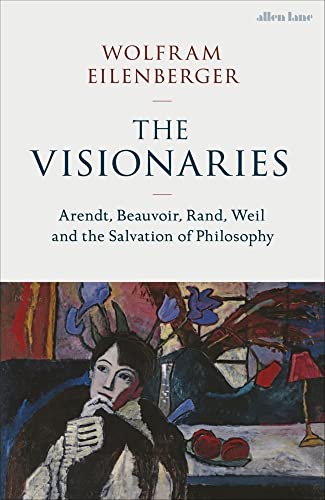
Before the meeting: It’s unlikely that the group would have read The Visionaries if we chose books by consensus. But The Chooser has spoken and we’re out of our comfort zones.
It’s a hard book to describe. Without anything by way of preamble or general argument, it plunges straight into its story. The first chapter, ‘Sparks: 1943’, introduces the book’s four subjects: four quite different women writers, each heroic in her own way, poised to take a major leap forward In the midst of the horrors of the Second World War. As with each of the book’s eight chapters and Coda, the chapter is subtitled:
Beauvoir is in the mood, Weil in a trance, Rand in a fury, and Arendt in a nightmare.
And the four philosophers are introduced:
- Simone de Beauvoir, aged 35, is in occupied France in her famously unconventional ‘family’ with Jean-Paul Sartre, with ‘better things to do than worry about the judgment of that petit-bourgeois fascist’ (that is, Adolf Hitler): she is on the brink of ‘a new definition of man (sic!) as an acting creature. And one that was neither empty of content, as in Sartre’s latest work, nor bound to remain absurd, as in Camus’s writing.’
- Simone Weil, 34, is in London, desperately ill and in pain, but lobbying for the creation of ‘a special unit of French nurses at the front who would be deployed only in the most dangerous places, to provide first aid in the middle of battle’. She would head this unit personally, in what looks awfully like a plan to commit suicide by altruism. De Gaulle dismisses the proposal out of hand: ‘She is mad!’ Instead she writes urgently and copiously, including ‘a 300-page redesign of the cultural existence of humanity in the modern age’ before collapsing in exhaustion.
- After ten years as a freelance writer in New York City, Ayn Rand, 37, sees the publication of her 700-page novel, The Fountainhead, and launches her passionate espousal of independence, her worldview that saw altruism as the great destructive force.
- Hannah Arendt, 36, also in New York, has been driven out of Hitler’s Germany, and is now finding in herself the courage to face the reality of the industrialised murder of millions of Jews. What mattered was ‘to be entirely present’, or, as paraphrased by Eilenberger, ‘to philosophise’.
In the following chapters, Eilenberger tells us the story of the life and work of each of these four women over the preceding decade. It’s left to the reader to discern any unifying theme or concern. In my reading, the closest he comes to articulating a central theme is on page 69:
The philosophising person seems to be essentially a pariah of deviant insights, the prophet of a life lived rightly, whose traces can be found and deciphered even in the deepest falsity. At least this is one way to understand the role that Ayn Rand as well as her contemporaries Weil, Arendt and Beauvoir assumed with ever greater confidence. Not that they had expressly made a choice. They simply experienced themselves as having been placed fundamentally differently in the world from how other people had been. And deep inside they remained certain of who or what the problem needing treatment was: not themselves, but the Others. Possibly, in fact – all the Others.
If one were to pursue that view, the actual impulse of astonishment at the beginning of all philosophising is not the surprise that there is ‘something and not nothing’, but rather, honest bafflement that other people live as they do.
If I understand this correctly, part of what he is saying is that whereas their male colleagues were interested in the individual human being in relation to the world, these four women were interested in human beings in relationship to each other.
It may be that what you find in any book depends on what you bring to it. A reader well-versed in 20th century philosophy would read this one differently from me: it seems that each of these women was pushed to the margins of political and philosophical thinking, and this book is part of a movement to rectify that. But I’m not that well-versed reader. I haven’t read a whole work by any of them, but I’ve known about all four in a general way.
In my mental landscape, Simone Weil is a weirdly saintly figure who embraced suffering (and loved one of my own favourite poems, as I blogged recently), a Jew who was lived her own intense version of non-Church Christianity; Ayn Rand is a demonic figure who celebrated and justified libertarian capitalism; Simone de Beauvoir is Jean-Paul Sartre’s devoted lover who wrote The Second Sex, a key text of second-wave feminism; and Hannah Arendt is a woman of extraordinary integrity who coined the phrase ‘the banality of evil’ and wrote about totalitarianism.
This book leaves those thumbnail sketches pretty much in place, but I now have a much richer understanding of the people and their works. I didn’t know, for instance, that Simone Weil had worked as a trade union organiser and had brilliant political insights, that Simone de Beauvoir had such a complex set of intimate relationships, that Ayn Rand was married and counted on her husband Frank O’Connor while she wrote fiercely about independence (and that ‘Ayn’ rhymes with ‘fine’), or that Hannah Arendt was quite so marvellous a human being as she appears in these pages.
Their stories are told independently, but Eilenberger makes occasional telling comparisons, and sometimes the women’s paths cross. I love the meeting between the two Simones on page 55, quoted from Simone de Beauvoir’s Memoirs of a Dutiful Daughter:
I managed to get near her one day. I don’t know how the conversation got started; she declared in no uncertain tones that only one thing mattered in the world: the revolution which would feed all the starving people of the earth. I retorted, no less peremptorily, that the problem was not to make men happy, but to find the reason for their existence. She looked me up and down: ‘It’s easy to see you’ve never been hungry,’ she snapped. Our relations ended right there.
And on page 190, the moment that has stayed with me as a piece of wisdom to live by – far from the self-abnegation of Simone Weil or the grand existentialist abstraction of de Beauvoir. Hannah Arendt, Eilenberger writes, is ‘laying the foundation of her own ethics of true self-determination in the face of the Other’:
Gratitude, for the existence of other people in the world, and active concern, for their always given vulnerability, are for Arendt the two true sources of our moral life. And it is no coincidence … that these two predispositions are the very ones that are essentially alien to Ayn Rand’s superhuman ideal figure, Howard Roark.
Amid all the egotism, altruism, self-sacrifice, angst, ambition, bitterness, sweetness, ruthlessness, pain, of those brilliant young adult lives, the notion that gratitude and concern are central went straight to my heart.
After the meeting: Usually, we spend quite a bit of time chatting before turning to the book of the night, but this time we were into it before we even sat down. The food was, as always, excellent. Our host had done a huge tray of roast vegetables and the contributions of the other five of us, with minimal advance coordination, worked well. He Who Usually Brings Dessert was on the other side of the continent, but it was someone’s birthday, and we had cake.
Though the book took us well outside our collective comfort zone, I think we were all glad to have read it. Most enjoyed it for the history, and tended to skip the philosophy. One of us is doing a philosophy course with the University of the Third Age, and had read Wolfram Eilenberger’s previous book, Time of the Magicians, about four male 20th century philosophers. He gave a couple of mini-lectures that cast light, gratefully received, on some of our dark places.
We had three different readings of ‘the Salvation of philosophy’ in the subtitle: these four women were saved by philosophy in times of extreme hardship; they saved philosophy from the dried-up mainstream by focusing on the connections among people; in the terrible time of the Second World War and Nazi atrocities, they kept the flame of philosophical thinking alive. Maybe all three are correct. (I’ve just seen the subtitle of the original is Die Rettung der Philosophie in finsteren Zeiten (1933-1943), literally The Salvation of Philosophy in Dark Times (1933–1943). And the title itself is Feuer der Freiheit – Fire of Freedom. It’s kind of intriguing that the four woman aren’t named, and there’s not even a hint that the book focuses on particular women. I wonder how much that change of packaging influences out reading.)
A couple of guys took against Simone de Beauvoir. I tried to defend her, and was supported by someone drawing a comparison between her and one of the participants in Australian Survivor that was as obscure to me as the extracts from Simone Weil’s journals. Incidentally, I now know how to pronounce Weil (it’s VAY).
We were in awe at how young the four women were in the years covered by the book. Some were pretty sure that Simone de Beauvoir’s entanglement with a student would get her fired and publicly shamed these days. It was a revelation that for de Beauvoir the war at times barely disturbed her way of life (someone had been to see the Anne Dangar exhibition in Canberra and had a similar revelation – ‘Oh yes, Hitler’s doing all that stuff,’ the artists in France said to each other, ‘but cubism is so interesting.’) It was pointed out that two of the four women were novelists rather than philosophers as such. Someone thought Hannah Arendt was a bit dull (I was shocked). Some were surprised to find themselves feeling sympathy for Ayn Rand (I was ashamed).
We barely talked about Donald Trump. I hope he noticed the lack of attention.


 Me fail? I fly!