
Megan Stack, Every Man in This Village is a Liar: An Education in War (Scribe 2010)
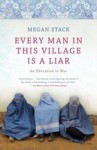 Megan Stack was a 25 year old US journalist on assignment in Paris on 11 September 2001. She was sent to Afghanistan after the US invaded, and over the next years she reported for the Los Angeles Times on war and upheaval in Afghanistan, Israel, Iraq and half a dozen other Middle Eastern countries. She’s no slouch as a journalist, as her bio demonstrates. She’s won prizes, been shortlisted for the Pulitzer and is now LA Times bureau chief in Moscow. If you’re looking for a brief, accessible introduction to the 21st century Middle East (at least as it was before the events beginning with the Egyptian Spring) this book probably fits the bill as well as anything. And I suspect we all need regular introductions and re-introductions like this, because of the phenomenon Stack describes in her Prologue:
As Americans we have the gift of detaching ourselves and drifting on; it has saved us over and over again from getting mired in guilt or stuck in the past. Sometimes we are too good at it. Here in the same generation, the wars happening over there, elsewhere, already have the irreality of a dream. […] But the wars are still happening, and they have been happening all along. People died. Promises were broken. Things were destroyed. And as Americans these actions belong to us.
Detachment and moving on are even more rife in Australia. ‘Over there, elsewhere’ is even further away for us. And we can tell ourselves that we’re only bit players after all.
The book is animated by a passionate concern to break through that detachment. It’s a series of personal essays, more personal and more ambitious than a collection of journalistic pieces. Again and again she brings us the reality of war on the ground: not the prurient suspense of The Hurt Locker, the heroics of embedded journalists, or the ever so slightly smug satire of, say, Wag the Dog, but the purple corpse of a baby found in a bombed house in Lebanon, an Iraqi boy shot by US soldiers on his way to the corner shop, US expatriate women living in luxury and fear behind high walls in Saudi Arabia, the appalling realisation that two university students have disappeared after being seen talking to her, the hardening of an Ammanese interpreter friend against the US when she learns about Abu Ghraib.
This book, in other words, has shit on its shoes and, to push the metaphor, blood on its boots. It stands as a formidable challenge toawful lot of coverage of the Middle East – things like spin about spreading democracy and freedom, ‘balanced’ reporting of the bombing of civilian populations, or cant about collateral damage and rebel strongholds. As just one example, the other day a former CIA operative said on the radio that George W Bush’s one chance to capture Osama Bin Laden, at Tora Bora in December 2001, failed because he entrusted the task to two Afghans who had fought alongside Bin Laden against the Soviets, who were therefore ‘going to be a day late and a dollar short’. Well, maybe. Megan Stack was near Tora Bora at the time, and spoke to both the Afghani warlords involved: she doesn’t claim to know what happened, but she saw how upset they both were at Bin Laden’s escape and heard their frustration at the US military’s handling of the situation. On the evidence the CIA man’s version is conveniently self-exonerating.
The book has one major flaw which I think comes from Stack’s having to work against her training as impersonal, objective reporter. To tell this story, she needs to be present as a character in the story, to convey the emotional reality of what she witnesses, and the emotional reality of being a witness. To do this, she seems to have felt the need to write in a literary mode, and hardly a page goes by without a strained simile, an adjective that’s working too hard or a dubious epigram. ‘Zaman came out, tall and deliberate, his face sagging from his skull.’ ‘Violence is a reprint of itself, an endless copy.’ ‘The sun had teeth and a hard glare; every blade of grass glowed like a stalk of ice.’ Even the book’s title is an example: it’s meant to evoke the difficulty of determining the truth in a war zone, but it refers to a famous logical puzzle, and sends the reader down a trail of irrelevant associations. In the Epilogue she writes, ‘By now I have given up on pulling poetry out of war.’ If only a great bully of an editor had persuaded her to give it up before the book got into print, this very good, useful book might have been a great one.


 Me fail? I fly!