Monthly Archives: May 2012

Anna the Goanna

Jill McDougall & Jenny Taylor, Anna the Goanna and other poems (Aboriginal Studies Press 2000)
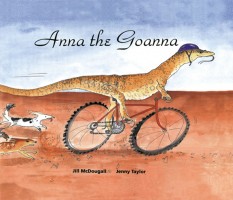
This is a collection of poems written by a schoolteacher ‘in order to provide classroom reading material which reflected the daily experiences of her students’. That description, taken from Jill McDougall’s bio at the back of this book, could be a recipe for semi-literate, patronising disaster, all the more so when the students in question are Aboriginal. On the contrary, this collection is a delight, words and images both. Not that the opinion of a 65 year old urban middle class white men matters all that much, but I’d be surprised if this book didn’t go down very well indeed, in the classroom and out of it, performed for the students or by them or read in private, by curious non-Indigenous as well as Indigenous children.

Why did I read it? Well, reading the Kevin Gilbert books reminded me of how much I enjoyed his children’s poems, and this was a gift that has been sitting on my shelves for a couple of years now, waiting for a suitable child to turn up to be read to from it. I just decided to stand in for that hypothetical child.

As the title promises, there are silly poems about goannas. There are also mosquitoes, crows, flies, and a crocodile, but it’s not all animals. There are babies, big sisters, football and baseball, a sweet   comedy about the difference between Aboriginal and mainstream economics, and two pieces that depart from the general cheerful tone – ‘Too Many Drunks’ and ‘Sad Boys’ , the latter being about petrol sniffing.

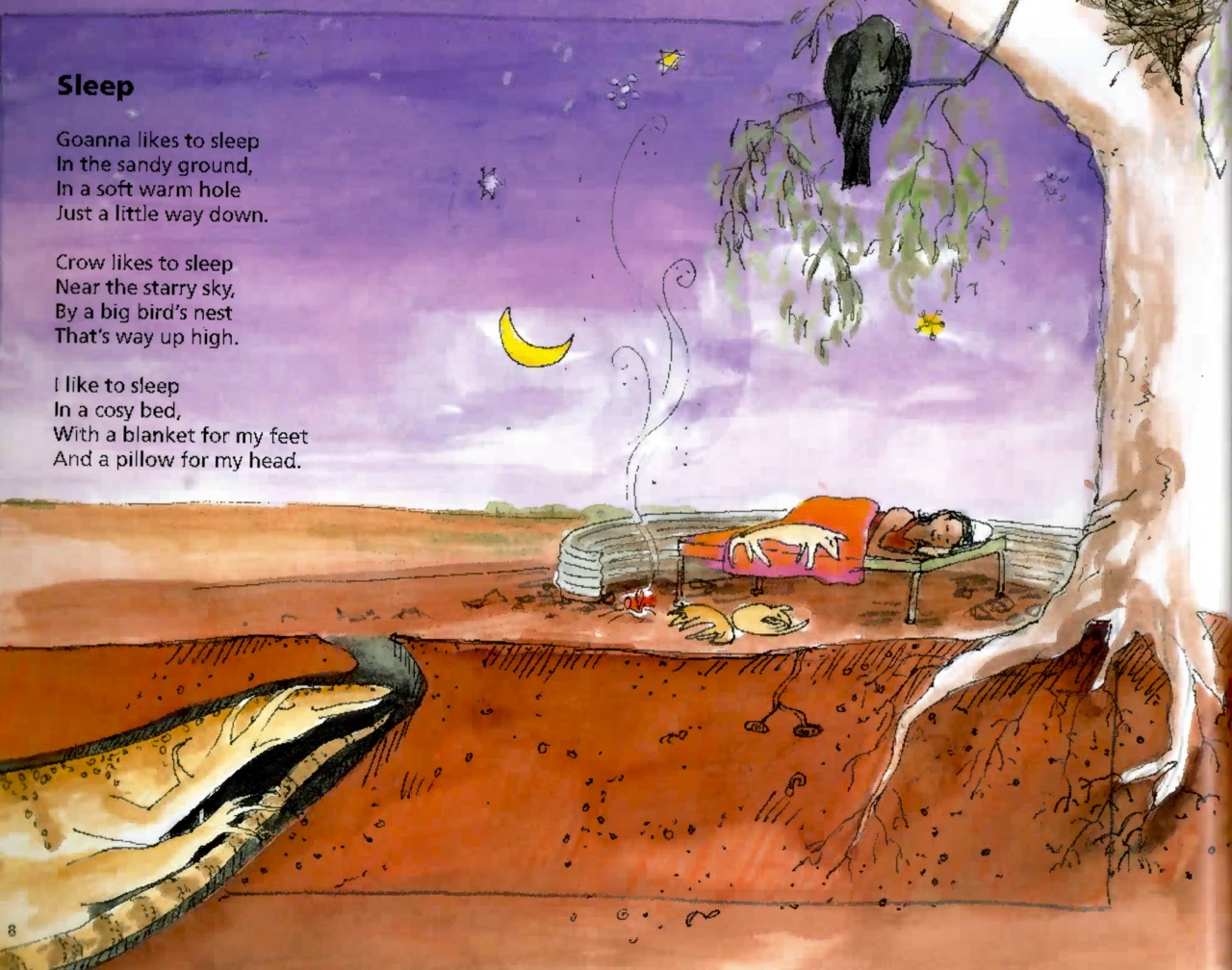
Jenny Taylor’s illustrations demonstrate just how important the interplay of text and image can be in a picture book. One page that struck me in particular was ‘Sleep’. The poem:

Goanna like to sleep
In the sandy ground,
In a soft warm hole
Just a little way down.

Crows like to sleep
Near the starry sky,
By a big bird’s nest
That’s way up high.

I like to sleep
In a cosy bed,
With a blanket for my feet
And a pillow for my head.

The final stanza could be spoken by any child, anywhere. One could easily think of a room with pastel wallpaper and shelves of stuffed toys. The illustration is a revelation about possible meanings for the word ‘cosy’:
Scary sign

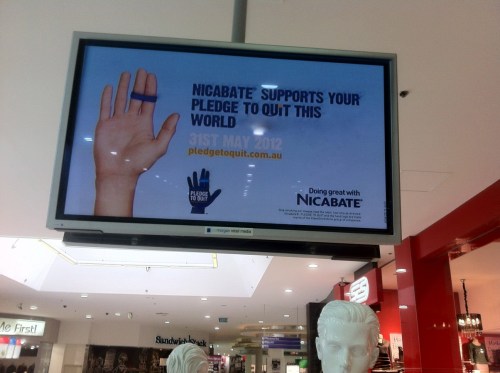
Seen in the Marrickville Metro:

True, that’s what I saw! Nicabate supporting someone’s suicide pledge! What I saw when I looked again, and what was in this photo before I took to it with the eraser tool, was ‘STOP SMOKING DAY’ after ‘WORLD’. How useful a comma would have been after “QUIT’!


Terry Pratchet’s Snuff

Terry Pratchett, Snuff (Harper, 2011)

Apart from the Tiffany Aching books (which are for children, and also for adults, and brilliant), I have been out of touch with Discworld, though each Christmas I’ve given the current novel to my younger son, who has been a fan for half his life. Last year he reversed the flow and gave me Snuff. I decided to read it just now for light relief from a string of books about grim subjects – only to find that it’s pretty much about a genocidal slave trade. I don’t know if Terry Pratchett had the European-American slave trade in mind, or Queensland blackbirding, or the Nazi Holocaust, and I wouldn’t be surprised to learn that he had read Sea of Poppies – both books feature a drug trade conducted by establishment people and a vessel (the Ibis/the Wonderful Fanny) carrying a viciously oppressed human cargo (not exactly human in Snuff, but certainly sentient) that makes its way down a personified river (Mother Ganga/Old Treachery) and encounters many kinds of turbulence.

There are three overlapping strands in the Discworld series: the witches, the wizards and the City Watch. This is a City Watch story, starring Commander Sam Vines, who when I last saw him was a mere Captain, but has now been elevated like his creator to the peerage. Sam is dragged from his putrid native habitat, the streets of Ankh Morpork, for a holiday on his wife’s ancestral country estate. It takes a while, but of course the country turns out to contain just as much nastiness, danger and corruption as the city, and just as much stumbling heroism, awkward romance and unexpected beauty. A Discworld Jane Austen makes a cameo appearance, and a scatological children’s writer plays a significant role.

Sam is a wonderful character, an uncompromising servant of the law and believer in the rule of law who is all too aware of his own dark side, his own demons (and this being fantasy, both the darkness and the demons are literal). He discriminates among kinds of evildoing. For example, when the main atrocity has been exposed one of the villagers who had failed to intervene approaches Sam, who is having a snack at the village pub:

‘Well sir, yes, of course we knew about the goblins and no one liked it much. I mean they’re a bloody nuisance if you forget to lock your chicken coop and suchlike, but we didn’t like what was done, because it wasn’t … I mean, wasn’t right, not done like that, and some of us said we would suffer for it, come the finish, because if they could do that to goblins then what might they think they could do to real people, and some said real or not, it wasn’t right! We’re just ordinary people, sir, tenants and similar, not big, not strong, not important, so who would listen to the likes of us? I mean, what could we have done?’

Heads leaned a little forward, breaths were held, and Vimes chewed the very last vinegary piece of crisp. Then he said, directing his gaze to the ceiling, ‘You’ve all got weapons. Every man jack of you. Huge, dangerous, deadly weapons. You could have done something. You could have done anything. You could have done everything. But you didn’t, and I’m not sure but that in your shoes I might not have done anything, either. Yes?’

Hasty had held up a hand. ‘I’m sure we’re sorry. sir, but we don’t have weapons.’

‘Oh, dear me. Look around. One of the things that you could  have done was think. It’s been a long day, gentlemen, it’s been a long week … [Addressing the barman] Jiminy, these gentlemen are drinking at my expense for the rest of the evening.’

This is the third book Sir Terry has written since he revealed to the world that he has Alzheimer’s. He can no longer type, but – with the help of voice recognition software – he can certainly still write. For those who have kept up this book may be showing signs of flagging mental ability, but it’s full of wit and passion and sheer inventiveness, and also wisdom. If you haven’t read any of his books I wouldn’t start here. Try Guards! Guards! or Witches Abroad or Mort or The Wee Free Men.

Elizabeth Jolley, My Father’s Moon

Elizabeth Jolley, My Father’s Moon (Penguin 1989)

I started this more from duty than for pleasure. Previously I’d read just the one short story by Elizabeth Jolley and seen the movie of The Well, and failed to be grabbed. But I want to be well read in Aust Lit, and I couldn’t be sure it wasn’t just sexism that had me avoiding this Big Name Author. It’s a slim book, easy to read on public transport, described by the cover blurb as ‘the novel at the heart of all her work’.

It’s probably very good. Middle class English schoolgirls, then nurses in a hospital during World War Two, then teachers at a ‘progressive’ school (though not in that order – this is a Literary Novel of 1989, remember, and a lot is told out of chronological order for no apparent reason other than to play with the reader’s mind) are variously mean, petty, homoerotic, spiteful, class-conscious, kind, gossipy, weird, naive, vulnerable, pretentious, callous, romantic, obtuse, pregnant – though the narrator, who happily has described two women waltzing naked, is too reticent to give us anything physical about the moment of conception. It’s very well written, and made me think of Blake: ‘Sooner murder an infant in its cradle than nurse unacted desires.’

So now I can say I’ve read some Elizabeth Jolley. I don’t feel the urge to read more.

Madlands launch at Gleebooks

Last night we went to Gleebooks for the launch of Anna Rose’s Madlands. This is her book about the experience of going on ABC television’s I can change your mind about … climate with Nick Minchin. I confess to not watching the show: there was enough condescension on the basis of age and gender in the trailers to do me for a lifetime, though Anna Rose seemed remarkably unflustered by it. He called her a warmist! It was as attractive as an hour ‘debating’ whether the earth is flat or passive smoking is a health hazard or Rupert Murdoch is rich.

Last night was not a ‘debate’, though it was largely about the vested interests, economic and ideological, that keep talking that way.

Louise Adler of Melbourne University Press referred in passing to the current debasement of political life and we realised that this was not the ABC, where Balance rules, and all opinions are equal.  Incidentally, she confessed (under a cone of silence so as not to build up other writers’ expectations, but us bloggers know no shame) that the book was written in two and a half months and then proceeded from manuscript to the bookshops in another couple of months.

John Hewson, once leader of the Liberal Party and sufficiently neo-liberal to have been called the Feral Abacus by Paul Keating, launched the book. (Incidentally, to have been insulted by Paul Keating must be a little like having been caricatured by one of the greats – it might not portray you in a good light, but the artistry is so fine that you will tell people about it for the rest of your life.) Hewson  talked quite a bit about his own activism in the business sector. He’s currently involved in a project, for instance, which will result in a published list of the top thousand superannuation funds rated according to their investment in sustainable enterprises – a listing which, he hopes, will result in a significant increase in investment in non-carbon energy options. But he wasn’t so much taking the opportunity to blow his own trumpet as to contextualise Anna’s book and her activism as co-founder and chair of the Australian Youth Climate Coalition: it’s no good waiting for government to act, was his message, but if you look around you’ll see that there are alternatives.

Anna Rose spoke too. Asked about her calmness on the TV show, she said that she kept remembering that her aim was to speak to the people watching the show, and if she allowed herself to be rattled by unpleasantness coming at her she wold probably lose those people. She invited us to applaud her mother (in the audience, almost as alarmingly young as Anna Rose herself), who over many years had given her a brilliant example of talking to people respectfully and changing their minds. Evidently she has received an enormous amount of hate mail since the show went to air – she commented that the anonymity of the Web allows some people to behave very badly, but shrugged and said you get used to it. (She’s married to Simon Sheikh of Get-Up, also there with a big smile on his face, so I guess she has some forces countering the hate.)

There was some talk about hope. Anna Rose quoted Paul Kremer (I looked it up and found the context here):

If you look at the science about what is happening on earth and aren’t pessimistic, you don’t understand the data. But if you meet the people who are working to restore this earth and the lives of the poor, and you aren’t optimistic, you haven’t got a pulse.

Any time we are feeling discouraged, she said, we should visit http://aycc.org.au/, see what the Australian Youth Climate Coalition is up to and make a donation. At the moment they’re raising funds to give a copy of this book to every member of the Australian Parliament.

We bought three copies of the book and went off to dinner knowing that we had pulses.