Monthly Archives: Apr 2015

Quarterly Essay 57: Dear Life

Karen Hitchcock, Quarterly Essay 57: Dear Life: On Caring for the Elderly (Black Inc February 2015)
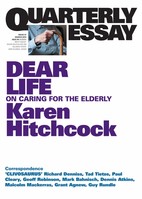
qe57

Like every Quarterly Essay, this one includes lively correspondence on the previous one. Guy Rundle’s Clivosaurus drew thoughtful responses from a number of writers of the left, defensive missives from representatives of The Australian, fascinating psephology from Malcolm Mackerras, and more. Much of it was too technical for my pay grade, but one thing is clear to me: if you get into an argument with Guy Rundle, it would be unwise to let him have the last word – he’s very good at the devastating rebuttal.

A number of people have already tweeted that every Australian should read Karen Hitchcock’s essay on the treatment of elderly people in our health system. She is a general physician who has worked in large hospitals in several Australian states, and so has extensive hands-on experience in working with frail and/or demented elderly people. As she says:

There are two strong narratives in our culture about the ageing population and death. The first is that medicine is keeping elderly patients alive against their will – medicine is denying a death the patient desires. The second is that elderly patients are seeking to stay alive unreasonably – the patient (or their family) is denying an unavoidable death.

The essay takes these narratives on fiercely, and does a brilliant job of unpicking the ageist assumptions and fanciful versions of sickness and hospitals on which they are built. She marshals her own personal and professional experience as well as current research to mount a convincing counter-narrative.

She describes the way modern medicine is fragmented into specialities, a situation that makes it hard to treat elderly people with multiple conditions.

She explores the concept of futility: is treatment futile if it extends a person’s life for just a few days but those few days allow them to say goodbye to family? can a hospital specialist who is as drenched in ageism as the rest of us and has no personal knowledge of a patient be trusted to make a sound judgement about the futility or otherwise of treatment?

She savagely rips into the often heard argument that the increasingly aged population will make the health care system unsustainable.  ‘Sustainable’, she argues, ‘is just a word for “what we are willing to pay”.’ And the real challenge to the health system comes not from the aged but from ‘a population of increasingly poor, obese, diabetic, sedentary young and middle-aged who are the multi-morbid patients of the future and who will require many drugs, doctors, operations (joint replacements, bariatic surgery, amputations, coronary vessel interventions) and hospitalisations’.

Advanced medical directives, documents that spell out ahead of time conditions that are not to be treated if a person is incapable of making their wishes known, are singled out for special opprobrium. Hitchcock is an excellent storyteller, and her story of 84-year-old Fred who came to hospital begging to be allowed to die is enough to win her case without any further discussion: he was wretched, and didn’t want to be a burden (an often heard internalised version of the message with which older people are too often bombarded); she listened to him, encouraged him, treated him, and followed up some time after he was discharged:

I said, ‘Fred , you told me you didn’t ever want to come back to hospital.’
He said, ‘Of course I want to come back if I get sick. I get silly when I’m sick. I hate everything. I say silly things.’

Not all her stories have such cheerful endings. Death does happen. But if we are to have a national electronic system where people’s advanced care directives are recorded, then these directives, she argues, should be reviewed regularly, even monthly, by the people whose lives they concern.

The essay discusses the isolation that is the lot of many elderly people, including those who are placed in nursing homes when their families can no longer care for them. It argues that this is an issue that should be taken up by the society as a whole – ‘if we are to attend to the social needs of our elderly citizens both inside and out of institutions, then we need government interventions and funding, along with the community’s engagement and help.’ What is needed, and what is beginning to happen in some places is

a shift in perspective: the elderly are not a growing cost to be managed or a burden to be shifted or a horror to be hidden away, but people whose needs require us to change our society. They are those for whom we are responsible and to whom we owe real care.

Another sacred cow the essay takes head-on is the idea that it is better to die at home than in hospital. My own father had himself discharged from hospital in Townsville when he knew he was dying, and was flown and driven the 500 miles to Innisfail because he wanted to die at home. I have no doubt that that was a good decision: he spent his last days surrounded by friends and family, being visited by a doctor he’d known most of his life and a nurse he’d known all hers. He died in bed beside my mother, his wife of more than 50 years. But Hitchcock makes it very clear that his situation was exceptional in the western world today. A hospital death can be a good death.

In short, this Quarterly Essay is a call to arms against the oppressive attitudes and practices which we have insinuated their way into our minds and practices around older people. I’m 68, not yet in the frail and/or demented group that Hitchcock is talking about. I hope I never will be. But reading her essay, I wonder if my GP’s slightly disturbing lack of interest in my symptoms on my most recent visit, which I put down to his having had a long day or perhaps the lack of drama in my presentation, might have grown from an assumption that once you’re past a certain age you just have to put up with a certain amount of suffering. And that’s partly Karen Hitchcock’s point: if the problems she writes about are chickens, then we are all roosts waiting to happen.

aww-badge-2015

This is the fourth book I’ve read for the Australian Women Writers Challenge for 2015.

Tim Winton’s That Eye, the Sky at the Book Group

Tim Winton, That Eye, the Sky (McPhee Gribble 1986)

1TETSBefore the Meeting: That Eye, the Sky isn’t an obvious choice to discuss at a book club close to 30 years after it was published. It’s even less obvious, given that one or two of our members have disparaged Winton’s work (apart from Cloudstreet) fairly comprehensively. But we were looking for a film–book pairing and a couple of us – at least, I hope it wasn’t only me – remembered being moved by John Ruane’s movie based on this book. And it’s short.
I have mixed feelings about Tim Winton’s work. I loved The Turning, felt that the slow bits of Dirt Country were adequately compensated by other elements, especially the ending, and found The Riders close to pointless. His chapter in Big Surf, last year’s  essay on class  and his Palm Sunday oration about asylum seeker policy are all marvellous. Generally, I love his sentences. So, though I had loved the film (apart from a dimly remembered unease about the Peter Coyote character), I approached That Eye, the Sky with cautious optimism.

The narrator, Ort (short for Morton), is the 12 year old son of ex-hippies, living poor on the outskirts of a Western Australian city. His father has a car accident which leaves him in a coma then pretty much vegetative until the very last pages. Henry Warburton, a man Ort and his angry older sister Tegwyn have seen living rough under a nearby bridge, turns up and helps the family, bathing the incapacitated father and doing odd jobs. Henry, it turns out, is a bit of a loose cannon, but before his looseness becomes completely apparent he converts Ort and his mother to his peculiar brand of Christianity. Meanwhile, Ort is the only one who sees a strange light that hovers over their little house – possibly an after-effect of Ort having been comatose and died, twice, when he was little and had meningitis; or possibly Ort’s contact with a reality beyond this one.

The complex web of relationships is beautifully done, including Ort’s belligerent friendship with the boy from across the road, but I wasn’t convinced by the magic realism, if that’s what it is, and there were whole swathes where it felt awfully as if Tim Winton was wanting to tell us about the Bible. I was reminded of what someone said about Rob Reiner’s movie Stand by Me: there’s a lot of swearing and other stuff that lets the movie get away with its moments of tenderness. Well, Ort’s matter-of-fact description of bodily functions, and the final revelation of Henry’s moral dubiousness aren’t enough for this book to get away with its spiritual message. Not that there’s anything wrong with non-institutional Christianity – I just don’t believe in it in this book. The device of the uncomprehending child narrator – ‘What Ort Knew’ if you like – becomes annoying as one feels the ventriloquist author behind him:

The forest moves quiet tonight. Jarrahs move a long way up and out of sight. Now and then I hear little animal noises. All these trees are dying, and all these little animals will have nowhere to live. One day the whole world will die and we’ll die too. My back hurts and my bum stings and the backs of my legs too. I’ve got no clothes on out here in the forest. Prickles and burrs and twigs stick in me all over. I rub them in, squirm and shake around. It hurts a lot. I’m hurting myself. I want to hurt myself. I want to.

It made me yearn for the easy flow of Winton’s own unmediated prose.

The meeting: We couldn’t find a copy of the film anywhere. So what we had was dinner, each other and the book!

(That much was uploaded prematurely. Here’s a bit more about the meeting.) Perhaps because two of the six of us arrived late, the discussion of the book kept up for most of the evening. Each new arrival would be asked for an opinion and that opinion would set us all off again.

My impression is that we were all uneasy about the book’s supernatural/ religious/ spiritual elements , which just weren’t integrated into the story. On the other hand, when I singled out as implausible the passage where Ort summarises the Bible, someone said that a childhood friend of his had told him about this fantastic story of a bloke who gets nailed to a tree. So not so implausible.

Interestingly enough, the book triggered a spate of reminiscences: of country childhoods, of vengeful boyhood impulses involving urination, of helplessly witnessing someone’s life spiralling towards disaster.

As someone said, irritating but compelling.

Kit Kelen’s Scavenger’s Season

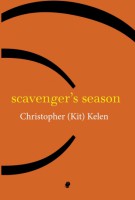
Christopher (Kit) Kelen, Scavenger’s Season; Fragments of an almanac  (Puncher and Wattmann 2014)

scavengers_season

Kit Kelen mostly lives in Macau, but there’s a patch of bush in New South Wales where he has spent a lot of time over the last quarter century. The 150 pages of Scavenger’s Season are filled with poetry of that place – as the title page says, they are ‘poems at Markwell, via Bulahdelah to mark the quarter century’. We’re invited to immerse ourselves in the poetry as Kelen immerses himself in his bit of bush.

Drought, rain, fire, the sounds of the bush at night, bush regeneration, the passing of the seasons, white and black cockatoos, wild and domestic animals, pastoral lyric, blokes and sheds, and through it all the experience of being humble with the bush. I just loved this book. I’ve read most of it a number of times. Some of the poetry is difficult to decipher, and I just plain gave up on two long poems, but mostly the difficulty is of a kind that offers new rewards every time you go back to the poem.

Kelen’s relationship with his patch of land is a kind of groping opposite to the colonising farmer attitude so elegantly articulated in David Campbell’s ‘Cocky’s Calendar’: ‘The hawk, the hill, the loping hare, / The blue tree and the blue air, / O all the coloured world I see / And walk upon are made by me.’ The ‘me’ who makes that world does it as farmer, but also as poet. Kelen echoes this idea  uneasily in ‘minor manifesto’:

one should acknowledge mastery

among sunfall and foliage
loathed and admired
is it not I who make
the landscape looking?

But there’s no hint of Campbell’s triumphalism. It’s a question, and the next lines suggest that the answer is complex:

I am the field here
cattle numb in
rain is waiting
for thirst to be spoke
taps on my shoulder home

That might be hard to follow if you haven’t acclimatised to Kelen’s language (more about that later), but I read it as continuing the acknowledgement of ‘mastery’, but modifying it – he doesn’t just make the field for cattle to be numb in (I don’t think he likes cows much), he is the field; and in the last three lines the ‘mastery’ becomes very tenuous – thirst may give rain meaning, and rain when it comes may serve the speaker’s purpose, but rain exists independently of how we need it, understand it or welcome it.

These line’s from the title poem, ‘Scavenger Season’, are more characteristic of Kelen’s attitude:

it’s true that I make no use of the land
that the land has no use for me

if each has a voice and neither has spoken
then there might be a treaty yet

‘little manifesto’ , which I quoted from above, is one of a dozen long poems in the book – it runs to eight pages. In a moment that’s characteristic of the book’s understated humour, the poem ‘manifesto’, not a little one this time, consists of just four lines:

from my door

everywhere leads me
every way home
nowhere but the way

I want to say a little bit about the language of the poems.

From my brief time as a 19 year old schoolteacher, I  remember only one piece of student writing. It’s a sentence in an essay written by a boy in Year 8, describing his arrival home from school: ‘Dog barking and jumping and licking my face.’ I knew that this was not a proper sentence, and it was my job to correct it. I did so, but with a heavy heart because I knew that pushing the sentence into a ‘proper’ shape (‘The dog barked and jumped up and licked my face’) would rob it of vitality and only theoretically make it clearer. My student had recently arrived from somewhere in China, so I guessed that his syntax wasn’t so much mistaken as transplanted. And technically incorrect as his sentence may have been, I remember it 50 years later.

Towards the end of my second reading of in Scavenger’s Season I realised that something similar was happening. The opening lines of the first poem, ‘think of this’, are as good an example as any:

think of this
a string of pearls
trail of droppings
as you’re disposed
or as light catches

The paraphrasable meaning is clear enough, but something odd is going on. It’s as if some words have been erased: ‘Think of this [as] a string of pearls [or as a] trail of droppings, as you’re disposed  [to] or as [the] light catches [them.]’ Almost every poem in this book asks for that kind of work from the reader.

Filling in the elisions isn’t always as simple in those five lines. The very next lines are pretty opaque:

think this where you’ve always been
and this advice could not have sought you
these your ageless friends among

But mostly the words cohere in response to slow, open-minded and open-hearted reading. It’s not unpleasant: it’s a little like reading in a language one learned long ago and has a rusty hold of – there’s a deep pleasure in feeling meaning emerge. I think that Kelen, who has taught at the University of Macau for 14 years, is doing what my Year 8 student did: writing English that is influenced by Chinese syntax. The result is richly memorable.

So there you have it: a book that invites you to join the poet in an immersive experience of the Australian bush, flavoured by a deep familiarity with Chinese culture and language.

I received a complimentary copy of this book from the publishers. I’ve read and re-read, used and abused it so much I may have to buy a fresh one with my own money!