See this post for the brief description of the challenge.
This week I haven’t done well at all – partly because I’ve been preoccupied with people I already know, and patly because I haven’t got out much. I realised that this project isn’t quite as trivial as I might have thought when I went for a walk by the Cooks River one afternoon and passed maybe 20 people of a range of ages, ethnicities and genders, and try as ai might I couldn’t even make eye contact with one of them … except for the one who features at point 5 here
Saturday evening, 7 o’clock, walking down Marion Street in Leichhardt looking for somewhere to eat, we had to make our way through a crowd of partygoers, carrying balloons and wearing funny hats. Three young women seemed the most approachable, especially as one of them was carrying a huge slice of sponge cake on a paper plate dripping with whipped cream. I said something inane to the cake-bearer. She laughed.
Tuesday. I went to a shop to pick up something that someone else had ordered. At my first words to the young man at the front of the shop, a voice from behind a tall display called out, and its owner emerged with the thing I was after in his hands. It turned out we had met briefly before in completely different circumstances, and had a brief and friendly chat about bike helmets as disguises
Thursday. At the pool with our granddaughter, I was paying to get in, and having trouble making my phone make the payment. I made several attempts that produced only clicks, no card image. The young man behind the counter – without a hint of pity, contempt or disdain – said, ‘You have to click twice. You’re pressing the volume button at the same time and taking screen shots.’ Quick as a flash, I said, ‘I knew that,’ and we were in business. (Just now I deleted three photos of the pool’s Covid sign-in screen from my phone.)
Thursday evening, the eve of garbage collection, I took our non-compost food scraps out to put in the appropriate council bin. Two women of a certain age were going through the recycling bins from our whole complex of units, collecting bottles and cans that can be redeemed. ‘Having any luck?’ I called to them. People mostly don’t seem to grasp the actual words I use in my opening gambits. ‘Bring it over here,’ one of them replied. ‘Oh no,’ I said, ‘This is rubbish.’ ‘Okay,’ she said, and they both lost interest in me.
Friday evening. Walking beside the Cook River, just as I was despairing of making contact with anyone we passed, a couple of tiny dogs in a house yard took noisy exception to a harmless-looking Labrador who was approaching us with a woman in tow. The Labrador ignored the hostile yappy dogs. The woman looked our way apologetically. I said, ‘Your dog’s handling that well.’ She said, ‘Poor thing.’
& 7. Saturday midday. As we were heading out on a walk, two youngish women were reading the small explanatory board near our front entrance and admiring the handsome Victorian Italianate house that is part of our complex of units. ‘So it is a residence,’ one of them said. I seized the opportunity. ‘Yes, it’s a residence,’ I said,. ‘There are 43 units.’ They looked interested. ‘It used to be a hospital, then a home for unmarried mothers.’ And I pointed to my favourite phrase on the board: ‘young women who gave their affections unwisely.’ Someone said (remember, this is the week when Australian parliamentary leaders seem to indicate that sexual assault is beneath their serious attention), ‘Always blame the women.’ 8, 9, 10, 11. Saturday a little later. On my way home I passed an auction in the street a block away from the recently reopened Enmore Theatre. The auctioneers rolled up contract came down on 2.3 something million dollars, and the crowd of stickybeaks began to disperse. I checked the poster at the front of the house – a corner terrace with 3 bedrooms and 1 bathroom – and, this being Sydney, fell into easy conversation with a young woman who was also checking it. Then another woman and two men joined in. Someone’s phone told us that the median price for a three bedroom house around here is 1.6 million. We variously commented on how happy the vendors must be, likewise their neighbours, and how prohibitive the housing market was. My impression that one couple, possibly both, were hoping to buy something sometime and weren’t being cheered. But maybe like me they were just passers-by seizing a chance to speak to strangers.
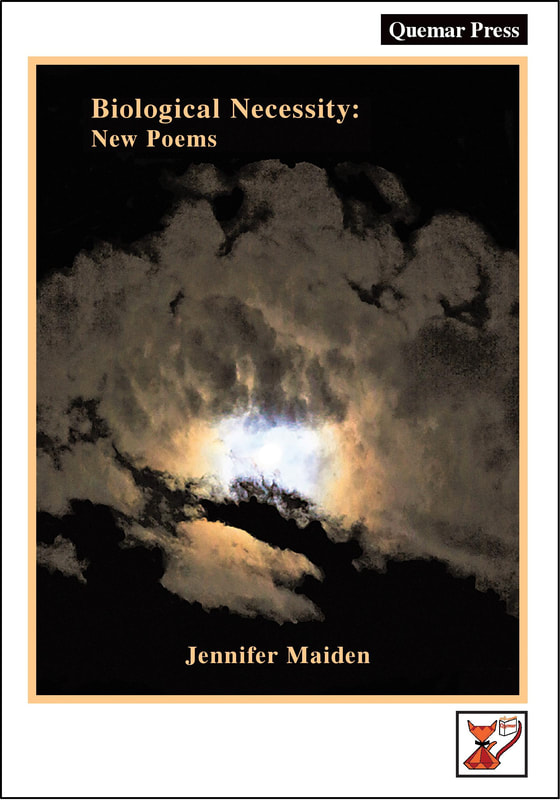
For some time now, Jennifer Maiden has produced new poetry collections almost as regularly as the earth revolves around the sun. Giramondo published five books between 2010 and 2017, handsomely designed by Harry Williamson. Since then Quemar Press, the publishing company created and run by Maiden’s daughter Katharine Margot Toohey, has published a collection of her poetry at the beginning of each year (as well as Selected Poems 2017–2018, a number of novels and two other slim non-poetry books authored or co-authored by Maiden). Biological Necessity is the fourth new collection.
I look forward to each new book in much the way I’ve looked forward to each new season of, say, Call My Agent.
I want to know what happens next in a number of continuing narratives. Maiden’s fictional characters George Jeffreys and Clare Collins continue to turn up in international hotspots – in Biological Necessity, they spend time in Covid quarantine at Darling Harbour, and they talk to Donald Trump by Skype on 2020 election night (in a poem published online before the votes were counted). Her versions of real people living and dead continue to chat with each other, at least one person in each chat having just woken up as if a switch has turned them on in the poet’s inner mind – here Eleanor Roosevelt’s ambivalence about Hillary Clinton reaches a kind of peak in her 17th poem; and Gore Vidal continues to hover around Julian Assange. Maiden’s incarnation of the Carina Galaxy as a sixties bombshell, last seen several books ago, makes a repeat appearance.
Surrounding the narratives, a sprawling, multi-faceted conversation has continued over the years, a conversation largely about politics and abuses of power. There are Diary Poems, which usually include ‘Uses of … ‘ in the title: in this book, poems meditate on the uses of biological necessity (Aneurin Bevan said that socialism was a biological necessity), indigo (the colour), Sacha Baron Cohen (for his performance in The Trial of the Chicago 7) and Finnegans Wake. In them, and in Maiden’s poems generally, there’s a quality of heightened chattiness: a subject is announced in the opening lines, and is reflected on; then, sometimes as if distracted by a random association, the poem veers off, and perhaps veers off again, always to interesting places, sometimes to recondite ones such as, in this book, Bolivian elections or Andean mountain cats; those different veerings crisscross one another, and – to mix my metaphors – weave something new. I love this process; it’s like listening to someone’s mind doing the basic work of thinking, meditatively and associatively.
The poems/conversation/meditations generally deal with topics more usually found in op-ed journalism: Julian Assange, Ghislaine Maxwell, Donald Trump, Greta Thunberg, Syria, Covid–19, the CIA, right-wing cultural machinations. But it wouldn’t do them justice to read them as op-eds cut up to look like verse, with an occasional rhyme for good measure. We don’t read them so much to find out what Jennifer Maiden thinks, or to learn about the world (though they often send me searching the web), or to debate a position, but rather to enjoy the carefully-crafted illusion that we are listening to the poet in the act of thinking.
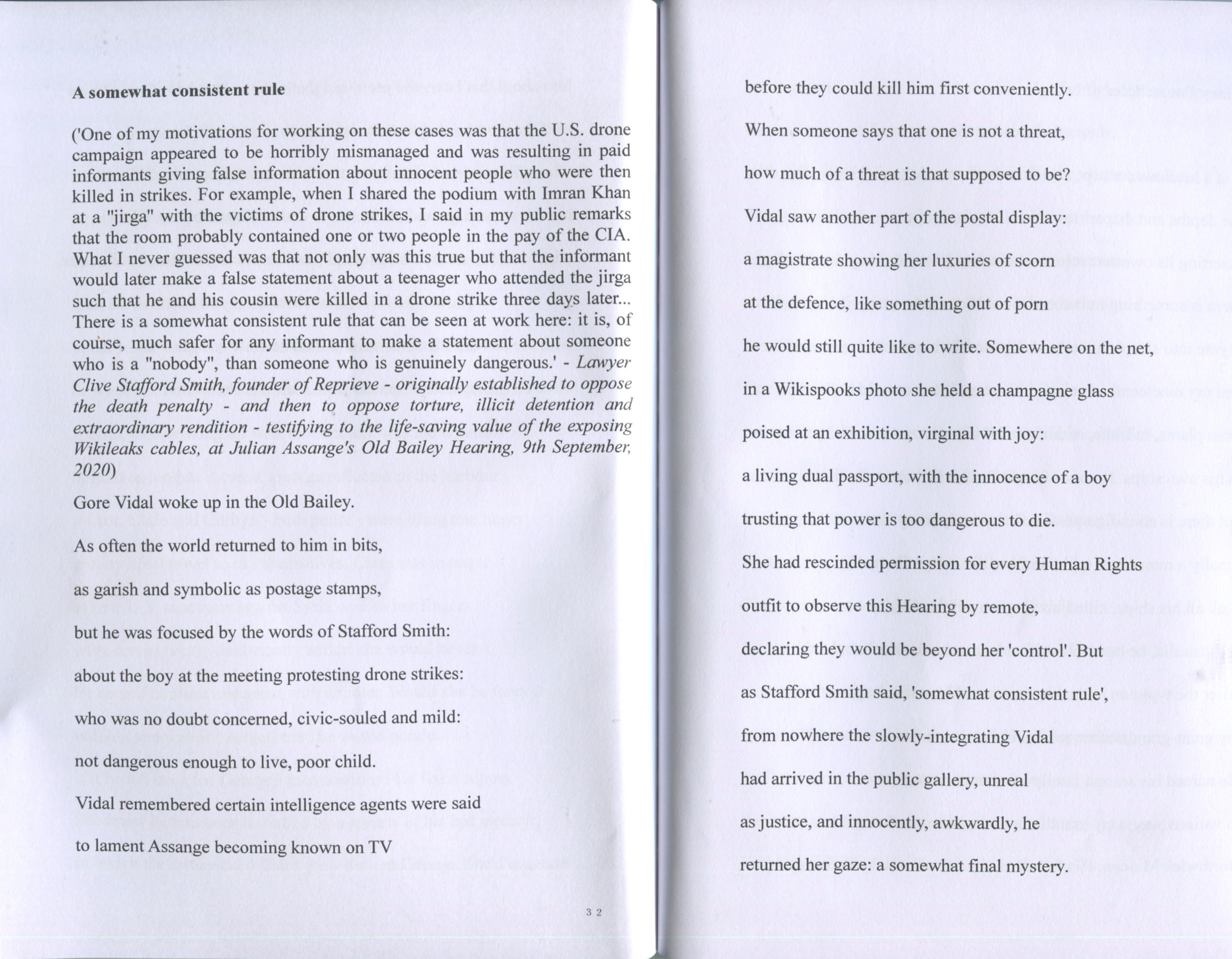
Usually when I write about a book of poetry I focus on a single poem. So hard to choose! ‘After the Volcano’, which revolves around a poem by Martin Johnston that Jennifer Maiden read at a zoom event, which I attended, marking the 30th anniversary of Martin’s death? One of the excellent Covid poems? ‘The Watchchain’, on a family story of a watchchain made from a dead woman’s hair? I ended up choosing ‘A somewhat consistent rule’, because it’s one of the shortest in the book, and can be captured in a single scan. (If you can’t read it easily here, you can find it on page 39 of the pdf sampler from this book on the Quemar website.)
We know from the prose introduction – unusually long and informative for a Jennifer Maiden poem – that this is one of her poems inspired by the travails of Julian Assange, of which the short lyric ‘My Heart Has an Embassy‘ is perhaps the best known. The quote is from Clive Stafford Smith’s official witness statement at the Assange hearing in September 2020, which is available as a PDF at this link (see paragraph 86). It not only announces the poem’s context, but also identifies the ‘rule’ of the title: it could almost stand alone as a found poem. In reading this poem, it’s important to note that the statement was read aloud in court.
I don’t know how this poem would work for a reader unfamiliar with Jennifer Maiden’s work. I read it as part of a web of poems that relate to each other in form and content. The first line places it in a long series of Maiden’s poems that open with someone waking up, all the way back to when it was always George Jeffreys waking up to see George W Bush on television obsessing about Iraq. Specifically, it’s at least the fifth poem, and not the last, in which Gore Vidal wakes up. He is Maiden’s main conduit for engaging with Assange (along with Diana Spencer and Emma Goldman in previous poems). He’s not a completely arbitrary choice: Assange was clutching a book by Vidal when he was dragged out of the Ecuadorian embassy in April 2019, which led to Vidal feeling ‘quite possessive of his reader’ (‘Resistance’, The Espionage Act, page 6).
The next two lines mark a departure in the ‘woke up’ poems. Vidal doesn’t simply snap awake as in these poems previously, but the waking process continues for the whole poem: ‘the world returned to him in bits’, and the lines that follow show us the bits. (As my regular readers know, I’m currently reading À la recherche du temps perdu, and am reminded that Proust’s narrator takes several pages to describe such a bit-by-bit waking up.) Not yet fully awake, Vidal finds a focus in the words of Stafford Smith about the boy
who was no doubt concerned, civic-souled and mild:
not dangerous enough to live, poor child.
It’s worth noticing the deliberate use of rhyme. In ‘mild’ / ‘child’, and later in ‘scorn’ / ‘porn’, ‘joy’ / ‘boy’, and ‘awkwardly, he’ / ‘mystery’, there’s a whiff of, say, Alexander Pope’s classic rhyming couplets:
Heav'n from all creatures hides the book of fate,
All but the page prescrib'd, their present state
Maiden’s couplets don’t aspire to that magisterial authority. They don’t scan beautifully like Pope’s, but the rhyme does suggest a connection to that tradition, in which the poet casts a withering eye on hypocrisy and pretension.
The next three lines, in a characteristic Maiden move, invoke insider gossip about public events. I assume that Jennifer Maiden, who lives in Western Sydney, doesn’t have much access to US intelligence agents, so what Vidal remembers hearing is probably as much an invention as the awakening Vidal himself. But it’s plausible, and here the ‘TV’ / ‘conveniently’ rhyme adds a hint of dark comedy.
Vidal’s focus on ‘the words of Stafford Smith’ ends with the chilling general implication that being seen as harmless, far from meaning one will be ignored, might actually be a threat.
Then the poem veers. In nine or ten lines, Vidal pictures, one of the postage-stamp images that he wakes to, the magistrate hearing Assange’s case.
a magistrate showing her luxuries of scorn
at the defence, like something out of porn
he would still quite like to write.
In real life this is Vanessa Baraitser. I found this description by John Pilger:
Her face was a progression of sneers and imperious indifference; she addressed Julian with an arrogance that reminded me of a magistrate presiding over apartheid South Africa’s Race Classification Board …
When [Julian Assange] spoke truth and when his barrister spoke, Baraitser contrived boredom; when the prosecuting barrister spoke, she was attentive. She had nothing to do; it was demonstrably preordained. In the table in front of us were a handful of American officials, whose directions to the prosecutor were carried by his junior; back and forth this young woman went, delivering instructions.
‘Luxuries of scorn’ isn’t too bad a summing-up. ‘Porn’ in the next line isn’t an arbitrary rhyme: it’s Gore Vidal who is seeing these things, and though I don’t know if he write any porn, he was interested in sexuality as much as in politics.
I found the photo of Baraitser poised at an exhibition with a champagne glass as described in the next lines. It’s here if you’re interested, but it doesn’t add a lot. The word image is strong enough. The next lines do a lot of work:
________________________ virginal with joy:
a living dual passport, with the innocence of a boy
trusting that power is too dangerous to die
‘Virginal with joy’ contrasts with Vidal’s associating the magistrate’s manner with porn. The use of passport as a metaphor for two-facedness reminds even those of us who haven’t followed Assange’s trials closely that passports and citizenship have been an issue. The phrase ‘too dangerous to die’ echoes ‘not dangerous enough to live’ from earlier in the poem. The magistrate has dual identities, on the one hand an innocent viewer of art ‘poised at an exhibition’ and on the other an agent of oppression (hinting at one of Maiden’s themes that reactionary forces manipulate art and literature for political ends); innocence and trust are attributed to her, but rendered nastily ironic by the phrase ‘of a boy’, recalling the boy who was killed by forces that the magistrate is at least indirectly abetting.
The next lines – ‘She had rescinded permission …’ – refer to her action that’s on the public record, but the poem is doing more than simply stating the facts. The scare quotes around ‘control’, taken together with ‘remote, are a nod and a wink towards the deadly drones that are the background to the hearing and to the poem. without any big display, the found language of the court is being harnessed to remind us that the courtroom procedures are intimately connected to murder by drone in Afghanistan.
I had trouble parsing the final five lines:
____________________________________ But
as Stafford Smith said, 'somewhat consistent rule',
from nowhere the slowly-integrating Vidal
had arrived in the public gallery, unreal
as justice, and innocently, awkwardly, he
returned her gaze: a somewhat final mystery.
Once I realised that ‘as Stafford Smith said’ means not, ‘in agreement with Stafford Smith,’ but, ‘at the moment when Stafford Smith was saying,’ the penny dropped. Stafford Smith’s witness statement isn’t a document being recalled here, but the spoken background to the poem’s action. At the beginning, when Gore Vidal ‘was focused by the words of Stafford Smith’, he was waking up, bit by bit, to the sound of Stafford Smith’ evidence, and hearing the story of the boy killed by drones is what makes him fully present ‘from nowhere’. The poem’s action is the imaginary Gore Vidal’s coming to full wakefulness.
‘Unreal as justice’: yes, the poem is saying, this Gore Vidal is imaginary, coming ‘from nowhere’, but so is any justice that Assange will receive in this court. Innocence and awkwardness aren’t words that have often been applied to Gore Vidal, one of last century’s most wickedly sophisticated writers, but even he must experience that first moment of wakefulness as an awkward freshness. His sharp intelligence meets the gaze of the morally compromised magistrate. Vidal becomes fully present, the poem’s perspective on this judge in this trial solidifies, becomes ‘somewhat final’. As for ‘mystery’, it’s a satisfying rhyme for ‘awkwardly, he’, and reminds us that Gore Vidal, like the other people who wake up in Maiden’s poems, isn’t simply a mouthpiece for the poet’s views: there’s a mysterious process by which these imagined figures come from somewhere (‘from nowhere’, perhaps) to help her, and us, think. Not What Would Jesus Do? but what Would Gore Vidal Think?
We started the week with an overnight trip to Canberra to see the Know My Name exhibition at the National Art Gallery (apologies to Canberra friends we didn’t contact). The exhibition is fabulous, from the Djampi Weavers to Linda Lee. And the trip provided lots of opportunities to add to my meeting-people challenge. See last week’s post for the brief description of the challenge. This week’s exchanges range from tiny to trivial, but in most of them I made a decision to initiate contact, and it seemed mostly to be welcomed. Which is the point of the challenge.
Sunday morning, 21 February. At a petrol station near Mittagong, as I went to pay, I passed a woman wiping her hands on paper towel with exaggerated gestures. She said, to the world in general, ‘It’s slimy.’ I stopped to ask, ‘What is?’ ‘The hand sanitiser,’ she said. ‘ I thought it would be slimy, and it was.’ She said this through teeth clenched around a credit card, which she was evidently protecting from the slime. I made a sympathetic noise and went on my unsanitised way.
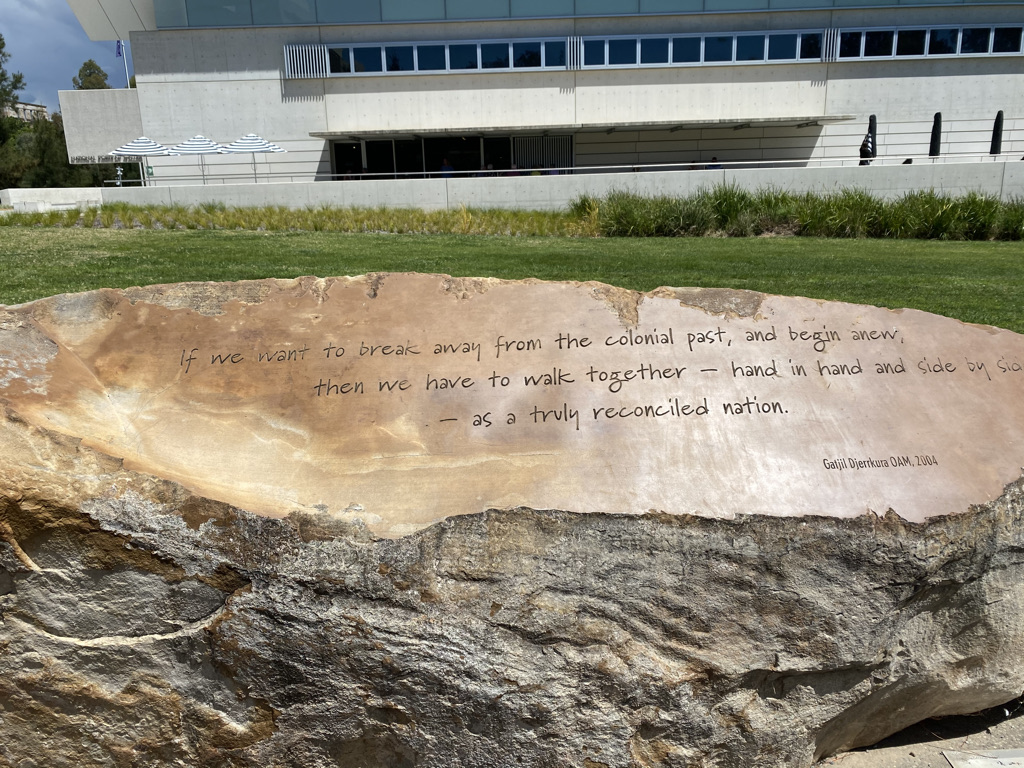
Sunday afternoon, in Canberra. As we approached what turned out to be Reconciliation Place, we passed a 50-something white man who had just been looking at a piece of carved stone. He greeted us with a smile and nod that felt a little like the solemn acknowledgements people make at the start of funerals. We reciprocated, then read the inscription on the stone and understood his demeanour. In case the image isn’t legible, it says: If we want to break away from the colonial past, and begin anew, then we have to walk together – hand in hand and side by side – as a truly reconciled nation. Gatjil Djerrkura OAM, 2004
Sunday evening, the Jonathan-is-an-idiot moment, which I hope won’t be a regular feature. I ordered pappardelle with beef ragú. When the waiter asked how the meal was, I said, truthfully, that it was excellent, but I thought pappardelle were butterfly shaped pasta. She looked astonished, and told me I was wrong. I checked on my phone, and discovered that butterfly pasta is farfalle, and pappardelle, named from pappare, to gobble, are exactly the broad ribbons I had just enjoyed. When I paid, I told the waiter my phone had discovered that she was right.
Sunday. In Canberra you can have more than one person in a lift. We shared a ride with a young man in a grey T-shirt that said, in neat black lettering, ‘THIS IS NOT A PHASE‘. He was observing rigorous modesty of the eyes – or willing us out of existence, take your pick. When we stopped at his floor, I said, ‘Nice T-shirt.’ He flashed a big smile and said, ‘Thanks.’ I didn’t get to ask him what THIS was.
Tuesday morning. When I arrived at the physiotherapist a woman was taking up a lot of space in the waiting room, fussily and vocally searching for her mask (still required in the treatment rooms). She was the kind of perfectly nice person I tend to avoid. When I came out from my treatment, she was still there, sitting quietly. I realised I didn’t have my backpack, and made a little fuss of my own. She said, quite calmly, ‘You’ve probably left it in your car, love.’ I agreed and thanked her. She was right.
Wednesday morning, 6.30. In the change room at the pool, there were just two of us, me dressing after a swim, and a young man undressing before one, mostly with our backs discreetly to each other. As we headed off in our different directions, I remarked that it was good to have proper hot water at last (the pool management have used the Covid lockdown to fix the plumbing). The young man looked as if he had no idea what I was taking about, but gave a friendly smile and said something about it being a good way to wake up.
Thursday afternoon at the Australian Museum, a young woman gave a tiny presentation about volcanoes to a group of preschool-age children, which culminated in an eruption generated by a mixture of vinegar and sodium bicarb. I couldn’t resist telling her about my own volcano demo from years ago, in which I demonstrated what happens when phosphorus is exposed to air. As the classroom filled with clouds of white smoke, I said, ‘You know, I think this gas is poisonous,’ and you’ve never seen a room empty faster than that one. The young woman was more shocked than amused. ‘Were you a science teacher?’ she asked. ‘I was that day,’ I said. I don’t think it was the beginning of a friendship.
Thursday a little later, as my companions were in the ladies, I was sharing a small vestibule with a woman with a baby on her front, two small children playing with balls, and a brightly coloured cart filled with childhood paraphernalia and crowned by a large umbrella. In the interests of talking to strangers I asked about the cart. She explained that it was invented by a Brisbane woman, and made life so much easier on an outing, able to carry two children and a baby plus food, change of clothes, toys, picnic gear, and more. It was easy to pull along, as the boy, aged about four, was happy to demonstrate. The only problem was that it didn’t fold. Nonetheless, she takes it on the train. I looked for the contraption online later, with no success.
Friday morning, breakfast in a nearby cafe. My companions each order smashed avo. I ask for an almond croissant. The waitress says to me, ‘Good choice.’ One of my companions says, ‘What, so ours wasn’t a good choice?’ She doesn’t miss a beat: ‘The avo is always excellent, but if you’re going to depart from the written menu, the almond croissant is wise.’ I say, ‘You should be a diplomat,’ then I worry that she may have felt a bit harassed as she says, very softly, ‘Just doing my job.’
Friday afternoon, in Kinokuniya to buy a birthday gift. I know which comic book I want but can’t find it. I stop a masked man and tell him that while I can see the huge omnibus of the title I’m after I can’t see the individual books. He is delighted to show me the way. I’m not sure if this one counts, because I’m fairly sure that beneath the mask was the face of the man who had originally recommended the series to me back in December.
That’s encounters 11 to 20 – I couldn’t figure out how to number this lot and also include the image for encounter Nº 2.
Partly because of Covid isolation, I’ve decided to take up a challenge someone proposed recently: to meet 500 new people in the remainder of this year. I’m defining ‘meet’ to include minimal encounters, but there has to be some reciprocity and at least a remote possibility of more to come. I can count people serving in shops, but they have to be new to me and the encounter has to be more than purely transactional. Electronic encounters don’t count. I plan to do a weekly blog post, listing 10 or so encounters each week. This will mostly to be a chronicle of moments that would usually pass unremarked. I don’t expect it to be hard to reach 500. Here goes with Week One.
Sunday 14 February, morning. The Emerging Artist and I were on a morning walk in Newtown. As we cut through the Matt Hogan Reserve, a tiny patch of green between Camden and Alice Streets, we passed a man walking two small dogs. The EA and the man nodded good morning to each other. I greeted him separately, and he replied, with a noticeably broader smile, acknowledging that I was a second separate greeting, not a mere extension of the first. I’d guess that he was Polynesian.
Monday morning. I bought a soy and linseed loaf at our local artisanal bakery. The woman behind the counter, new to me, was extra cheerful. We had a little bit of banter when the card reader took two attempts to register my payment. ‘It happens to me too,’ she said. In retrospect she may have been reassuring the old guy, but it just felt friendly at the time.
Monday afternoon. There were men in the sauna, ignoring each other comprehensively, barely even a nod exchanged as each one came in (I tried). Then a fourth, a young man, joined us. After a beat, I rose to the occasion, pointed to the Covid-safety notice on the door, and broke the silence: ‘There’s a limit of three people in the sauna.’ He looked me in the eye and said, quite politely, ‘Oh, is there?’ and gave no sign of intending to move. Of all the possible responses, many of which would have been civil, I moved straight to: ‘Well someone has to leave, and since you’re not going to, I will. And,’ pointing an angry-old-man finger at him, ‘you’re a fucker.’ Everyone else remained impassive as I picked up my towel and left. No one said these encounters had to be pleasant, or that they had to make me look like a decent person.
Tuesday afternoon. The EA and I had a meeting about financial matters with two people, one of whom we’ve known for years (decades?). The other we were meeting for the first time. When we emerged, we agreed that we both felt the new person was warm and approachable, as well as inspiring trust in her professional competence. That is to say, above and beyond the business of the meeting we liked each other.
Wednesday, lunch: There were six of us at lunch, including was one man I’d not met before. This man revealed that he has taken the advice of his daughters and stopped climbing ladders so as not to tempt fate. I was a little surprised, and asked his age. 78, four years older than me. And not only has he stopped climbing ladders, but he receives an age-care home-help package. His wife needs help with showering and mobility, but he himself hasn’t got any discernible disability. Another chap, just my age, said he had been inspired by to get a package himself, and there seemed to be consensus that I should be applying for one as well. Start lining up help now, was the message; don’t wait until the need is urgent. We had a lot of other pleasant and interesting conversation, but this is the place where he made his mark on my psyche, and I’m guessing that my response of shocked denial made a similar mark on his.
Wednesday, also at lunch was a man I hadn’t seen since 1964, so I’m counting him as new. Conversation ranged far and wide, but the most interesting exchange (to me) was about the false fingernails on his right hand. They were strikingly shiny and long in a way I’ve never seen on a man’s hand before. The closest I’ve come is one very long fingernail on a Balinese customs officer. In that case I assumed the fingernail was there for purposes of playing a musical instrument, and it turned out that was the case here too. He had learned to play the guitar finger-picking and couldn’t bring himself to use a plectrum. He could have made a decent stand-up routine out of his first visit to a nail parlour.
Wednesday evening, at the movies. During the ads, a young man arrived and sat a couple of seats away from us. I leaned across and said, ‘If you’re uncomfortable about us not having masks on, we can put them on no worries.’ ‘Thanks, mate,’ he said, ‘we’re not worried.’
Thursday afternoon. We were at the pool with our three-year-old granddaughter. One of several fleeting encounters was with a woman who was here with her 10-month-old daughter. After a bit of parallel play, we actually spoke to each other. We swapped children’s names, but not ours. Then the rest of her mother’s group arrived and we went back to our separate lives.
Thursday afternoon, still at the pool, we were joined by a friend with her 10-month-old son. I’ve met him briefly twice before, but it’s not much of a stretch to say he was new to me and so can be included in this chronicle. I was bowled over by the quality of his attention. Several times, he held my gaze with solemn concentration for a good ten seconds – it was like being checked out for some unnamed quality and, mercifully, fund satisfactory. Later, in our living room, he cheerfully crawled to me and I felt that I was now one of his crew.
Saturday morning, we were at the pool again, without little ones. It was busy at 8 o’clock, one whole section taken up by a noisy aquarobics class, some lanes reserved for ‘squad’, and other with barriers up at the halfway mark. Just as we were about to enter the slow half-lane, a young man removed the sign and replaced it with one saying ‘Swimming Class’. I asked him if there was anywhere we could swim lengths. From the way he looked around I could tell he was a swimming teacher and not a pool employee, but he made a mental effort on my behalf, and pointed me to the couple of free half-lanes at the other end. I thanked him, warmly I hope.
I’m surprised at how few of these encounters I’ve had in a week, but interested to notice how many opportunities I’ve missed. The outstanding missed opportunity was midweek. I noticed the brilliant multicoloured shoes being worn by a woman sitting opposite the Emerging Artist and me on the bus, and then realised that her whole outfit was bright, daring and brilliant: a pink dress with shiny bits, etc. I toyed with saying something to her, but decided against it – but then as I was getting off at our stop, I realised that the EA had stopped to compliment her. She told me as we walked home that it would have been inappropriate for me to say anything – only women are allowed.
Is this too boring to blog about? The comments are open.
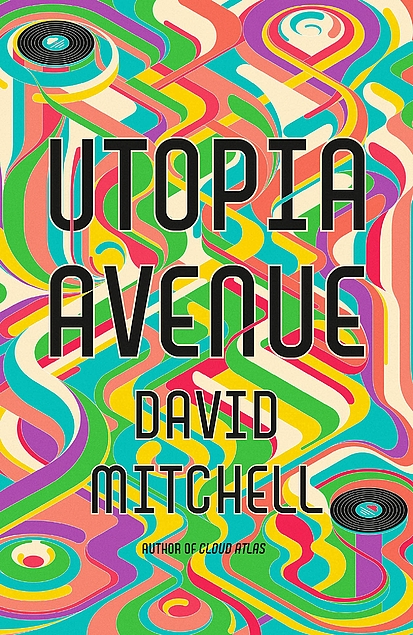
Before the meeting: This is the first book by David Mitchell that I’ve read. Once again, the Book Group has taken me off my customary reading track.
The book takes its title from Utopia Avenue, a fictional English rock band in the late 1960s: a socially awkward guitar player from a wealthy Dutch family who wrestles with his personal demons (word chosen carefully), a working-class bass player with long hair and a troubled relationship (an understatement) with his father, a rough Yorkshire lad on the drums, a middle-class woman folk-singer who is a wonder on the keyboards, and their Canadian manager, a decent man who gets them together and believes in their talent. Three of the four band members are song-writers, and the book’s chapters are named for their songs. Its longer sections are named for the band’s three albums.
The novel charts the band’s progress from their coming together, to their disastrous first gig, to a painful but comparatively rapid rise in the charts, to success at home and in the USA and (not a spoiler) their eventual break-up. Plus a brief reunion fifty-one years later.
Even though the book is unmistakably fiction, it has a powerful documentary quality. It feels animated by a love for that moment in pop history (roughly the time when David Mitchell was being born, I just found out). There’s careful attention to period details – how to make a phone call and why you might hesitate to call internationally, how to negotiate sexual politics when the world is on the cusp of second-wave feminism, how to manage the politics of the US war in Vietnam when you’re a ‘non-political’ band, the meaning of long hair. We are often told what song is playing in the background, and although I was living in a monastery in the years in question, this evokes the flavour of the times wonderfully. Historical figures make cameo appearances: Brian Jones, David Bowie, Janis Joplin, Leonard Cohen – and Jimmy Saville with the faintest whiff of the revelations to come much later. Francis Bacon presides over a whole chapter. Words of wisdom are quoted from Mama Cass and Mick Jagger. The band members sit and discuss the newly-released Sergeant Pepper’s track by track. I felt I was in safe hands: I believe that Jagger actually said the things attributed to him, that Mama Cass gave such sex-and-marijuana parties (in fact I’m pretty sure I’ve seen one just like it in a movie), that Leonard Cohen spoke with this flirtatious formality, that radio and television shows were tacky in something close to this way. The research doesn’t push itself to the front of the picture, but it provides a solid, fine-grained background.
Possibly someone who knows more about music than I do will complain that the descriptions of the band’s concerts are inauthentic (as one of the Book Group has been scathing about Tim Winton’s descriptions of surfing), but I loved them. For example, in Side One of the third album, where the band begins to play Jasper’s song ‘Sound Mind’, I wouldn’t know a chop-slap from a scale of triads, but I do get the excitement of the moment:
Jasper strums; asks the tech-guy for more volume on his guitar; shuts his eyes … and slams into an amp-blowing, bent-string howl; and fires off a scale of triads, starting from high E, all the way down. Jasper rewards his first cheer of the night with a new riff that isn’t ‘Sound Mind’: nobody will ever know it’s a rip-off of Cream’s ‘Born Under a Bad Sign’. It gets the audience thunder-clapping in time. Griff, Dean and Elf join in on drums, bass and Hammond. Jasper steers the jam through three cycles before wrapping it up in a Wah-Wah’d B flat, the opening of ‘Sound mind’. Dean comes in with the bass riff; Elf comes in on the next bar; and Griff chop-slaps on the next. Jasper leans in for his psycho-whisper …
(Page 461)
What I’m saying is that this is a terrific historical novel. But then … astonishingly integrated with the rest, is a fantasy narrative strand. There are characters who are hundreds of years old, something akin to demonic possession and something akin to exorcism. For me as a newcomer to David Mitchell, when this strand comes to the fore, it does so as a brilliant plot twist. Seasoned Mitchell readers wouldn’t be so joyfully blindsided. For them, hints abound. For example, the lead guitarist is Jasper De Zoet, a name that suggests that he may be a descendant of the title character of Mitchell’s 2010 novel, The Thousand Autumns of Jacob De Zoet. (Again, not a spoiler: he is revealed to be just that.) It turns out that any number of minor characters have wandered into these pages from earlier Mitchell novels, just as others have wandered in from the real-life 1960s, and the weird stuff harks back to the imagined realities of earlier books. It speaks wonders for Mitchell’s writing that I didn’t have a sense that I was coming in late: everything makes sense in terms of the present-time story, and everything is explained coherently. Only towards the end, when there are hints that the odd behaviour of a young child is doing what in a TV show would be laying the grounds for next season, I went DuckDuckGoing and found the notion that all Mitchell’s novels are connected into an über-novel – which I think means that each of his novels adds something to an ongoing story that stretches over centuries.
I’m left with at least one mystery. When Dean, the bass player, goes to an anti-Vietnam demonstration in London, he is attracted to a woman named Lara. She says something about the demonstrators being in a great revolutionary tradition, and this uncharacteristically stilted conversation follows (remember, this is in the middle of a demo where people are being attacked by police with batons):
‘What’s yer surname, Lara?’ asked Dean. ‘Why do you ask?’ ‘One day yer going to be famous.’ Lara lit a Marlboro. ‘Lara Veroner Gubitosi.’ ‘Wow. That’s … long.’ ‘Most names on Earth are longer than “Dean Moss”.’ ‘S’pose so. Are yer Italian, then?’ ‘I’m from many places.’
Something is being hinted at here, and I don’t know what it is. As far as I can find out, Lara Veroner Gubitosi isn’t a historical personage. Nor, as far as I know, is she a character from another David Mitchell novel. I tried for an anagram, and came up with ‘revolutionaries brag’ or ‘love is but a roaring’. Neither feels conclusive. Maybe it too is a hint of things to come in future novels.
So I’m taking two questions to the Group. How do the musicians among us feel about the descriptions of music? and, Why is that minor character called Lara Veroner Gubitosi?
After the meeting: There was some WhatsApp discussion of what music should be playing at this dinner. It was a long list, and it looked like a real possibility that book talk would be secondary to fogeys reminiscing about the 60s, even though a couple of the chaps weren’t born then.
The playlist was there and a source of much pleasure. Likewise the reminiscing. One of us could boast that back in the mid 60s he was a founding member of one of the London clubs that feature in the book. Another was close friends with Joe Strummer. Yet another knew someone who auditioned to replace Pete Best when was turfed as drummer for the Beatles – and believed that Ringo was absolutely the right person for the job. Closer to the experience of the rest of us was the chap who said he still has the little tin he kept his dope in, and when he lifts the lid – every couple of years – he can still smell the 70s.
We did talk about the book, a lot. One or two found it too long. one said that the structure of our meeting – all in a single, focused conversation for some time, then splintering into two or three disparate chats, then back together again, repeat – was similar to the book’s structure. There was a difference of interpretation about Jacob’s story: some read it as a graphic and moving account of schizophrenia, whereas I’m convinced that while that’s clearly there as a metaphorical resonance, the weird events he experiences are real in the world of the book. When I mentioned as evidence that the same immortal creatures appear in other David Mitchell books, someone said that that was all very well, but just sticking to the book in front of us, the schizophrenic reading held up. The one person who had read other David Mitchell novels abstained from the debate, and of course the emotional force of the story was the same whichever way you read it.
It’s a book that conversation can thrive on. Judgements divided about the cameo appearances of real people, heavily leaning toward the view that they worked well. On my question about the descriptions of music, those who knew more about music than I do (which wouldn’t take much) enjoyed the descriptions at least as much as I did. On my question about Lara Veroner Gubitosi, the consensus seemed to be that I have too much time on my hands, though at least one person conceded that David Mitchell may well be playing little games with us. We talked about the book’s portrayal of the difference between British and US pop culture, of the situation of women in rock at that time, of the realism in the account of Dean being hit with a possibly opportunistic paternity claim.
In non-book conversation, we were generally dismayed at Scott Morrison’s statement that it was when his wife suggested that he imagine their daughters being sexually abused that he realised he needed to empathise with a young woman currently in the news; we barely mentioned the former US President; there was some back and forth, mainly back, about Elizabeth Farrelly’s new book, Killing Sydney; Covid got surprisingly little wavelength; there was some amusing reporting on how some women (met at parties? on dating apps? I don’t know) are fascinated at the concept of an all male Book Group, who not only meet, but once they’ve met actually talk about the book. We had what we have come to call a Gentlemen’s Picnic – that is, we brought food. There was too much, and it was excellent.
As a child in North Queensland, I thought of myself as Irish Catholic. My father sang ‘The Rose of Tralee’ or ‘Galway Bay’ when he was feeling romantic, and Patrick O’Hagan was often on the gramophone; the parish priests (Hogan and Fitzpatrick, among others) spoke longingly of their homes in County Kilkenny or County Clare; we sang ‘At the Rising of the Moon’ and ‘Slattery’s Mounted Foot’ in school concerts, and ‘Hail Glorious Saint Patrick’ at Mass on Sundays. No matter that two of my grandparents were from Protestant backgrounds (though one of them converted), and only one of the four was from Ireland, and Northern Ireland at that. I identified as Irish. When, some time in my twenties, I met the concept of an Irish diaspora, I felt I had found my place, or at least a name for my sense of belonging to a place I’d never seen.
When I got to know some actual Irish people, I was shocked that they didn’t think of me as one of them, and even considered my Irishness to be sentimental, delusional and vaguely insulting. When I visited Ireland, it did feel a little like coming home, but no more than when I visited Naples or Valletta (after all, my North Queensland home has huge Italian and Maltese populations, and as well as marching on St Patrick’s Day we had passion plays at Easter and the school choir sang ‘Funiculì Funiculà’).
All the same, whenever I read an Irish novel, or see an Irish movie or TV show, it’s personal. One way or another it’s going to speak to my heritage. The Green Road hit a lot of personal notes.
The novel is named for an actual green road near Galway in Western Ireland, where the novel’s climactic events take place. The title also gestures towards the reality of the Irish diaspora: it’s the Emerald Isle but, the title suggests, the emblematic green has taken to the road. Each of the five chapters in the first half of the book – Part One: Leaving – tells a new story set in a new time and place. If you’re a bit slow on the uptake like me, it takes a while to realise that the serial protagonists are members of the same Irish family, living disparate lives on different continents as the decades pass: a young girl in an Irish village in 1980, her brother a decade later in AIDS-ravaged Gay Manhattan, a sister later still, housewife and mother in Dublin, another brother working for an NGO in Mali in 2002, and finally, back in the unnamed village of the first chapter, the mother, now in her 70s in 2005.
In Part Two: Coming Home, all four children come home for Christmas. As in home-for-the-holidays Hollywood movies, the famil’s unresolved tensions, jealousies and resentments come bubbling to the surface during what is supposed to be a festive gathering. But the novel brings a depth to that genre because we know a lot about each of these people: Dan, the oldest and his mother’s joy, was once going to be a priest but is now about to marry his rich male lover in Toronto; Constance, the responsible one, is now a mother who has had a cancer scare but didn’t want to alarm anyone; Emmet has devoted his life to doing good work for NGOs in developing countries, but can’t form a solid intimate relationship; Hanna, the youngest, is a failing actress, alcoholic and not coping well with having a young baby; and Rosaleen, the mother, is a wonderfully complex character for whom motherhood was her life and who, now that she is widowed, wrestles with ambivalence about her children, and plans to sell the family home.
The novel moves on from home-for-the-holidays when Rosaleen, overwrought, drives off and wanders on the green road in the bitter winter night, filled with memories of courtship with the children’s father, half hallucinating, possibly hypothermic. I won’t spoil the ending.
There are some wonderful set pieces: little Hanna watches her father behead a chicken in the first chapter (a scene that comes close to moments from my own childhood); Gay men party on in the second chapter, in ways that seem familiar from plays like Matthew Lopez’s The Inheritance or TV like It’s a Sin; and, my favourite, Constance goes shopping for Christmas – a chore that takes several pages to narrate, ending like this:
She was on the road home before she remembered potatoes, thought about pulling over to the side of the road and digging some out of a field, imagined herself with her hands in the earth, scrabbling around for a few spuds.
Lifting her head to howl.
(page 232)
This family is very different from mine. Yet, whether it’s the Irishness or something much more general than that, the book’s relationships struck many familiar notes. The oldest son’s special status, for example: as someone is looking through Rosaleen’s things, they see postcards of famous paintings and realise they have come from Dan in the wide world – and though my oldest brother, Michael, wasn’t gay, and the big city he went to was Brisbane, he taught us all about classical music, contemporary theatre and foreign language movies, and gave my parents a Blackman print to replace the painting of a gum tree on the kitchen door. I’ve already mentioned the killing of the chook. Rosaleen keeps bursting into poetry; my mother was a very different person from her, but she did love to recite the opening lines of ‘The Hound of Heaven’, and when one of the characters recites the opening lines of the ‘Hail Holy Queen’ I am transported back to the family rosary.
So much of my reading is about people, places and situations different from mine and either informative about how the other 99.9 percent live or invitation to speculation/fantasy. There’s real pleasure in reading something that keeps bumping into and overlapping my own experience and heritage, shedding light and conjuring forgotten tastes and smells – confirming and maybe grinding some sentimental or delusional edges off the identity I took on as a child.
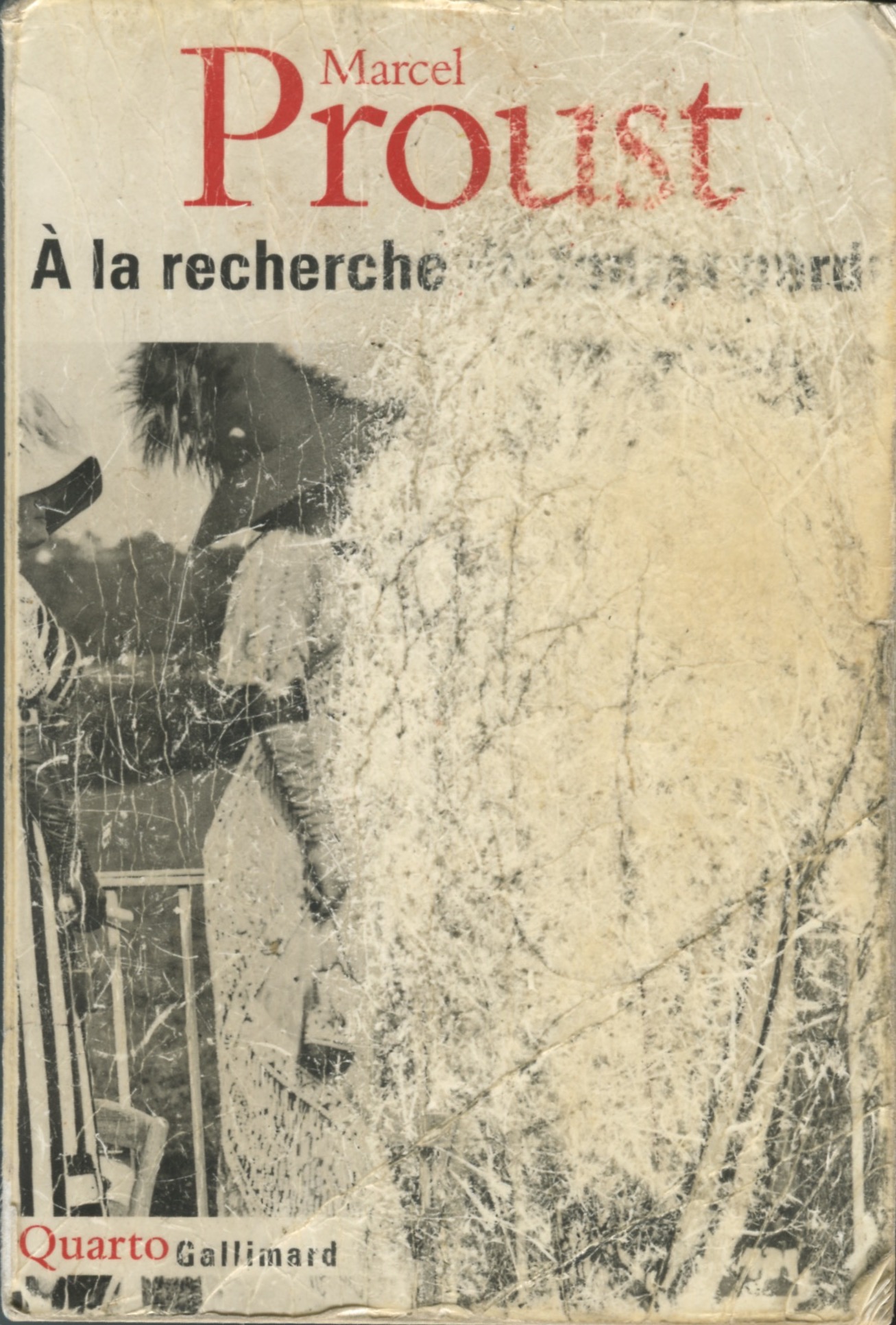
Someone recently commented on a sporting event, probably a cricket match, that watching it was like reading Proust. I would have been tempted to reply, ‘You mean it made you obsess about the sexuality of the players?’ In the sixth book, Albertine disparue, the narrator gradually gets over the loss of his beloved Albertine, but even when his grief is well and truly in the past, he still frets over her probable lesbianism, no longer writhing with jealousy perhaps, but now ruminating for pages on the unreliability of witness accounts, on the universality of lying, and – of course – on memory, imagination, and the gap between them and reality.
So much has happened in what I’ve read this month. When I began, the narrator was in Venice with his mother lusting after young Venetian women, his lust being largely based in what he thought would have stirred Albertine’s desire. There are a couple of encounters with characters from earlier books. M de Norpois, now retired, is still wielding influence in diplomatic circles. Mme de Villeparisis has a lovely cameo appearance which, to use the cricket analogy, is like someone hitting a six. On hearing Mme de Villeparisis’s name, Mme Sazerat, who is a guest of the narrator and his mother, gets all excited. Her father, she explains, had an affair with Mme de Villeparisis many years previously, and was ruined. Mme Sazerat’s only consolation was that the terrible suffering her whole family endured was a result of his having been involved with the greatest beauty of the day. Now she would love to clap eyes on that great beauty for the first time. Marcel escorts her to the restaurant and points out the object of her fascination:
Mais comme les aveugles qui dirigent leurs yeux ailleurs qu’où il faut, Mme Sazerat n’arrêta pas ses regards à la table où dînait Mme de Villeparisis, et, cherchant un autre point de la salle: – Mais elle doit être partie, je ne la vois pas où vous me dites. Et elle cherchait toujours, poursuivant la vision détestée, adorée, qui habitait son imagination depuis si longtemps. – Mais si, à la seconde table. – C’est que nous ne comptons pas à partir du même point. Moi, comme je compte, la seconde table, c’est une table où il y a seulement, à côté d’un vieux monsieur, une petite bossue, rougeaude, affreuse. – C’est elle!
(page 2082–2083)
But, like blind people who look in the wrong direction, Mme Sazerat did not bring her gaze to rest at the table at which Mme de Villeparisis was dining, and, looking towards another part of the room: ‘But she must have gone, I can’t see her where you say.’ And she searched on in pursuit of the loathed, adored vision that had haunted her imagination for so long. ‘But yes, at the second table.’ ‘We mustn’t be counting from the same point. The second table by my count is one where there is only, beside an old gentleman, a little hunchback, red-faced and hideous.’ ‘That is she!’
Perhaps because Proust died before making a final revision of this book, he lets that tragicomic moment stand without even a sentence reflecting on the gap between imagination and reality. We can be glad of that. And yet it looks as if Mme Sazerat’s great disillusionment is a kind of hinge: from here on, disparate threads of the narrative are tied up, imagined meanings of long-ago events are punctured, and there’s a general sense of things closing down.
When his mother is about to leave Venice, Marcel decides to stay behind in the hope of meeting up with a Mme Putbus for carnal purposes, but at the last minute joins her on the train. They both open letters and the thread-tying begins in earnest: they learn of two marriages. To avoid spoilers, I’ll just say that Robert gets married, and Gilberte gets married, and Jupien’s daughter gets married, and it turns out that Robert (no spoiler here, I hope) has realised he’s gay and is pretty open about it, which causes his new wife considerable distress. M de Charlus has made a kind of amends to Jupien by providing for his daughter. Morel, who seduced Jupien’s daughter and dumped M de Charlus a couple of books back, is now doing very well with another rich patron of Guermantes lineage, thank you very much. The narrator is still curious about Albertine’s sexuality, and has a lot to say about male homosexuality, including speculating that all the Guermantes men are homosexual with only an occasional aberration, and surmising that homosexual men make the best husbands (he does enjoy salaciousness, paradox and gossip, and all the better if he can combine all three).
At the start of the final book, the narrator is staying at Gilberte’s place in the country. After, among other things, completely reinterpreting his earliest memories of her, she lends him some bedtime reading – an unpublished diary of the Goncourts – and in what I think of as a typical Proustian moment, he gives us six pages word for word of what he read before he went to sleep. In those pages, we are given a version of a salon that our narrator has mocked relentlessly: in this version, the guests are witty, intelligent, creative, and are given credit for inspiring, educating and even instructing at least one artist that Marcel reveres. I think I read correctly that the shock of seeing this difference is so great that Marcel decides he isn’t talented enough to be a writer, or alternatively that literature is too far removed from reality to be taken seriously in any way. And he turns his back on the whole writing enterprise.
Years later – and this is where I’m up to – after spending years far from Paris in a maison de santé (a sanatarium?), he comes back to the capital in 1916 (the first time he has mentioned a date). I’m sure something is about to happen, but currently he is having a fine time mocking the way clothes design has replaced art at the cultural centre, and the newspapers are celebrating the way the war allows glorious innovations in women’s fashion.
Having gone months without an update on the books I’m encountering or re-encountering with my granddaughter, here’s a second in quick succession.
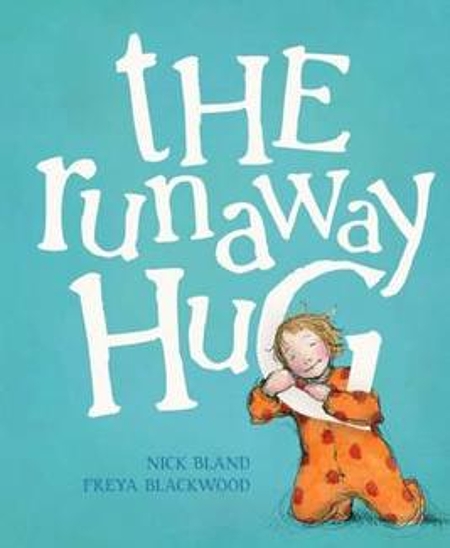
Nick Bland (writer) and Freya Blackwood (illustrator), The Runaway Hug (Scholastic 2011)
Lucy’s Mummy has only one hug left, so when she gives it to Lucy, Lucy promises to bring it back as soon as she’s finished with it. Then Lucy goes through her whole family giving and receiving the same hug – until Annie the dog takes it and runs out the door. Lucy is devastated.
But it’s all right: the dog returns the hug, ‘a lot more slobbery than before, but just as nice’. And there’s no limit on kisses. Freya Blackwood’s illustrations bathe Lucy’s family in glorious warmth: we know from the start that nothing can go seriously wrong.
I wouldn’t necessarily have expected a three-year-old to follow this kind of playful commodification of affection, but our three-year-old completely gets it, asks for the book frequently, and has been inventing her own variations on the ‘I’m all out of hugs’ routine.
We went hunting for Rosemary Wells books, because we had enjoyed a number of them when Ruby’s father and uncle were members of the intended readership. So far we’ve had no luck with Benjamin and Tulip, in which a fairly nasty episode of bullying is resolved into a watermelon-seed-spitting friendship. But we did find this. It’s a Christmas book. Morris is a rabbit (I think), the youngest of four in his family, and on Christmas day all his siblings’ presents look more interesting than his, but none of the siblings will let him play with the presents. Then he discovers one more parcel under the tree, which turns out to be the disappearing bag of the title. First he climbs in and becomes invisible, then of their own free will all three siblings climb in, leaving him free to play with their skates, chemistry set and cosmetics for the rest of the day.
I imagine this would be enjoyed most acutely by a young person who wishes his or her older siblings would just vanish from the face of the earth for a while. But the magic of it, and the complex, gently subversive take on sharing are pretty enjoyable for anyone who’s relatively at ease with Christmas, me and Ruby included.
We bought this at a bricks and mortar bookshop (Gleebooks in Dulwich Hill) under the impression that we were buying the original Noisy Nora, one of our favourites from all those decades ago. It’s nice to see that Rosemary Wells has stayed engaged with the same family of, um, hamsters.
I remember Nora as a character who hadn’t quite come to grips with the idea of quiet inside voice as opposed to loud outside voice. This book isn’t about voices, but the suffering inflicted on a family when a young person insists on learning to play the violin – not a xylophone, a banjo, or a harp, but a screeching violin – and the joy all round when the young person succeeds. Rosemary Wells’s illustrations show the suffering with wry humour, and the flow of her rhyming narrative contrasts reassuringly with the ‘Twang! Whine ! Scrape! Squeak!’ and so on that Nora extracts from the violin.
Claire Messud (Wikipedia entry here; her own website here) is primarily a novelist. I haven’t read any of her novels, but this book – a collection of essays of which versions were published between 2002 and 2019 in journals ranging from Vogue to the Kenyon Review – was on offer at our book-swapping Book Club. I’m a bit of a sucker for writers’ writing about writing, and on top of that I was intrigued: Did Kant keep a tiny sculpture of a head on his shelf, and whose head was it?
It turns out this is the first book I’ve read that mentions Covid–19. The introduction, dated April 2020, strikes an optimistic note. Speaking of the climate emergency, life under late capitalism, and the way recent years have been ‘a dark maelstrom’ (which may be code for the Trump presidency), she continues:
This ominous hurtling, the relentless ouroboros that is social media, the destruction of ourselves and our environs – we had come to see it as inevitable, and ourselves as the passive and ineluctable victims of forces beyond our control. Humanity has risked collective despair, than which there is no more certain doom for our planet and ourselves. But even in the past two months, although at the mercy of a ravaging virus, we have discovered that in other ways we aren’t disempowered. Crisis and extremity are by no means to be desired; and their consequences – human and economic both – will be challenging for the foreseeable future. But these extraordinary times have also forced us to slow down, to think collectively, to seek hope, to value the truth, and to celebrate resilience and faith in our fellow human beings.
To find these resources, we may look to the past – to history and to literature – to the vast compendium of recorded human experience, from which we draw wisdom, solace, or, at the least, a sense of recognition.
It might have been harder to hit that note of optimism eight or ten months later in the USA, and harder to assume that the ‘we’ in that passage is universal, or even a majority, but it’s still saying something real.
The book is organised into three parts: ‘Reflections’, which comprises mostly family history, and the self-explanatory ‘Criticism: Books’ and ‘Criticism: Images’. The divide, while clear, isn’t absolute. As Messud says in her Acknowledgments, her ‘family is at the heart of it all’. The three essays on Albert Camus at the start of the second section – on respectively his ‘naive optimism’ during the Algerian War of Independence (1954–1962), a new translation of Camus’ L’Étranger, and Kamel Daoud’s Meursault, which is a response to L’Étranger – take on extra depth and resonance from Messud’s family history. Her father’s family were pied-noirs (Algerian-born French) like Camus, and the first Camus essay begins with a memory of her father as an old man grieving for the country he hadn’t seen since he was a teenager.
I approached the first part cautiously. Other people’s family history provoke one central question: Why should I be interested? Will this family be amusing? Will their stories shed light on my own? Will they open out to some broader understanding of the world? In this case the answer to all three questions is Yes. Claire Messud brings to her stories of her parents and grandparents not only the precise aura of childhood memory, but also an adult grasp of their contexts. She spent a large part of her childhood in the eastern suburbs of Sydney, then moved with her family to Toronto, and from there to the USA. Each move meant a cultural shift, and it’s Kambala Church of England School for Girls in Rose Bay, seen through Messud’s eyes and now ours, that is the weirdest of them:
We had uniforms for summer and for winter. The former was a grey-and-white checked shirtdress, belted, worn with a straw boater banded in grey, with the school crest upon it. The latter was a grey tunic, beneath which we wore white shirts (with Peter Pan collars while at [the junior school] Massie House) and grey-and-gold striped ties (bow ties, with the Peter Pans), and topped by a grey felt hat, again banded with the crest. Grey socks; black oxfords; grey jumpers; grey blazer (with gold piping); grey knickers; grey ribbons (compulsory if your hair touched your collar).
(‘Then’, page 8)
And there’s much more.
The dislocations in the early lives of Messud and her sisters, it turns out, are mild reprises of their parents’ lives. Her father was a pied-noir. His father, a patriotic Frenchman who also loved his native Algeria, took his family to Morocco in 1955. Messud’s father never returned to Algeria, but moved from country to country, and when his guard was down would grieve for the country and language of his childhood. A fierce atheist, when he was dying in a nursing home, he was bullied into taking Communion from a visiting priest, but as the priest was offering the host:
‘Isn’t there someone,’ my father asked me pleadingly, ‘who could do this in French?’
(‘Two Women’, p 45)
Her mother was ‘raised petit-bourgeois and socially aspirant in mid-century Toronto’. The parents met in Oxford, and their first date was at a picnic also attended by Gloria Steinem. Messud’s father’s younger sister, mentally unstable and zealously Catholic (she’s the one who pushed for the deathbed Communion) became part of their life from their marriage in 1957.
The family story is told with generosity to all parties, including the aunt, and extends to the tribulations of Messud’s teenage daughter as she deals with school-age bullying.
Inevitably, some of the essays are less interesting than others: ‘How to be a Better Woman in the Twenty-First Century’ is little more than a listicle, and an account of the author’s two dogs, though funny and heart-rending, is still an essay about dogs.
I’ve been reluctant to read review essays of books I haven’t read ever since Colm Toibìn’s review of On Chesil Beach essentially told the whole plot of that very short book in one full page of the London Review of Books. But I read all the critical essays here. I enjoyed and was enlightened by the one on a book I’ve read – Teju Cole’s Open City (link is to my blog post): I was surprised by a twist at the end; Messud doesn’t mention the twist, but discusses many moments along the way that would have made it less surprising if I’d been paying attention. I’ve seen the movie based on Kazuo Ishiguro’s Never Let Me Go, and her discussion of the book brought back the movie’s power. Essays on Jane Bowles, Italo Svevo, Magda Szabó, Rachel Cusk (this one especially), Saul Friendlander, Yaasmine El Rashidi and Valeria Luiselli are all enticing, giving enough information and context to make one want to rush out and get hold of a copy.
The third section comprises catalogue essays on painters Alice Neel and Marlene Dumas, a review of photographer Sally Mann’s Hold Still, and finally returns to family with a sweet essay on how she and her children love Boston’s Museum of Fine Arts. Living as I do with an Emerging Artist, I read the catalogue essays with relevant books open beside me, and could feel my capacity to appreciate art expanding as I read and looked. These essays are enriched by their inclusion in this book. When Messud writes that Marlene Dumas’ Amends, like each of her paintings, ‘has evolved out of a particular combination of autobiography, politics, culture, and the demands of the medium’, she could be describing the book as a whole or in its parts. In her essay on Sally Mann (which also, by the way, makes a telling contribution to current conversations about whether you can appreciate a work of art created by a person of vile character), she could likewise have been describing these essays, a good bit more accurately than the book’s subtitle, when she wrote:
… this memoir is notably neither confessional nor self regarding. Mann, ever the photographer, stays behind her lens, turning her ‘intensely seeing eye’ on the people and the natural world around her. […] We will know Mann by the outline that she leaves, by what touches her and how.
(‘Sally Mann’, p 287)
I didn’t get the writer-writing-about-writing hit I was expecting. The title essay is the only one that explicitly fits the bill – and the title, incidentally, refers to a line in a Thomas Bernhard novel that Kant’s monumental work shrivels down to a legacy of ‘Kant’s little East Prussian head and to a thoroughly amorphous world of night and fog’: to write is to aim to have at least that much legacy.
It’s been a long time since I’ve posted about books read with my granddaughter. Here’s a beginning catch-up.
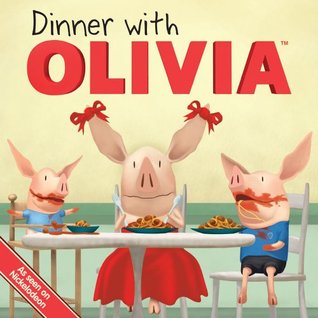
Dinner with Olivia (Simon & Schuster 2009, based on the TV series, adapted by Emily Sollinger, illustrated by Guy Wolek)
Neither Ruby nor her grandparents knew there was a TV series featuring Olivia, and at first I was wary of this knock-off of Ian Falconer’s wonderful books: as befits children’s TV, the illustration style is a lot cruder than Falconer’s New Yorkish elegance. But it turns out the book is lovely. Olivia goes to her posh friend Francine’s place for dinner. At first she is in awe, and mildly ashamed of the messiness of her own family, especially her little brothers. But once she has experienced the rule-bound life of Francine’s family, not to mention the Brussels sprouts, she – and Francine – realise how excellent it is to slurp spaghetti sauce and occasionally have a meatball bounce to the floor.
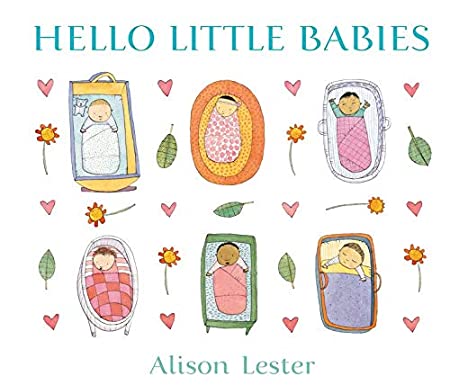
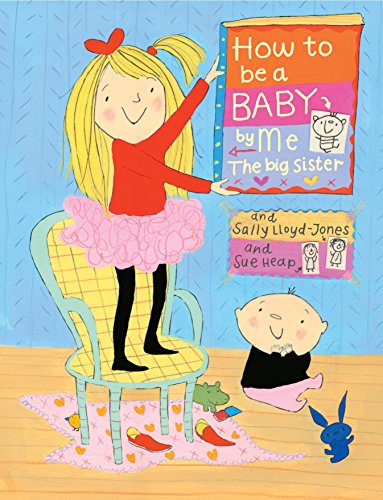
Like Alison Lester’s Clive Eats Alligators, this follows a number of children in different activities. This time the children are babies, of a range of ethnicities. Ruby is besotted with her little brother, and with babies in general – at the museum, the exhibit that held her attention was the diorama of baby dinosaurs hatching from their eggs. An added attraction in this book is that one of the babies is named Ruby.
Much loved by Ruby, this mocks the narrator’s baby brother for his comparative helplessness. At least, we assume the baby is male, because that’s what Ruby’s baby brother Charlie is. We first read this before he was born. It has become much more popular since he became a reality. I’m not entirely comfortable with the book’s rampant condescension, but I think Ruby can tell it’s joking, and she particularly likes the last pages, where the big sister looks forward to the time when the baby will be as tall as her and able to play with her.
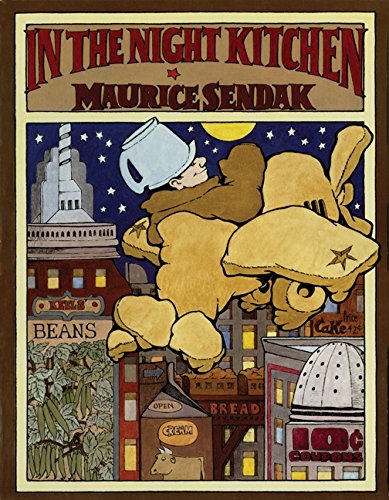
Ruby’s not so fond of this. I think there’s too much that she doesn’t quite recognise: the cooks in the kitchen, dough rising, New York skysline, naked boy … And the story line is weird. However, we were driving in the car the other day and she started chanting, ‘Milk in the batter! Milk in the Batter!’ So the magic of Sendak is percolating.
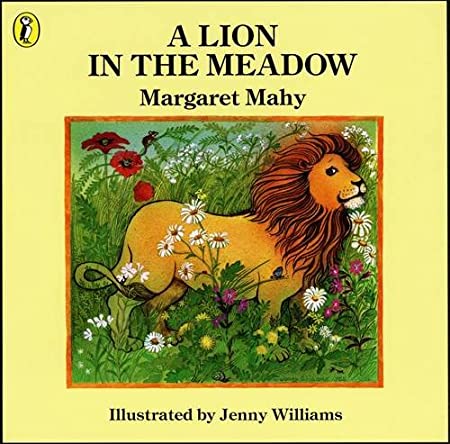
We picked this up at the Addison Road markets. Margaret Mahy is one of the great children’s writers, and Ruby has responded to this book appropriately. Like Sendak’s The Sign on Rosie’s Door, it has a brilliant mother who responds intelligently to her child’s fantasies. The difference is that is this case the child’s fantasy, of ‘a big, roaring, yellow, whiskery lion in the meadow’, turns out to be real, and so does the mother’s counter-fantasy of a dragon in a matchbox who will chase the lion away. Not a word out of place, this is irresistible, and – like the Sendak books – a pleasure to read aloud.
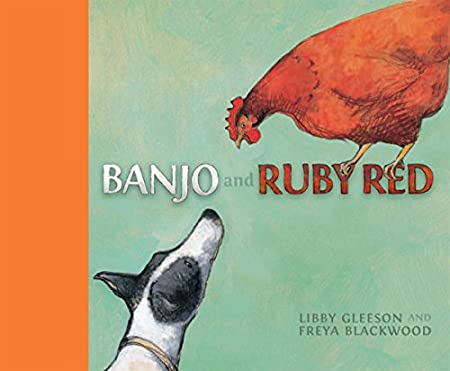
Libby Gleeson (writer) and Freya Blackwood (illustrator), Banjo and Ruby Red (Little Hare 2013)
A dog and a chook overcome initial relationship difficulties to become good friends. What’s not to love? We used to visit some urban chickens when Ruby was much smaller (her word for chicken as ‘babook’, but she eventually decided to go with the consensus). She still talks about the family dog who died some time ago – ‘It’s very sad.’ And relationship difficulties seem to be an issue as she spends more time in childcare. Plus, the chook’s name is Ruby Red. I don’t imagine the Australian farm setting is any more familiar to our inner-city girl than Sendak’s New York skyline, but in this case that doesn’t seem to matter.
This book is also a pleasure to read aloud, for the pathos of a scene where Ruby Red is apparently lifeless as much as for the pages where Banjo does a lot of barking and for the way movement can be traced in great arc across the pages in Freya Blackwood’s illustrations







 Me fail? I fly!
